
 by
by
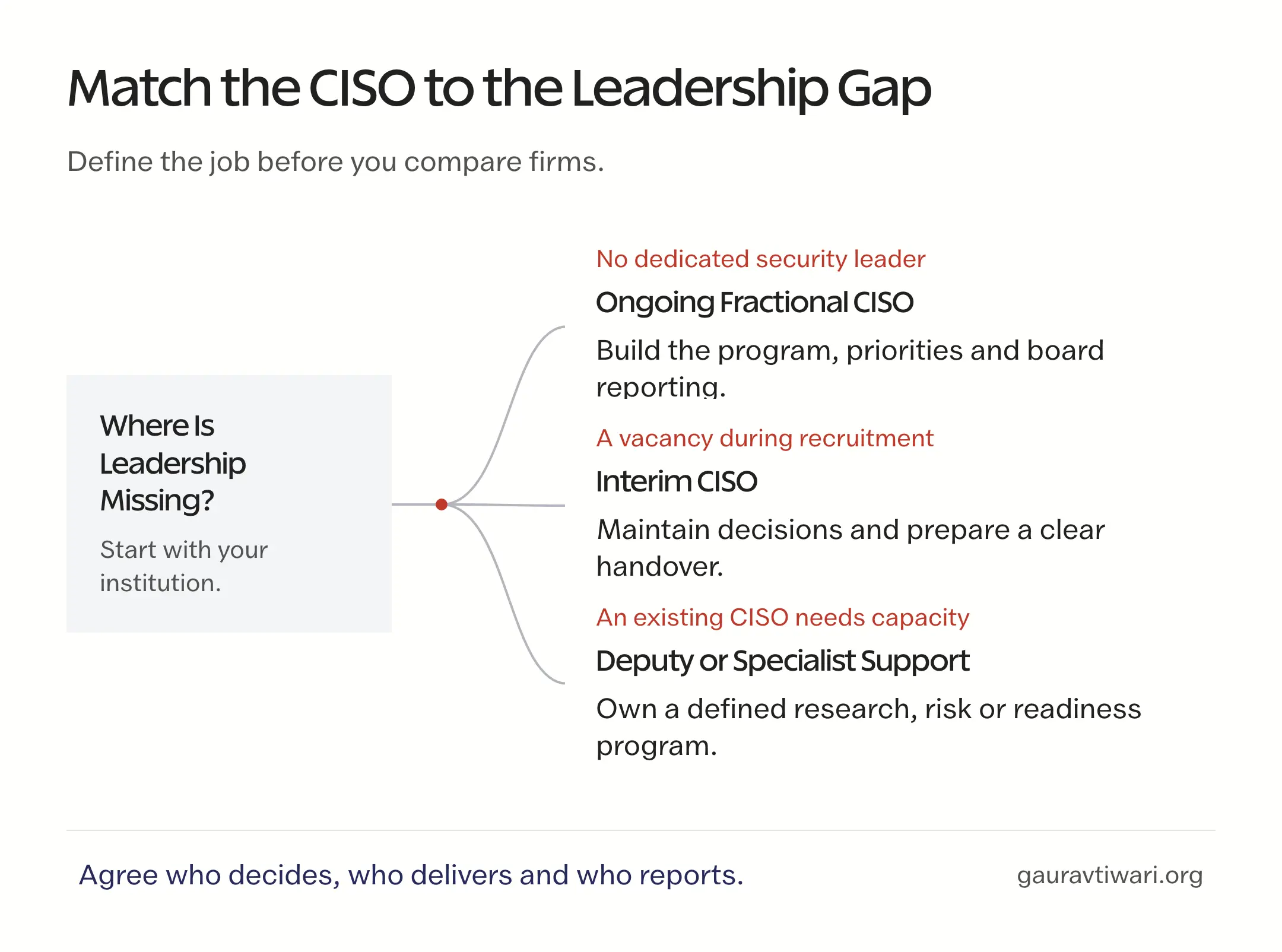
Fractional CISO services for higher education give colleges and universities executive security leadership without a full-time hire. The right fit depends on whether your institution needs an ongoing program leader, interim coverage or specialist support for an existing CISO.
Cybersecurity leadership in higher education has an unusual job description. A university may operate student information systems, research environments, residence halls, payment infrastructure, health services, cloud platforms, administrative systems, laboratories, athletic facilities, hundreds of third-party applications, and networks accessed every day by thousands of students, faculty members, employees, contractors, and visitors.
Higher Education CISO Responsibilities
The challenge in higher education isn’t simply that the network is large. One institution can contain several risk environments with different stakeholders, priorities and regulatory expectations.
A useful fractional CISO must be capable of operating across all of them.
| Campus Stakeholder | Security Question the CISO Must Answer | Leadership Output |
|---|---|---|
| President, cabinet, trustees | What cyber risks could materially disrupt the institution? | Executive risk reporting and investment priorities |
| CIO and IT leadership | Which technical risks should be addressed first? | Security roadmap and control priorities |
| Financial aid and administration | Are student financial records adequately protected? | GLBA-aligned safeguards and evidence |
| Registrar and academic units | How should education records and student information be governed? | FERPA-aware data governance |
| Research leadership | How should sensitive, sponsored, or regulated research environments be secured? | Research security architecture and controls |
| Faculty, students, and staff | How can security improve without obstructing academic activity? | Identity, awareness, acceptable-use, and access strategies |
| Procurement and departments | Which technology vendors introduce unacceptable risk? | Third-party risk governance |
| Incident leadership | Who makes decisions when ransomware or another major incident occurs? | Tested incident response and crisis governance |
Fractional CISO Firms for Higher Education
These firms offer security leadership for colleges and universities, with different levels of technical and governance support. DeepSeas is a strong starting point if you want advisory leadership connected to operational services; Moran is worth comparing when higher education specialization is the priority. Compare the named CISO, scope and references before choosing.
DeepSeas
DeepSeas leads this shortlist for institutions that want fractional cybersecurity leadership connected to the technical capabilities needed to execute and improve a security program.
DeepSeas provides Strategic Security Advisory in several forms, including strategic advisory access, full-time advisory support and virtual or deputy CISO engagements. The service is designed to augment an institution with an experienced cybersecurity executive who can guide risk mitigation, policy development, technical transformation and security program priorities.
The higher education experience is particularly relevant. DeepSeas has developed a vCISO framework for colleges and universities that addresses limited cybersecurity resources, executive support, program prioritization and GLBA requirements. Its model places the security leader within a broader team of CISOs and cybersecurity specialists, including professionals with higher education experience.
DeepSeas has published a higher education case study describing its work helping a university establish a more structured cybersecurity and risk management program. Its advisory page also carries a testimonial from North Central College describing compliance support and greater confidence in protection for staff, faculty and students. These are vendor-published accounts, so ask for a reference from an institution with a similar environment.
Moran Technology Consulting
Moran Technology Consulting has an unusually specific higher education orientation. Its virtual CISO service is designed directly for colleges and universities rather than being a general corporate vCISO offering that can also be sold to educational institutions.
Moran provides several engagement models, including security advisory support for individual challenges, ongoing virtual CISO leadership, interim CISO coverage during staffing gaps, and collaborative security services for groups of institutions.
The service can produce an annual security strategy, policy and program reviews, risk and compliance maturity assessments, executive reporting, and strategic coordination with the institution’s CIO or executive leadership.
ASMGi
ASMGi combines fractional cybersecurity leadership with a portfolio of technical and governance services built specifically for higher education.
Its ONEteam vCISO offering can be used when an institution has no CISO or when the existing security organization lacks capacity for specific CISO-level responsibilities. The engagement can draw on a mix of senior resources, including CISOs, GRC consultants, solution architects, engineers, and program managers.
That resource model is useful for colleges where the leadership gap and execution gap are intertwined. An institution may not simply need someone to establish policy. It might simultaneously need a GLBA assessment, vendor-risk program, penetration testing, incident response exercises, managed detection, or architecture assistance.
Compass IT Compliance
Compass IT Compliance offers virtual CISO services alongside a broad portfolio of assessment, compliance, risk and technical security capabilities. Its higher education practice provides access to veteran security professionals on either a full-time or part-time basis to identify risk and improve the institution’s cybersecurity program.
The surrounding expertise is particularly relevant for academic environments. Compass lists support for GLBA and the FTC Safeguards Rule, PCI DSS, HIPAA where applicable and CMMC-related work, alongside NIST frameworks and the HECVAT vendor assessment process. These are different kinds of obligations and assessment tools, not a single compliance checklist. It also provides incident response planning, business continuity, vendor management, penetration testing, vulnerability management and AI governance services.
Columbia Advisory Group
Columbia Advisory Group combines higher education technology consulting with interim executive leadership and cybersecurity services. Its vCISO offering is explicitly available to colleges and universities and is designed to give institutions access to experienced cybersecurity leadership while assessing infrastructure, security posture, privacy requirements and technology modernization priorities.
That broader IT context differentiates the firm from security-only advisory practices. Higher education CISOs frequently have to work around large ERP transformations, student information systems, aging infrastructure, cloud migrations, and institution-wide modernization projects. Columbia Advisory Group provides services across many of those adjacent areas, which can help connect cyber risk with wider technology planning.
Inversion6
Inversion6 offers fractional CISO services backed by a wider security organization that includes managed security, incident response and technology services. Its approach to higher education reflects familiarity with the structural problems faced by universities.
Inversion6 has specifically discussed fractional CISO use in colleges and universities, including support for academic, research, and residential risk management. It also describes use cases in which a fractional leader can support an existing CISO, exercise incident response and business continuity processes, strengthen governance, or temporarily take responsibility for a particular risk domain.
Assura
Assura provides fractional CISO services within a broader education cybersecurity practice. Its Virtual ISO model covers policies, procedures, security planning, compliance assessments, third-party vendor oversight and secure system development. The firm’s education services also include security assessments, MDR, penetration testing and compliance support.
Its regulatory coverage is particularly broad for colleges with multiple compliance obligations. Assura lists support for FERPA, GLBA, HIPAA, CMMC, NIST 800-171, NIST CSF, NIST 800-53, PCI-related requirements, and other federal and state obligations.
Assura may therefore be relevant to institutions that want the fractional CISO role to lean heavily toward governance, compliance and formal risk management. Its service page lists vendor risk assessments, MDR and penetration testing as add-ons, so confirm what your proposal includes.
Match the CISO Mandate to Your Institution
“Higher education” is too broad to represent a single cybersecurity environment. A community college, a residential liberal arts college, and a large research university may all need a fractional CISO, but the job can look very different at each institution.
Community Colleges
Community colleges often need cybersecurity leadership without having enough security headcount to create an independent executive organization. The fractional CISO may therefore need to be highly practical. The mandate can center on:
- Establishing baseline governance
- GLBA readiness
- Identity and MFA
- Vendor risk
- Cyber insurance requirements
- Incident response
- Security awareness
- Prioritizing a limited security budget
The objective is not to recreate the security department of a major research university. It is to establish accountable leadership and ensure the available budget is directed toward the risks that could cause the most institutional damage.
Private Colleges
Smaller private institutions may have a capable CIO and IT team but limited executive security capacity. Their fractional CISO often acts as the bridge between technical staff and institutional leadership.
Board communication can become particularly important, as can helping leadership distinguish between risks the college should mitigate, risks it can transfer, and risks it may consciously accept. These institutions may also benefit from a fractional leader who can work directly with the existing IT team rather than introduce another management layer.
Research Universities
Research universities present a different problem. They may already have a CISO and sizeable security organization, but cyber responsibility is distributed across central IT, colleges, laboratories, research programs, medical environments, federal projects, and independent technology groups.
A fractional or deputy CISO can be used to strengthen a particular part of that portfolio. Research security is an obvious example.
An experienced outside security executive may lead NIST SP 800-171 or CMMC-related initiatives where the research data and contract terms make them applicable, evaluate sensitive research environments, coordinate security expectations with principal investigators or provide temporary leadership for a specialized risk program.
In this model, fractional CISO does not mean part-time replacement. It means additional executive security capacity exactly where the institution needs it.
Campus Security Beyond Compliance
Higher education certainly has significant compliance obligations, but treating the CISO primarily as a compliance officer creates a dangerous blind spot. A university can have policies and still be unable to stop ransomware. It can complete an annual risk assessment and still have unmanaged privileged accounts.
It can complete vendor questionnaires while departments independently purchase new cloud tools. It can meet a framework requirement while lacking the visibility required to investigate an actual incident. That is why fractional security leadership should continuously connect 3 areas:
- Governance determines what the institution expects.
- Operations reveal what is actually happening.
- Validation determines whether the controls work.
The strongest fractional CISO relationships create a feedback loop between the three.
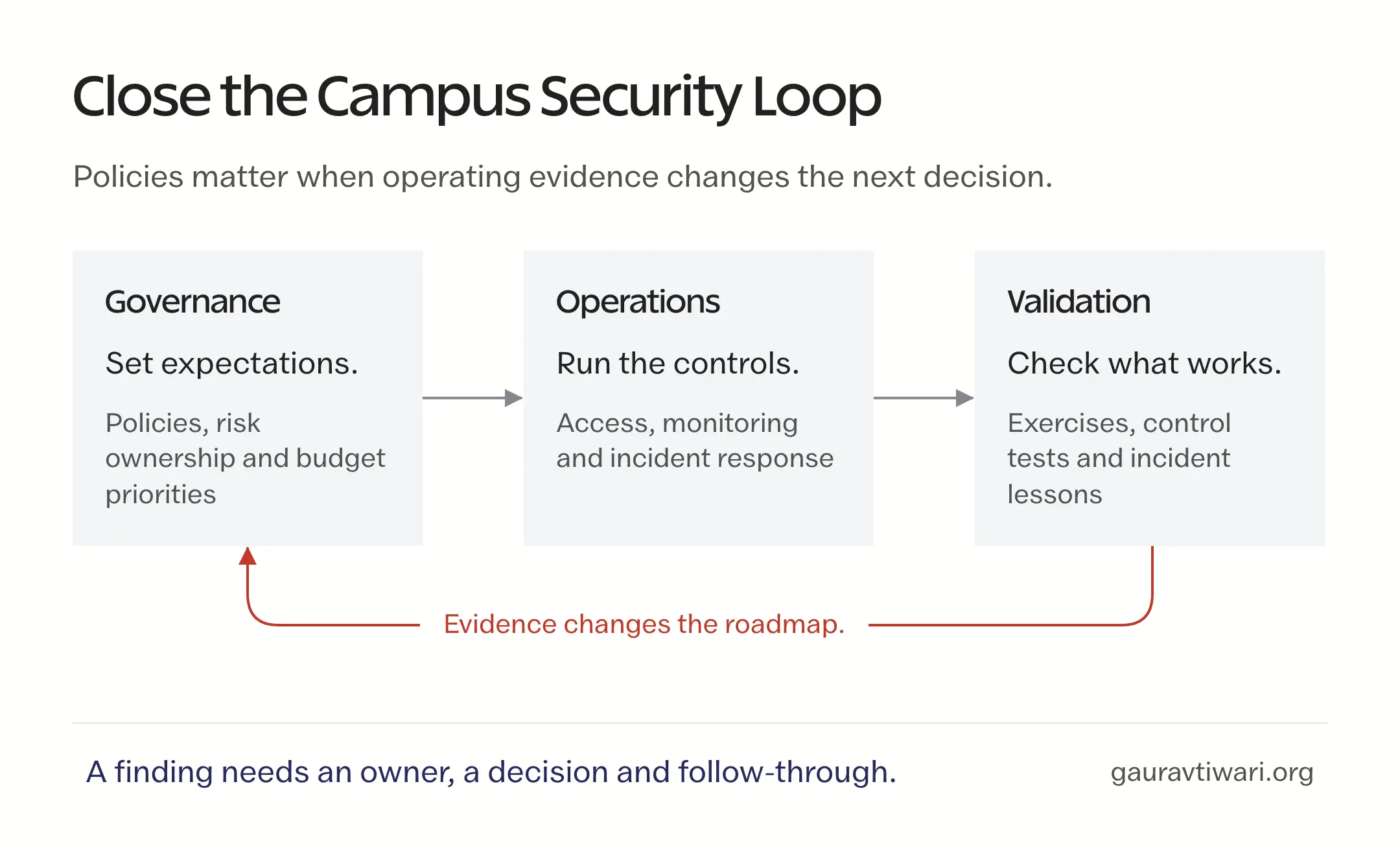
An incident should influence the roadmap. A penetration test should influence priorities. Threat intelligence should influence control decisions. A regulatory requirement should become an operating process. Board reporting should reflect actual risk rather than an abstract maturity score.
This is where DeepSeas’ broader model is particularly relevant. Its strategic advisory capability can operate alongside GRC, offensive security, threat intelligence, and security operations rather than treating the CISO engagement as an isolated consulting service.
For higher education institutions, that connection can help turn limited security resources into a coordinated cyber defense program.
FAQs About Fractional CISO Services
What is a fractional CISO in higher education?
A fractional CISO is an experienced cybersecurity executive who provides ongoing leadership to a college or university without joining the institution as a full-time employee. The role can include security strategy, governance, risk prioritization, compliance, executive reporting, incident preparedness, vendor oversight, budgeting, and coordination with IT, privacy, research, financial aid, and institutional leadership.
Is a fractional CISO the same as a virtual CISO?
The terms frequently describe similar services. “Fractional CISO” emphasizes that the institution receives part of an executive’s time, while “virtual CISO” emphasizes an outsourced delivery model. In practice, either arrangement can range from periodic executive advisory to a deeply embedded security leader who owns major components of the institution’s cybersecurity program.
Why do colleges use fractional CISOs?
Colleges may use fractional CISOs because recruiting a full-time experienced CISO can be difficult, the institution may not need a full-time executive, or the existing team may need additional leadership capacity. A fractional model can also support interim leadership, a major compliance initiative, research security, incident preparedness, governance improvements, or another program requiring CISO-level experience.
What compliance requirements should a higher education CISO understand?
The requirements depend on the institution and its activities. Common areas include GLBA, FERPA, PCI DSS, HIPAA where applicable and state privacy and breach-notification laws. NIST SP 800-171 and CMMC may be relevant to particular research data and defense contracts; they are not blanket requirements for every campus or research project. Title IV participating institutions also have GLBA responsibilities associated with federal student aid information. Check the current CMMC guidance and the actual contract before defining that work.
Does FERPA require specific cybersecurity controls?
FERPA protects the privacy of student education records but does not prescribe a specific set of cybersecurity controls. The Department of Education nevertheless advises institutions to safeguard student records because security incidents can create privacy violations and expose students to harms such as identity theft, fraud and extortion.
Tell Google you want more of this.
Add Gaurav Tiwari as a preferred sourceOne tap, and this site shows up more often in your own Top Stories, AI Overviews and AI Mode. Remove it any time.