
 by
by
A purchased view count can rise while watch time, comments, subscribers, and sales stay flat. That is the trap. You paid for the most visible number on the page, but not for an audience that chose the video.
Searching “buy YouTube views” usually means you want faster distribution. There are two different products hiding behind that phrase: artificial traffic from a third party and paid placement through Google Ads. One violates YouTube policy. The other buys an opportunity for a real person to watch.
The policy line is clear: YouTube’s fake engagement policy prohibits artificial increases from automated systems or videos served to unsuspecting viewers. Artificial traffic is not counted and violations can lead to warnings, strikes, content removal, or channel termination. Google Ads is the legitimate paid route, but ad-campaign watch hours do not count toward YouTube Partner Program thresholds.
What “buying YouTube views” actually means
“Buy YouTube views” covers three very different things, and lumping them together is why so many creators get burned. One is legitimate and the platform encourages it. Two will get your numbers deleted or your channel flagged. Know which one you’re actually buying before you spend a rupee or a dollar.
- Bot views: automated scripts and server farms hitting your video. Cheapest, fastest, and the most dangerous. These are what most “$5 for 5,000 views” sellers deliver.
- Click-farm or “real-looking” views: low-paid workers or incentivized traffic from SMM panels. Slightly harder for YouTube to spot, still against the rules, still useless because nobody actually watches.
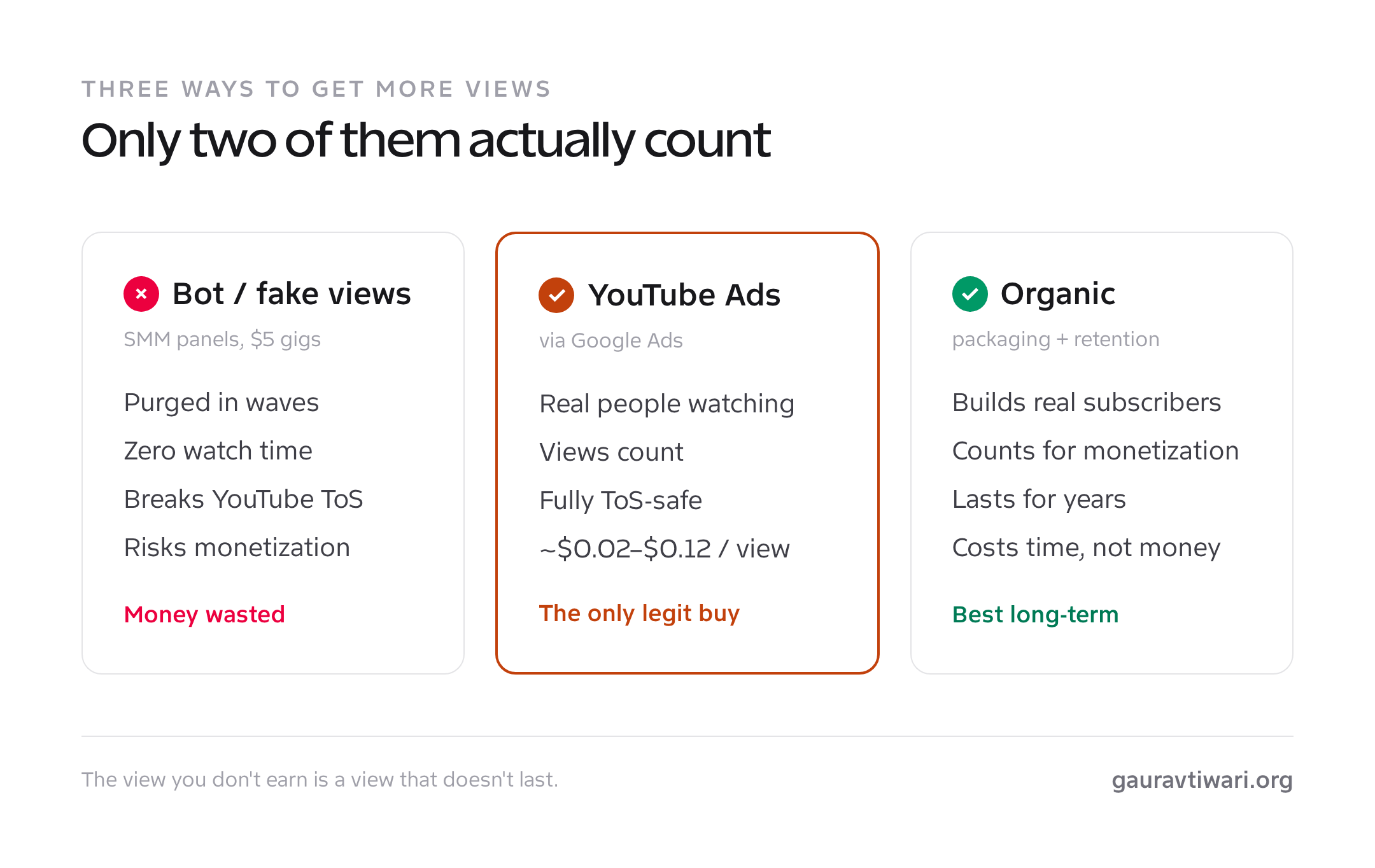
- Paid advertising (YouTube Ads): you pay Google to show your video to real people who match a target audience. They choose to watch. This is the only “bought” view that counts as a real view.
The first two are what people usually mean by “buying views,” and they share a fatal flaw: the viewer never wanted to watch your video. YouTube’s whole machine runs on whether real humans keep watching. Fake views give you a big number with none of the signal underneath it, which is like buying a crowd of mannequins for your store opening. This is the same trap I broke down for Instagram in my guide on whether you should buy Instagram followers, and the logic carries over almost one to one.
What happens when you buy fake YouTube views
Buying fake views doesn’t just fail to help. It actively works against you. Here’s what actually happens, roughly in the order you’ll notice it.
- The views get purged. YouTube audits view counts continuously. Fake views vanish in waves, sometimes within hours, sometimes weeks later. The 50,000 you paid for can drop to 4,000 overnight.
- Your retention tanks. Bots don’t watch. Average view duration craters, and retention is one of the strongest signals YouTube uses to decide whether to recommend a video. You’re teaching the algorithm your video is bad.
- The engagement ratio looks fake. 50,000 views and 11 likes is a flare gun that says “manipulated” to both the algorithm and every real viewer who lands on the page.
- Monetization risk. Bought views don’t count toward the 4,000 valid public watch hours for the YouTube Partner Program, and “artificially inflating metrics” is a stated policy violation that can cost you monetization or the channel.
- You wasted the money. Even in the best case where nothing gets flagged, you paid for a number that drives no subscribers, no watch time, and no revenue.
YouTube’s Fake Engagement policy is explicit: artificially increasing views through automatic systems or unsuspecting viewers isn’t allowed, and content that does it can be removed. This isn’t a gray area the way some sellers imply. It’s a named, enforceable rule.
The one legitimate way to buy YouTube views: YouTube Ads
If you want to pay for distribution, run a video campaign through Google Ads. You choose targeting and format, then measure views, view rate, clicks, and downstream actions. Google’s YouTube ad view metrics distinguish billable TrueView views from public YouTube views, so define which result you are buying before comparing campaigns.
You will mostly compare skippable in-stream, in-feed, and Shorts placements. With cost-per-view bidding on skippable in-stream ads, Google counts a TrueView view when someone watches 30 seconds, reaches the end of a shorter video, or interacts with the ad. In-feed and Shorts formats use different view rules. A view is still only an attention event. Judge the campaign by qualified watch time, subscriber conversion, site action, or another business outcome.
Ads cannot repair weak retention. If the hook, pacing, or topic is not landing, paid traffic spends money faster without solving the content problem. Use ads to test or extend a video that already holds relevant viewers, not to disguise one that does not. If running campaigns is not your thing, this is the kind of work my YouTube marketing services handle, and what good social media marketing agencies set up for clients.
Bought views vs YouTube Ads vs organic growth
Here’s how the three paths compare on the things that actually decide whether your channel grows. Notice that fake views lose on every row that matters.
| What you get | Bought (bot) views | YouTube Ads | Organic growth |
|---|---|---|---|
| Real humans watching | No | Yes | Yes |
| Counts as a valid view | Gets purged | Yes | Yes |
| Adds watch time / retention | No (hurts it) | Yes | Yes |
| Counts toward monetization | No | Yes | Yes |
| Violates YouTube ToS | Yes | No | No |
| Builds subscribers | No | Sometimes | Yes |
| Lasts beyond the spend | No | Limited | Yes |
| Typical cost | $1-$20 / 1,000 (wasted) | ~$0.02-$0.12 / view | Time + effort |
What actually grows YouTube views
Real view growth comes from one loop: a video earns clicks, holds attention, and YouTube responds by showing it to more people. Everything that works is just a way to strengthen one of those three links. None of it is a secret, but almost nobody does all of it consistently.
- Packaging beats everything. Your title and thumbnail decide the click. A great video with a weak thumbnail dies in impressions. Aim for a click-through rate above 4-5% and iterate on the videos that beat it.
- Win the first 30 seconds. Retention is the engine. Open with the payoff, cut the throat-clearing, and give people a reason to stay before they swipe.
- Search and suggested. YouTube is the second-biggest search engine. Titles, descriptions, and topics that match what people actually search keep earning views for years, long after the upload spike fades.
- Consistency and a clear niche. A focused channel trains the algorithm on exactly who to recommend you to. Random topics confuse it.
- Cross-promotion. Push each video to your email list, community, and other platforms in the first 48 hours to seed real early watch time.
If you only fix one thing this month, fix your thumbnails and titles. I’ve watched videos triple their views from a thumbnail swap alone, no new footage, same content. And if you’re still filming on a phone propped against a coffee mug, a small gear upgrade helps more than any view package. My picks for the best cameras for YouTube cover options at every budget.
Tools that improve the work (instead of faking views)
Spend the money you were about to waste on bot views here instead. These tools help you earn real views by improving the parts of the loop that matter, and unlike a view package, the benefit compounds.
- TubeOnAI: AI-assisted title, idea, and summary research so you stop guessing what to make and how to package it. Good for beating creative block and improving click-through.
- VidIQ and TubeBuddy: keyword research, competitor analysis, and thumbnail testing built into YouTube. Both have free tiers worth starting with before you pay.
- Vista Social: schedule the cross-promotion that seeds real early views, so your launch-day push to other platforms actually happens instead of slipping.
- Google Ads: the only place to literally buy real views, when you have a video worth amplifying.
None of these tools create demand. They make research, packaging, or distribution faster. Spend on a repeatable capability before you spend on a number that cannot tell you why anyone watched. For a wider kit, my roundup of content marketing tools covers the rest of the workflow.
Who should never buy views (and the one exception)
Skip bought views entirely if you care about monetization, brand deals, or building something that lasts, which is basically everyone reading this. Sponsors check engagement ratios, not just view counts, and a 50,000-view video with 20 likes scares them off faster than a 2,000-view video with a real, engaged audience. Fake numbers don’t just fail to impress. They actively signal that you cut corners.
The only “buying” that makes sense is YouTube Ads on a video that already performs with real viewers, used to reach more of the right people faster. That’s not gaming the system. That’s marketing. Everything else is paying to make your channel look healthy while quietly making it sicker.
Frequently asked questions
Is it illegal to buy YouTube views?
It’s not a crime, but buying fake or bot views violates YouTube’s Terms of Service and Fake Engagement policy. That can get the views purged, the video removed, or the channel penalized. Buying real views through YouTube Ads is fully allowed.
Will I get banned for buying YouTube views?
A single small purchase usually triggers a view purge rather than a ban. But repeated or large-scale fake engagement can lead to strikes, demonetization, or termination. It’s not worth the risk for numbers that get deleted anyway.
Do bought views count toward monetization?
No. Artificial traffic does not count. YouTube also says watch hours and Shorts views gained through ad campaigns do not count toward Partner Program eligibility thresholds, even though paid ad views can appear in campaign or public-view reporting.
Can YouTube detect bought views?
Yes, routinely. YouTube continuously audits traffic sources and watch behavior. Bot and click-farm views get flagged and removed in waves, which is why a purchased count often drops sharply days or weeks later.
What’s the cheapest legitimate way to get more views?
Better thumbnails and titles, for free. Packaging decides your click-through rate, and a higher click-through rate earns more impressions from YouTube at no cost. After that, a small YouTube Ads budget on your best video is the cheapest paid option that actually counts.
Are any ‘buy YouTube views’ services safe?
The ones selling cheap bulk views are not, regardless of ‘real’ or ‘high-retention’ claims. The policy-compliant way to pay for distribution is a YouTube campaign through Google Ads. It buys placement, not guaranteed retention, subscribers, or Partner Program watch hours.
Buy distribution, not a view count
You can buy a number, or you can buy growth. They’re not the same purchase. Cheap YouTube views give you a vanity figure that gets purged, drags your retention down, and spooks the sponsors and viewers you actually want. YouTube Ads give you real people who count, convert, and stay. One is a shortcut to nowhere. The other is just marketing.
So here’s what I’d do with the money you were about to spend on a view package: fix your thumbnail, put $20 into a YouTube Ads test on your best video, and pour the rest into making the next one better. Do that for six months and you’ll have something no SMM panel can sell you, an audience that actually shows up. That’s the growth worth paying for.
Tell Google you want more of this.
Add Gaurav Tiwari as a preferred sourceOne tap, and this site shows up more often in your own Top Stories, AI Overviews and AI Mode. Remove it any time.