
 by
by
Passive income for creators is one of the most misunderstood phrases online. It does not mean money without work. It means doing the work once, in a way that keeps paying you long after you have moved on to the next thing. Every creator I have helped build income streams started in the same place: trading hours for money, one post or one client at a time.
The honest version of this guide is simple. The “passive” part is real, but it sits on top of a stack of upfront active work. A course takes weeks. An evergreen blog takes months. Index fund returns take years. What you are really choosing is how long you work before the income keeps showing up on its own.
Verdict: If you only build one passive income stream this year, build a single digital product on top of content you already publish, then layer affiliate links and a recurring membership around it. That stack reinforces itself. What does not work is treating any of these as set-and-forget. In 2026, only about 4% of creators earn over $100,000 a year, down from 10% in 2022, and the ones who get there stacked two or three income streams instead of betting on one. This is education, not financial advice.
What changed in 2026: The creator economy is now worth more than $250 billion, with over 200 million people calling themselves creators. But the low-effort version of passive income, generic AI courses about “how to use ChatGPT” and template-spam stores, is saturated. The streams that still pay are niche and well-made. AI shortened production time. It did not remove the upfront work. The moat is now editorial quality and a specific audience, not volume.
The strategies below outline practical ways creators can move from short-term, hours-for-money earnings toward long-term, asset-based financial growth. Read them in order, but build them one at a time.
The “Passive Income” Myth Every Creator Falls For

Passive income for creators is not money without effort. It is income from an asset you already built. That distinction is the whole game, and it is where most creators get burned. They expect the “passive” part on day one and quit when it does not arrive.
Passive wealth is built through assets. These assets generate income, appreciate in value, or both. For creators, assets often take digital form. A video library, a course, a membership community, or a well-designed website can all become income-generating resources. But none of them start passively. Most require significant upfront effort. A course may take two to six months of active work before it sells on its own. A blog may take a year of consistent writing before it attracts steady search traffic.
The difference lies in longevity. Instead of earning money only when you are actively working, these assets keep producing results over time. Creators who focus on asset-building eventually shift from constant content output toward a more sustainable income structure. That is the foundation of every monetization strategy beyond traditional ads, and it is why the rest of this guide treats “passive” as a destination, not a starting condition.
Passive Income Streams For Creators, Ranked By Effort And Lag
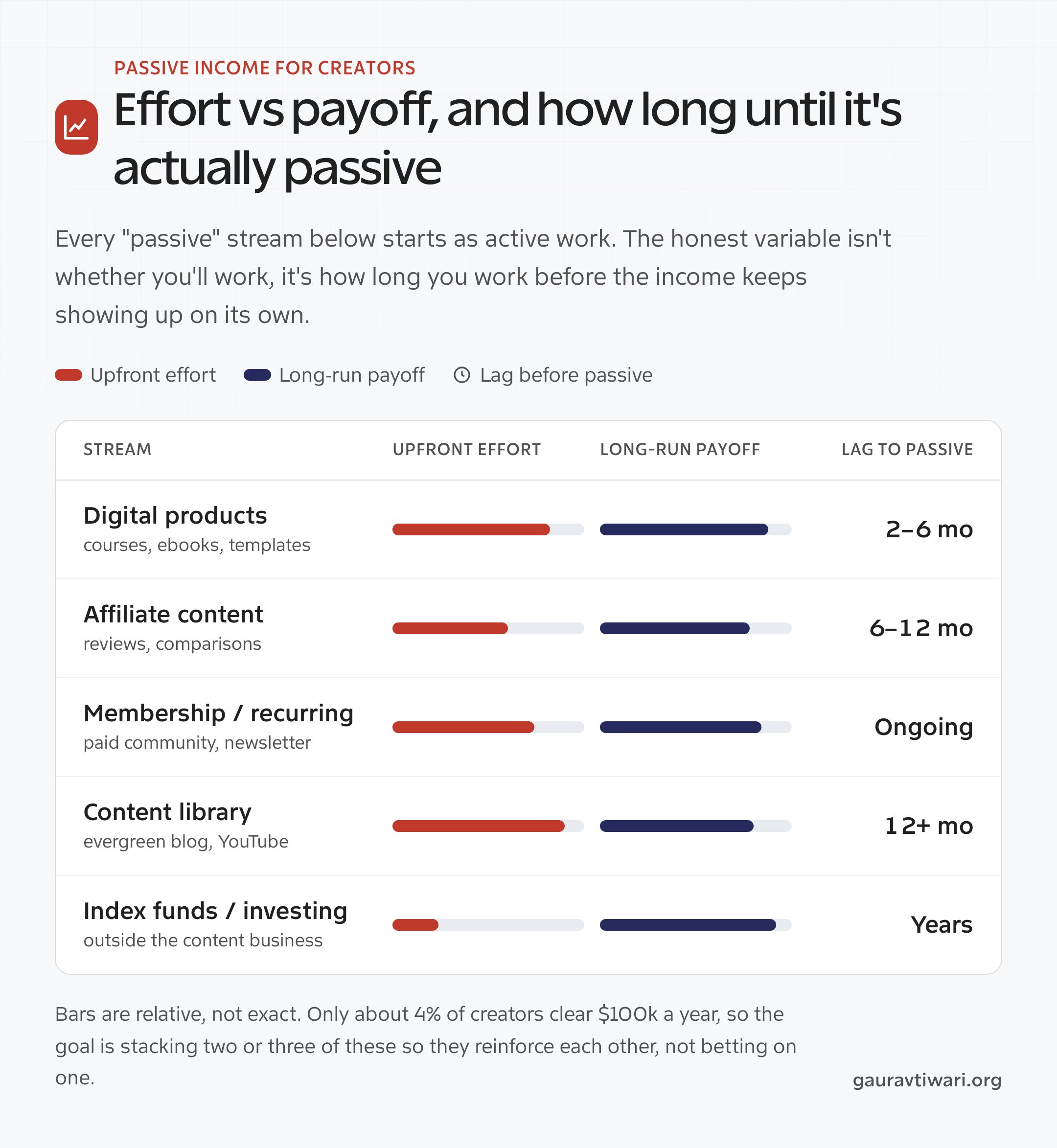
Before the individual strategies, here is the honest map. Every passive income stream below starts as active work. The useful question is not “is this passive,” it is “how long until it pays without me.” This table ranks the main income streams for creators by upfront effort, long-run payoff, and the lag before the income runs on its own.
| Income stream | Upfront effort | Long-run payoff | Lag before it’s passive |
|---|---|---|---|
| Digital products (courses, ebooks, templates) | High | High | 2–6 months |
| Affiliate content (reviews, comparisons) | Medium | High | 6–12 months |
| Membership / recurring revenue | Medium-high | High | Ongoing upkeep |
| Content library (evergreen blog, YouTube) | Very high | High | 12+ months |
| Index funds & investing | Low | Very high | Years (compounding) |
Retirement Accounts and Long-Term Financial Security
Many creators focus heavily on growing their brand but overlook retirement planning. Traditional employment often includes employer-sponsored retirement plans. Independent creators must set up these systems themselves.
Retirement accounts provide tax advantages that can accelerate long-term wealth building. These accounts allow investments to grow either tax-deferred or tax-free, depending on the structure. For creators with self-employment income, common options include:
- Roth IRAs
- Traditional IRAs
- SEP IRAs
- Solo 401(k) plans
Each type has different contribution limits and tax benefits. A Roth IRA, for example, allows contributions using after-tax income while withdrawals in retirement are typically tax-free.
Many creators begin this process by opening a Roth IRA through a specialized platform and contributing small, consistent amounts from their earnings. Over decades, compounded investment growth can turn modest contributions into substantial retirement savings.
Even irregular creator income can support retirement investing. The key is consistency rather than large deposits. Building retirement savings early provides long-term security that is independent of audience size or platform performance. For a deeper look at getting started, see this guide on investing basics for beginners and a longer walkthrough on how to invest in stocks for beginners.
Digital Products That Sell Continuously
One of the most reliable passive income strategies for creators is developing digital products. They are attractive because they can be sold repeatedly without manufacturing or shipping costs. Once the product exists, distribution is nearly effortless.
Common digital products include:
- Online courses
- Ebooks or guides
- Templates and presets
- Notion dashboards or digital planners
- Stock photos, music, or design elements
A course explaining a skill you already teach through content can become a long-term revenue source. An ebook that compiles your expertise into a structured format may sell for years. The most successful digital products solve a clear problem. They save people time, help them learn something faster, or simplify a process.
Here is the honest caveat for 2026. Generic digital products are saturated. The realistic income range is wide: a single ebook might earn a few hundred dollars a month, while a focused course in an underserved niche can clear several thousand. The difference is specificity. “Strength training for women over 40” outsells “fitness.” Creators who consistently publish value-driven content have a natural advantage, because their audience already trusts their expertise. Expect two to six months of active work before a product sells on its own.
Platforms like Teachable and Thinkific make it straightforward to host and sell courses, while Gumroad works well for ebooks, templates, and smaller digital downloads. If you are deciding which fits best, this comparison of the best online teaching platforms is worth reading first.
Affiliate Marketing That Compounds Over Time
Affiliate marketing is another passive income stream many creators overlook. It is one of the cleanest ways to monetize content you would publish anyway. At its core, it means recommending products or services and earning a commission when someone purchases through your referral link. Unlike brand sponsorships, affiliate content can keep generating income long after it is published.
For example, a tutorial recommending certain tools may bring in commissions months or even years later. The same applies to blog articles, email newsletters, and resource pages. Successful affiliate strategies focus on authenticity. Recommend only tools you genuinely use or believe in, because audiences detect forced recommendations fast.
Long-form educational content tends to perform best. Reviews, comparison guides, and tutorials often rank well in search and stay relevant over time. When implemented thoughtfully, affiliate marketing becomes a system where older content keeps producing income. For a practical walkthrough, see this affiliate marketing for beginners guide.
Membership Communities and Recurring Revenue
Passive income does not always mean one-time payments. Recurring income can be even more powerful, and in 2026 memberships have moved from one option among many to the primary revenue foundation for most community-led creator businesses.
Membership communities let creators charge a monthly or yearly fee for exclusive content, resources, or interaction. Platforms like Patreon, Substack, and private Discord communities have made this model mainstream. Recurring revenue has two major advantages. First, it improves financial predictability. Instead of starting every month at zero, you begin with a baseline income from existing members. Second, it strengthens community relationships, because members feel more connected when they receive ongoing value.
Successful membership communities typically offer:
- Exclusive content or tutorials
- Live Q&A sessions
- Private discussions or networking
- Early access to content
- Premium resources or downloads
The goal is not simply locking content behind a paywall. It is creating a deeper experience for the most engaged members of your audience. Managing membership communications is easier with a purpose-built email platform. Kit (formerly ConvertKit) is built specifically for creators running paid newsletters and membership-style email products.
Content Libraries as Long-Term Assets
Many creators focus heavily on new content while underestimating the value of their existing work. A well-organized content library can function as a long-term asset. Articles, videos, and podcasts often keep attracting traffic for years.
Search-driven platforms like blogs and YouTube are particularly valuable here. Evergreen topics can stay relevant indefinitely. Instead of constantly producing entirely new material, creators can strengthen older assets by:
- Updating outdated information
- Improving search optimization
- Repurposing content into new formats
- Linking related content together
A single piece of evergreen content can generate thousands of views long after its publication date. As a library grows, it begins to function like an archive of intellectual property. Each piece becomes another door through which audiences discover your work. Creators who treat their blog as a compounding asset often find it becomes their most reliable revenue channel. This guide on blogging for profit breaks down how to build that kind of library, and this look at what makes a successful blogger covers the habits behind it.
Investing Outside Your Content Business
While digital income streams are powerful, long-term wealth typically requires investing outside your content business as well. Relying entirely on platform income is risky. Algorithms change. Platforms lose popularity. Monetization rules shift. Investments create an additional layer of financial security.
Common options include:
- Index funds
- ETFs
- Dividend-paying stocks
- Real estate investments
- High-yield savings accounts
Index funds are especially popular among long-term investors. They track large portions of the market and historically provide steady growth over time. Automating investments each month can gradually turn fluctuating creator income into a growing portfolio. The goal is diversification. When your wealth exists in multiple forms, financial volatility becomes easier to manage. The modern investor’s checklist covers what to prioritize, and the simple math behind long-term growth shows why starting early matters more than starting big.
Automating Financial Systems
Passive income strategies become far more effective when paired with automation. Automation reduces decision fatigue and ensures financial progress happens consistently. Creators can automate several key areas:
- Monthly investment transfers
- Savings allocations
- Tax withholding accounts
- Subscription revenue tracking
For U.S. creators living abroad, automation should include compliance catch-up. If you’ve missed prior filings, the IRS Streamlined Foreign Offshore Procedures let expats get current through streamlined tax filing, including FBAR e-filing and a Form 14653 certification, reducing risk while you focus on building assets.
For example, some creators automatically move a percentage of every payment into separate accounts for taxes, savings, and investments. This structure prevents accidental overspending and ensures long-term financial goals stay funded. Automation also frees creators to focus more energy on creative work instead of constantly managing financial logistics.
Turning Side Income Into Sustainable Revenue
Many creators start with one income stream and never diversify. The real shift happens when you combine two or three of these strategies and let them reinforce each other. A blog post that ranks well in search can include affiliate links, promote a digital product, and funnel readers into a membership community. That single piece of content now generates revenue from multiple directions without any additional daily effort.
The creators who build lasting wealth are not necessarily the ones with the largest audiences. They are the ones who set up systems that work in parallel. If you are still exploring what kind of side income works best for your situation, this roundup of the best side hustle ideas and these business ideas to make money are good starting points.
FAQs
What is passive income for creators, really?
Passive income for creators means building assets that keep producing income or financial value after the initial work is done. It is not money without effort. It can include digital products, affiliate content, membership systems, content libraries, and long-term investments, each of which needs upfront active work before it pays on its own.
Is passive income really passive for creators?
Not at the start. Most creator income streams need meaningful upfront work, such as writing articles, recording a course, building a product, or setting up automation. The passive part comes later, often two to twelve months in, when those assets keep working without daily effort.
Which passive income stream should a new creator start with?
Start with one asset you can realistically maintain. For many creators that means a focused digital product built on a skill you already teach, evergreen blog content with affiliate links, or a basic retirement investing habit. The best first step is the one you can keep funding and improving consistently.
Are digital products still a good passive income idea in 2026?
Yes, but only niche, well-made ones. Generic AI courses and template-spam stores are saturated. A focused product for a specific audience still sells because it can be delivered repeatedly without inventory or shipping. Specificity is the antidote to saturation.
How much do creators actually earn from passive income?
Income is highly skewed. More than half of creators earn under $15,000 a year, and only about 4% clear $100,000. A single ebook might earn a few hundred dollars a month, while a focused course in an underserved niche can earn several thousand. The earners who do well stack multiple income streams.
Why do membership communities create more stable income?
Memberships create recurring revenue, which makes monthly income more predictable. In 2026 they have become the primary revenue foundation for most community-led creator businesses. They also deepen the relationship with your most engaged audience through exclusive content, discussions, live sessions, and premium resources.
Should creators invest outside their content business too?
Yes. Relying only on platform income is risky because algorithms, audience behavior, and monetization rules change fast. Investing in index funds, ETFs, dividend stocks, real estate, or high-yield savings adds a second layer of financial security that does not depend on your audience.
How can creators automate their finances for long-term wealth?
Automate transfers into investment accounts, savings buckets, and tax accounts, and track recurring revenue automatically. That reduces decision fatigue, prevents overspending, and keeps long-term goals funded even when income changes from month to month.
Conclusion
Building passive income for creators requires more than producing great content. Sustainable financial growth comes from developing systems that keep working long after the initial effort. Digital products, affiliate partnerships, membership communities, and long-term investments each contribute to a more stable foundation. Over time, these systems shift income away from constant output and toward asset-based growth.
The process does not happen overnight, and the “passive” part always arrives later than people hope. It develops gradually through intentional decisions and consistent action. Creators who prioritize asset-building alongside creativity, and who stack two or three income streams instead of chasing one, position themselves for a far more secure financial future.
Tell Google you want more of this.
Add Gaurav Tiwari as a preferred sourceOne tap, and this site shows up more often in your own Top Stories, AI Overviews and AI Mode. Remove it any time.