
Quantum Computing for Students: The Complete Reference Guide
Quantum computing explained properly for students: qubits and the Bloch sphere, quantum gates with their matrices, Bell states and entanglement, Grover's and Shor's algorithms, real hardware platforms, error correction, and a free LaTeX-typeset PDF of the full lesson. Everything you need in one reference guide.
 by
by
A classical computer with 300 bits holds one 300-bit number at a time. A quantum computer with 300 qubits can work with a superposition spanning \( 2^{300} \) states, more than the number of atoms in the observable universe. That single comparison explains why quantum computing attracts billions in research funding, and why it gets hyped beyond recognition. This guide is the antidote to both the hype and the intimidation.
I’ve written it as a complete reference for students: the quantum physics you actually need, the math of qubits and gates (rendered properly, not as blurry screenshots), the algorithms worth knowing by name, the hardware, the honest limitations, and a downloadable PDF of the whole lesson at the end. Read it top to bottom or jump to the section you need.
Table of Contents
What Exactly Is Quantum Computing?
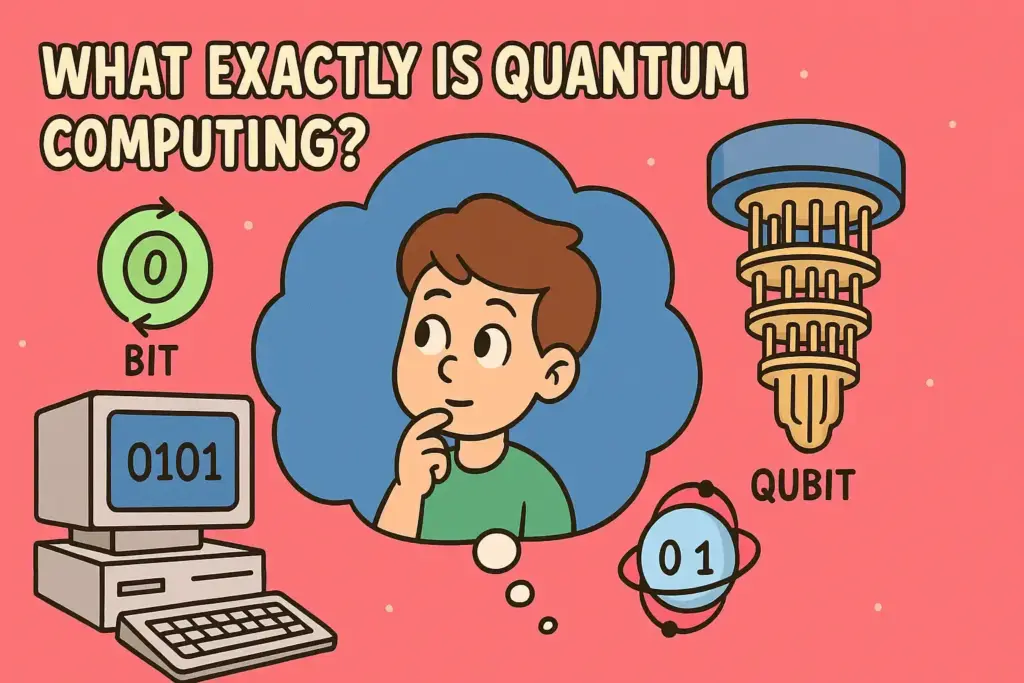
Quantum computing is a model of computation that stores and processes information using quantum mechanical systems, exploiting superposition, entanglement, and interference to solve certain problems far faster than any classical machine. It is not a faster version of your laptop. It is a fundamentally different way of computing, useful for a specific (and important) class of problems.
The idea has a precise birthday. In 1981, Richard Feynman argued at MIT that simulating quantum systems on classical computers is exponentially hard, so we should build computers out of quantum systems themselves. David Deutsch formalized the universal quantum computer in 1985. Peter Shor’s 1994 factoring algorithm turned the field from curiosity into a security concern, and today IBM, Google, IonQ, and a dozen serious startups are racing to build machines with thousands of reliable qubits.
Before any of that makes sense, you need four ideas from quantum physics. They take ten minutes and they’re the foundation for everything else in this guide.
The Quantum Physics You Need First
Quantum mechanics is the physics of the very small: electrons, photons, atoms. Four of its rules power every quantum computer ever built. If you want to go deeper after this section, I keep a list of the best quantum physics YouTube channels for exactly that.
1. Particles Are Also Waves
Electrons and photons behave as both particles and waves. In the famous double-slit experiment, single electrons fired one at a time still build up a wave-like interference pattern. This wave behavior is what lets quantum states overlap and interfere inside a quantum computer, and interference is the engine of every quantum algorithm.
2. Uncertainty Is Built In
You cannot know everything about a quantum particle at once. Heisenberg’s uncertainty principle makes this quantitative: the uncertainties in position and momentum always satisfy
$$ \Delta x \, \Delta p \geq \frac{\hbar}{2} $$
where \( \hbar \approx 1.055 \times 10^{-34} \) J·s is the reduced Planck constant. This isn’t a limitation of our instruments. Nature itself doesn’t assign definite values to both quantities simultaneously.
3. States Exist in Superposition
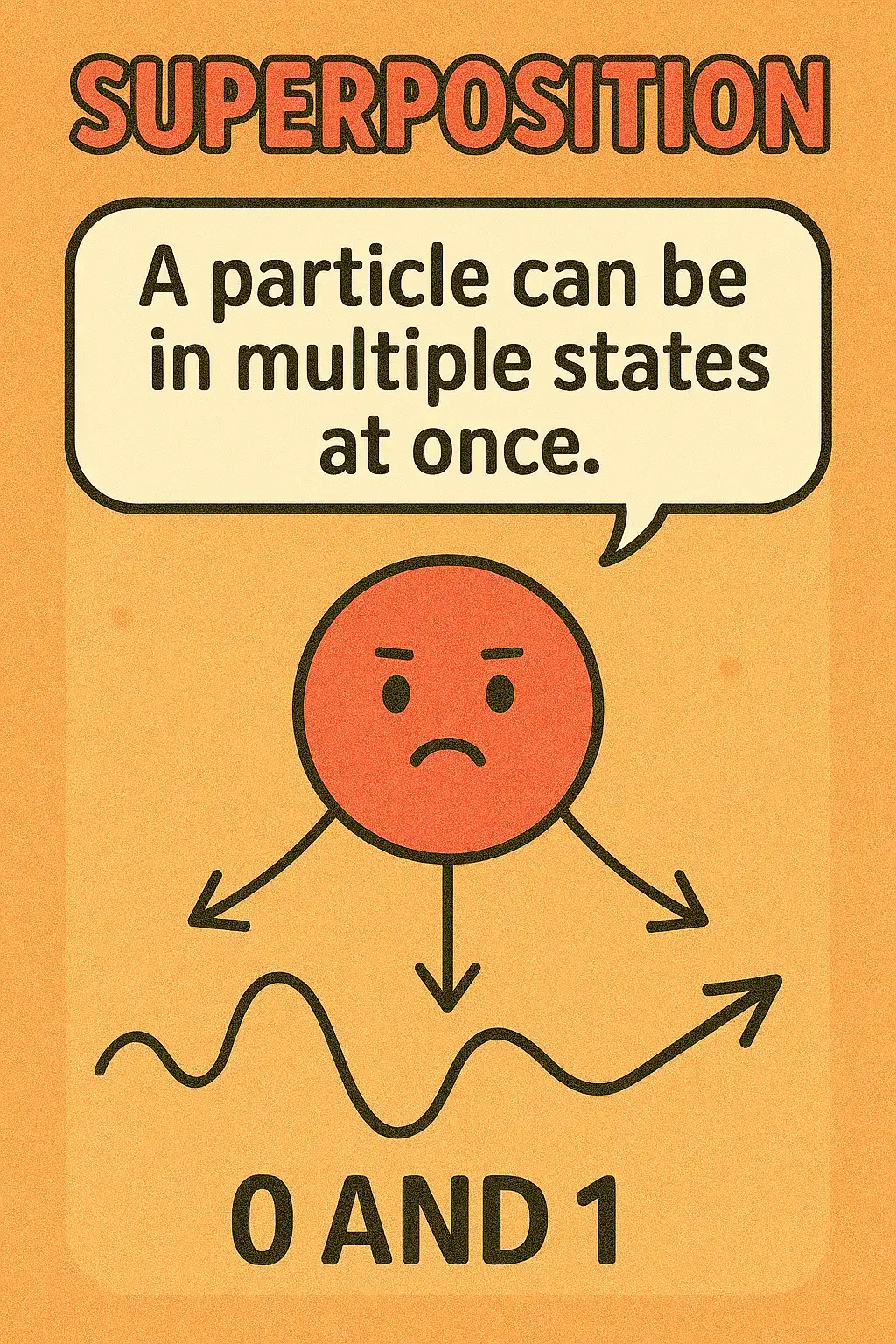
Until measured, a quantum system doesn’t sit in one definite state. It exists in a weighted combination (a superposition) of all its possible states, and the weights are complex numbers called amplitudes. Measurement forces a choice, with probabilities given by the squared magnitudes of those amplitudes. This is the Born rule, and it’s the exact mechanism a quantum computer uses to turn quantum states into readable answers.
4. Entanglement Links Particles
Two particles can share a joint state in which measuring one instantly determines the outcome of measuring the other, no matter how far apart they are. Einstein dismissed it as “spooky action at a distance,” but the 2022 Nobel Prize in Physics went to Aspect, Clauser, and Zeilinger for proving experimentally that entanglement is real. I’ve covered the concept in detail in my quantum entanglement study notes. In a quantum computer, entanglement is what makes many qubits more powerful than the sum of their parts.
The Qubit: The Heart of Quantum Computing
A qubit is a two-level quantum system whose state is a superposition of the basis states \( |0\rangle \) and \( |1\rangle \). Where a classical bit is either 0 or 1, a qubit’s general state is
$$ |\psi\rangle = \alpha\,|0\rangle + \beta\,|1\rangle $$
Here \( \alpha \) and \( \beta \) are complex numbers called amplitudes, and they must satisfy the normalization condition \( |\alpha|^2 + |\beta|^2 = 1 \). When you measure the qubit, you get 0 with probability \( |\alpha|^2 \) and 1 with probability \( |\beta|^2 \). The notation \( |\cdot\rangle \) is Dirac’s “ket” notation, and it’s just a column vector: \( |0\rangle = \binom{1}{0} \) and \( |1\rangle = \binom{0}{1} \).
One subtlety students miss: a qubit in superposition is not “both 0 and 1 at the same time” in any classical sense. It’s a definite quantum state, a specific point in a two-dimensional complex vector space. The fuzziness only appears when you measure.
The Bloch Sphere
Every single-qubit state can be drawn as a point on a unit sphere called the Bloch sphere. Write the state with two angles,
$$ |\psi\rangle = \cos\frac{\theta}{2}\,|0\rangle + e^{i\varphi}\sin\frac{\theta}{2}\,|1\rangle $$
and \( \theta \) (the polar angle) controls the balance between 0 and 1, while \( \varphi \) (the azimuthal angle) sets the relative phase. The north pole is \( |0\rangle \), the south pole is \( |1\rangle \), and the equator holds the equal superpositions.
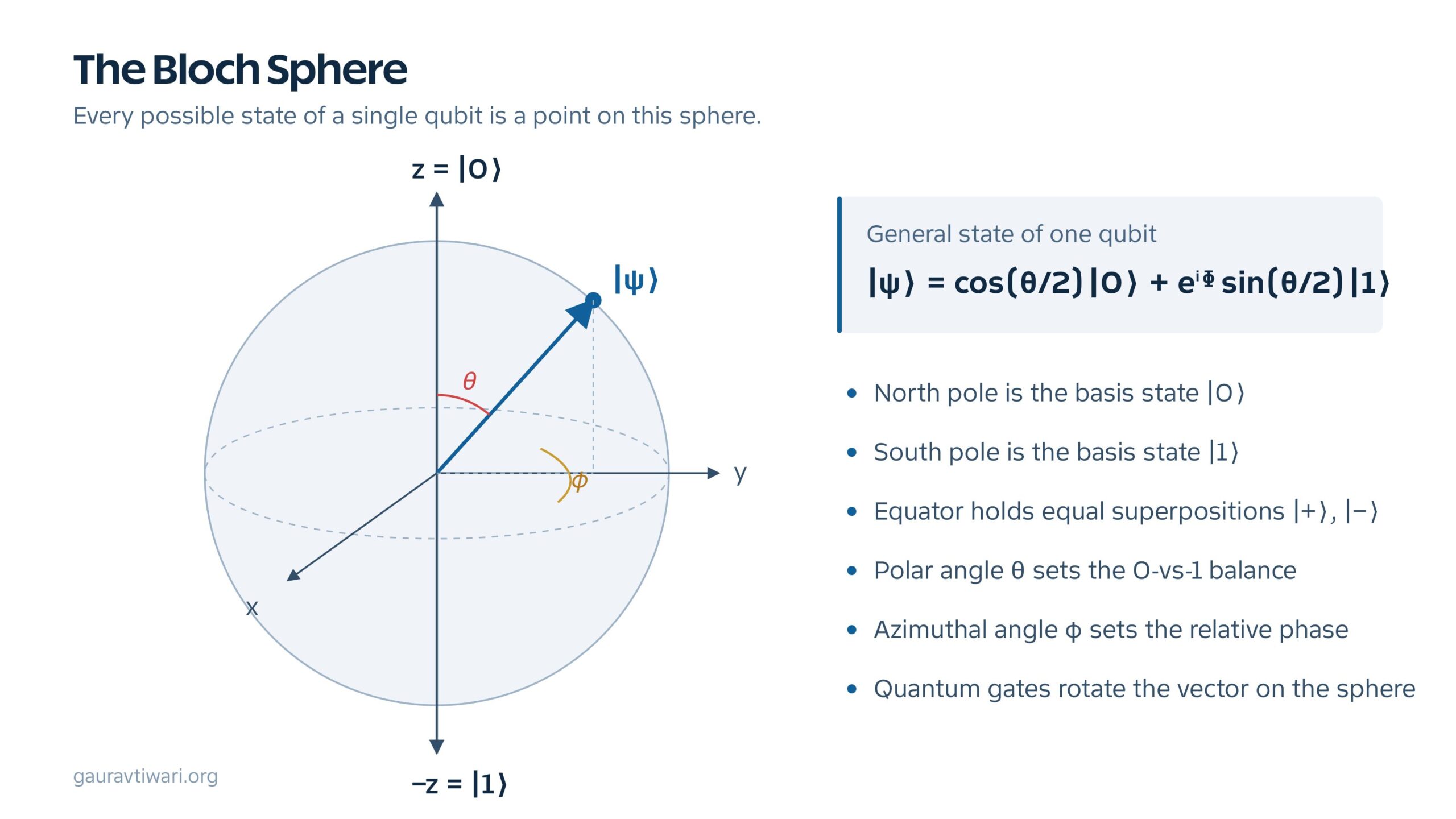
This picture earns its place in every textbook because it turns algebra into geometry: single-qubit quantum gates are simply rotations of this sphere. Once you see gates as rotations, half of quantum computing stops being mysterious.
Many Qubits: The Exponential State Space
Qubits combine through the tensor product, and this is where the exponential power comes from. A register of \( n \) qubits lives in a \( 2^n \)-dimensional space, so describing its state takes \( 2^n \) complex amplitudes.
| Qubits | Amplitudes needed to describe the state | Classical equivalent |
|---|---|---|
| 1 | 2 | trivial |
| 10 | 1,024 | a kilobyte of complex numbers |
| 30 | \( \approx 10^9 \) | gigabytes of RAM |
| 50 | \( \approx 10^{15} \) | petabytes; edge of supercomputers |
| 300 | \( \approx 10^{90} \) | more numbers than atoms in the universe |
A 50-qubit machine already outruns any classical computer’s ability to store its full state vector. But here’s the honest catch: you can’t read all \( 2^n \) amplitudes out. Measurement collapses everything to just \( n \) classical bits. The art of quantum algorithm design is arranging interference so that the answer you want survives the collapse.
Quantum Gates: The Instruction Set
Quantum gates are the elementary operations of a quantum computer, and mathematically each gate is a unitary matrix acting on qubit states. Unitary means reversible and length-preserving, so quantum computation (unlike classical logic with AND and OR) never destroys information mid-circuit. If matrices feel rusty, my study notes cover everything used below.
These are the gates every student should recognize on sight:
| Gate | Qubits | What it does | Matrix / action |
|---|---|---|---|
| Pauli-X | 1 | Bit flip, the quantum NOT | \( X = \begin{pmatrix} 0 & 1 \\ 1 & 0 \end{pmatrix} \) |
| Pauli-Z | 1 | Phase flip; leaves \( |0\rangle \), negates \( |1\rangle \) | \( Z = \begin{pmatrix} 1 & 0 \\ 0 & -1 \end{pmatrix} \) |
| Hadamard (H) | 1 | Creates equal superposition from a basis state | \( H = \frac{1}{\sqrt{2}}\begin{pmatrix} 1 & 1 \\ 1 & -1 \end{pmatrix} \) |
| S and T | 1 | Quarter and eighth phase turns | \( T = \begin{pmatrix} 1 & 0 \\ 0 & e^{i\pi/4} \end{pmatrix} \) |
| CNOT | 2 | Flips the target qubit if the control is \( |1\rangle \) | the entangler; see circuit below |
| Toffoli (CCNOT) | 3 | Flips the target if both controls are \( |1\rangle \) | gives quantum computers all of classical logic |
The Hadamard gate deserves a worked example because it appears at the start of almost every algorithm. Applied to \( |0\rangle \):
$$ H|0\rangle = \frac{|0\rangle + |1\rangle}{\sqrt{2}} \equiv |+\rangle $$
That’s a 50/50 superposition. Apply H to every qubit of an \( n \)-qubit register of zeros and you get an equal superposition over all \( 2^n \) bitstrings in a single step. This is the standard opening move of Grover’s algorithm, Shor’s algorithm, and most others.
A remarkable theorem says the small set \( \{H, T, \text{CNOT}\} \) is universal: any quantum computation whatsoever can be built from just these three gates, the same way NAND alone builds all of classical logic.
Quantum Circuits and Measurement
A quantum circuit is a sequence of gates applied to qubits, read left to right, ending in measurement. The best first circuit to understand creates a Bell state, the simplest fully entangled state of two qubits. It takes exactly two gates:
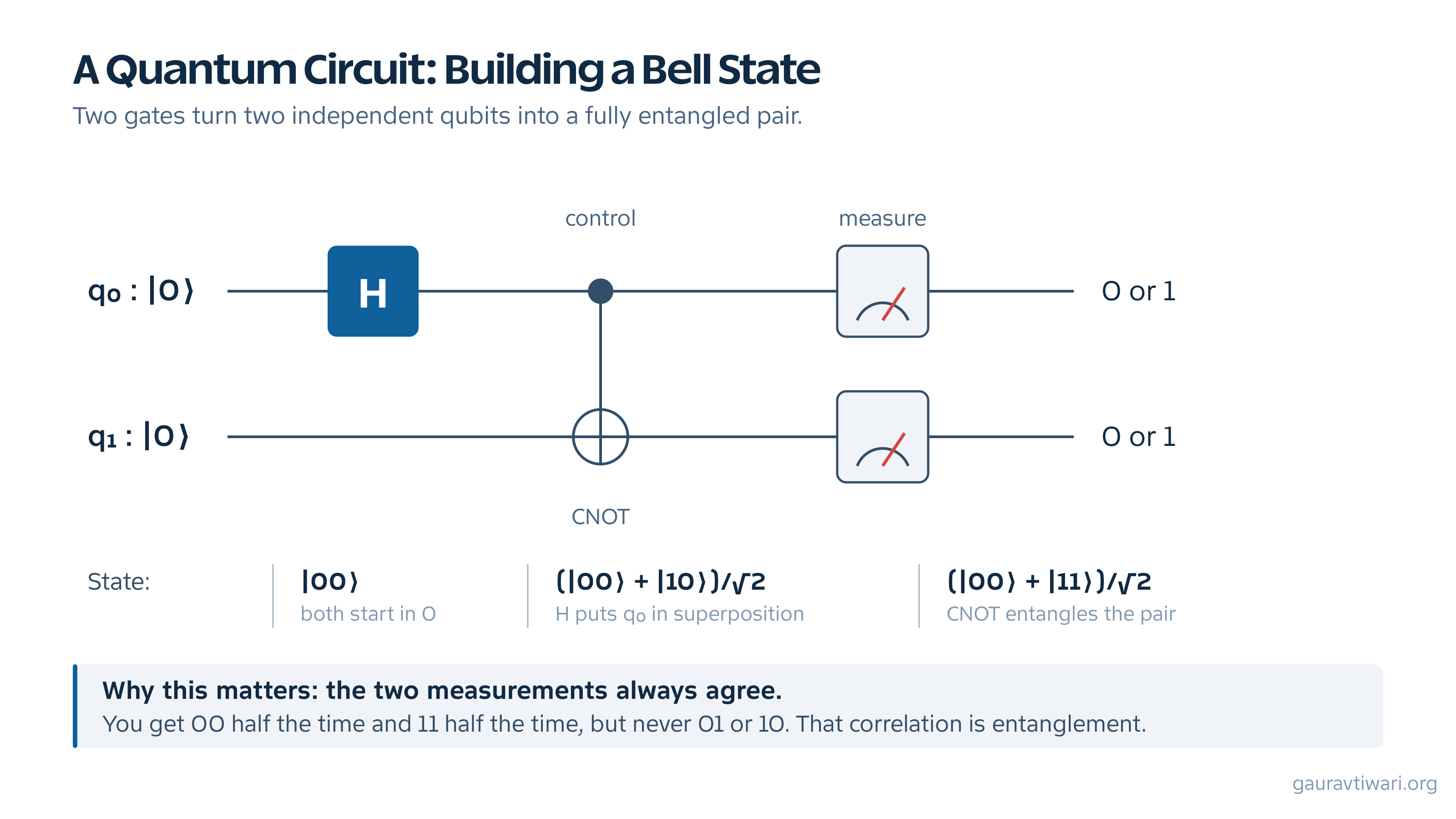
Trace it by hand once in your life. Both qubits start as \( |00\rangle \). The Hadamard puts the first qubit in superposition, giving \( \frac{1}{\sqrt{2}}(|00\rangle + |10\rangle) \). Then CNOT flips the second qubit only in the branch where the first is 1:
$$ |\Phi^+\rangle = \frac{|00\rangle + |11\rangle}{\sqrt{2}} $$
This state cannot be written as (state of qubit 1) \( \times \) (state of qubit 2). The qubits no longer have individual states, only a joint one. Measure both and you get 00 or 11 with probability \( \tfrac{1}{2} \) each, and never 01 or 10. The outcomes are perfectly correlated even though each individual outcome is perfectly random.
Measurement itself follows the Born rule: the probability of reading outcome \( i \) from state \( |\psi\rangle \) is
$$ P(i) = |\langle i|\psi\rangle|^2 $$
Because outcomes are probabilistic, real quantum programs run the same circuit thousands of times (each run is called a shot) and read the answer from the statistics.
Quantum vs Classical Computing
Every row of this table is a difference of kind, not degree. This is why a quantum computer will never replace your laptop, and why your laptop will never factor a 2048-bit number.
| Classical computer | Quantum computer | |
|---|---|---|
| Basic unit | Bit: 0 or 1 | Qubit: \( \alpha|0\rangle + \beta|1\rangle \) |
| State of n units | One of \( 2^n \) strings | Superposition over all \( 2^n \) strings |
| Logic | Boolean gates (AND, OR, NAND), mostly irreversible | Unitary gates (H, CNOT, T), always reversible |
| Copying data | Trivial | Forbidden by the no-cloning theorem |
| Reading output | Deterministic, read anytime | Probabilistic, collapses the state |
| Errors | Roughly 1 in \( 10^{17} \) operations | Roughly 1 in \( 10^{3} \) on today’s hardware |
| Killer domain | General-purpose everything | Simulation, factoring, unstructured search, optimization |
| Operating environment | Room temperature | Often near 15 millikelvin, colder than deep space |
The error-rate row is the one that matters most in practice. It’s the entire reason the field talks so much about error correction, which we’ll get to shortly.
Quantum Algorithms Every Student Should Know
A quantum computer is only as useful as its algorithms, and genuinely fast quantum algorithms are rare and precious. These are the four families that define the field.
Grover’s Search Algorithm
Lov Grover showed in 1996 that a quantum computer can find a marked item among \( N \) unsorted possibilities in about
$$ O\!\left(\sqrt{N}\right) \text{ steps instead of } O(N) $$
It works by starting in an equal superposition and repeatedly applying a “Grover iteration” that amplifies the amplitude of the marked item while shrinking the rest, pure constructive and destructive interference. Searching a million items takes roughly a thousand iterations instead of half a million lookups. The speedup is quadratic, not exponential, but it applies to a huge range of brute-force problems.
Shor’s Factoring Algorithm
Peter Shor’s 1994 algorithm factors an integer \( N \) in polynomial time by converting factoring into a period-finding problem and solving that with the quantum Fourier transform. Classically, factoring is believed to take super-polynomial time, and that hardness is what RSA encryption rests on. A large fault-tolerant quantum computer running Shor’s algorithm would break RSA-2048, which is why NIST finalized its first post-quantum cryptography standards (including ML-KEM, published as FIPS 203) in August 2024, years before such a machine exists. The threat is taken seriously enough that the migration has already started.
Quantum Simulation
This is Feynman’s original use case and, in my view, still the most likely first source of real commercial value: using a controllable quantum system to simulate molecules and materials that overwhelm classical methods. Simulating chemistry means tracking quantum states of interacting electrons, exactly the thing whose description blows up exponentially on classical hardware. It also connects directly to the mathematics of statistical mechanics and ensembles, where the same exponential state-counting problem appears.
Here’s the cheat sheet for the algorithms you’ll meet by name:
| Algorithm | Year | Problem | Speedup |
|---|---|---|---|
| Deutsch-Jozsa | 1992 | Is a function constant or balanced? | Exponential (but the problem is artificial) |
| Shor’s algorithm | 1994 | Factoring, discrete logarithms | Superpolynomial; breaks RSA and ECC |
| Grover’s algorithm | 1996 | Unstructured search | Quadratic: \( O(\sqrt{N}) \) |
| Quantum phase estimation | 1995 | Eigenvalues; core subroutine of Shor’s | Underpins simulation and factoring |
| VQE / QAOA | 2014 | Molecular energies, optimization | Heuristic; designed for noisy near-term devices |
How Real Quantum Computers Are Built
A qubit is anything quantum with two controllable levels, and at least five hardware platforms are in serious competition to scale. Each trades off speed, fidelity, and engineerability differently.
| Platform | Qubit | Who builds it | Strengths | Weaknesses |
|---|---|---|---|---|
| Superconducting | Current in a Josephson-junction circuit | IBM, Google, Rigetti | Fast gates (~20 ns), mature fabrication | Needs ~15 mK dilution refrigerators; short coherence |
| Trapped ion | Energy levels of ions held by EM fields | IonQ, Quantinuum | Highest gate fidelities (99.9%+), long coherence | Slow gates; hard to scale trap size |
| Photonic | States of single photons | PsiQuantum, Xanadu | Room temperature; natural for networking | Photons are hard to make interact |
| Neutral atom | Rydberg states of trapped atoms | QuEra, Pasqal | Hundreds of qubits; reconfigurable layouts | Newer control stack; slower cycles |
| Spin / silicon | Electron spin in quantum dots | Intel, Diraq | Rides existing chip fabrication | Early stage; few qubits demonstrated |
Milestones worth knowing: IBM’s Condor chip passed 1,121 physical qubits in December 2023, and Google’s Willow chip (105 qubits, December 2024) demonstrated error correction that improves as the code grows, the first convincing below-threshold result. D-Wave’s machines, with thousands of qubits, are quantum annealers, a different and more specialized model than the universal gate-based machines this guide describes.
Decoherence and Quantum Error Correction
Decoherence is the loss of quantum behavior through unwanted interaction with the environment, and it is the single biggest obstacle in the entire field. Stray heat, vibration, or electromagnetic noise entangles a qubit with its surroundings and smears its delicate superposition into classical noise. Superconducting qubits typically hold their state for around 100 to 300 microseconds. Every computation is a race against that clock.
The fix is quantum error correction: spreading one logical qubit across many physical qubits so errors can be detected and undone without reading (and collapsing) the encoded state. The most practical scheme, the surface code, needs roughly 1,000 physical qubits per logical qubit at realistic error rates. The threshold theorem is the reason anyone believes in the roadmap at all: if the physical error rate is below a threshold (around \( 10^{-2} \) for the surface code), adding more qubits suppresses logical errors exponentially.
This is why qubit counts alone are a misleading benchmark, and why today’s era is called NISQ: Noisy Intermediate-Scale Quantum, a term coined by John Preskill in 2018. We have machines with hundreds of physical qubits, but a fault-tolerant computer able to run Shor’s algorithm on RSA-2048 needs millions. Estimates for that milestone cluster in the 2030s.
What Quantum Computers Can and Cannot Do
More misinformation circulates about quantum computing than almost any other technology, so let’s kill the three biggest myths directly.
- Myth: quantum computers try all answers in parallel and pick the best one. They don’t. All \( 2^n \) branches exist in superposition, but measurement returns one random outcome. Without cleverly arranged interference, a quantum computer is just an expensive random-number generator.
- Myth: quantum computers will replace classical ones. For spreadsheets, browsing, games, and 99% of daily computing, classical machines are and will remain better. Quantum advantage exists only where quantum structure in the problem can be exploited.
- Myth: quantum computers are just faster. On most tasks they’re dramatically slower. A quantum gate takes tens of nanoseconds to microseconds; your CPU executes billions of operations per second at error rates a trillion times lower.
What they realistically will do: simulate molecules for drug and materials discovery, break current public-key cryptography (eventually), speed up certain optimization and sampling problems, and possibly accelerate parts of machine learning. That short list is worth trillions, which is why the field is worth your attention despite the hype.
Where Quantum Computing Is Used Today
Today’s honest status: pilot projects and research collaborations, not production workloads. But the direction is visible in who is spending money.
- Drug discovery and chemistry: Roche, Boehringer Ingelheim, and Merck run quantum chemistry pilots for protein and catalyst simulation.
- Finance: JPMorgan Chase and Goldman Sachs research quantum algorithms for portfolio optimization, option pricing, and risk analysis.
- Security: the post-quantum migration is the most concrete impact so far; browsers and messaging apps (Chrome, Signal, iMessage) already deploy hybrid post-quantum encryption against “harvest now, decrypt later” attacks.
- Logistics and energy: Volkswagen, Airbus, and ExxonMobil have tested quantum optimization for routing, wing design, and grid problems.
- AI: quantum machine learning is an active research field, though classical artificial intelligence still wins every practical benchmark today.
How to Start Learning Quantum Computing
You need surprisingly little to start: linear algebra and complex numbers cover 90% of an introductory course. Here’s the path I’d give any student, in order.
- Master the math core: vectors, matrix multiplication, eigenvalues, complex numbers, and basic probability. Calculus is optional at this stage.
- Learn the physics intuitively: superposition, measurement, entanglement. Good lectures beat textbooks here; start with the quantum physics YouTube channels I recommend.
- Write real circuits early: IBM Quantum gives free cloud access to real hardware through Qiskit (Python). Google’s Cirq, Amazon Braket, and Microsoft’s Azure Quantum are the other major platforms. Build the Bell circuit from this guide on real hardware; it costs nothing.
- Then go deep with a textbook: Nielsen and Chuang’s Quantum Computation and Quantum Information is the standard reference. For the physics side, my list of college physics textbooks has the supporting material.
The single best exercise for a beginner: work out the Bell-state circuit on paper, then run it on IBM’s free tier with 1,000 shots and watch the 00 and 11 counts come back at roughly 500 each. Nothing makes quantum mechanics feel real faster.
Glossary of Key Terms
| Term | Meaning |
|---|---|
| Qubit | Two-level quantum system; state \( \alpha|0\rangle + \beta|1\rangle \) |
| Superposition | A weighted combination of basis states, with complex amplitudes |
| Amplitude | Complex coefficient whose squared magnitude gives a probability |
| Entanglement | Correlation between qubits that has no classical explanation |
| Gate | Reversible (unitary) operation on one or more qubits |
| Circuit | A sequence of gates followed by measurement |
| Measurement | Readout that collapses a superposition to a classical outcome |
| Decoherence | Loss of quantum behavior through environmental noise |
| Fidelity | How close an operation comes to its ideal version |
| NISQ | Noisy Intermediate-Scale Quantum, today’s era of imperfect machines |
| Logical qubit | Error-corrected qubit encoded across many physical qubits |
| Quantum advantage | A quantum machine beating the best classical method on a real task |
| Shot | One repetition of a circuit; results are read from statistics over many shots |
Quick Recap
- Quantum computing processes information with qubits, which hold superpositions \( \alpha|0\rangle + \beta|1\rangle \) instead of definite bits.
- Gates are unitary matrices; \( n \) qubits span \( 2^n \) amplitudes; entanglement (built with H + CNOT) links qubits beyond anything classical.
- The power comes from interference, not from “trying everything at once.” Measurement returns only one outcome, so algorithms must be engineered to make the right answer likely.
- Grover gives a quadratic search speedup; Shor breaks RSA and forced the post-quantum cryptography migration that’s already underway.
- Today’s NISQ machines have hundreds of noisy qubits; fault-tolerant machines need millions of physical qubits and are realistically a 2030s milestone.
- You can run real circuits today, free, on IBM Quantum with Python.
Want this whole guide as a printable PDF? I’ve typeset the entire lesson in LaTeX, with every equation, table, and diagram, so you can keep it in your notes folder or print it for revision.
Enter your email and I’ll send the PDF straight to your inbox. Free and print-friendly.
Frequently Asked Questions
What is quantum computing in simple terms?
Quantum computing is a way of processing information using the rules of quantum mechanics. Instead of bits that are 0 or 1, it uses qubits that can exist in superpositions of 0 and 1, and it uses interference and entanglement to solve certain problems (like simulating molecules or factoring huge numbers) far faster than classical computers.
Do I need to know quantum physics to learn quantum computing?
No. You need linear algebra and complex numbers, which cover about 90% of an introductory course. Quantum computing is usually taught as applied linear algebra: states are vectors, gates are matrices, and measurement is a probability rule. The physics intuition helps but can be picked up along the way.
How many qubits does a useful quantum computer need?
It depends on the task and on error rates. Useful chemistry simulations might need a few hundred high-quality logical qubits, while breaking RSA-2048 with Shor’s algorithm needs several thousand logical qubits, which translates to millions of physical qubits after error correction. Today’s largest processors have around a thousand noisy physical qubits.
Will quantum computers replace classical computers?
No. Quantum computers are specialized accelerators, not general-purpose replacements. For everyday tasks like browsing, documents, and games, classical computers are faster, cheaper, and more reliable, and that won’t change. Quantum machines will sit in the cloud and handle specific hard problems.
Is quantum computing a threat to my passwords and bank account?
Not today, and mostly not ever for passwords. Shor’s algorithm threatens public-key cryptography (RSA, elliptic curves), not the symmetric encryption and hashing that protect stored passwords. The industry is already migrating to post-quantum standards like ML-KEM, finalized by NIST in 2024, well ahead of any capable machine.
Can I try a real quantum computer for free?
Yes. IBM Quantum offers free cloud access to real superconducting processors through Qiskit, a Python library. You can write a circuit, run it on actual quantum hardware, and read the measurement statistics within an hour of signing up. Amazon Braket and Microsoft Azure Quantum offer paid access to other hardware.
What should I study first for a career in quantum computing?
Linear algebra, then a programming language (Python), then an introductory course built around Qiskit or Cirq. From there, the field splits into hardware (physics and engineering), algorithms (math and computer science), and software (compilers, error correction tooling). All three paths are hiring.
Quantum computing rewards exactly the kind of patient, math-first curiosity that students already have. The machines are real, the access is free, and the field is young enough that the textbooks are still being written. Start with the Bell circuit, and go from there.
Tell Google you want more of this.
Add Gaurav Tiwari as a preferred sourceOne tap, and this site shows up more often in your own Top Stories, AI Overviews and AI Mode. Remove it any time.
Browse more in Physics.