by
by
Quantum entanglement is the phenomenon where two or more particles share a quantum state such that measuring one instantly determines the result of measuring the other, no matter how far apart they are. Einstein called it ‘spooky action at a distance’ and used it (with Podolsky and Rosen in 1935) to argue that quantum mechanics must be incomplete. He was wrong. John Bell’s 1964 theorem and the Aspect experiments of the 1980s proved entanglement is real and the world is genuinely non-classical. The 2022 Nobel Prize in Physics went to Aspect, Clauser, and Zeilinger for their entanglement work. Entanglement now powers quantum computing, quantum cryptography, and quantum teleportation.
Entanglement describes correlations in a joint quantum state that cannot be reduced to separate pure states for each subsystem.
What Entanglement Is
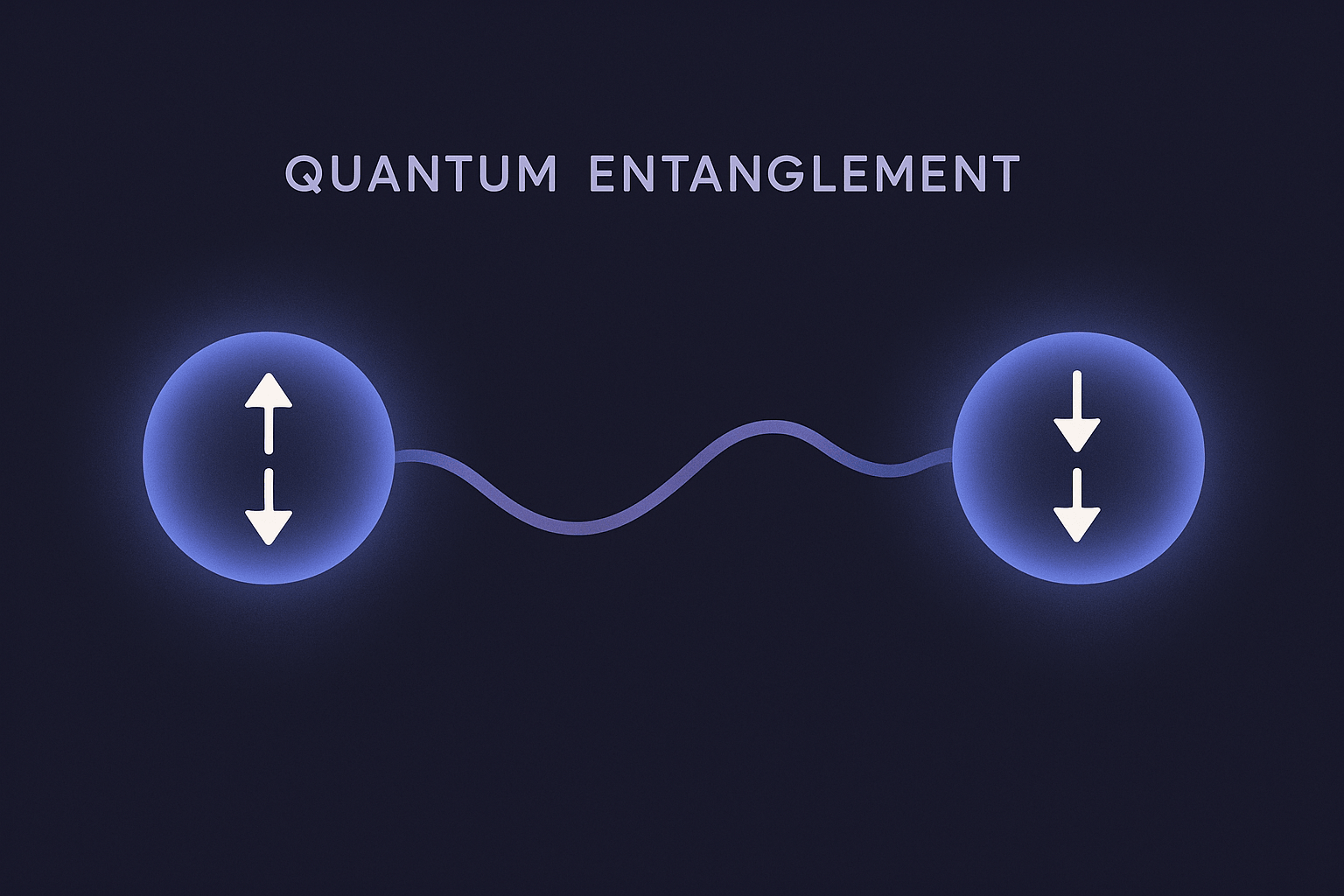
Two particles are entangled when their quantum state cannot be described as the simple combination (product) of each individual particle’s state. Instead, the joint state is a superposition that constrains the two particles’ measurement outcomes to be correlated.
The canonical example: a pair of electrons in the singlet state, where one electron has spin up and the other has spin down, but until measurement, neither electron has a definite spin. The state is:
$$ |\psi\rangle = \frac{1}{\sqrt{2}} \left( |\uparrow\downarrow\rangle – |\downarrow\uparrow\rangle \right) $$
If you measure the first electron and find spin up, the second electron is INSTANTLY determined to be spin down, no matter how far apart they are. The reverse is also true. The correlation is perfect.
Why Einstein Hated It
Einstein, Podolsky, and Rosen (EPR) argued in 1935 that this ‘spooky action at a distance’ violated locality (no influence faster than light) and proved that quantum mechanics must be incomplete. They proposed there must be ‘hidden variables’ that determined the spins in advance, the apparent randomness was just our ignorance of the deeper truth. The EPR paradox launched decades of debate.
Einstein was wrong. Bell’s theorem (1964) showed that no local hidden-variable theory can reproduce all the predictions of quantum mechanics. Specifically, Bell derived an inequality (the Bell inequality) that local hidden-variable theories must satisfy but that quantum mechanics violates. Experiments could then decide between the two.
Bell’s Theorem and the Aspect Experiments
Bell’s theorem states that any local realistic theory (where measurement outcomes are predetermined and no influence travels faster than light) must satisfy certain statistical inequalities. Quantum mechanics, by contrast, predicts correlations that VIOLATE these inequalities. So you can experimentally test which world we live in by measuring entangled particles and computing the correlations.
Alain Aspect’s experiments in 1981-82 (using entangled photons) clearly violated Bell’s inequalities, ruling out local hidden variables. Subsequent loophole-free experiments by Hensen et al. (2015), Giustina et al. (2015), and Shalm et al. (2015) closed the remaining experimental loopholes. The verdict is in: nature is genuinely non-local in the entanglement sense.
The 2022 Nobel Prize in Physics went to Alain Aspect, John Clauser, and Anton Zeilinger for their pioneering entanglement experiments.
No Faster-Than-Light Communication
Despite the instant correlation, entanglement CANNOT be used to send information faster than light. When you measure one entangled particle, you get a random result (50% up, 50% down). The other particle is then locked into the opposite result, but the distant observer can’t tell whether their result is ’caused’ by your measurement or is just random.
Only when the two observers later compare their results (via classical communication, limited to light speed) do they see the correlation. The entanglement provides correlation, not signal. This subtle distinction is what saves special relativity. Entanglement is ‘spooky’ but not ‘paradoxical’ once you understand it properly.
Modern Applications
- Quantum computing. Entangled qubits can represent and process information in ways classical bits cannot. Quantum algorithms like Shor’s (factoring) and Grover’s (search) rely on entanglement for their speedup. As of 2026, quantum computers with 100+ entangled qubits exist (Google Willow, IBM Heron, etc.).
- Quantum cryptography. Entanglement-based key distribution (e.g., E91 protocol) lets two parties share a secret key with information-theoretic security. Any eavesdropper would disrupt the entanglement detectably. Commercial quantum key distribution systems are in production use.
- Quantum teleportation. Using a shared entangled pair plus 2 bits of classical communication, the quantum state of one particle can be ‘teleported’ to another. Demonstrated experimentally many times since 1997. Teleports the STATE, not matter or energy.
- Quantum sensing. Entangled atoms can be used to make ultra-precise clocks, magnetometers, and gravimeters with sensitivities below the standard quantum limit.
The Open Conceptual Question
Entanglement is real, but what does it MEAN? Several interpretations of quantum mechanics give different answers:
- Copenhagen interpretation: measurement collapses the wavefunction; the entanglement is a real physical link, and asking ‘what is happening in between measurements’ is meaningless.
- Many-worlds interpretation: there is no collapse; both outcomes occur in different branches of reality, and entanglement is just correlations between branches.
- De Broglie-Bohm (pilot wave): particles always have definite positions guided by a non-local pilot wave that explains the entanglement correlations.
- QBism: quantum states represent observer beliefs, not physical reality; entanglement is a correlation between observers’ beliefs.
All these interpretations make the same experimental predictions. The interpretation problem is philosophy, not physics, and it remains unresolved after 90 years of debate.
Related study notes: The Schrödinger Equation, Heisenberg Uncertainty Principle, Special Relativity, Planck’s Constant.
The OpenStax physics textbooks develop the corresponding physical models with further worked problems.
Correlations and Communication
For a spin singlet, measurements along the same axis have opposite outcomes. Before comparing records, either observer sees locally random up or down results. A changed measurement choice at the distant site does not create a controllable message in that local result sequence.
The correlations become visible when the observers compare their settings and outcomes through ordinary communication. Bell tests probe whether suitable correlations can be explained by local hidden-variable models under stated assumptions. The phrase “instant communication” therefore misdescribes what an entangled state allows.
The points to check in this example are:
- The same-axis singlet outcomes are perfectly anticorrelated in the ideal model.
- Local measurement results remain random.
- Comparing the records requires a communication channel.
Check Your Understanding
Try the questions before reading the answers.
Question 1. Can entanglement send a chosen bit faster than light?
Answer. No.
Question 2. Do all entangled states have the same singlet-style anticorrelation?
Answer. No. Correlations depend on the state and the measurement settings.
Frequently Asked Questions
What is quantum entanglement?
Quantum entanglement is a phenomenon where two or more particles share a quantum state such that measuring one instantly determines the measurement outcome of the other, no matter how far apart they are. The two particles can’t be described independently, their joint state is correlated in a way that has no classical analog.
Why is quantum entanglement ‘spooky’?
Einstein called it ‘spooky action at a distance’ because the measurement of one entangled particle instantly determines the state of its partner, even if they’re separated by light-years. This seemed to violate locality (no influence faster than light). It turns out the world really is this way, entanglement is real, but it doesn’t violate relativity because no usable information is transmitted.
Can entanglement be used to send messages faster than light?
No. When you measure one entangled particle, you get a random outcome. The distant observer sees their particle’s state, but can’t tell whether it’s ’caused’ by your measurement or is just random. Only when you compare results via ordinary (light-speed-limited) communication do you see the correlation. Entanglement provides correlation, not signal. Special relativity is safe.
What is Bell’s theorem?
Bell’s theorem (1964) showed that no local hidden-variable theory can reproduce all the predictions of quantum mechanics. Specifically, certain statistical inequalities (Bell inequalities) that any local theory must satisfy are violated by quantum mechanics. Aspect’s 1981-82 experiments showed nature violates Bell inequalities, ruling out local hidden variables. The 2022 Physics Nobel went to Aspect, Clauser, and Zeilinger for this work.
What is quantum teleportation?
Quantum teleportation is a protocol that uses a shared entangled pair, plus 2 bits of classical communication, to ‘teleport’ the quantum state of one particle to another. The original particle’s state is destroyed in the process. Note: it teleports the STATE (the information about the particle), not the matter or energy. Experimentally demonstrated thousands of times since 1997.
How is entanglement used in quantum computing?
Quantum computers manipulate entangled qubits to perform calculations that classical computers can’t efficiently do. Algorithms like Shor’s (factoring large numbers) and Grover’s (database search) achieve exponential or quadratic speedups by exploiting entanglement and superposition. As of 2026, working quantum computers with 100+ entangled qubits exist (Google Willow, IBM Heron, Quantinuum H2).
Browse more in Physics.