by
by
Ratios compare two quantities by division. Proportions equate two ratios. Together they describe how quantities scale relative to each other, recipes, maps, mixing ratios, currency conversion, share prices, statistical odds, mechanical leverage. Anywhere you reason about ‘this many per that many’, you’re using ratio and proportion. The mathematics is straightforward, but the applications stretch from elementary arithmetic to chemistry stoichiometry and finance.
A ratio of 2:3 compares parts. Sharing a total in that ratio divides it into 5 equal ratio parts.

Ratios
A ratio compares two quantities of the same kind, usually written \( a : b \) or as a fraction \( a/b \). Examples:
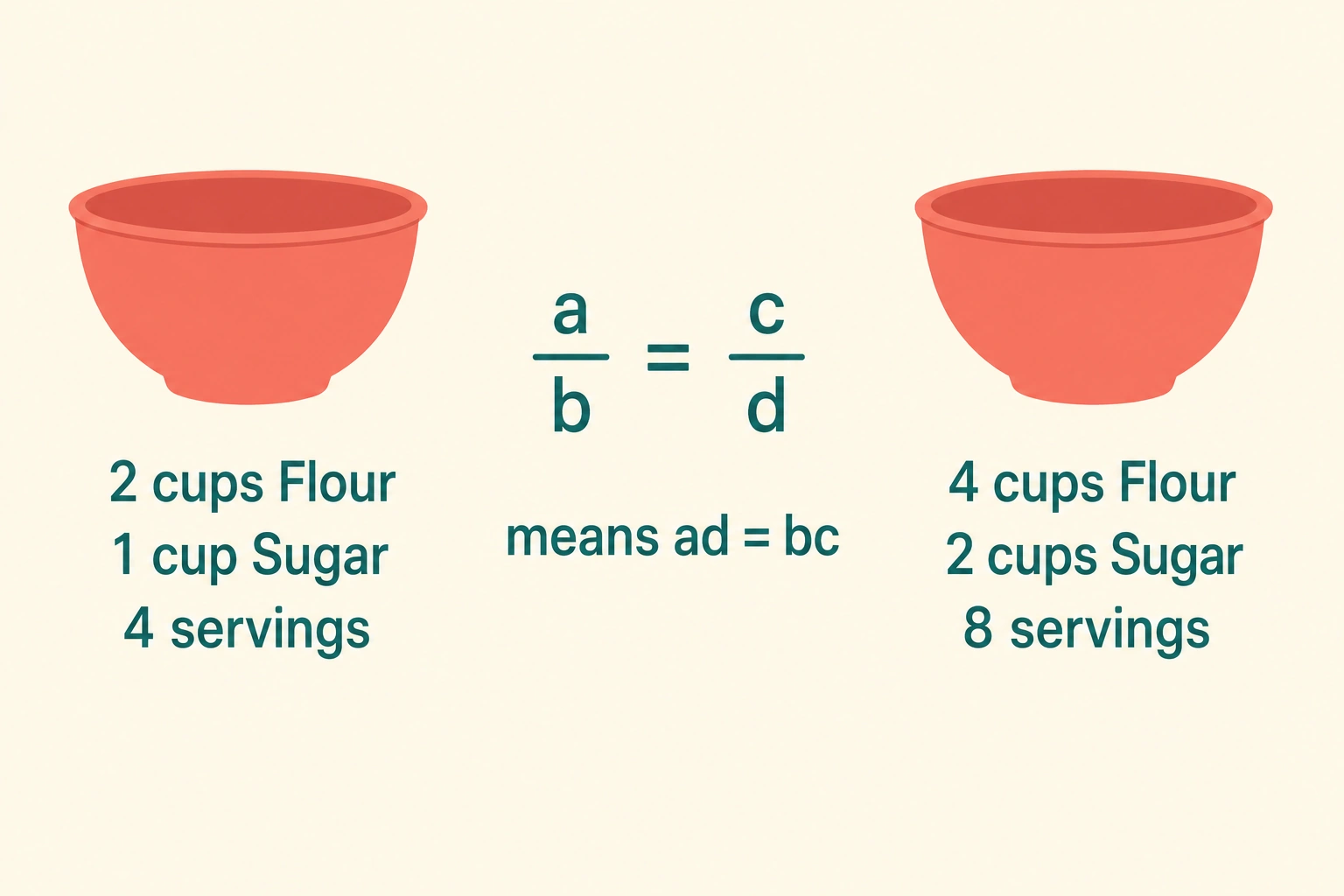
- Cooking. 2 cups of flour to 1 cup of sugar, ratio 2 : 1.
- Class composition. 18 girls to 12 boys, ratio 18 : 12 = 3 : 2 (simplified).
- Map scale. 1 cm on a map represents 100,000 cm on the ground, ratio 1 : 100,000.
Ratios are scale-free: 2 : 1 and 4 : 2 and 100 : 50 all describe the same proportion. The simplified form (using the GCD) is preferred.
Proportions
A proportion is an equation of two ratios:
$$ \frac{a}{b} = \frac{c}{d} $$
This says ‘a is to b as c is to d’. The cross-multiplication identity is:
$$ \frac{a}{b} = \frac{c}{d} \iff a \cdot d = b \cdot c $$
This is the single most useful tool for solving proportions: if three of \( a, b, c, d \) are known, you can solve for the fourth.
Direct and Inverse Proportion
Two quantities are in direct proportion if doubling one doubles the other. \( y = kx \) for some constant \( k \). Examples: cost and quantity at a fixed price, distance traveled at a fixed speed, weight of a uniform material.
Two quantities are in inverse proportion if doubling one halves the other. \( y = k/x \) for some constant \( k \). Examples: time taken and speed for a fixed distance, pressure and volume of a gas at fixed temperature (Boyle’s law), number of workers and time taken to complete a task.
Worked Examples
Direct: scaling a recipe. A recipe for 4 people uses 200 g of pasta. How much for 7 people? \( \frac{200}{4} = \frac{x}{7} \Rightarrow x = \frac{200 \cdot 7}{4} = 350 \) g.
Inverse: workers and days. 6 workers finish a wall in 10 days. How many days for 4 workers (assuming same total work)? Direct ratio gives wrong answer; this is inverse proportion: \( 6 \cdot 10 = 4 \cdot x \Rightarrow x = 15 \) days.
Currency conversion. 100 USD = 8,300 INR. So 250 USD = \( \frac{8300}{100} \cdot 250 = 20{,}750 \) INR.
Compound Ratios and Percentages
A percentage is a ratio with denominator 100. ‘Tax is 18%’ means a ratio of 18 to 100 between tax and base amount. Compound ratios, multiplying two ratios together, e.g., for converting square units or for combining two scale changes, work by ordinary fraction multiplication.
Example. A map’s scale is 1 : 50,000. Areas on the map scale as the square of the linear ratio: \( 1^2 : 50{,}000^2 = 1 : 2.5 \times 10^9 \). So 1 cm² on the map represents 2.5 km² on the ground.
Applications
- Cooking and baking. Scaling recipes up or down preserves taste only if you respect the ingredient ratios.
- Chemistry. Stoichiometry, the calculation of reactant quantities needed for a given reaction, is just ratio and proportion applied to molecular and molar quantities.
- Map and engineering drawings. A scale of 1 : 100 means 1 cm on the drawing = 100 cm in reality.
- Finance. Price-to-earnings ratios, debt-to-equity ratios, return on equity, every fundamental analysis ratio is a comparison of two financial quantities.
- Mechanical advantage. Gear ratios, pulley ratios, and lever arms all express force or speed multiplications as ratios.
- Statistics. Odds ratios in epidemiology, signal-to-noise ratios in engineering, conversion ratios in marketing, proportional reasoning is everywhere.
Related study notes: Percentages, Golden Ratio, Molarity, Compound Interest.
The related OpenStax mathematics textbooks provide additional explanations and exercises for the mathematical definitions used here.
Sharing a Total in a Ratio
A ₹1,500 budget is split between printing and binding in the ratio 2:3. Each ratio part is ₹300, so printing receives ₹600 and binding ₹900. The printing share is 2/5 of the total; 2/3 compares printing directly with binding.
If printing rises to ₹750 while binding stays ₹900, the ratio becomes 5:6. Multiplying both amounts by the same nonzero factor preserves the ratio. Units should be made consistent before simplification: 50 cm to 2 m becomes 50:200, or 1:4.
The points to check in this example are:
- A part-to-part ratio and a part-to-whole fraction answer different questions.
- Equivalent ratios scale both terms by the same nonzero factor.
- Cross-multiplication requires nonzero denominators.
Check Your Understanding
Try the questions before reading the answers.
Question 1. What fraction goes to binding?
Answer. 3/5.
Question 2. How much goes to printing if the total doubles?
Answer. ₹1,200, provided the same ratio is retained.
Frequently Asked Questions
What is the difference between a ratio and a proportion?
A ratio compares two quantities (e.g., ‘3 cups of flour to 2 cups of sugar’ or 3 : 2). A proportion is an equation stating that two ratios are equal: a/b = c/d. The proportion lets you solve for an unknown when you know the other three quantities, typically by cross-multiplication.
What is cross-multiplication?
The identity a/b = c/d if and only if a × d = b × c. It’s used to solve proportions: if three of the four values are known, you can isolate the fourth. Example: x/3 = 8/12 gives 12x = 24, so x = 2.
What’s the difference between direct and inverse proportion?
In direct proportion, doubling one quantity doubles the other (y = kx). Examples: cost and quantity at a fixed unit price, distance and time at constant speed. In inverse proportion, doubling one halves the other (y = k/x). Examples: speed and time for a fixed distance, workers and time for a fixed task, pressure and volume in Boyle’s law.
How do you simplify a ratio?
Divide both sides by their greatest common divisor. The ratio 18 : 12 simplifies by dividing by 6 to get 3 : 2. The ratio 250 : 1000 simplifies by dividing by 250 to get 1 : 4. Both forms describe the same proportion; the simplified form is conventionally preferred for readability.
How is ratio used in chemistry?
Stoichiometry uses molar ratios from balanced chemical equations to compute the amount of each reactant or product. For the reaction 2H₂ + O₂ → 2H₂O, the molar ratio of H₂ to O₂ to H₂O is 2 : 1 : 2. To make 4 moles of water, you need 4 moles of H₂ and 2 moles of O₂.
What is the golden ratio?
The special number φ ≈ 1.618, defined as the unique positive ratio such that (a + b) : a = a : b. It appears in geometry, the Fibonacci sequence, and natural growth patterns. It’s often discussed alongside ratio and proportion as a particular ratio with surprising properties.
Browse more in Mathematics.