by
by
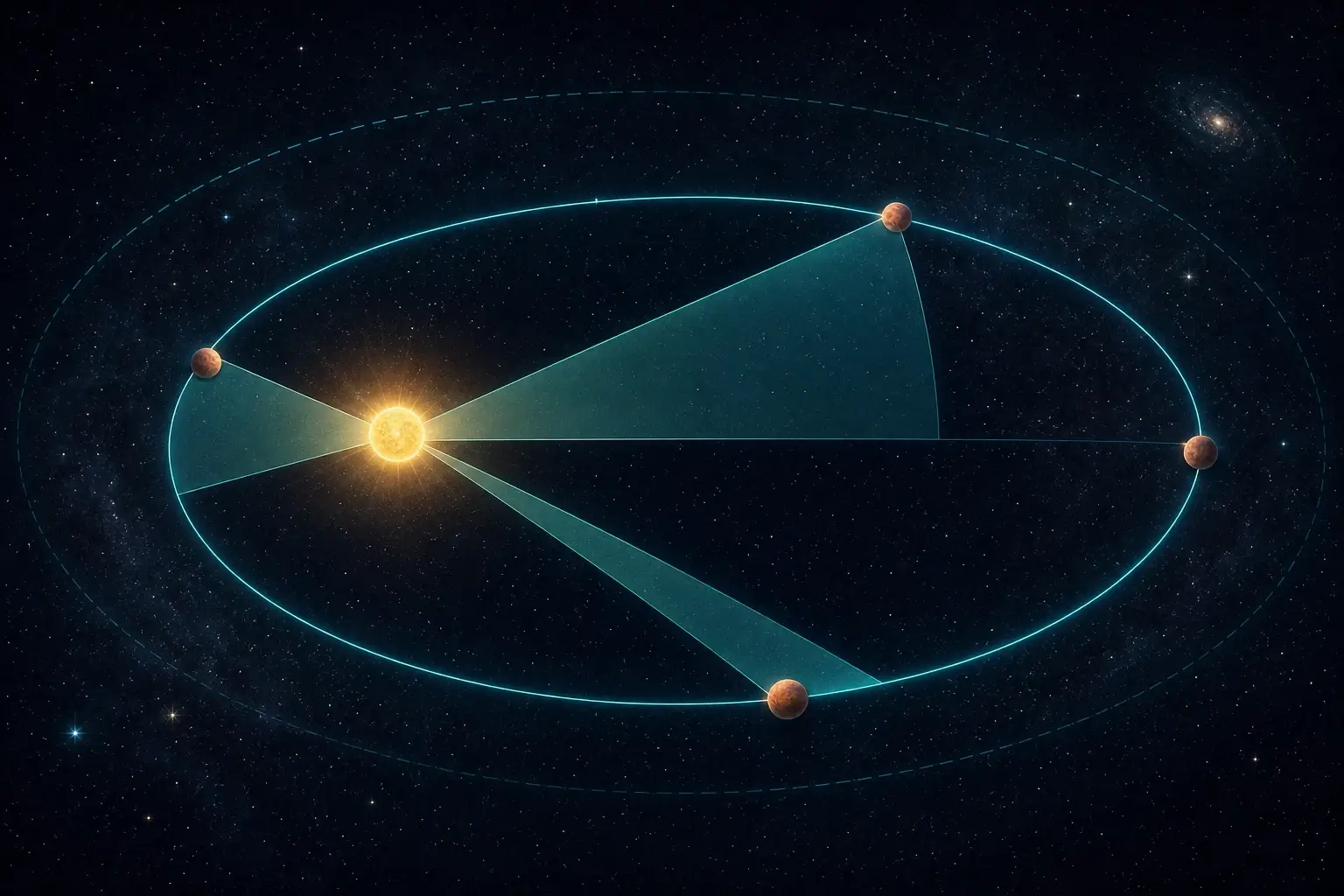
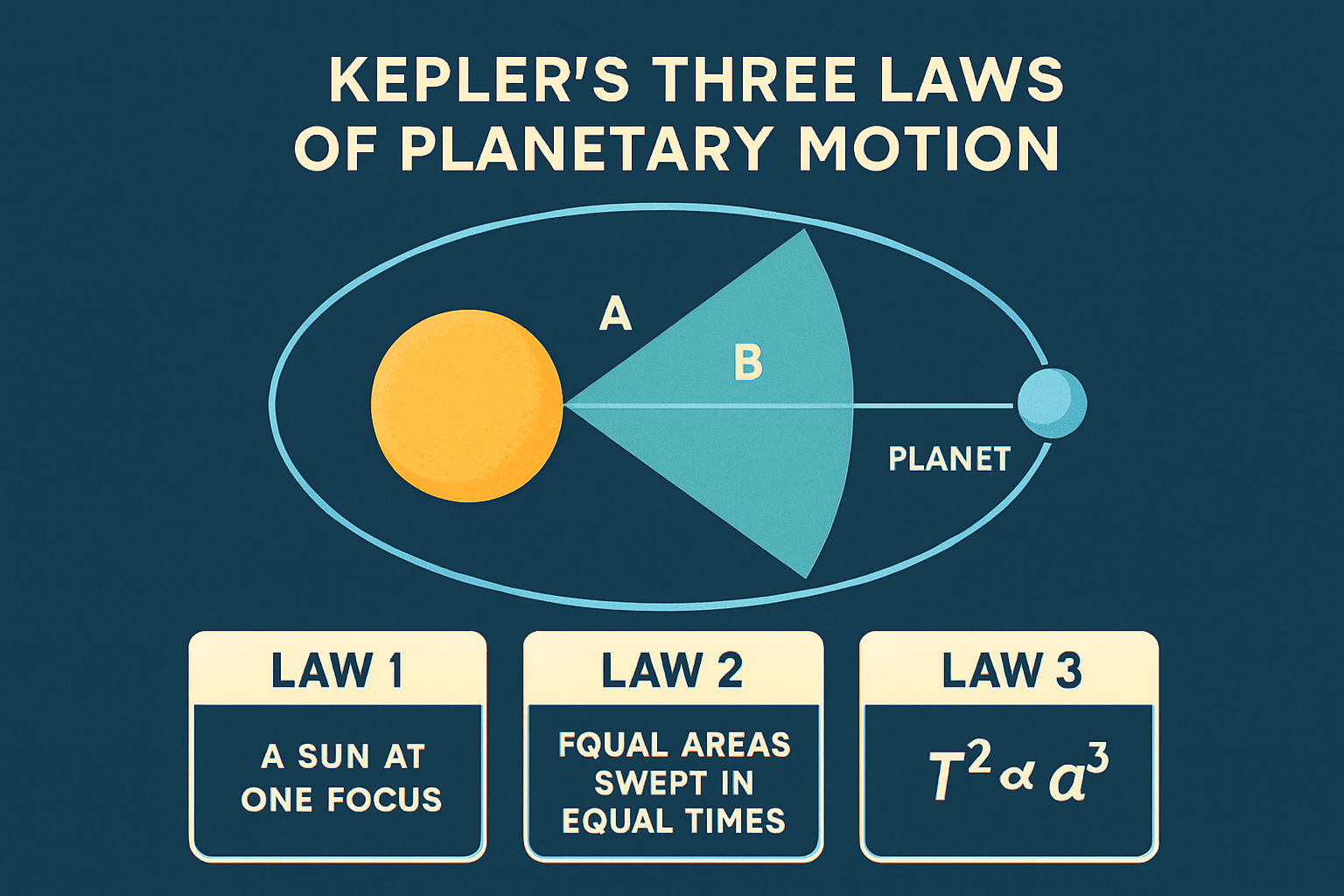
Kepler’s laws describe the motion of planets: each orbit is an ellipse with the Sun at one focus, the radius vector sweeps equal areas in equal times, and the square of the orbital period is proportional to the cube of the semi-major axis.
Kepler’s laws apply to the orbital geometry and timing of an appropriate two-body model. The central mass matters in quantitative period comparisons.
The laws began as empirical rules extracted from precise observations. Newton later showed that they follow from an inverse-square gravitational force in the ideal two-body problem. That makes Kepler’s work both historically important and practically useful.
If you want to check a value before working it by hand, use the Kepler’s third law calculator. It keeps the unit conversion beside the result, which is where most avoidable mistakes happen.
What Are Kepler’s Three Laws?
| Law | Statement | Immediate meaning |
|---|---|---|
| First: ellipses | A planet follows an ellipse with the Sun at one focus | The Sun is not at the centre unless the orbit is circular |
| Second: equal areas | The Sun-planet line sweeps equal areas in equal times | The planet moves faster near perihelion |
| Third: periods | \(T^2\propto a^3\) | Larger orbits take longer |
NASA’s orbits and Kepler’s laws guide gives a concise official overview and applies the same laws beyond the original six planets known to Kepler.
First Law: Orbits Are Ellipses
An ellipse is the set of points for which the sum of distances to two fixed foci is constant. A bound two-body orbit is an ellipse, and the central attracting body lies at one focus. A circle is the special case where the two foci coincide.
$$r(\theta)=\frac{a(1-e^2)}{1+e\cos\theta}$$
Here \(a\) is the semi-major axis and \(e\) the eccentricity. Bound elliptical orbits have \(0\le e<1\). The closest point is periapsis and the farthest point is apoapsis; for the Sun they are called perihelion and aphelion.
$$r_{\mathrm p}=a(1-e),\qquad r_{\mathrm a}=a(1+e)$$
| Eccentricity | Conic | Orbit type in Newtonian gravity |
|---|---|---|
| \(e=0\) | Circle | Bound |
| \(0<e<1\) | Ellipse | Bound |
| \(e=1\) | Parabola | Escape threshold |
| \(e>1\) | Hyperbola | Unbound flyby |
Second Law: Equal Areas in Equal Times
Kepler’s second law says that the line from the central body to the orbiting object sweeps equal areas during equal time intervals. The object therefore moves faster when close to the focus and slower when far away.
$$\frac{dA}{dt}=\text{constant}$$
In Newtonian mechanics, the gravitational force points along the radius vector, so its torque about the central body is zero. Angular momentum is conserved, and the areal velocity is
$$\frac{dA}{dt}=\frac{L}{2m}$$
This is the deeper reason for the equal-area law. It is also a clean example of how conservation laws connect with symmetry in physical laws.
Third Law: Period and Semi-Major Axis
For bodies orbiting the same dominant central mass
$$T^2\propto a^3$$
For a two-body Newtonian orbit with masses \(M\) and \(m\), the exact form is
$$T^2=\frac{4\pi^2}{G(M+m)}a^3$$
When \(M\gg m\), the smaller mass can be neglected. For planets orbiting the Sun, measuring \(T\) in years and \(a\) in astronomical units gives the convenient approximation \(T^2=a^3\).
Worked Example: An Orbit at 4 AU
A small body with semi-major axis 4 AU orbiting the Sun has
$$T=\sqrt{a^3}=\sqrt{4^3}=8\,\text{years}$$
This relation uses the semi-major axis, not the instantaneous distance. For an eccentric orbit, the object’s distance changes continuously while \(a\) remains fixed.
How Newton Derived Kepler’s Laws
Newton’s law of gravitation supplies the dynamics Kepler did not have. A central inverse-square force produces conic-section trajectories. Conservation of angular momentum produces equal areas, and the force strength sets the period relation.
$$F=\frac{GMm}{r^2}$$
For a circular orbit, setting gravitational force equal to centripetal force gives \(GMm/r^2=mv^2/r\). Combining \(v=2\pi r/T\) yields \(T^2=4\pi^2r^3/(GM)\). The elliptical result replaces the circular radius with semi-major axis \(a\).
Worked Example: Finding a Central Mass
If a satellite’s period \(T\) and semi-major axis \(a\) are measured, and the satellite mass is negligible, rearrange the generalized third law:
$$M=\frac{4\pi^2a^3}{GT^2}$$
This is how orbital motion becomes a weighing scale. Astronomers infer masses of planets, stars, binary systems, and compact objects from the motion of orbiting bodies.
Where Kepler’s Laws Are Used
- Solar-system ephemerides: Keplerian elements provide the first description of planetary and small-body orbits.
- Satellites: period and semi-major axis determine mission timing and orbital energy.
- Exoplanets: transit periods and radial-velocity measurements constrain orbital distance and stellar or planetary mass.
- Binary stars: the generalized third law gives the total system mass.
- Spaceflight: transfer orbits use pieces of Keplerian motion before perturbations and propulsion corrections are added.
Limits and Perturbations
Kepler’s laws are exact for an ideal Newtonian two-body system with point masses or spherically symmetric bodies. Real systems contain more bodies, non-spherical gravity fields, atmospheric drag, radiation pressure, tidal effects, and relativistic corrections.
- Planetary perturbations slowly change orbital elements because every planet attracts the others.
- Oblateness causes satellite orbital planes and periapsis directions to precess.
- Atmospheric drag removes energy from low Earth orbits.
- General relativity adds effects such as Mercury’s extra perihelion precession.
- Mass loss or transfer changes the assumptions behind a fixed two-body parameter.
Keplerian motion is still the correct starting model. The art is knowing which perturbation is large enough to add for the precision and time span you need.
Common Mistakes
- Putting the Sun at the centre of an ellipse: it lies at a focus.
- Using current distance in the third law: use the semi-major axis.
- Assuming constant orbital speed: equal areas require changing speed in an ellipse.
- Forgetting the central mass: the simple \(T^2=a^3\) unit form is specific to solar orbits.
- Calling every trajectory an ellipse: escape trajectories can be parabolic or hyperbolic.
- Treating real orbits as permanently fixed: perturbations make orbital elements evolve.
Related Physics Guides
Use these next if you want to connect this result with the surrounding physics:
Key Takeaways
- Kepler’s first law makes bound two-body orbits ellipses with the central body at one focus.
- The second law is a statement of constant areal velocity and angular-momentum conservation.
- The third law is \(T^2=4\pi^2a^3/[G(M+m)]\).
- Semi-major axis, not instantaneous separation, sets the period.
- Real orbit prediction begins with Kepler’s laws and then adds perturbations.
A Period and Orbit Comparison
For planets orbiting approximately the same dominant central mass, T² is proportional to a³. An orbit with semimajor axis 4 times as large has period 8 times as long. The cube and square powers should be applied to the same central-mass comparison.
In an eccentric orbit, the planet moves faster near periapsis and slower near apoapsis while sweeping equal areas in equal times. Equal elapsed times do not correspond to equal distances along the orbit. Perturbations from other bodies make actual trajectories depart from the ideal two-body ellipse.
The points to check in this example are:
- The Sun lies at a focus of a planetary ellipse, not its geometric center.
- The semimajor axis sets the two-body period for a fixed total mass.
- A circular orbit is the eccentricity-zero case.
Check Your Understanding
Try the questions before reading the answers.
Question 1. What is the period ratio if a doubles?
Answer. 2 to the power 3/2, about 2.83.
Question 2. Is equal-area motion the same as constant orbital speed?
Answer. Only for a circular orbit in the ideal model.
Frequently Asked Questions
What are Kepler’s laws of planetary motion?
They state that planets move in ellipses with the Sun at one focus, sweep equal areas in equal times, and have orbital periods whose squares are proportional to the cubes of their semi-major axes.
Why do planets move faster near the Sun?
Gravity gives zero torque about the Sun in the two-body model, so angular momentum is conserved. A smaller radius therefore requires greater tangential speed, consistent with equal areas in equal times.
What does T² = a³ mean?
For solar orbits measured in years and astronomical units, the square of orbital period equals the cube of semi-major axis approximately. The general formula includes G and the two masses.
Are planetary orbits perfect ellipses?
They are close to osculating ellipses at any instant, but other planets, relativity, tides, and non-spherical bodies slowly change their orbital elements.
Where is the Sun in an elliptical orbit?
The Sun lies at one focus of the ellipse, not at its geometric centre. The other focus is usually empty.
Do Kepler’s laws apply to satellites and exoplanets?
Yes. They apply to any ideal two-body gravitational orbit, with the generalized third law using the total mass of the two bodies.
If a period calculation uses anything other than the semi-major axis, stop and fix that before trusting the answer.
Browse more in Physics.