by
by
Conic sections are the curves obtained by slicing a double cone with a plane. Depending on the angle of the cut, you get one of four shapes: a circle, an ellipse, a parabola, or a hyperbola. Studied by the Greeks more than 2,000 years ago, these curves describe the orbits of planets, the path of a projectile, the design of telescope mirrors, and the focusing properties of satellite dishes and car headlights. The unifying algebraic form is the second-degree equation in two variables.
A conic can be recognized algebraically as well as geometrically. Completing the square identifies its center and scale.
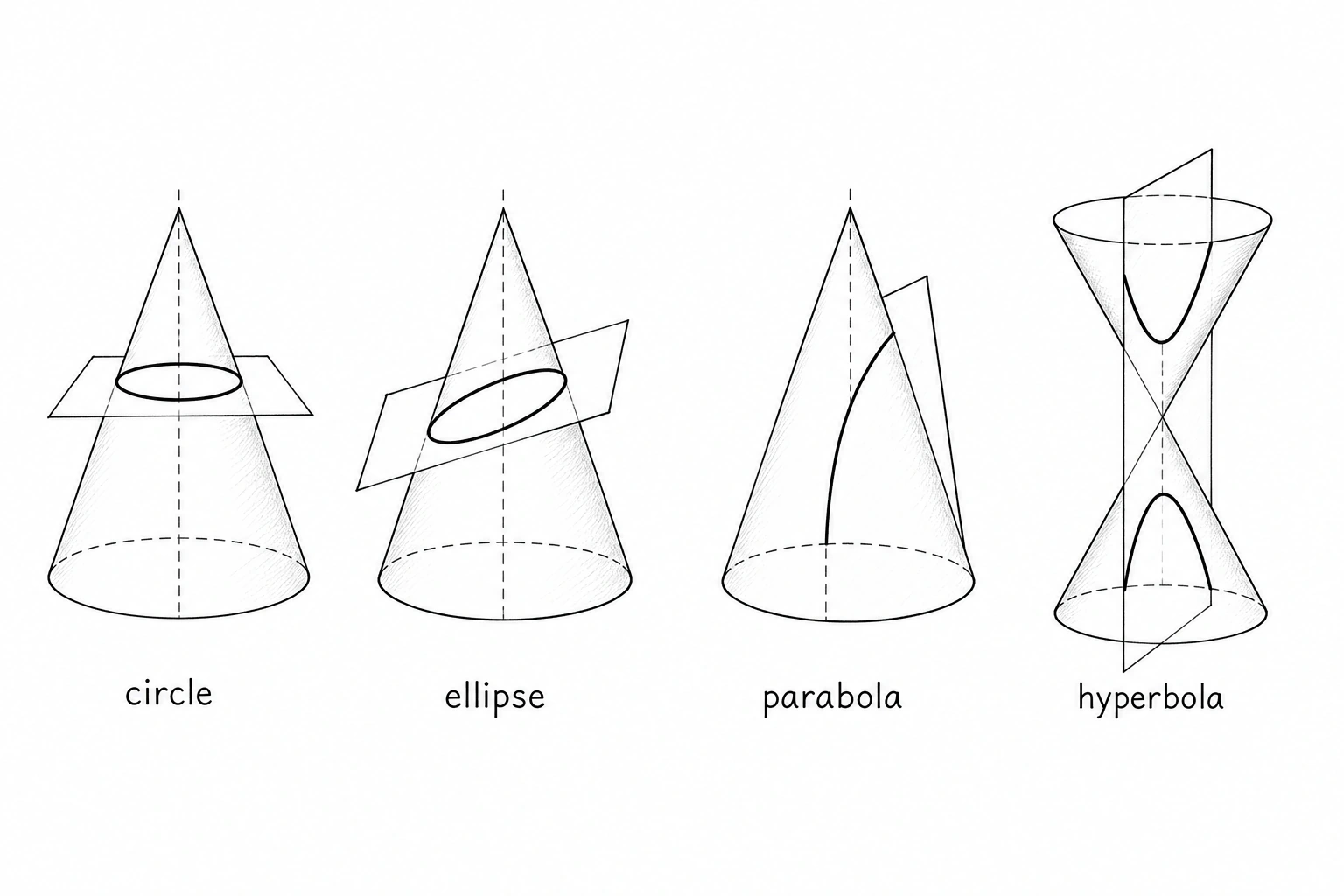
Four Curves from One Cone
Imagine an infinite double cone with its vertex at the origin. Slice it with a plane:
- Circle. Plane perpendicular to the cone’s axis. Equation: \( x^2 + y^2 = r^2 \).
- Ellipse. Plane tilted but not parallel to the side of the cone. Equation: \( \dfrac{x^2}{a^2} + \dfrac{y^2}{b^2} = 1 \).
- Parabola. Plane parallel to one side of the cone. Equation: \( y = ax^2 + bx + c \) (or \( x = ay^2 + by + c \)).
- Hyperbola. Plane parallel to the axis (slicing both halves of the cone). Equation: \( \dfrac{x^2}{a^2} – \dfrac{y^2}{b^2} = 1 \).
The General Equation
All four conics are described by a single second-degree polynomial in \( x \) and \( y \):
$$ Ax^2 + Bxy + Cy^2 + Dx + Ey + F = 0 $$
The discriminant \( B^2 – 4AC \) classifies the curve:
- \( B^2 – 4AC < 0 \): ellipse (circle if \( B = 0 \) and \( A = C \)).
- \( B^2 – 4AC = 0 \): parabola.
- \( B^2 – 4AC > 0 \): hyperbola.
The Focus-Directrix Definition
Every conic can be defined as the locus of points whose distance to a fixed focus \( F \) and a fixed directrix line \( d \) have a constant ratio \( e \), the eccentricity:
$$ e = \frac{\text{distance to focus}}{\text{distance to directrix}} $$
- \( e = 0 \): circle.
- \( 0 < e < 1 \): ellipse.
- \( e = 1 \): parabola.
- \( e > 1 \): hyperbola.
Reflective Properties
- Parabola. Any ray parallel to the axis reflects off the parabola and passes through the focus. This is why parabolic dishes are used for satellite reception, radio telescopes, headlight reflectors, and solar concentrators, they collect parallel incoming energy at a single point.
- Ellipse. Any ray emitted from one focus reflects off the ellipse and passes through the other focus. This is the principle behind ‘whispering galleries’ (Statuary Hall in the US Capitol, St. Paul’s Cathedral) and medical lithotripsy machines that focus shock waves to break up kidney stones.
- Hyperbola. A ray aimed at one focus reflects off the hyperbola as if it had come from the other focus. Used in Cassegrain telescopes and certain GPS positioning calculations.
Orbits and Kepler
Kepler’s first law states that planets orbit the Sun in ellipses with the Sun at one focus. Comets typically follow elongated ellipses or, if they’re unbound, parabolic or hyperbolic paths. Newton derived this directly from his inverse-square law of gravity: the only orbits possible under \( 1/r^2 \) attraction are conic sections. Eccentricity tells you which: planets and most asteroids \( e < 1 \), comets often \( e \) near 1, interstellar visitors \( e > 1 \).
Applications
- Astronomy. Every gravitationally bound orbit is an ellipse; every gravity-assist trajectory through a planet’s gravity well is a hyperbola.
- Engineering. Parabolic arches in bridges (Sydney Harbour, classic stone arches) and suspension bridge cables (catenary, very close to parabolic when loaded uniformly).
- Optics. Reflective telescopes (Newtonian, Cassegrain) use parabolic primary mirrors. Radar antennas and satellite dishes are parabolic for the same focusing reason.
- Acoustics. Whispering galleries shaped as elliptical domes: sound from one focus carries with surprising clarity to the other focus.
- Computer graphics and CAD. Bézier and NURBS curves used for vector graphics and 3D modeling are direct generalizations of conics.
Related study notes: Kepler’s Laws, Quadratic Equations, Coordinate Geometry, Escape Velocity.
The related OpenStax mathematics textbooks provide additional explanations and exercises for the mathematical definitions used here.
Completing the Square
For \(x^2+4y^2-6x+8y-3=0\), completing the squares gives \((x-3)^2+4(y+1)^2=16\). Dividing by 16 yields \((x-3)^2/16+(y+1)^2/4=1\).
The curve is an ellipse centered at (3,-1), with semiaxes 4 and 2. The major axis is horizontal. The focal distance from the center is \(\sqrt{16-4}=2\sqrt3\). Equal positive quadratic coefficients would instead give a circle after completing the squares.
The points to check in this example are:
- A center shift changes the translated coordinates, not the semiaxis lengths.
- The larger denominator in the standard ellipse equation identifies the major semiaxis.
- A nondegenerate hyperbola has opposite signs on its 2 squared terms.
Check Your Understanding
Try the questions before reading the answers.
Question 1. What is the ellipse eccentricity here?
Answer. √3/2.
Question 2. Where are its horizontal vertices?
Answer. (-1,-1) and (7,-1).
Practice Questions
Work each question before reading its solution. The set runs from direct recall and substitution to the applied questions that exams actually use to separate grades. The downloadable PDF includes these questions and their solutions.
Question 1. Name the 4 conic sections and the single geometric idea that unifies them.
Solution. Circle, ellipse, parabola, hyperbola. All 4 are cross-sections of a double cone sliced by a plane at different angles: perpendicular to the axis gives a circle, tilted gives an ellipse, parallel to the cone’s slant gives a parabola, and cutting both nappes gives a hyperbola. One shape, one family, 4 slicing angles.
Question 2. Write the standard equation of a circle centered at \((3, -2)\) with radius 5, and verify the point \((7, 1)\) lies on it.
Solution. \((x-3)^2 + (y+2)^2 = 25\). Check: \((7-3)^2 + (1+2)^2 = 16 + 9 = 25\). Confirmed. The circle equation is the Pythagorean theorem in disguise: distance from center equals radius.
Question 3. For the ellipse \(\dfrac{x^2}{25} + \dfrac{y^2}{16} = 1\), find the semi-axes and the foci.
Solution. \(a = 5\) (major, along x), \(b = 4\) (minor, along y). \(c = \sqrt{a^2 – b^2} = \sqrt{9} = 3\), so foci at \((\pm 3, 0)\). The larger denominator always marks the major axis’s direction; mixing that up flips the whole picture.
Question 4. State the reflective definition of an ellipse using its 2 foci, and name 1 real application.
Solution. An ellipse is the set of points whose distances to 2 fixed foci sum to a constant. Whispering galleries and lithotripsy machines exploit this: sound or shock waves from 1 focus reflect off the elliptical wall and converge exactly on the other focus, concentrating energy on a kidney stone without surgery.
Question 5. Find the vertex, focus, and directrix of the parabola \(y^2 = 12x\).
Solution. Matching \(y^2 = 4px\): \(4p = 12\), \(p = 3\). Vertex at the origin, focus at \((3, 0)\), directrix \(x = -3\). Every point on the parabola sits equidistant from the focus and the directrix line, the defining property that makes satellite dishes work.
Question 6. Explain why a parabolic reflector concentrates incoming parallel rays at a single point.
Solution. The defining property, equal distance to focus and directrix, forces every ray traveling parallel to the axis to reflect off the curve and pass through the focus, regardless of where it strikes. Satellite dishes, car headlights (reversed), and solar collectors all exploit this exact geometric guarantee, not an approximation.
Question 7. For the hyperbola \(\dfrac{x^2}{16} – \dfrac{y^2}{9} = 1\), find the vertices, foci, and asymptotes.
Solution. \(a = 4\), \(b = 3\), \(c = \sqrt{a^2+b^2} = 5\). Vertices \((\pm 4, 0)\), foci \((\pm 5, 0)\), asymptotes \(y = \pm\frac{3}{4}x\). Note the PLUS under the square root for \(c\), the opposite sign convention from the ellipse: that sign flip is what turns a bounded curve into 2 unbounded branches.
Question 8. Identify the conic represented by \(x^2 + y^2 – 6x + 4y – 3 = 0\) and find its center and radius.
Solution. Equal coefficients on \(x^2\) and \(y^2\) signal a circle. Complete the square: \((x-3)^2 + (y+2)^2 = 3 + 9 + 4 = 16\). Center \((3, -2)\), radius 4. Completing the square is the universal translator from the expanded form to the recognizable standard form.
Question 9. The eccentricity \(e\) classifies every conic on one scale. Give the ranges for circle, ellipse, parabola, and hyperbola.
Solution. \(e = 0\): circle. \(0 < e < 1\): ellipse. \(e = 1\): parabola. \(e > 1\): hyperbola. Eccentricity measures how far a conic strays from circular: 0 is a perfect circle, and larger values open the curve progressively wider, until \(e = 1\) breaks the curve open into an unbounded parabola.
Question 10. Planetary orbits are ellipses with the Sun at 1 focus (Kepler’s first law). Earth’s orbital eccentricity is about 0.017. What does that say about Earth’s orbit shape, and contrast it with a comet on a near-parabolic path.
Solution. \(e = 0.017\) is barely different from 0: Earth’s orbit is nearly circular, which is why seasons come mainly from axial tilt, not distance variation. A long-period comet with \(e\) close to 1 traces a highly elongated ellipse, swinging deep into the solar system once and receding for millennia, the near-parabolic limit of a bound orbit.
Frequently Asked Questions
What are the four conic sections?
Circle, ellipse, parabola, and hyperbola. They’re obtained by slicing a double cone with a plane at different angles: perpendicular to the axis gives a circle, slightly tilted gives an ellipse, parallel to the cone’s side gives a parabola, and parallel to the axis gives a hyperbola.
What’s the general equation of a conic section?
Ax² + Bxy + Cy² + Dx + Ey + F = 0. The type is determined by the discriminant B² − 4AC: negative gives an ellipse (circle if also B = 0 and A = C), zero gives a parabola, positive gives a hyperbola.
What is eccentricity?
A number that describes how ‘stretched’ a conic is. It’s the ratio of the distance from any point on the curve to a focus over the distance to a directrix. Circle: e = 0. Ellipse: 0 < e 1. Planets have very low eccentricity (Earth’s is 0.017); Halley’s comet has e ≈ 0.967.
Why does a satellite dish work?
Because of the parabola’s reflective property: any incoming ray parallel to the axis reflects to the focus. Signals from a distant satellite arrive as essentially parallel rays; the dish focuses them all on the receiving antenna placed at the focus. Same principle is used in radio telescopes, headlight reflectors, and solar cookers.
How are conic sections related to planetary orbits?
Newton proved that any orbit under inverse-square gravity is a conic section. Bound orbits (with enough kinetic energy to escape, etc.) are ellipses (or circles as a special case). Marginally bound orbits are parabolas. Unbound trajectories, interstellar visitors, gravity-assist flybys, are hyperbolas. Kepler’s first law (planets orbit in ellipses with the Sun at a focus) is the bound case.
Did the Greeks really study conics 2000 years ago?
Yes. Apollonius of Perga wrote a treatise titled ‘Conics’ around 200 BCE that systematically developed the theory. The Greeks worked purely geometrically, coordinates and algebra came much later (Descartes, 17th century). Apollonius’s results are still essentially correct and form the basis of modern conic-section theory.
Browse more in Mathematics.