by
by
Euler’s identity, \( e^{i\pi} + 1 = 0 \), is widely considered the most beautiful equation in mathematics. In one line it links the five most fundamental mathematical constants, 0, 1, \( i \), \( \pi \), and \( e \), using the three basic operations of addition, multiplication, and exponentiation, exactly once each, with no extraneous symbols. It’s a special case of Euler’s broader formula \( e^{i\theta} = \cos\theta + i\sin\theta \), which connects exponential functions to trigonometry through the complex plane.
Euler’s identity is the half-turn case of Euler’s formula. The angle is in radians, and the complex exponential has unit magnitude for real angles.
The Identity
Euler’s identity:
$$ e^{i\pi} + 1 = 0 $$
The five constants in one equation:
- 0: the additive identity.
- 1: the multiplicative identity.
- \( \pi \): the ratio of a circle’s circumference to its diameter, \( \approx 3.14159 \).
- \( e \): the base of the natural logarithm, \( \approx 2.71828 \).
- \( i \): the imaginary unit, \( \sqrt{-1} \).
Each appears exactly once. Three operations, addition, multiplication, exponentiation, also each appear exactly once.
Euler’s Formula
The identity follows immediately from Euler’s broader formula:
$$ e^{i\theta} = \cos\theta + i \sin\theta $$
valid for all real \( \theta \). Plugging in \( \theta = \pi \): \( e^{i\pi} = \cos\pi + i\sin\pi = -1 + 0 = -1 \). Rearranging: \( e^{i\pi} + 1 = 0 \). Done.
Why Euler’s Formula Is True
Three independent derivations, each illuminating:
(1) Taylor series. Expand each side:
$$ e^x = 1 + x + \frac{x^2}{2!} + \frac{x^3}{3!} + \cdots $$
Substitute \( x = i\theta \) and use \( i^2 = -1 \), \( i^3 = -i \), \( i^4 = 1 \), …. Group real and imaginary terms. The real part matches the Taylor series for \( \cos\theta \), and the imaginary part matches \( \sin\theta \). Done.
(2) Differential equations. Both sides satisfy \( y’ = i y \) with \( y(0) = 1 \). By uniqueness of solutions, they must be equal.
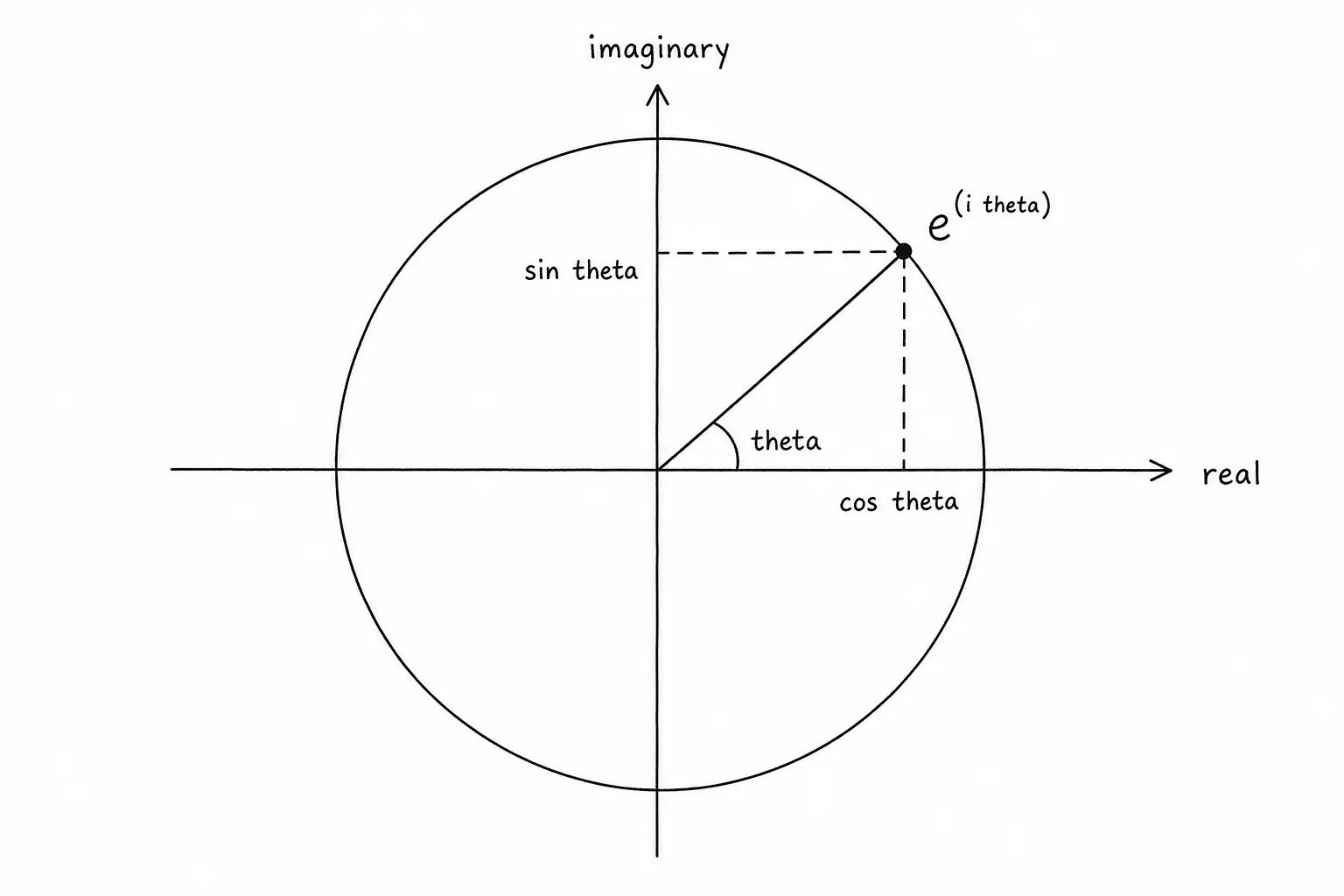
(3) Complex plane geometry. \( e^{i\theta} \) represents the point on the unit circle at angle \( \theta \) from the positive real axis. Multiplying by \( e^{i\theta} \) rotates the complex plane by \( \theta \). The point at angle \( \pi \) on the unit circle is exactly \( -1 \).
Consequences and Applications
- Trigonometric identities. All standard identities (sum-to-product, double-angle, half-angle) follow from \( e^{i(\alpha + \beta)} = e^{i\alpha} e^{i\beta} \) by expanding both sides.
- Complex exponentials in physics. Wave equations of every kind are written using \( e^{i\omega t} \), quantum mechanics, electromagnetism, circuit theory, signal processing, acoustics, optics.
- Fourier transforms. The Fourier transform decomposes a function into a sum of \( e^{i\omega t} \) terms. All of signal processing rests on this.
- Roots of unity. The \( n \) solutions of \( z^n = 1 \) are \( e^{2\pi i k / n} \) for \( k = 0, 1, \ldots, n-1 \), equally spaced points on the unit circle. They’re used in everything from cyclic codes to discrete Fourier transforms.
- Electrical engineering. Complex impedance \( Z = R + iX \) lets phasor algebra replace messy sinusoidal time-domain calculations.
Why Mathematicians Find It Beautiful
Three reasons combine. Economy: five fundamental constants and three operations, each appearing exactly once. Surprise: \( e \) is connected to compound growth, \( \pi \) to circles, \( i \) to algebra, they have no obvious relationship, yet they combine into a clean integer identity. Depth: the identity isn’t a coincidence; it falls out of the deep connection between exponential functions and rotation in the complex plane. Polls of mathematicians regularly rank it as the most beautiful equation in mathematics.
Related study notes: Imaginary Numbers, Exponential Function, Trigonometry, Fourier Series.
The related OpenStax mathematics textbooks provide additional explanations and exercises for the mathematical definitions used here.
A Rotation on the Unit Circle
Euler’s formula gives \(e^{i\theta}=\cos\theta+i\sin\theta\). At \(\theta=\pi/2\), the point is i; at \(\theta=\pi\), it is -1. The latter substitution gives \(e^{i\pi}+1=0\).
Multiplying 2 unit complex exponentials adds their angles: \(e^{i\alpha}e^{i\beta}=e^{i(\alpha+\beta)}\). Two quarter-turns therefore give a half-turn. This rotation interpretation is also useful for roots of unity and oscillations, but the identity itself does not establish that all complex exponentials have unit magnitude: a nonzero real part in the exponent changes the magnitude.
The points to check in this example are:
- Angles in the formula use radians.
- A full turn corresponds to 2π and returns to 1.
- For real a and b, the magnitude of exp(a + ib) is exp(a).
Check Your Understanding
Try the questions before reading the answers.
Question 1. What is \(e^{i2\pi}\)?
Answer. 1.
Question 2. What is \(e^{i\pi/2}e^{i\pi/2}\)?
Answer. -1.
Practice Questions
Work each question before reading its solution. The set runs from direct recall and substitution to the applied questions that exams actually use to separate grades. The downloadable PDF includes these questions and their solutions.
Question 1. Write Euler’s identity and name the 5 constants it connects.
Solution. \(e^{i\pi} + 1 = 0\). It connects \(e\) (growth), \(i\) (the imaginary unit), \(\pi\) (geometry), 1 (multiplicative identity), and 0 (additive identity), 1 equation from 5 seemingly unrelated corners of mathematics, often called the most beautiful equation for exactly that reason.
Question 2. State Euler’s formula, the more general result Euler’s identity comes from.
Solution. \(e^{i\theta} = \cos\theta + i\sin\theta\), for any real \(\theta\). This links complex exponentials to trigonometry directly: raising \(e\) to an imaginary power does not diverge or misbehave, it traces a point on the unit circle.
Question 3. Derive Euler’s identity from Euler’s formula by substituting \(\theta = \pi\).
Solution. \(e^{i\pi} = \cos\pi + i\sin\pi = -1 + i(0) = -1\). Rearranged: \(e^{i\pi} + 1 = 0\). The identity is simply the formula evaluated at 1 specific, geometrically clean angle: halfway around the unit circle.
Question 4. Interpret \(e^{i\theta}\) geometrically. What curve does it trace as \(\theta\) runs from 0 to \(2\pi\)?
Solution. It traces the unit circle in the complex plane, starting at \((1,0)\) when \(\theta=0\) and sweeping counterclockwise. Multiplying by \(e^{i\theta}\) is literally a ROTATION by angle \(\theta\); this is why complex exponentials are the natural language for anything involving rotation or periodic motion.
Question 5. Use Euler’s formula to derive \(\cos\theta\) and \(\sin\theta\) in terms of complex exponentials.
Solution. From \(e^{i\theta} = \cos\theta+i\sin\theta\) and \(e^{-i\theta}=\cos\theta-i\sin\theta\): adding gives \(\cos\theta = \dfrac{e^{i\theta}+e^{-i\theta}}{2}\), subtracting gives \(\sin\theta = \dfrac{e^{i\theta}-e^{-i\theta}}{2i}\). These identities convert trigonometric integrals and derivatives into simpler exponential algebra, a standard engineering shortcut.
Question 6. Evaluate \(e^{i\pi/2}\) and \(e^{2\pi i}\), and interpret both results geometrically.
Solution. \(e^{i\pi/2} = \cos(\pi/2)+i\sin(\pi/2) = i\): a quarter-turn lands exactly on the imaginary axis. \(e^{2\pi i} = \cos 2\pi + i\sin 2\pi = 1\): a full turn returns to the start, confirming \(e^{i\theta}\) is periodic with period \(2\pi\), exactly matching the circle it traces.
Question 7. Multiply 2 complex numbers in polar exponential form: \((3e^{i\pi/4}) \times (2e^{i\pi/3})\). What does this reveal about complex multiplication?
Solution. Magnitudes multiply, angles add: \(3 \times 2 = 6\), \(\pi/4+\pi/3 = 7\pi/12\), giving \(6e^{i7\pi/12}\). This is the entire reason exponential form exists: multiplying complex numbers, geometrically confusing in \(a+bi\) form, becomes simple addition of angles and multiplication of lengths in exponential form.
Question 8. Electrical engineers write an AC voltage as \(V(t) = V_0 e^{i\omega t}\) instead of \(V_0\cos(\omega t)\). Explain the practical advantage.
Solution. Differentiating or integrating \(e^{i\omega t}\) just multiplies by \(i\omega\) or divides by it, a plain algebraic operation, while differentiating \(\cos(\omega t)\) forces a trigonometric identity (\(\cos \to -\sin\)) at every step. Circuit analysis with resistors, inductors, and capacitors becomes ordinary complex-number algebra (impedances) instead of a swamp of trig identities; only at the final step does an engineer take the real part to recover the physical voltage.
Question 9. A quantum wavefunction includes a phase factor \(e^{i\phi}\). Why does this factor never affect any measurable probability, and what does this reveal about the structure of quantum mechanics?
Solution. Probability comes from \(|\psi|^2\), and \(|e^{i\phi}|^2 = 1\) for any real \(\phi\), since \(e^{i\phi}\) always sits on the unit circle. Multiplying a wavefunction by an overall phase changes nothing observable: it reveals that quantum states are, strictly, equivalence classes under global phase, not literal complex-valued objects, which is a foundational and often underappreciated structural fact about the theory.
Question 10. Solve \(x^4 = 1\) over the complex numbers using Euler’s formula, finding all 4 roots.
Solution. Write \(1 = e^{i \cdot 0}\), then also \(e^{i\cdot 2\pi k}\) for any integer \(k\). Fourth roots: \(x = e^{i \cdot 2\pi k/4}\) for \(k = 0,1,2,3\), giving \(1, i, -1, -i\), evenly spaced around the unit circle every 90°. Complex exponential form is the standard method for finding ALL \(n\)-th roots of any number, real solving methods routinely miss the complex ones entirely.
Frequently Asked Questions
What is Euler’s identity?
The equation e^(iπ) + 1 = 0. It connects five of the most fundamental mathematical constants, 0, 1, i, π, and e, in a single short expression. It’s often described as the most beautiful equation in mathematics.
What’s the difference between Euler’s identity and Euler’s formula?
Euler’s formula is the more general statement e^(iθ) = cos θ + i sin θ, valid for all real θ. Euler’s identity is the special case θ = π. Plugging in: cos π = −1 and sin π = 0, giving e^(iπ) = −1, or equivalently e^(iπ) + 1 = 0.
Why is Euler’s identity considered beautiful?
It connects five fundamental constants (0, 1, i, π, e) using three basic operations (+, ×, exponentiation), each exactly once, with no extra symbols. The constants come from unrelated areas, algebra (0, 1, i), geometry (π), and analysis (e), yet combine into a clean equation. Polls of mathematicians regularly rank it the most beautiful equation in mathematics.
How can you prove Euler’s formula?
Three standard ways. (1) Compare the Taylor series of e^(iθ) with those of cos θ + i sin θ, they match term by term. (2) Both sides satisfy the differential equation y’ = i·y with y(0) = 1, and the solution is unique. (3) Interpret e^(iθ) geometrically as the unit-circle point at angle θ, rotation by θ in the complex plane.
Did Euler actually write this equation?
Not in this exact form. Leonhard Euler (1707-1783) derived the general formula e^(iθ) = cos θ + i sin θ in 1748, but the specific arrangement e^(iπ) + 1 = 0 was popularized much later. The ‘most beautiful equation’ framing is largely a 20th-century reception.
Where is Euler’s identity used in physics?
The more general Euler’s formula is used everywhere. Quantum mechanics describes wave functions as ψ(x, t) = e^(iωt) times a spatial part. Electrical engineers describe AC circuits using complex exponentials (phasors). Signal processing’s entire toolkit (Fourier transforms, filters, modulation) is built on e^(iθ). The identity itself is a clean reminder that ‘rotating by π’ is the same as ‘multiplying by −1’.
Browse more in Mathematics.