
 by
byAn exponential function is any function where the variable appears in the exponent: \( f(x) = a^x \). Despite the simple form, exponential functions describe almost every process where a quantity changes by a fixed proportion per unit time, compound interest, radioactive decay, population growth, viral infection spread, signal attenuation, capacitor charging. The natural exponential \( e^x \) sits at the center of calculus because it is its own derivative.
Free download: Exponential Function Study Notes (PDF)
The full note as a print-ready PDF: every section and worked example, the 10-question practice set with solutions, an answer key, and a 1-page revision sheet for last-minute revision.
The Definition
An exponential function has the form:
$$ f(x) = a^x $$
where \( a > 0 \) and \( a \neq 1 \). The base \( a \) is a positive constant; the variable \( x \) is the exponent. If \( a = 1 \), the function reduces to the constant 1, which is not exponential. If \( a = 0 \), the function is undefined for negative exponents.
More generally, you’ll see \( f(x) = b \cdot a^x \) or \( f(x) = a^{kx} \), where \( b \) and \( k \) are constants. These are still exponential functions, \( b \) is the value at \( x = 0 \), and \( k \) controls how fast the function changes.
Growth vs Decay
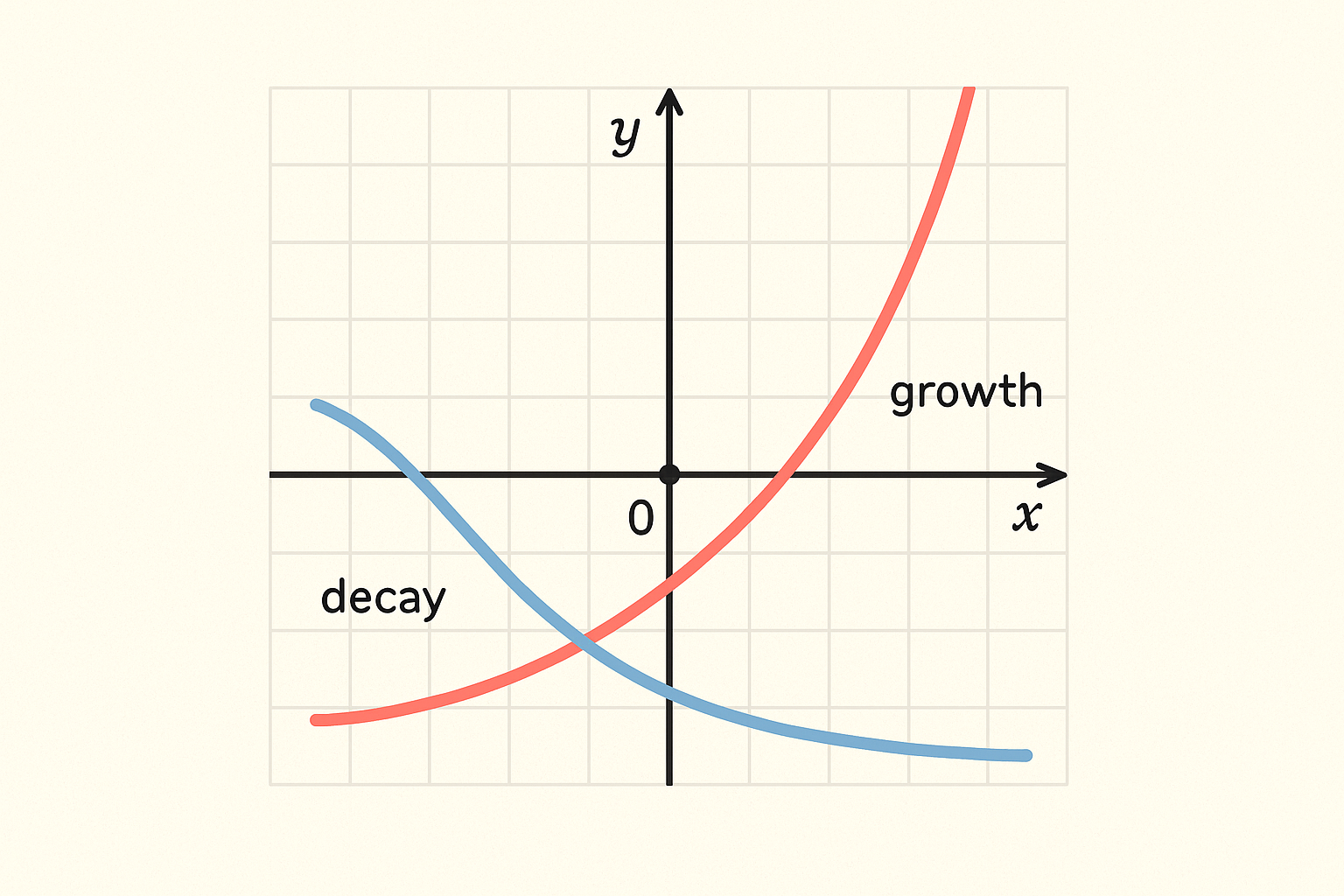
The behavior of \( a^x \) depends entirely on whether the base \( a \) is greater than or less than 1.
- If \( a > 1 \): the function increases as \( x \) increases. This is exponential growth. Examples: \( 2^x, 3^x, e^x, 10^x \). The function rises slowly at first, then accelerates.
- If \( 0 < a < 1 \): the function decreases as \( x \) increases. This is exponential decay. Examples: \( (1/2)^x, 0.95^x, e^{-x} \). The function starts high and approaches zero as \( x \) grows.
Both types pass through the point \( (0, 1) \), because \( a^0 = 1 \) for any positive \( a \). Both have the x-axis as a horizontal asymptote on one side (right side for decay, left side for growth).
Key Properties
Exponential functions satisfy a small set of identities that show up everywhere.
- Multiplicative shift: \( a^{x+y} = a^x \cdot a^y \). Adding exponents corresponds to multiplying values.
- Division: \( a^{x-y} = a^x / a^y \).
- Power of power: \( (a^x)^y = a^{xy} \).
- Zero exponent: \( a^0 = 1 \) for any \( a > 0 \).
- Negative exponent: \( a^{-x} = 1 / a^x \). A negative exponent flips the function: \( 2^{-x} = (1/2)^x \).
- Inverse function: the inverse of \( a^x \) is the logarithm \( \log_a x \). They cancel: \( \log_a(a^x) = x \) and \( a^{\log_a x} = x \).
The Number e
Among all possible bases, \( e \approx 2.71828 \) is special. \( e \) is the unique base for which the derivative of \( a^x \) equals \( a^x \) itself:
$$ \dfrac{d}{dx} e^x = e^x $$
This single property makes \( e \) the standard base for exponential functions in calculus, physics, and probability. \( e \) is defined as the limit:
$$ e = \lim_{n \to \infty} \left(1 + \dfrac{1}{n}\right)^n \approx 2.71828\ldots $$
This limit arises naturally from continuous compounding. If you invest $1 at 100% annual interest compounded \( n \) times per year, the value after one year is \( (1 + 1/n)^n \). As compounding becomes continuous (\( n \to \infty \)), the value approaches \( e \) dollars. Hence the ‘natural’ exponential.
\( e \) is irrational and transcendental, it cannot be expressed as a fraction or as a root of any polynomial with rational coefficients. It also has a clean series expansion:
$$ e^x = \sum_{n=0}^{\infty} \dfrac{x^n}{n!} = 1 + x + \dfrac{x^2}{2!} + \dfrac{x^3}{3!} + \cdots $$
Exponential Growth in Practice
Anything that grows by a fixed percentage per unit time follows an exponential. The general form is:
$$ N(t) = N_0 e^{kt} $$
Where \( N_0 \) is the initial quantity, \( k \) is the continuous growth rate, and \( t \) is time. Doubling time \( t_d \) (time to double): \( t_d = \ln 2 / k \approx 0.693 / k \).
The famous Rule of 72: doubling time in years ≈ 72 / (percent growth rate). At 6% annual growth, money doubles in 12 years. At 10%, in 7.2 years. The Rule of 72 is the Rule of 70 dressed up, 0.693 (the exact constant) rounded to 0.72 for easier mental math with the percentages that show up in finance.
Exponential Decay in Practice
Decay follows the same form with a negative exponent:
$$ N(t) = N_0 e^{-\lambda t} $$
Where \( \lambda > 0 \) is the decay constant. Half-life \( t_{1/2} = \ln 2 / \lambda \), the time for the quantity to fall by half. Carbon-14 has half-life 5,730 years (radiocarbon dating). Caffeine has half-life ~5 hours (which is why coffee at 3pm still affects sleep). RC circuit voltage decays with a time constant \( \tau = RC \) according to \( V(t) = V_0 e^{-t/\tau} \).
Related study notes: Logarithms, Derivatives in Calculus, Limits in Calculus, Slope-Intercept Form.
Practice Questions
Work each question before reading its solution. The set runs from direct recall and substitution to the applied questions that exams actually use to separate grades. All 10 also appear in the downloadable PDF with a separate answer key.
Question 1. Define an exponential function and explain what makes it fundamentally different from a polynomial like \(x^2\).
Solution. \(f(x) = ab^x\) with \(b > 0\), \(b \neq 1\): the variable sits in the EXPONENT, not the base. Polynomials grow by fixed additive amounts per step through repeated multiplication of \(x\); exponentials grow by a fixed RATIO per step. That ratio-based growth is why exponentials eventually outrun every polynomial, no matter how high its degree.
Question 2. A population of 500 bacteria doubles every 3 hours. Write its growth function and find the population after 12 hours.
Solution. \(P(t) = 500 \times 2^{t/3}\). At \(t=12\): \(500 \times 2^4 = 500 \times 16 = 8000\). Four doubling periods fit into 12 hours, and each doubling is a full multiplication by 2, never an addition.
Question 3. What is the number \(e\), approximately, and where does it arise naturally?
Solution. \(e \approx 2.71828\), the base that emerges from continuous compound growth: \(e = \lim_{n\to\infty}(1+1/n)^n\). It appears wherever a quantity’s growth rate is proportional to its own current size at every instant, populations, radioactive decay, continuously compounded interest, making it the natural, not arbitrary, choice of exponential base for calculus.
Question 4. Simplify \(e^{\ln 5}\) and \(\ln(e^3)\), and state the general rule these illustrate.
Solution. \(e^{\ln 5} = 5\) and \(\ln(e^3) = 3\): \(\ln\) and \(e^x\) are inverse functions, so composing them in either order cancels, leaving only the input. This inverse relationship is the entire tool for solving exponential and logarithmic equations.
Question 5. Solve \(3^x = 81\) without a calculator, then solve \(2^x = 20\) using logarithms.
Solution. \(81 = 3^4\), so by matching bases, \(x = 4\) directly. For \(2^x = 20\), take \(\ln\) of both sides: \(x\ln 2 = \ln 20\), so \(x = \frac{\ln 20}{\ln 2} \approx 4.32\). Match bases when you can; take logarithms when you cannot.
Question 6. \$5,000 is invested at 6% annual interest, compounded continuously. Find the balance after 10 years using \(A = Pe^{rt}\).
Solution. \(A = 5000 \times e^{0.06 \times 10} = 5000 \times e^{0.6} \approx 5000 \times 1.822 \approx 9{,}111\). Continuous compounding is the theoretical limit of compounding infinitely often, and banks’ daily-compounding formulas already sit extremely close to this \(e\)-based result.
Question 7. A radioactive sample decays according to \(N(t) = N_0 e^{-0.03t}\) (t in years). Find its half-life.
Solution. Set \(N(t)/N_0 = 0.5\): \(e^{-0.03t} = 0.5\), so \(-0.03t = \ln 0.5\), giving \(t = \dfrac{\ln 0.5}{-0.03} = \dfrac{0.693}{0.03} \approx 23.1\) years. Half-life is a fixed property of the decay constant, independent of the starting amount, which is exactly why it is used to date and compare radioactive materials.
Question 8. Explain why \(y = 2^x\) and \(y = (1/2)^x\) are mirror images of each other across the y-axis, algebraically.
Solution. \((1/2)^x = (2^{-1})^x = 2^{-x}\), so the second function is the first with \(x\) replaced by \(-x\), the standard algebraic signature of a reflection across the y-axis. Growth functions with base \(> 1\) and decay functions with base between 0 and 1 are always mirror pairs this way.
Question 9. A car worth \$30,000 depreciates 15% per year. Write its value function and find when it drops below \$10,000.
Solution. \(V(t) = 30{,}000(0.85)^t\). Solve \(30{,}000(0.85)^t < 10{,}000\): \((0.85)^t < 1/3\), so \(t > \dfrac{\ln(1/3)}{\ln(0.85)} = \dfrac{-1.099}{-0.163} \approx 6.75\) years. Depreciation is exponential decay in disguise, with the “decay constant” expressed as a percentage rate instead of a raw exponential coefficient.
Question 10. Explain the practical difference between linear growth (add a fixed amount each period) and exponential growth (multiply by a fixed ratio each period), using a concrete comparison at large \(t\).
Solution. Linear \(y = 100 + 10t\) reaches 1,100 at \(t=100\). Exponential \(y = 100(1.1)^t\) reaches roughly \(100 \times 13{,}781 \approx 1{,}378{,}100\) at the SAME \(t=100\): over 1,000 times larger. Human intuition, built for linear everyday experience, systematically underestimates exponential processes (viral spread, compound debt, Moore’s law), which is precisely why early-stage exponential growth looks deceptively tame before it explodes.
Frequently Asked Questions
What is an exponential function?
An exponential function has the form f(x) = a^x, where a > 0 and a ≠ 1, and x is the variable in the exponent. The base a is constant; the variable appears in the exponent. Examples: 2^x, e^x, (1/2)^x, 10^x. Exponential functions describe processes that change by a fixed proportion per unit time.
What is the difference between exponential growth and decay?
If the base a > 1, the function grows as x increases (exponential growth, like 2^x). If 0 < a 0 and decay if k < 0. Both curves pass through (0, 1).
Why is the number e special?
Because e^x is its own derivative, d/dx(e^x) = e^x. No other base has this property. That makes e the natural base for exponential functions in calculus, physics, and probability. e ≈ 2.71828 arises naturally as the limit (1 + 1/n)^n as n approaches infinity, which is the value of $1 invested at 100% interest compounded continuously for one year.
What is the doubling time formula?
For continuous exponential growth with rate k, doubling time t_d = ln(2) / k ≈ 0.693 / k. The Rule of 72 is a mental-math approximation: doubling time in years ≈ 72 / (percentage growth rate). At 6% growth, money doubles in 12 years; at 10%, in 7.2 years.
What is the half-life formula?
For exponential decay with rate λ, half-life t_(1/2) = ln(2) / λ ≈ 0.693 / λ. Carbon-14’s half-life is 5,730 years (radiocarbon dating); caffeine’s is about 5 hours in the human body; many drug doses are spaced based on the drug’s half-life so blood concentration stays in the therapeutic range.
What is the inverse of an exponential function?
The inverse of a^x is the logarithm log_a(x). For the natural exponential e^x, the inverse is the natural logarithm ln(x). They cancel: ln(e^x) = x and e^(ln x) = x. Exponentials turn addition into multiplication; logarithms reverse the transformation, turning multiplication into addition.
Browse more in Mathematics.