by
by
A geometric progression (GP) is a sequence in which each term is obtained by multiplying the previous one by a fixed non-zero number called the common ratio \( r \). Unlike an arithmetic progression, which grows by repeated addition, a GP grows (or shrinks) by repeated multiplication. This makes GPs the natural language of compound interest, population growth, radioactive decay, and any process where the change at each step is proportional to the current value.
A geometric progression uses a constant ratio. A finite sum always needs a term count; an infinite sum also needs a convergence condition.
Definition and General Term
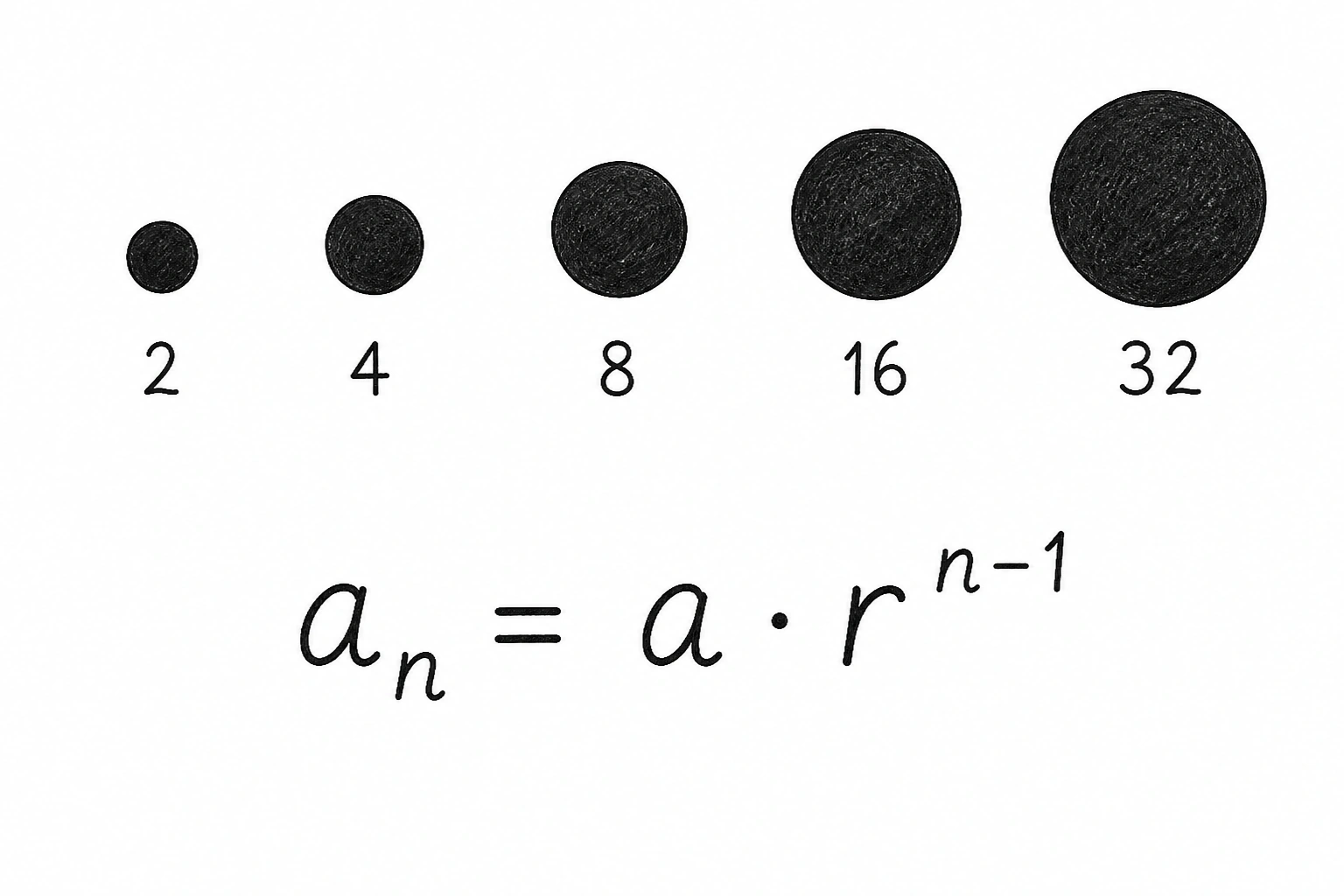
A geometric progression has the form: \( a, ar, ar^2, ar^3, \ldots \) where \( a \) is the first term and \( r \) is the common ratio. The \( n \)-th term is:
$$ a_n = a \cdot r^{n-1} $$
You can identify a GP by checking that the ratio between consecutive terms is constant: \( \frac{a_2}{a_1} = \frac{a_3}{a_2} = \cdots = r \).
Worked Examples
- 2, 4, 8, 16, 32, \( \ldots \): \( a = 2 \), \( r = 2 \). The 10th term is \( 2 \cdot 2^{9} = 1024 \).
- 81, 27, 9, 3, 1, \( \tfrac{1}{3}, \ldots \): \( a = 81 \), \( r = \tfrac{1}{3} \). Shrinking GP.
- 5, -10, 20, -40, \( \ldots \): \( a = 5 \), \( r = -2 \). Alternating signs.
- 1000, 1050, 1102.5, \( \ldots \): \( a = 1000 \), \( r = 1.05 \). Compound interest at 5%.
Sum of a Finite GP
The sum of the first \( n \) terms of a GP with \( r \neq 1 \) is:
$$ S_n = a \cdot \frac{1 – r^n}{1 – r} $$
Example: sum of \( 2 + 4 + 8 + \cdots + 1024 \) (10 terms with \( a = 2 \), \( r = 2 \)) is \( 2 \cdot \frac{1 – 2^{10}}{1 – 2} = 2 \cdot \frac{-1023}{-1} = 2046 \).
Sum of an Infinite GP
If \( |r| < 1 \), the terms shrink toward zero and the infinite sum converges:
$$ S_\infty = \frac{a}{1 – r} \quad \text{for } |r| < 1 $$
Example: \( 1 + \tfrac{1}{2} + \tfrac{1}{4} + \tfrac{1}{8} + \cdots = \frac{1}{1 – 1/2} = 2 \). This is Zeno’s paradox resolved: an infinite number of shrinking steps adds to a finite total.
If \( |r| \geq 1 \), the infinite series diverges (the terms don’t shrink) and no finite sum exists.
Geometric Mean
In a GP, every term is the geometric mean of its neighbors: \( a_n = \sqrt{a_{n-1} \cdot a_{n+1}} \). The geometric mean of two positive numbers \( x \) and \( y \) is \( \sqrt{xy} \), the side length of a square with the same area as a rectangle of sides \( x \) and \( y \).
Real-World Applications
- Compound interest. Money invested at rate \( r \) per period grows as \( P, P(1+r), P(1+r)^2, \ldots \), a GP with ratio \( 1+r \).
- Radioactive decay. The amount remaining after each half-life is half the previous amount, a shrinking GP with \( r = \tfrac{1}{2} \).
- Population growth. Idealized populations grow geometrically when resources are unlimited.
- Computer science. Binary trees, algorithm complexity (doubling work each step), and exponential time complexity all rest on GP behavior.
- Music. Equal-tempered scales use a GP of frequency ratios with \( r = 2^{1/12} \approx 1.0595 \), twelve semitones double the frequency.
Related study notes: Fibonacci Sequence, Exponential Function, Logarithms, Compound Interest.
The related OpenStax mathematics textbooks provide additional explanations and exercises for the mathematical definitions used here.
Finite and Infinite Totals
A bouncing-ball model starts with a rebound height of 80 cm and uses a ratio of 0.6 for later rebounds. The next heights are 48 cm and 28.8 cm. The third rebound uses \(80(0.6)^2\), since the first rebound is already the initial term.
Adding all rebound heights in this idealized model gives \(80/(1-0.6)=200\) cm. That is a sum of heights, not the total distance traveled by the ball: upward and downward travel must be accounted for separately. The infinite formula applies because the absolute ratio is less than 1. A GP with ratio 1 needs the separate finite formula na.
The points to check in this example are:
- A finite GP sum depends on the number of included terms.
- An infinite geometric series converges when |r| < 1.
- Alternating signs are possible when the ratio is negative.
Check Your Understanding
Try the questions before reading the answers.
Question 1. What is the fourth rebound height?
Answer. 80 × 0.6 cubed = 17.28 cm.
Question 2. Does 1 + 2 + 4 + … have a finite geometric sum?
Answer. No. Its ratio 2 fails the convergence condition.
Practice Questions
Work each question before reading its solution. The set runs from direct recall and substitution to the applied questions that exams actually use to separate grades. The downloadable PDF includes these questions and their solutions.
Question 1. For the GP 3, 6, 12, 24…, identify \(a\) and \(r\), and find the 10th term.
Solution. \(a = 3\), common ratio \(r = 2\). \(a_{10} = ar^9 = 3 \times 512 = 1536\). Unlike an AP where you add \(d\) repeatedly, in a GP you multiply by \(r\) repeatedly, which is exactly why GPs explode (or collapse) so much faster than APs.
Question 2. A GP has \(a_3 = 20\) and \(a_6 = 160\). Find \(r\) and \(a\).
Solution. \(\dfrac{a_6}{a_3} = r^3 = \dfrac{160}{20} = 8\), so \(r = 2\). Then \(a_3 = ar^2 = 4a = 20\), giving \(a = 5\). Dividing 2 terms cancels \(a\) and isolates a power of \(r\), the standard opening move for GP problems.
Question 3. Sum the first 8 terms of the GP 2, 6, 18…
Solution. \(S_n = a\dfrac{r^n-1}{r-1} = 2\times\dfrac{3^8-1}{3-1} = 2\times\dfrac{6560}{2} = 6560\). The finite-sum formula handles any ratio except \(r=1\), where the sum is trivially \(na\) instead.
Question 4. Find the sum of the infinite GP \(4 + 2 + 1 + 0.5 + \cdots\), and explain why this sum does NOT diverge despite having infinitely many terms.
Solution. \(|r| = 0.5 < 1\), so \(S_\infty = \dfrac{a}{1-r} = \dfrac{4}{0.5} = 8\). Each term shrinks fast enough that the total added by all remaining terms after any point becomes negligible; the partial sums converge to a finite limit even though the series never technically stops. This only works when \(|r|<1\).
Question 5. Convert the repeating decimal \(0.\overline{3}\) (0.3333…) to a fraction using the infinite GP sum formula.
Solution. \(0.3333\ldots = 0.3 + 0.03 + 0.003 + \cdots\), a GP with \(a = 0.3\), \(r = 0.1\). \(S_\infty = \dfrac{0.3}{1-0.1} = \dfrac{0.3}{0.9} = \dfrac{1}{3}\). Every repeating decimal is secretly an infinite geometric series, which is exactly why every repeating decimal equals some fraction.
Question 6. \$1,000 is invested at 8% annual interest, compounded annually. Write the balance after \(n\) years as a GP term, and find the balance after 5 years.
Solution. Balance follows \(A_n = 1000(1.08)^n\), a GP with \(a=1000\), \(r=1.08\) (n starting from year 0). After 5 years: \(1000(1.08)^5 \approx 1000 \times 1.4693 \approx 1{,}469.33\). Compound interest is literally a geometric progression: each year multiplies the balance by the same growth factor.
Question 7. A ball is dropped from 10 m and bounces back to 60% of its previous height each time. Find the total vertical distance it travels before effectively coming to rest.
Solution. Falls: 10 (first drop) then each bounce goes UP and back DOWN, so each bounce after the first contributes \(2 \times\) its rise height. Total \(= 10 + 2(6) + 2(3.6) + 2(2.16) + \cdots = 10 + 2 \times \dfrac{6}{1-0.6} = 10 + 2(15) = 40\) m. The infinite-sum formula handles the “bounces forever, but converges” physical reality cleanly.
Question 8. Insert 2 geometric means between 4 and 108 (i.e., find \(x, y\) so that 4, x, y, 108 forms a GP).
Solution. Four terms means \(r^3 = 108/4 = 27\), so \(r = 3\). Terms: \(x = 4\times3=12\), \(y=12\times3=36\). Check: \(4, 12, 36, 108\) with ratio 3 throughout. Inserting \(k\) geometric means always uses \(r^{k+1} = \) (last term)/(first term).
Question 9. Why does compound interest (“the eighth wonder of the world,” reportedly per popular finance lore) so drastically outperform simple interest over long periods? Compare \$1,000 at 10% simple vs compound interest over 30 years.
Solution. Simple interest: \(1000 + 1000(0.10)(30) = 1000 + 3000 = 4000\), linear growth (an AP in disguise). Compound: \(1000(1.10)^{30} \approx 17{,}449\), a GP, over 4 times larger. Compounding lets interest itself earn interest each period, a multiplicative ratchet that simple interest’s purely additive structure can never replicate, and the gap widens explosively with time.
Question 10. A chessboard has 64 squares. If 1 grain of rice is placed on square 1, 2 on square 2, 4 on square 3, doubling each time, find the total grains on the entire board, and give a sense of the scale.
Solution. \(S_{64} = \dfrac{1(2^{64}-1)}{2-1} = 2^{64}-1 \approx 1.8\times10^{19}\) grains. At roughly 25 mg per grain, that is about \(4.6\times10^{14}\) kg of rice, vastly more than all the rice ever harvested in human history. The classic “doubling on a chessboard” legend is the canonical illustration of how deceptively fast geometric growth compounds.
Frequently Asked Questions
What is a geometric progression?
A geometric progression is a sequence where each term equals the previous term multiplied by a fixed number called the common ratio. Example: 3, 6, 12, 24, 48… has common ratio 2. The general formula for the nth term is a_n = a × r^(n-1), where a is the first term.
What is the difference between an arithmetic and a geometric progression?
An arithmetic progression grows by repeated addition (constant difference between terms). A geometric progression grows by repeated multiplication (constant ratio between terms). 2, 5, 8, 11… is arithmetic; 2, 6, 18, 54… is geometric.
How do you find the sum of a geometric series?
For a finite series with n terms: S_n = a × (1 – r^n) / (1 – r), valid when r ≠ 1. For an infinite series with |r| < 1, the sum converges to S = a / (1 – r). If |r| ≥ 1, the infinite series diverges.
When does an infinite geometric series converge?
Only when the absolute value of the common ratio is less than 1 (|r| < 1). In that case, the terms shrink toward zero fast enough that infinitely many of them still add to a finite total. If |r| ≥ 1, the terms don't shrink and the sum grows without bound.
What is the geometric mean?
The geometric mean of two positive numbers x and y is √(xy). For n numbers it’s the nth root of their product. In a geometric progression, every term equals the geometric mean of its two neighbors, that’s where the name comes from.
Where do geometric progressions appear in real life?
Compound interest (money grows by a fixed percentage each period), radioactive decay (half-life is a GP with ratio 1/2), population growth, algorithmic complexity (doubling work each step), and musical scales (equal-tempered tuning uses a GP of frequencies). Any process where the change is proportional to the current value follows a GP.
Browse more in Mathematics.