by
by
Summation notation, written with the capital Greek letter sigma (\( \Sigma \)), is the mathematician’s shorthand for adding up many terms in a compact form. Instead of writing \( 1 + 2 + 3 + \cdots + 100 \), you can write \( \sum_{i=1}^{100} i \). The notation makes it possible to manipulate sums algebraically, to express formulas for sums of any length, and to lay the groundwork for calculus and statistics. It’s the standard tool wherever you need to add a sequence of numbers indexed by a counter.
The summation index is a placeholder. Its limits, summand and step size specify exactly which terms are included.
The Notation
A sum is written:
$$ \sum_{i=m}^{n} f(i) = f(m) + f(m+1) + \cdots + f(n) $$
The parts are:
- \( \Sigma \) (capital sigma): the summation symbol.
- \( i \): the index of summation, the counter (sometimes called the ‘dummy variable’). Choice of letter doesn’t matter; \( i, j, k, n \) are common.
- \( m \): the lower limit, where the counter starts.
- \( n \): the upper limit, where it stops.
- \( f(i) \): the summand, the expression to evaluate at each \( i \) and add to the total.
Basic Examples
- \( \sum_{i=1}^{5} i = 1 + 2 + 3 + 4 + 5 = 15 \).
- \( \sum_{i=1}^{4} i^2 = 1 + 4 + 9 + 16 = 30 \).
- \( \sum_{i=0}^{3} 2^i = 1 + 2 + 4 + 8 = 15 \).
- \( \sum_{i=1}^{n} c = nc \) (sum of \( n \) copies of a constant).
Closed-Form Sums
Some sums have closed-form (no-Σ) formulas. The four most important:
$$ \sum_{i=1}^{n} 1 = n $$
$$ \sum_{i=1}^{n} i = \frac{n(n+1)}{2} $$
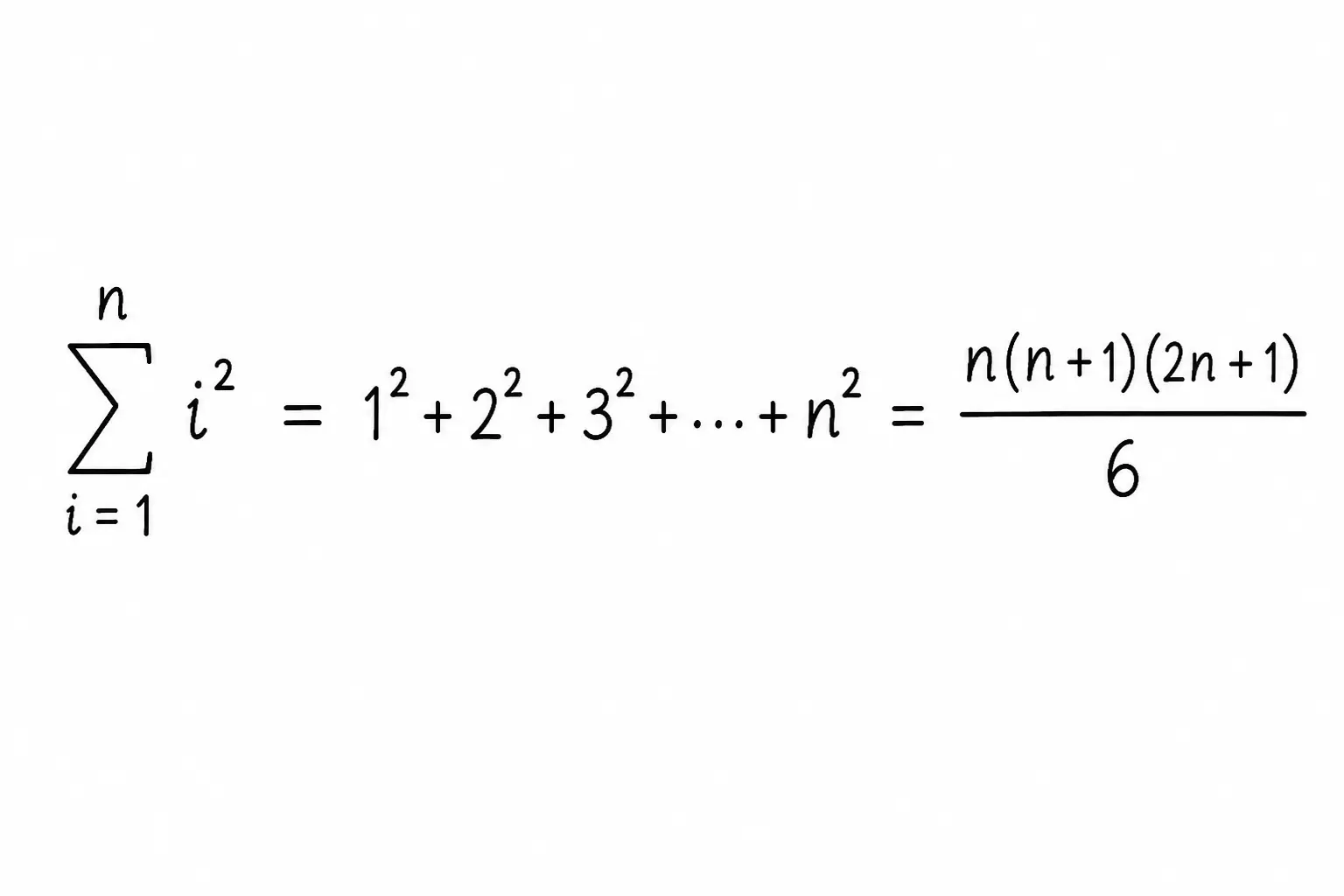
$$ \sum_{i=1}^{n} i^2 = \frac{n(n+1)(2n+1)}{6} $$
$$ \sum_{i=1}^{n} i^3 = \left[\frac{n(n+1)}{2}\right]^2 $$
The fourth result, sum of cubes equals the square of the sum, is a satisfying coincidence (proved by induction).
Properties of Summation
- Linearity (constants pull out). \( \sum_{i=1}^{n} c \cdot f(i) = c \sum_{i=1}^{n} f(i) \).
- Splitting (additivity). \( \sum_{i=1}^{n} \big[f(i) + g(i)\big] = \sum_{i=1}^{n} f(i) + \sum_{i=1}^{n} g(i) \).
- Index shift. \( \sum_{i=m}^{n} f(i) = \sum_{j=m-k}^{n-k} f(j+k) \), useful for aligning two sums or starting from a different index.
- Combining ranges. \( \sum_{i=1}^{n} f(i) = \sum_{i=1}^{k} f(i) + \sum_{i=k+1}^{n} f(i) \).
Worked Example
Compute \( \sum_{i=1}^{20} (3i^2 – 2i + 5) \).
Use linearity to split: \( 3\sum_{i=1}^{20} i^2 – 2\sum_{i=1}^{20} i + \sum_{i=1}^{20} 5 \).
Apply the closed forms: \( 3 \cdot \tfrac{20 \cdot 21 \cdot 41}{6} – 2 \cdot \tfrac{20 \cdot 21}{2} + 5 \cdot 20 \).
Evaluate: \( 3 \cdot 2870 – 420 + 100 = 8610 – 420 + 100 = 8290 \).
Double Sums and Higher
A double sum like \( \sum_{i=1}^{n} \sum_{j=1}^{m} f(i, j) \) iterates over all pairs \( (i, j) \). Order of summation can be swapped when the sum converges absolutely (Fubini’s theorem for sums). Sums of matrices, integrals over rectangles, and statistical aggregates over groups are all expressed as double sums.
Applications
- Statistics. The mean is \( \bar{x} = \tfrac{1}{n}\sum x_i \); variance involves \( \sum(x_i – \bar{x})^2 \). Every basic statistical formula is a sum.
- Series and Calculus. Definite integrals are defined as limits of Riemann sums: \( \int_a^b f(x)\,dx = \lim_{n \to \infty} \sum f(x_i^*) \Delta x \).
- Linear algebra. Matrix multiplication and inner products are sums: \( (AB)_{ij} = \sum_k A_{ik} B_{kj} \), \( \langle u, v \rangle = \sum u_i v_i \).
- Probability. Expected values for discrete random variables: \( E[X] = \sum x \cdot P(X = x) \).
- Computer science. Algorithmic complexity analysis uses sums (sum of i from 1 to n gives quadratic time; sum of 2^i gives exponential).
Related study notes: Arithmetic Progression, Geometric Progression, Binomial Theorem, Integration.
The related OpenStax mathematics textbooks provide additional explanations and exercises for the mathematical definitions used here.
Expanding and Reindexing a Sum
For \(\sum_{k=2}^{5}(2k+1)\), the terms are 5, 7, 9 and 11, giving 32. There are \(5-2+1=4\) terms. Counting only the difference between the limits would miss an endpoint.
With the substitution \(j=k-2\), the same sum becomes \(\sum_{j=0}^{3}(2j+5)\). The index, limits and summand have all changed together. Renaming an index without changing its range is harmless; shifting it requires adjusting the other parts of the expression.
The points to check in this example are:
- A constant summed over m terms contributes m times that constant.
- Finite sums distribute over addition.
- The number of integer terms from a through b is b – a + 1 when a ≤ b.
Check Your Understanding
Try the questions before reading the answers.
Question 1. Compute \(\sum_{k=1}^{4}k^2\).
Answer. 1 + 4 + 9 + 16 = 30.
Question 2. Compute \(\sum_{k=3}^{7}5\).
Answer. There are 5 terms, so the result is 25.
Frequently Asked Questions
What does the sigma symbol mean in math?
The capital Greek letter Σ (sigma) means ‘sum’. Σ f(i) for i from m to n is shorthand for f(m) + f(m+1) + … + f(n). The index variable below sigma is the counter, the value above is where it stops, and the expression to the right is what gets summed at each step.
What is the closed form for the sum of the first n integers?
Σ from i=1 to n of i = n(n+1)/2. So the sum of integers from 1 to 100 is 100 × 101 / 2 = 5050. This is the formula Gauss used as a child.
What is the sum of squares formula?
Σ from i=1 to n of i² = n(n+1)(2n+1)/6. Example: sum of squares from 1 to 10 is 10 × 11 × 21 / 6 = 385. The formula can be proved by induction or by telescoping.
What’s the difference between summation and integration?
Summation adds a discrete (finite or countable) set of values. Integration adds a continuous one, a sum over infinitely many infinitesimal pieces. Definite integrals are formally defined as limits of Riemann sums: ∫ f(x) dx = lim Σ f(x_i) Δx as Δx → 0.
Can you change the index variable in a summation?
Yes, the index is a ‘dummy variable’ that’s used only inside the sum. Σ from i=1 to n of i² and Σ from j=1 to n of j² are the same thing. This is occasionally useful when two sums use the same letter for different purposes and need to be combined.
What are double sums used for?
To sum over two indices at once. Σ Σ f(i, j) iterates over all pairs (i, j). They appear in matrix multiplication, expected values of joint distributions, and double integrals. When the sum converges absolutely, you can swap the order of summation freely (Fubini’s theorem).
Browse more in Mathematics.