
 by
byAn arithmetic progression (AP) is a sequence in which each term differs from the previous one by a fixed amount called the common difference. Unlike a geometric progression where you multiply by a constant ratio, an AP grows by repeated addition. APs describe situations with linear, steady change: equal monthly savings, stair steps of fixed height, the days in successive months of a year, simple-interest growth, and rows of seats that gain a fixed number from front to back.
Free download: Arithmetic Progression Study Notes (PDF)
The full note as a print-ready PDF: every section and worked example, the 10-question practice set with solutions, an answer key, and a 1-page revision sheet for last-minute revision.
Definition and General Term
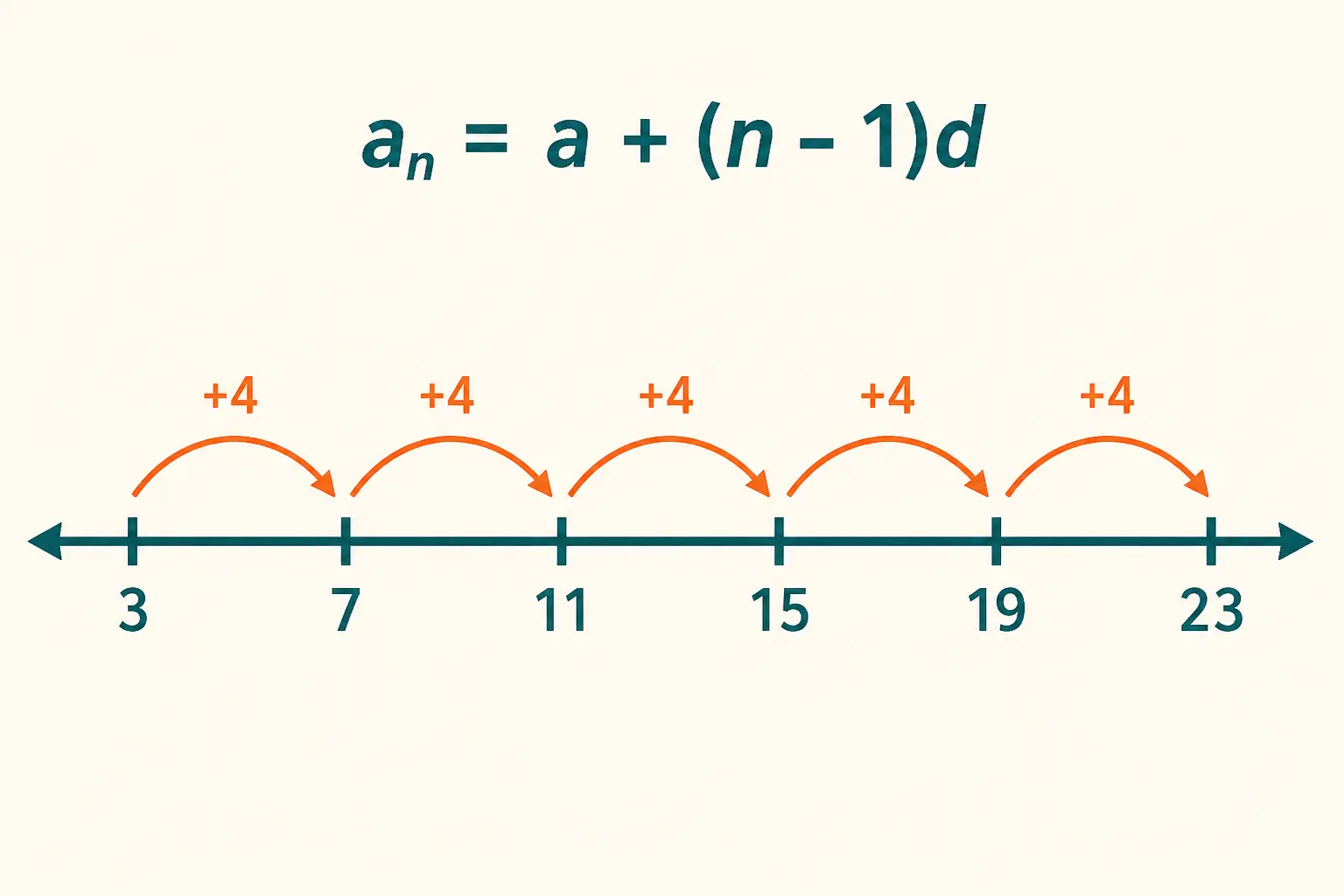
An arithmetic progression has the form: \( a, a+d, a+2d, a+3d, \ldots \), where \( a \) is the first term and \( d \) is the common difference. The \( n \)-th term is:
$$ a_n = a + (n – 1)\, d $$
A sequence is an AP precisely when the difference between consecutive terms is constant: \( a_2 – a_1 = a_3 – a_2 = \cdots = d \).
Worked Examples
- 3, 7, 11, 15, 19, \( \ldots \): \( a = 3 \), \( d = 4 \). 20th term: \( 3 + 19 \cdot 4 = 79 \).
- 100, 95, 90, 85, \( \ldots \): \( a = 100 \), \( d = -5 \). Decreasing AP. 21st term: \( 100 + 20 \cdot (-5) = 0 \).
- \( \tfrac{1}{2}, 1, \tfrac{3}{2}, 2, \ldots \): \( a = \tfrac{1}{2} \), \( d = \tfrac{1}{2} \). 15th term: \( \tfrac{1}{2} + 14 \cdot \tfrac{1}{2} = \tfrac{15}{2} = 7.5 \).
Sum of an AP
The sum of the first \( n \) terms of an AP is:
$$ S_n = \frac{n}{2}\,[2a + (n-1)d] = \frac{n}{2}\,(a + a_n) $$
The second form has an elegant geometric interpretation: the sum equals the number of terms times the average of the first and last terms.
The Story of Gauss
Carl Friedrich Gauss, age 7 or 8, was reportedly told by his teacher to sum the integers from 1 to 100, a task meant to keep the class occupied. Gauss noticed that pairing 1 + 100, 2 + 99, 3 + 98, all equal 101, and there are 50 such pairs, so the total is 50 · 101 = 5050. He had the answer almost instantly. The story is the most famous illustration of the AP sum formula.
Arithmetic Mean
In any AP, each term (except the first and last) is the arithmetic mean of its neighbors: \( a_n = \tfrac{1}{2}(a_{n-1} + a_{n+1}) \). The arithmetic mean of two numbers \( x \) and \( y \) is \( (x+y)/2 \), the most familiar ‘average’ in everyday usage.
AP vs GP: Side-by-Side
| Property | Arithmetic progression | Geometric progression |
|---|---|---|
| Operation between terms | Addition (constant d) | Multiplication (constant r) |
| nth term | a + (n-1)d | a · r^(n-1) |
| Sum of n terms | n/2 · [2a + (n-1)d] | a · (1 – rⁿ)/(1 – r) |
| Type of growth | Linear | Exponential |
| Sequence example | 3, 7, 11, 15… | 3, 12, 48, 192… |
Applications
- Simple interest. Money invested at simple interest grows arithmetically: P, P + Pr, P + 2Pr, P + 3Pr…, an AP with common difference Pr.
- Salary increments. A fixed annual raise of a set dollar amount produces an AP of yearly earnings.
- Stadium seating. Stadium rows often gain a fixed number of seats per row; the row counts form an AP.
- Distance with constant deceleration. An object decelerating uniformly covers distances in successive seconds that form an AP. (Galileo proved this geometrically.)
- Counting and combinatorics. The sum 1+2+…+n is the count of handshakes between n+1 people, the number of edges in a complete graph, and the closed form n(n+1)/2.
Related study notes: Geometric Progression, Summation Notation, Fibonacci Sequence, Compound Interest.
Practice Questions
Work each question before reading its solution. The set runs from direct recall and substitution to the applied questions that exams actually use to separate grades. All 10 also appear in the downloadable PDF with a separate answer key.
Question 1. For the AP 7, 11, 15, 19…, identify \(a\) and \(d\), and find the 25th term.
Solution. First term \(a = 7\), common difference \(d = 4\). \(a_{25} = a + 24d = 7 + 96 = 103\). The nth term needs \(n – 1\) steps, not \(n\): off-by-one here is the single most common AP error.
Question 2. Which term of the AP 3, 8, 13… equals 203?
Solution. \(a_n = 3 + 5(n-1) = 203\) gives \(5(n-1) = 200\), so \(n = 41\). The 41st term. Solving for \(n\) turns the term formula into a membership test: had \(n\) come out fractional, 203 would not belong to the sequence.
Question 3. Sum the first 100 natural numbers, the way young Gauss reportedly did.
Solution. Pair the ends: \(1 + 100 = 101\), \(2 + 99 = 101\)…, making 50 pairs of 101: \(S = 5050\). The general formula \(S_n = \frac{n}{2}(a + l)\) is exactly this pairing written once for all.
Question 4. Compute the sum of the first 20 terms of 5, 9, 13…
Solution. \(S_{20} = \frac{20}{2}[2(5) + 19(4)] = 10[10 + 76] = 860\). With no last term in hand, use \(S_n = \frac{n}{2}[2a + (n-1)d]\); with the last term known, \(\frac{n}{2}(a + l)\) is faster. Same formula, two outfits.
Question 5. An AP has \(a_5 = 22\) and \(a_{12} = 57\). Find \(a\) and \(d\).
Solution. Subtract: \(a_{12} – a_5 = 7d = 35\), so \(d = 5\); then \(a = 22 – 4(5) = 2\). Differences of terms leap straight to \(d\) because the \(a\)’s cancel: always subtract the given equations first.
Question 6. How many multiples of 7 lie between 100 and 500?
Solution. First: 105; last: 497. From \(497 = 105 + 7(n-1)\): \(n – 1 = 56\), so \(n = 57\). Counting multiples is an AP with \(d = 7\), and the endpoints must themselves be multiples before the formula applies.
Question 7. The sum of 3 consecutive AP terms is 27 and their product is 585. Find them.
Solution. Write them \(m – d, m, m + d\): the sum gives \(3m = 27\), \(m = 9\). Product: \(9(81 – d^2) = 585\), so \(81 – d^2 = 65\), \(d = \pm 4\). The terms are 5, 9, 13. Symmetric naming around the middle makes the sum trivial and the algebra quadratic instead of cubic.
Question 8. A theater has 20 rows: 12 seats in the first, each row 3 more than the last. Find the seats in row 20 and the total capacity.
Solution. Row 20: \(12 + 19(3) = 69\) seats. Total: \(S_{20} = \frac{20}{2}(12 + 69) = 810\). Auditoriums, log stacks, and staircase bricks are APs in the wild; the sum formula replaces 20 additions.
Question 9. A loan is repaid in installments forming an AP: 1,000 in month 1, decreasing by 50 each month, until the payment reaches 100. How much is repaid in all?
Solution. From \(100 = 1000 – 50(n-1)\): \(n = 19\) payments. Sum: \(\frac{19}{2}(1000 + 100) = 10{,}450\). Note the count first, then the sum: computing sums before pinning \(n\) is where these problems go wrong.
Question 10. Insert 4 numbers between 8 and 33 so all 6 form an AP.
Solution. Six terms means 5 gaps: \(d = (33 – 8)/5 = 5\). The inserted numbers: 13, 18, 23, 28. Inserting \(k\) means between two values always gives \(d = \frac{b – a}{k + 1}\): gaps outnumber insertions by one.
Frequently Asked Questions
What is an arithmetic progression?
A sequence in which each term is obtained by adding a fixed number (the common difference) to the previous term. Example: 5, 9, 13, 17… has common difference 4. The general formula for the nth term is a_n = a + (n−1)d.
What’s the difference between an arithmetic and geometric progression?
An arithmetic progression has a constant difference between consecutive terms (you add d each step). A geometric progression has a constant ratio (you multiply by r each step). 3, 7, 11, 15 is arithmetic with d = 4. 3, 6, 12, 24 is geometric with r = 2. APs grow linearly, GPs grow exponentially.
How do you find the sum of an AP?
S_n = (n/2) × [2a + (n−1)d], or equivalently S_n = (n/2) × (a + a_n) where a_n is the last term. The second form is easier to remember: the sum equals the count of terms times the average of the first and last terms.
How did Gauss sum 1 to 100?
By pairing 1 + 100, 2 + 99, 3 + 98, and so on. Each pair sums to 101, and there are 50 such pairs. So the total is 50 × 101 = 5050. He did this as a child to finish a tedious classroom exercise quickly. The trick generalises into the AP sum formula S_n = (n/2)(a + a_n).
Can an arithmetic progression be decreasing?
Yes, if the common difference d is negative. Example: 100, 95, 90, 85… has d = −5. Decreasing APs include cooling temperatures by a constant amount per minute, scoring penalties that subtract a fixed amount per missed shot, or stockpile depletion at a fixed rate.
What is the arithmetic mean?
The arithmetic mean of two or more numbers is their sum divided by how many there are. The most familiar ‘average’. In an AP, every middle term equals the arithmetic mean of its immediate neighbors: a_n = (a_(n−1) + a_(n+1))/2. This is where the AP gets its name.
Browse more in Mathematics.