
Fibonacci Sequence
The Fibonacci sequence is the most famous integer sequence in mathematics. Each term is the sum of the two before it, starting from 1 and 1: 1, 1, 2, 3, 5, 8, 13, 21, 34, 55, 89, 144, and so on. Named after Leonardo of Pisa (Fibonacci), who introduced it to European mathematics in 1202 through a problem about rabbit breeding, the sequence shows up in unexpected places — sunflower spirals, pinecones, nautilus shells, stock market technical analysis, computer algorithms. This study note covers the definition, the closed-form Binet formula, the connection to the golden ratio, and the surprising contexts where the sequence appears.
The Definition
The Fibonacci sequence is defined by a recurrence relation. The first two terms are seeded; each subsequent term is the sum of the two preceding ones.
$$ F_1 = 1, \quad F_2 = 1, \quad F_n = F_{n-1} + F_{n-2} \quad \text{for } n \ge 3 $$
Some texts start with F₀ = 0 and F₁ = 1, which gives 0, 1, 1, 2, 3, 5, 8, … The two conventions are equivalent except for the offset. The first 15 terms (using F₁ = F₂ = 1):
$$ 1, 1, 2, 3, 5, 8, 13, 21, 34, 55, 89, 144, 233, 377, 610, \ldots $$
The Original Rabbit Problem
Fibonacci introduced the sequence in his 1202 book Liber Abaci with this puzzle: a pair of rabbits is placed in a field. Each month, every mature pair produces one new pair. New pairs take one month to mature. No rabbits die. How many pairs are there after n months?
Month 1: 1 pair (the original). Month 2: still 1 pair (not yet mature). Month 3: 2 pairs (the original produces). Month 4: 3 pairs (the new pair from month 3 is now mature; original produces again). Month 5: 5 pairs. The sequence is 1, 1, 2, 3, 5, 8, 13, 21 — the Fibonacci numbers.
The mathematics behind the puzzle is more important than the puzzle itself. Any process where the next state depends on the sum of two previous states produces a Fibonacci-like growth pattern.
The Golden Ratio Connection
The most beautiful property of the Fibonacci sequence is its connection to the golden ratio φ ≈ 1.6180339887. The ratio of consecutive Fibonacci numbers approaches φ as n grows large:
$$ \lim_{n \to \infty} \dfrac{F_{n+1}}{F_n} = \varphi = \dfrac{1 + \sqrt{5}}{2} \approx 1.6180 $$
Check it: 2/1 = 2, 3/2 = 1.5, 5/3 ≈ 1.667, 8/5 = 1.6, 13/8 = 1.625, 21/13 ≈ 1.615, 34/21 ≈ 1.619, 55/34 ≈ 1.618. The convergence is fast. By F₁₀/F₉ = 55/34, the ratio is already correct to three decimal places.
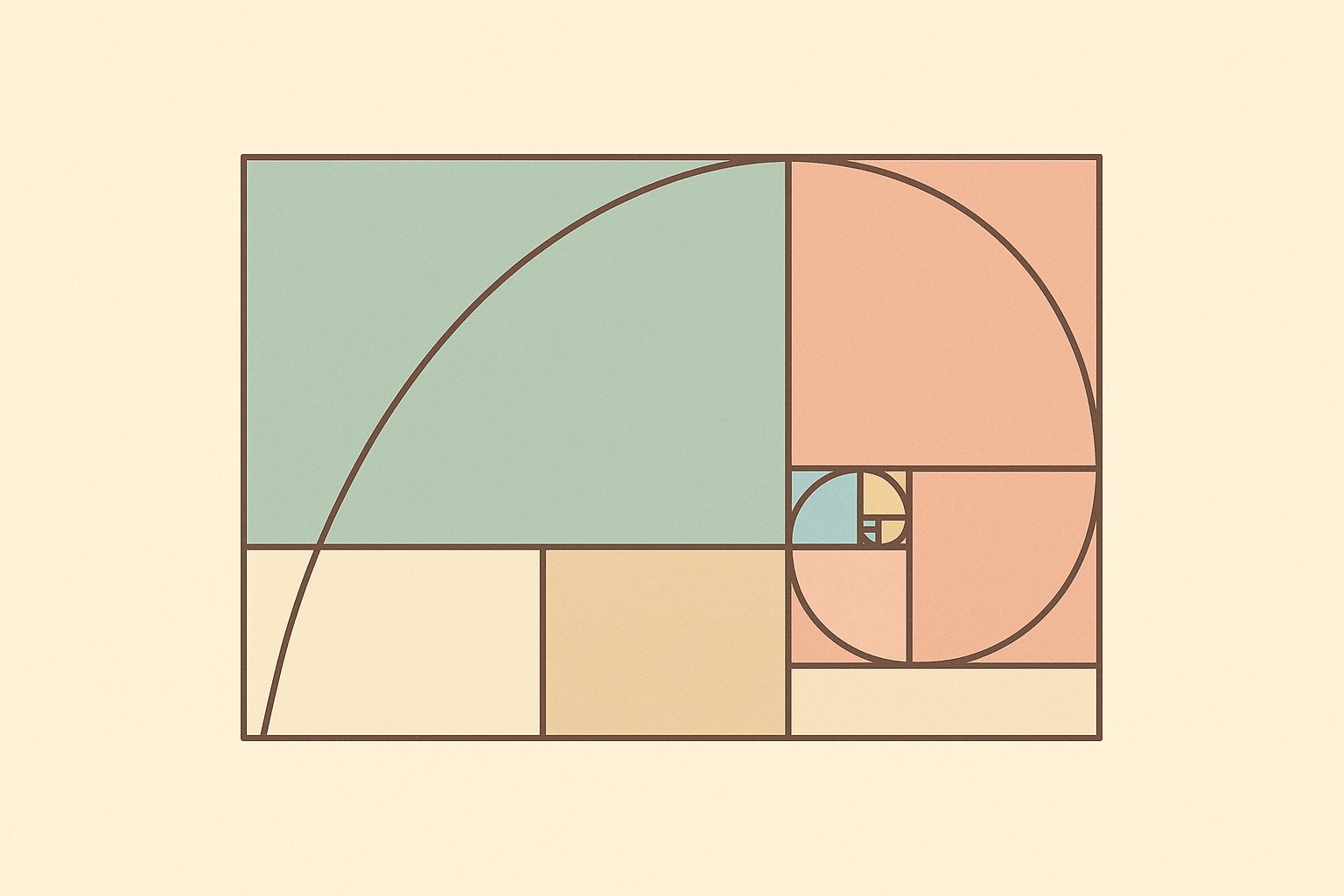
This is why the famous Fibonacci spiral, constructed from quarter-circle arcs through nested squares with Fibonacci side lengths, looks visually similar to the true golden spiral. They are not identical — the Fibonacci spiral is built from circular arcs, the golden spiral is a logarithmic spiral with growth factor φ — but the visual difference is small.
The Closed-Form Binet Formula
Despite being defined recursively, the Fibonacci sequence has a closed-form expression discovered by Jacques Binet in 1843 (though it was known earlier to Abraham de Moivre and Daniel Bernoulli):
$$ F_n = \dfrac{\varphi^n – \psi^n}{\sqrt{5}} \quad \text{where} \quad \varphi = \dfrac{1+\sqrt{5}}{2}, \;\; \psi = \dfrac{1-\sqrt{5}}{2} $$
Since |ψ| < 1, the term ψⁿ shrinks rapidly, and for any practical computation we have \( F_n \approx \varphi^n / \sqrt{5} \), rounded to the nearest integer. This is striking: a sequence of integers defined by integer addition has an exact formula involving the irrational √5 and the irrational golden ratio.
Identities and Properties
The Fibonacci sequence has dozens of clean identities. A few worth knowing:
- Sum of first n terms: \( F_1 + F_2 + \cdots + F_n = F_{n+2} – 1 \)
- Sum of squares: \( F_1^2 + F_2^2 + \cdots + F_n^2 = F_n F_{n+1} \). Geometrically: the squares tile a Fibonacci rectangle perfectly.
- Even-indexed sum: \( F_2 + F_4 + F_6 + \cdots + F_{2n} = F_{2n+1} – 1 \)
- Cassini’s identity: \( F_{n-1} F_{n+1} – F_n^2 = (-1)^n \). The product of the two neighbors of \( F_n \) differs from \( F_n^2 \) by exactly ±1.
- GCD property: \( \gcd(F_m, F_n) = F_{\gcd(m,n)} \). The greatest common divisor of two Fibonacci numbers is itself a Fibonacci number.
Where the Fibonacci Sequence Shows Up
- Phyllotaxis. The arrangement of leaves, seeds, and petals on plants very often follows Fibonacci numbers. Sunflower seed heads have spiral counts that are consecutive Fibonacci numbers (e.g., 34 spirals one way, 55 the other). The reason is that turning by the golden angle (137.5°) between successive leaves maximizes light capture and packing efficiency.
- Nautilus and snail shells. These shells grow in approximately logarithmic spirals close to (but not exactly) the golden spiral. The Fibonacci spiral is a piecewise approximation.
- Computer science. Fibonacci heaps support fast priority queue operations. The Euclidean algorithm’s worst case occurs on consecutive Fibonacci numbers. Many dynamic programming examples use the Fibonacci recurrence as their canonical introduction.
- Stock market technical analysis. Fibonacci retracement levels (23.6%, 38.2%, 50%, 61.8%) are widely used by chart-pattern traders. Their actual predictive value is heavily debated, but the convention is entrenched.
- Music and art composition. Bartók and Debussy reportedly used Fibonacci-based structures. The 8-bar phrasing common in popular music is a Fibonacci coincidence at best, but it is real that audiences find Fibonacci-proportioned structures pleasing.
What the Fibonacci Sequence Is Not
The Fibonacci sequence is widely mythologized. Three corrections worth making:
- Sunflowers and pinecones use Fibonacci-related numbers because of the golden angle, not because of mystical reasons. The golden angle is the rotation that minimizes overlap between successive leaves. Evolution finds it independently in many species.
- The ‘Fibonacci proportions’ attributed to ancient buildings (the Parthenon, the Great Pyramid) are almost always coincidence or motivated reasoning. The dimensions are close to φ if you pick the right measurements; they fail the test if you pick others.
- The human body is not actually built on Fibonacci proportions. Da Vinci’s Vitruvian Man uses simple integer ratios (1:8 for head to body, for instance), not φ. Modern measurements of finger bones, the navel-to-foot ratio, and similar claims do not reliably match the golden ratio.
Related study notes: Whole Numbers, Set, Complex Numbers.
Frequently Asked Questions
What is the Fibonacci sequence in simple words?
The Fibonacci sequence is a list of numbers where each number is the sum of the two before it. Starting with 1 and 1, the next term is 1+1 = 2, then 1+2 = 3, then 2+3 = 5, then 3+5 = 8, and so on: 1, 1, 2, 3, 5, 8, 13, 21, 34, 55, 89, 144, …
Why is the Fibonacci sequence important?
Three reasons. First, it is the canonical example of a recurrence relation, used to teach mathematical induction, generating functions, and dynamic programming. Second, its ratios converge to the golden ratio, which connects it to phyllotaxis, geometric design, and architecture. Third, it shows up in many places in nature and computer science, often unexpectedly.
What is the golden ratio connection?
The ratio of consecutive Fibonacci numbers approaches the golden ratio φ = (1+√5)/2 ≈ 1.6180 as n grows. F(n+1)/F(n) → φ. This is why the Fibonacci spiral closely approximates the golden spiral and why sunflower seed spiral counts are usually consecutive Fibonacci numbers.
What is Binet’s formula?
Binet’s formula gives a closed-form expression for the nth Fibonacci number: F(n) = (φⁿ – ψⁿ) / √5, where φ = (1+√5)/2 is the golden ratio and ψ = (1-√5)/2. For practical computation, F(n) ≈ φⁿ / √5 rounded to the nearest integer, because ψⁿ shrinks quickly.
Who invented the Fibonacci sequence?
The sequence was known to Indian mathematicians (including Pingala around 200 BCE and Hemachandra around 1150) before Leonardo of Pisa (Fibonacci) introduced it to European mathematics in his 1202 book Liber Abaci through a problem about rabbit breeding. The naming reflects Western adoption, not original invention.
Does the Fibonacci sequence really appear in nature?
Yes, but not for mystical reasons. The arrangement of leaves, seeds, and petals (phyllotaxis) often follows Fibonacci numbers because turning by the golden angle between successive structures maximizes light capture and packing efficiency. Sunflowers, pinecones, and pineapples are the textbook examples. But many natural Fibonacci claims (architectural proportions, body ratios) are coincidence or motivated reasoning, not real patterns.