
 by
byComplex numbers extend the real numbers with one new element, the imaginary unit \(i\), defined by \(i^2 = -1\). They turn the real line into a two-dimensional plane and make it possible to solve equations the real numbers can’t handle. Every quadratic with negative discriminant has roots in the complex numbers; every polynomial of degree \(n\) has exactly \(n\) complex roots. The fundamental theorem of algebra works only because the complex numbers exist.
Despite the name, there’s nothing imaginary about them. Complex numbers describe alternating current circuits, quantum mechanical wavefunctions, signal processing, control systems, and every modern field that touches oscillation or rotation. Once you visualize complex numbers as points on a plane, the algebra becomes geometry, and operations like multiplication start meaning rotation and scaling.
This study note covers the definition, arithmetic, the complex plane, polar form, Euler’s formula, applications across science and engineering, common pitfalls, and the historical context that explains why mathematicians needed them in the first place.
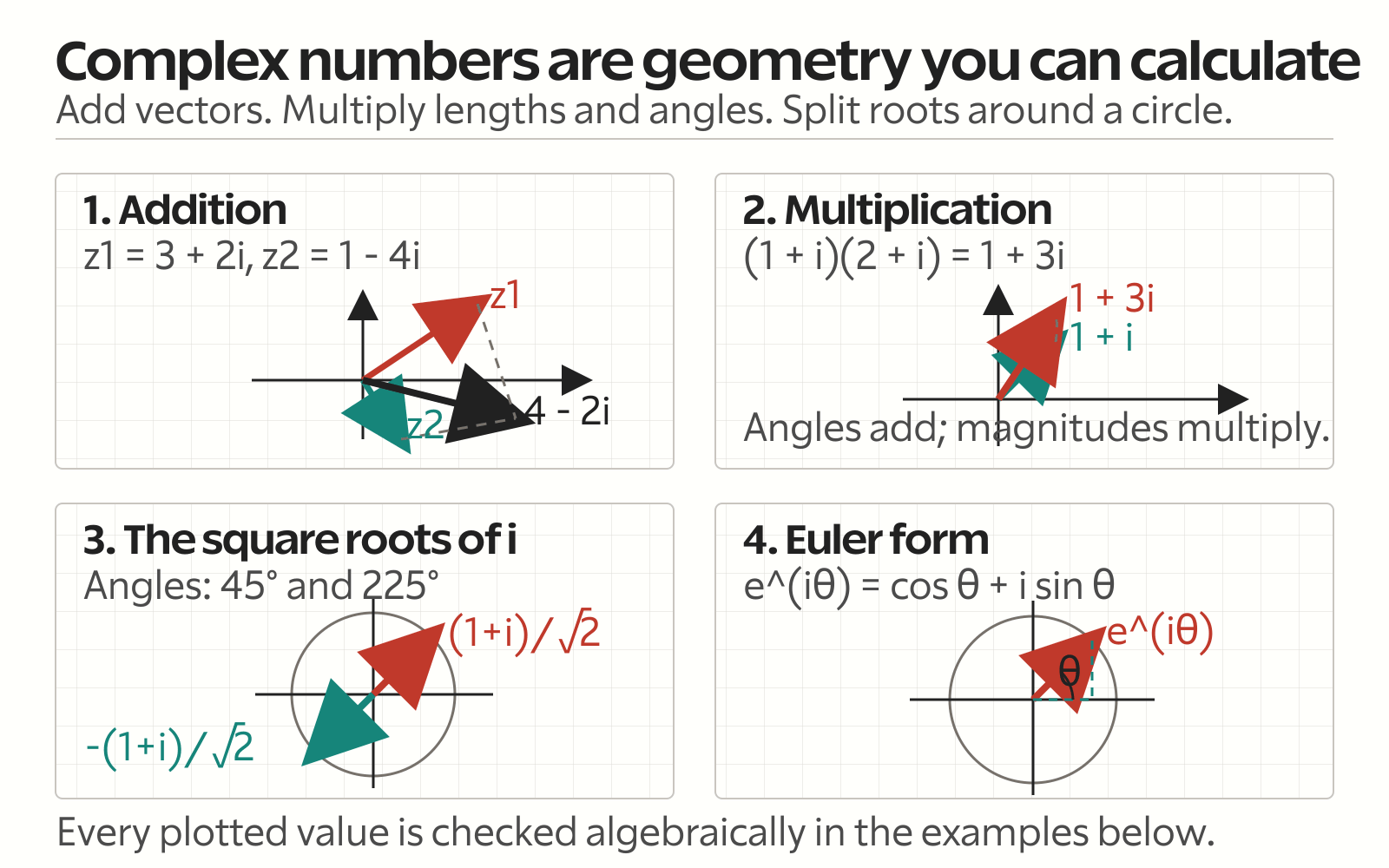
Four checked examples on the Argand plane
The diagram turns the algebra into geometry. The examples below use $z_1=3+2i$ and $z_2=1-4i$ where needed, and each result has been checked by direct calculation.
| Operation | Calculation | Checked result | Geometric meaning |
|---|---|---|---|
| Addition | (3 + 2i) + (1 – 4i) | 4 – 2i | Add horizontal and vertical components |
| Multiplication | (1 + i)(2 + i) | 1 + 3i | Multiply magnitudes and add arguments |
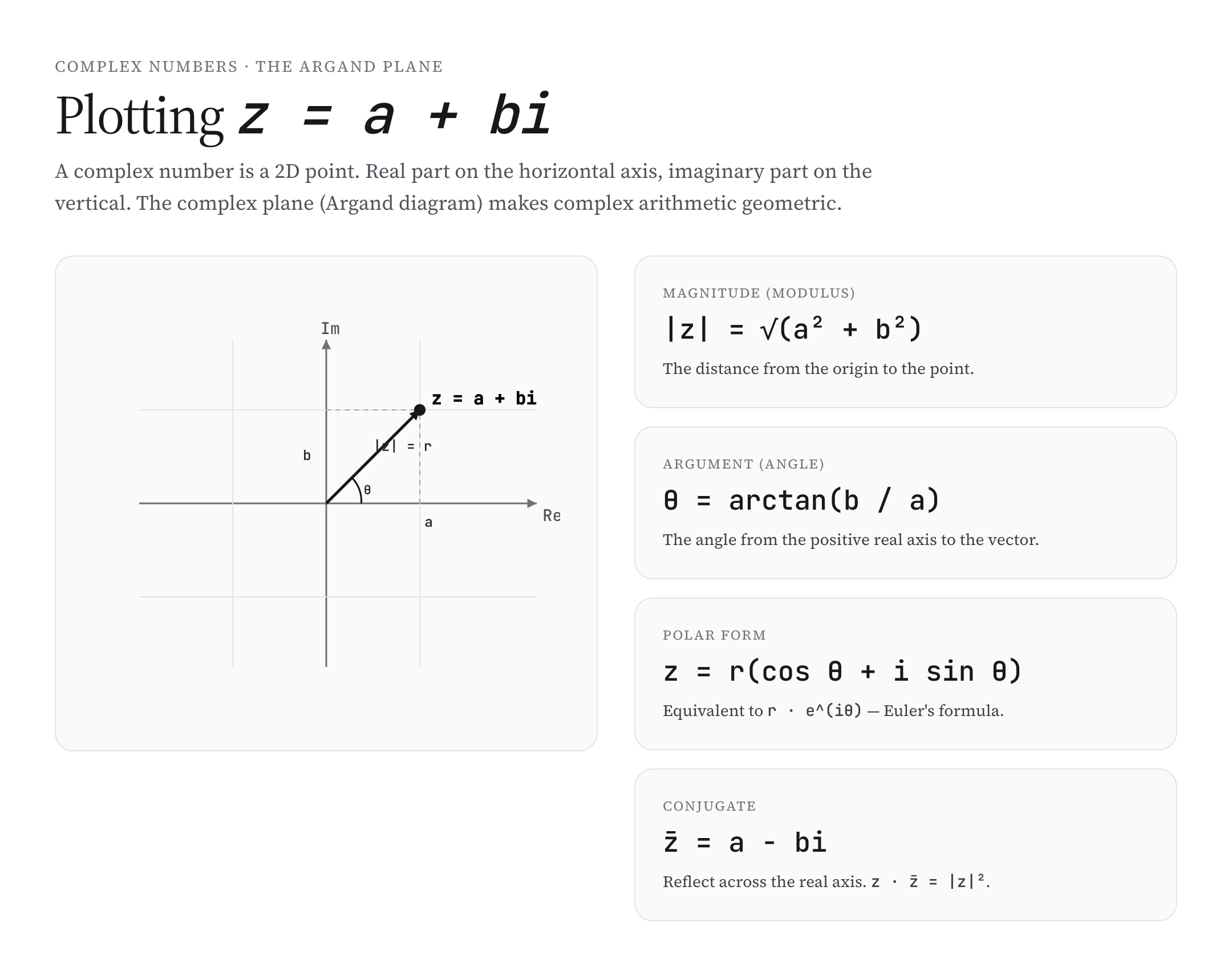
| Magnitude | |3 + 2i| | √13 ≈ 3.606 | Distance from the origin |
| Conjugate product | (3 + 2i)(3 – 2i) | 13 | Magnitude squared |
| Square roots of i | w² = i | ±(1 + i)/√2 | Half the angle, then add 180° |
- Addition check: real parts give $3+1=4$; imaginary parts give $2-4=-2$.
- Multiplication check: $2+i+2i+i^2=1+3i$ because $i^2=-1$.
- Magnitude check: $\sqrt{3^2+2^2}=\sqrt{13}$.
- Root check: $((1+i)/\sqrt{2})^2=i$, and squaring its negative gives the same result.
Definition
A complex number is a number of the form \(z = a + bi\) where \(a\) and \(b\) are real numbers and \(i\) is the imaginary unit satisfying \(i^2 = -1\). The number \(a\) is the real part; \(b\) is the imaginary part. Notation: \(\text{Re}(z) = a\), \(\text{Im}(z) = b\).
Real numbers are a special case where \(b = 0\). Pure imaginary numbers are the case \(a = 0\). Together they fill the entire complex plane.
The set of all complex numbers is denoted \(\mathbb{C}\). It contains the real numbers \(\mathbb{R}\) as the horizontal axis and is algebraically closed, every polynomial equation has all its roots in \(\mathbb{C}\).
Basic Operations
Addition and subtraction work component-wise:
$$(a + bi) + (c + di) = (a + c) + (b + d)i$$Multiplication uses the distributive property and the rule \(i^2 = -1\):
$$(a + bi)(c + di) = ac + adi + bci + bdi^2 = (ac – bd) + (ad + bc)i$$Division multiplies numerator and denominator by the conjugate of the denominator:
$$\frac{a + bi}{c + di} = \frac{(a + bi)(c – di)}{(c + di)(c – di)} = \frac{(ac + bd) + (bc – ad)i}{c^2 + d^2}$$The denominator \((c + di)(c – di) = c^2 + d^2\) is real, which is exactly why the conjugate trick works.
The Complex Conjugate
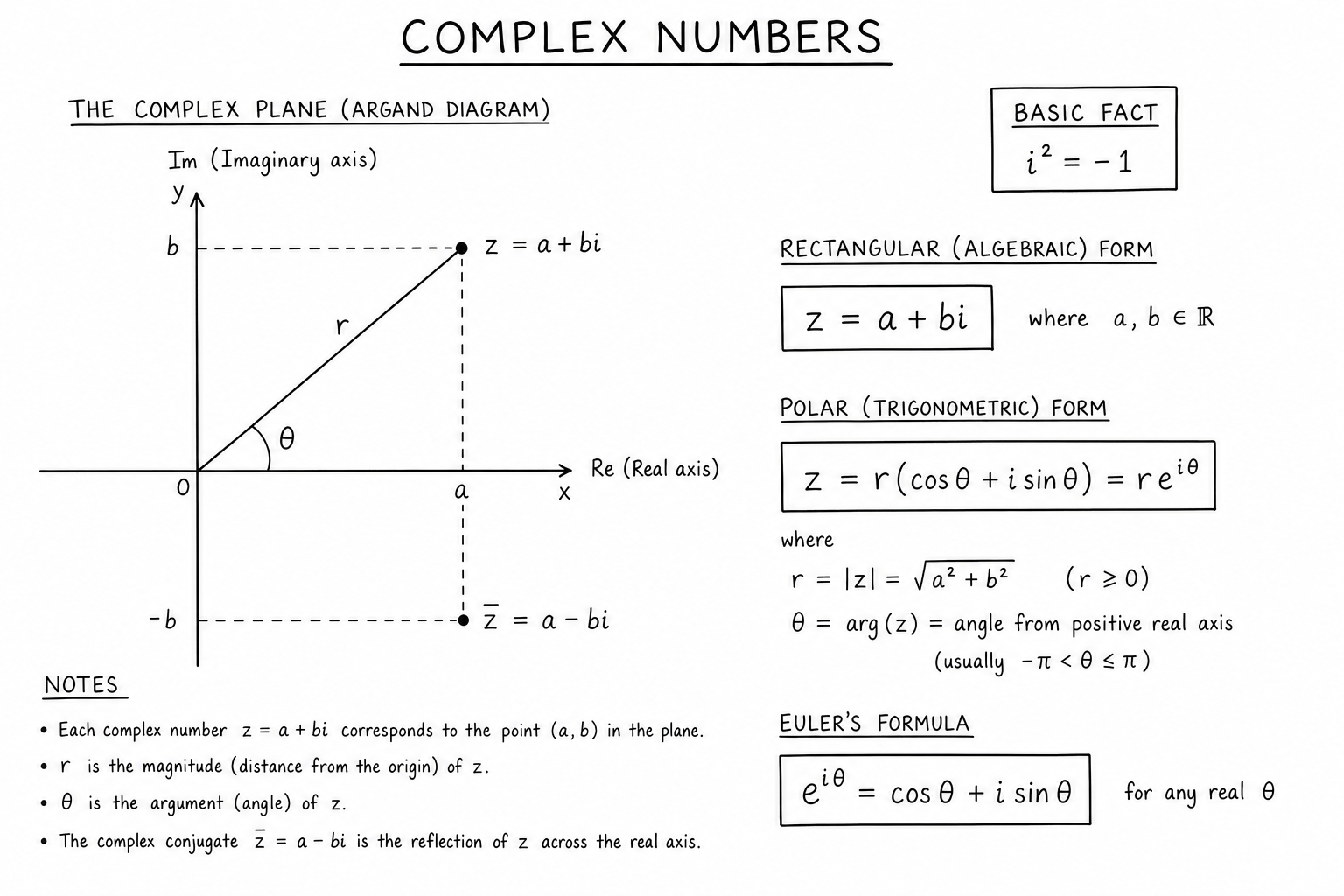
The conjugate of \(z = a + bi\) is \(\bar{z} = a – bi\). Geometrically, conjugation reflects across the real axis. Algebraically:
- \(z + \bar{z} = 2a = 2\text{Re}(z)\)
- \(z – \bar{z} = 2bi = 2i \cdot \text{Im}(z)\)
- \(z \cdot \bar{z} = a^2 + b^2 = |z|^2\)
- \(\overline{z + w} = \bar{z} + \bar{w}\), \(\overline{zw} = \bar{z} \bar{w}\)
Conjugates are used for division, for computing magnitudes, and for many proofs about complex polynomial roots (real-coefficient polynomials have roots that come in conjugate pairs).
The Complex Plane
Complex numbers form a 2D plane: the real part on the horizontal axis, the imaginary part on the vertical axis. This is the Argand plane or complex plane.
Each complex number is a point. Addition is geometric vector addition (head-to-tail). The magnitude (or modulus) is the distance from the origin: \(|z| = \sqrt{a^2 + b^2}\). The argument (or phase) is the angle from the positive real axis: \(\arg(z) = \arctan(b/a)\), with quadrant correction.
Once you switch to this geometric view, complex algebra becomes intuitive. Multiplication isn’t just a formula, it has a geometric meaning. So does conjugation, division, and exponentiation.
Polar Form
Every nonzero complex number can be written as:
$$z = r(\cos\theta + i\sin\theta)$$where \(r = |z|\) is the magnitude and \(\theta = \arg(z)\) is the angle. This is the polar form, and it makes multiplication and division dramatically simpler.
Multiplication in polar form: magnitudes multiply and arguments add.
$$r_1 (\cos\theta_1 + i\sin\theta_1) \cdot r_2 (\cos\theta_2 + i\sin\theta_2) = r_1 r_2 (\cos(\theta_1 + \theta_2) + i\sin(\theta_1 + \theta_2))$$Division: magnitudes divide and arguments subtract. Powers and roots follow the same pattern. Polar form is the natural language for everything in complex analysis that involves rotation, oscillation, or repeated multiplication.
Euler’s Formula
Euler’s formula is the deepest identity connecting complex exponentials and trigonometry:
$$e^{i\theta} = \cos\theta + i\sin\theta$$It says the complex exponential traces the unit circle in the complex plane as \(\theta\) varies. Combined with polar form, every complex number can be written compactly as:
$$z = r e^{i\theta}$$The famous identity \(e^{i\pi} + 1 = 0\) drops out as the special case \(\theta = \pi\). It connects five fundamental mathematical constants in one equation: \(e\), \(i\), \(\pi\), \(1\), and \(0\). Many mathematicians vote it the most beautiful equation in all of mathematics.
De Moivre’s Theorem
De Moivre’s theorem follows from Euler’s formula and gives powers of complex numbers in polar form:
$$(r e^{i\theta})^n = r^n e^{in\theta}$$or equivalently \((\cos\theta + i\sin\theta)^n = \cos(n\theta) + i\sin(n\theta)\).
This makes computing powers trivial. \((1 + i)^{10}\) would be tedious by direct expansion. In polar form: \(1 + i = \sqrt{2} e^{i\pi/4}\), so \((1 + i)^{10} = (\sqrt{2})^{10} e^{i 10\pi/4} = 32 e^{i 5\pi/2} = 32 e^{i\pi/2} = 32i\).
De Moivre’s theorem also handles roots: every nonzero complex number has \(n\) distinct \(n\)-th roots, evenly spaced around a circle in the complex plane.
Worked Example: Complex Multiplication
Compute \((3 + 2i)(1 – 4i)\). Use the distributive property:
$$(3 + 2i)(1 – 4i) = 3 – 12i + 2i – 8i^2 = 3 – 10i + 8 = 11 – 10i$$Verification using polar form: \(3 + 2i \approx \sqrt{13} e^{i \arctan(2/3)}\); \(1 – 4i = \sqrt{17} e^{-i\arctan(4)}\). Product: \(\sqrt{13 \cdot 17} e^{i (\arctan(2/3) – \arctan(4))} \approx 14.87 e^{-i 0.737}\), which has real part \(\approx 11\) and imaginary part \(\approx -10\). ✓
Both methods give the same answer; rectangular form is faster for individual products, polar form is faster for repeated multiplications and powers.
The Fundamental Theorem of Algebra
The fundamental theorem of algebra says every non-constant polynomial with complex coefficients has at least one complex root. Equivalently, a degree-\(n\) polynomial has exactly \(n\) complex roots (counted with multiplicity).
This is one of the deepest reasons complex numbers exist. Real numbers aren’t algebraically closed, \(x^2 + 1 = 0\) has no real solutions. Once you add \(i\), every polynomial has all its roots inside the system.
For real-coefficient polynomials, complex roots always come in conjugate pairs: if \(a + bi\) is a root, so is \(a – bi\). This is why a real cubic always has at least one real root (an odd number of conjugate pairs is impossible).
Where Complex Numbers Show Up
- Electrical engineering: AC circuit analysis uses complex impedance to combine resistance, capacitance, and inductance into a single complex number. Phasor methods rely entirely on complex numbers.
- Signal processing: Fourier transforms decompose signals into complex exponentials, making frequency-domain analysis possible.
- Quantum mechanics: wavefunctions are complex-valued. The probability density is the squared magnitude. Complex phases encode interference and entanglement.
- Control systems: stability analysis uses the location of poles in the complex plane (the s-plane in Laplace transforms).
- Fluid dynamics: 2D incompressible flow problems often map cleanly to complex potentials.
- Computer graphics: 2D rotations and transformations are conveniently expressed as complex multiplications.
- Number theory: Gaussian integers and complex algebraic number theory underlie deep results about prime factorization and Diophantine equations.
Magnitude, Argument, and Geometric Interpretation
Multiplication by a complex number has a clean geometric meaning. Multiplying \(z\) by \(w = re^{i\theta}\) scales the magnitude of \(z\) by \(r\) and rotates it counterclockwise by \(\theta\). Multiplication by \(i\) (which is \(e^{i\pi/2}\)) rotates by 90° without changing magnitude. Multiplication by \(-1\) (which is \(e^{i\pi}\)) rotates by 180°.
This is why complex multiplication is so useful for rotations and oscillations. In 2D graphics, rotation matrices and complex multiplications do the same job, with complex numbers being more compact and computationally efficient.
Common Mistakes With Complex Numbers
- Treating \(i\) like a regular variable. Always remember \(i^2 = -1\); higher powers cycle: \(i^3 = -i\), \(i^4 = 1\), \(i^5 = i\), and so on.
- Forgetting to use conjugates for division. Without multiplying by the conjugate, you can’t simplify a complex denominator.
- Confusing magnitude with norm-squared. \(|z|^2 = z \bar{z}\), which is real. \(|z|\) itself is the square root.
- Mishandling the argument. \(\arctan(b/a)\) gives the principal value; you need to adjust by \(\pi\) when the point is in the second or third quadrant.
- Forgetting that \(\sqrt{-1}\) is not a real-valued function. Standard square root rules don’t extend cleanly to negative numbers, \(\sqrt{-4} \cdot \sqrt{-9} \neq \sqrt{36}\).
- Treating real-valued tools as if they work for complex. Comparison operators (\(\leq\), \(\geq\)) don’t extend to complex numbers, there’s no natural ordering on \(\mathbb{C}\).
A Brief History of Complex Numbers
Complex numbers first appeared in 16th-century Italian work on cubic equations. Cardano’s formula for cubics produced expressions like \(\sqrt{-121}\) even when the final answers were real, which forced mathematicians to take square roots of negatives seriously.
Rafael Bombelli formalized the rules for complex arithmetic in 1572. Leonhard Euler introduced the notation \(i\) for \(\sqrt{-1}\) and discovered Euler’s formula in the 18th century. Caspar Wessel (1797) and Jean-Robert Argand (1806) independently developed the geometric interpretation as points in a plane.
Carl Friedrich Gauss popularized the term “complex” and proved the fundamental theorem of algebra. By the late 19th century, complex analysis (Cauchy, Riemann, Weierstrass) had become one of the central branches of mathematics. Today complex numbers appear across quantitative disciplines, they’re the natural setting for oscillation, rotation, wave behavior, and quantum mechanics.
Roots of Unity
The \(n\)-th roots of unity are the \(n\) complex numbers satisfying \(z^n = 1\). They sit evenly spaced on the unit circle in the complex plane:
$$z_k = e^{2\pi i k / n} \quad \text{for } k = 0, 1, \ldots, n – 1$$For \(n = 4\), the roots are \(1, i, -1, -i\). For \(n = 3\), they’re \(1, e^{2\pi i /3}, e^{4\pi i /3}\), forming an equilateral triangle.
Roots of unity appear constantly: in the discrete Fourier transform (where they form the basis), in number theory (cyclotomic fields), in symmetry analysis, in error-correcting codes, and in the Cooley-Tukey FFT algorithm that underpins most modern signal processing.
Complex Numbers in Quantum Mechanics
Quantum mechanical wavefunctions are complex-valued. The probability of finding a particle at a position is the squared magnitude of its wavefunction at that position: \(P(x) = |\psi(x)|^2\). The complex phases between wavefunctions encode interference patterns and entanglement.
Why complex and not real? Because quantum mechanics requires both magnitude and phase information at every point, and the natural mathematical object that encodes both in a single number is the complex number. The Schrödinger equation \(i\hbar \partial \psi / \partial t = H \psi\) explicitly contains \(i\); without complex numbers, you can’t even write quantum mechanics down.
Complex Functions and Conformal Mapping
Complex functions \(f: \mathbb{C} \to \mathbb{C}\) include polynomials, rational functions, exponentials, logarithms, and trig functions. Differentiable complex functions (called holomorphic or analytic) have remarkable properties, once differentiable, they’re differentiable infinitely many times, and they conserve angles locally (conformal mapping).
Conformal maps are used in 2D fluid mechanics, electrostatics, and image processing because they preserve angles between curves. The Riemann mapping theorem says any simply-connected open subset of the complex plane (other than \(\mathbb{C}\) itself) can be conformally mapped to the unit disk. This is one of the deepest results in classical complex analysis.
Fourier Analysis and Complex Exponentials
Every well-behaved periodic function decomposes into a sum of complex exponentials \(e^{i\omega t}\). This is the Fourier series. The complex exponential basis is more elegant than the sine-and-cosine basis because each frequency is a single complex number rather than two real coefficients.
Fourier transforms (the continuous-frequency version) and discrete Fourier transforms (for digital signals) extend this idea everywhere, audio compression, image processing, JPEG and MP3 codecs, MRI image reconstruction, communications systems. Almost every modern signal processing technique relies on complex-exponential decompositions, and the elegance comes directly from the complex number system.
Worked Example: Computing Powers in Polar Form
Compute \((1 + i)^8\) using polar form. First convert: \(|1 + i| = \sqrt{2}\), \(\arg(1 + i) = \pi/4\). So \(1 + i = \sqrt{2} e^{i\pi/4}\).
By De Moivre’s theorem: \((\sqrt{2})^8 e^{i \cdot 8\pi/4} = 16 \cdot e^{i 2\pi} = 16 \cdot 1 = 16\). The eighth power of \(1 + i\) is exactly 16, a real number.
Computing this in rectangular form by repeated multiplication takes seven steps and is error-prone. Polar form does it in one operation. This is why polar form dominates anywhere repeated complex multiplication appears, Fourier analysis, AC circuit cascades, rotation matrices applied many times.
Complex Numbers in Electrical Engineering
AC circuit analysis uses complex impedance to combine resistance, capacitance, and inductance into a single complex number per circuit element. Resistors have impedance \(R\) (real). Inductors have \(j\omega L\) (purely imaginary). Capacitors have \(1/(j\omega C)\) (purely imaginary, opposite sign). Note electrical engineers use \(j\) instead of \(i\) to avoid confusion with current.
Phasor analysis represents sinusoidal voltages and currents as complex numbers. Adding and combining sinusoids becomes complex arithmetic. The magnitude of a complex impedance gives the amplitude relationship; the argument gives the phase shift. Without complex numbers, AC circuit analysis would require constant trigonometric identity manipulation.
FAQs
What is i in complex numbers?
i is the imaginary unit, defined by i² = −1. It extends the real number system to allow square roots of negative numbers. Powers of i cycle: i¹ = i, i² = −1, i³ = −i, i⁴ = 1, then back to i for i⁵.
Why are complex numbers called ‘imaginary’?
Historical accident. Descartes coined ‘imaginary’ in 1637 as a pejorative for solutions involving square roots of negatives, which he found philosophically suspect. The name stuck even though there’s nothing imaginary about complex numbers, they describe real-world phenomena like AC circuits and quantum states.
What is the complex conjugate?
The conjugate of a + bi is a – bi. Geometrically, it is a reflection across the real axis. Algebraically, multiplying a number by its conjugate gives a real result: z times its conjugate equals |z| squared. Conjugates are used in complex division and in analyzing real-coefficient polynomial roots.
How do you multiply complex numbers?
Use the distributive property and i² = −1. (a + bi)(c + di) = ac + adi + bci + bdi² = (ac − bd) + (ad + bc)i. In polar form, multiplication is much simpler: magnitudes multiply and arguments add.
What is Euler’s formula?
e^(iθ) = cos(θ) + i sin(θ). It connects complex exponentials with trigonometry and lets you write any complex number as r · e^(iθ) in polar form. The famous identity e^(iπ) + 1 = 0 is the special case θ = π.
How are complex numbers used in real life?
AC circuit analysis uses complex impedance. Signal processing uses complex Fourier transforms. Quantum mechanics uses complex wavefunctions. Control systems analyze stability using poles in the complex plane. 2D rotations and transformations in computer graphics use complex multiplication.
What does the magnitude of a complex number mean?
It’s the distance from the origin to the point on the complex plane: |a + bi| = √(a² + b²). Geometrically, magnitudes are the lengths in the Argand diagram. Algebraically, |z|² equals z times its conjugate.
Why does i² equal −1?
By definition. The whole point of introducing i is to have a number whose square is −1, so the equation x² + 1 = 0 has solutions. From this single rule, all complex arithmetic follows by extending the standard algebraic operations from the real numbers.
Can complex numbers be ordered like real numbers?
No. Real numbers have a natural ordering (≤, ≥), but no consistent ordering exists for complex numbers that respects the algebraic operations. You can compare magnitudes (which are real and orderable), but not the complex numbers themselves.
What’s the difference between rectangular and polar form?
Rectangular form is a + bi (real part plus imaginary part). Polar form is r(cos θ + i sin θ) = r · e^(iθ) (magnitude and angle). Rectangular is convenient for addition and subtraction; polar is convenient for multiplication, division, and powers. Both describe the same complex numbers.
What is De Moivre’s theorem?
(r · e^(iθ))^n = r^n · e^(inθ), or equivalently (cos θ + i sin θ)^n = cos(nθ) + i sin(nθ). It makes computing powers and roots of complex numbers efficient, and it’s a direct consequence of Euler’s formula.
How do complex numbers relate to vectors?
A complex number a + bi can be visualized as a 2D vector (a, b) from the origin. Addition works the same way for both. But complex numbers also support a natural multiplication that vectors don’t have, and that multiplication encodes rotation, which is why complex numbers are more powerful than vectors for 2D rotation problems.
What are roots of unity?
The n complex solutions to z^n = 1, evenly spaced on the unit circle. They form regular n-gons in the complex plane and underpin discrete Fourier transforms, FFT algorithms, cyclotomic fields, and many results in number theory and signal processing.
Why are complex numbers necessary in quantum mechanics?
Wavefunctions encode both magnitude and phase, and complex numbers naturally combine both into a single value. The Schrödinger equation contains i explicitly, so quantum mechanics cannot be written in terms of real numbers alone without losing the phase information that produces interference and entanglement.
Browse more in Mathematics.