by
by
Imaginary numbers extend the real number system by introducing a new unit \( i \) defined by \( i^2 = -1 \). The name ‘imaginary’ is historical and unfortunate, these numbers are no less real than negative numbers or fractions, and they’re absolutely essential in physics, engineering, and pure mathematics. Combined with real numbers, they form the complex numbers, which give algebra and geometry their cleanest unified language.
The imaginary unit extends arithmetic while retaining consistent algebra. The cycle of powers of i is a quick way to check calculations.
The Imaginary Unit
The imaginary unit \( i \) is defined by:
$$ i^2 = -1 \quad \text{or equivalently} \quad i = \sqrt{-1} $$
This single definition unlocks the square root of any negative number: \( \sqrt{-9} = 3i \), \( \sqrt{-2} = i\sqrt{2} \), and so on. An imaginary number is anything of the form \( bi \) where \( b \) is real.
Powers of I
The powers of \( i \) cycle through four values:
$$ i^1 = i, \quad i^2 = -1, \quad i^3 = -i, \quad i^4 = 1, \quad i^5 = i, \ldots $$
To compute \( i^n \) for any positive integer, take \( n \bmod 4 \) and look up the value. Example: \( i^{2026} \): \( 2026 \bmod 4 = 2 \), so \( i^{2026} = -1 \).
Complex Numbers
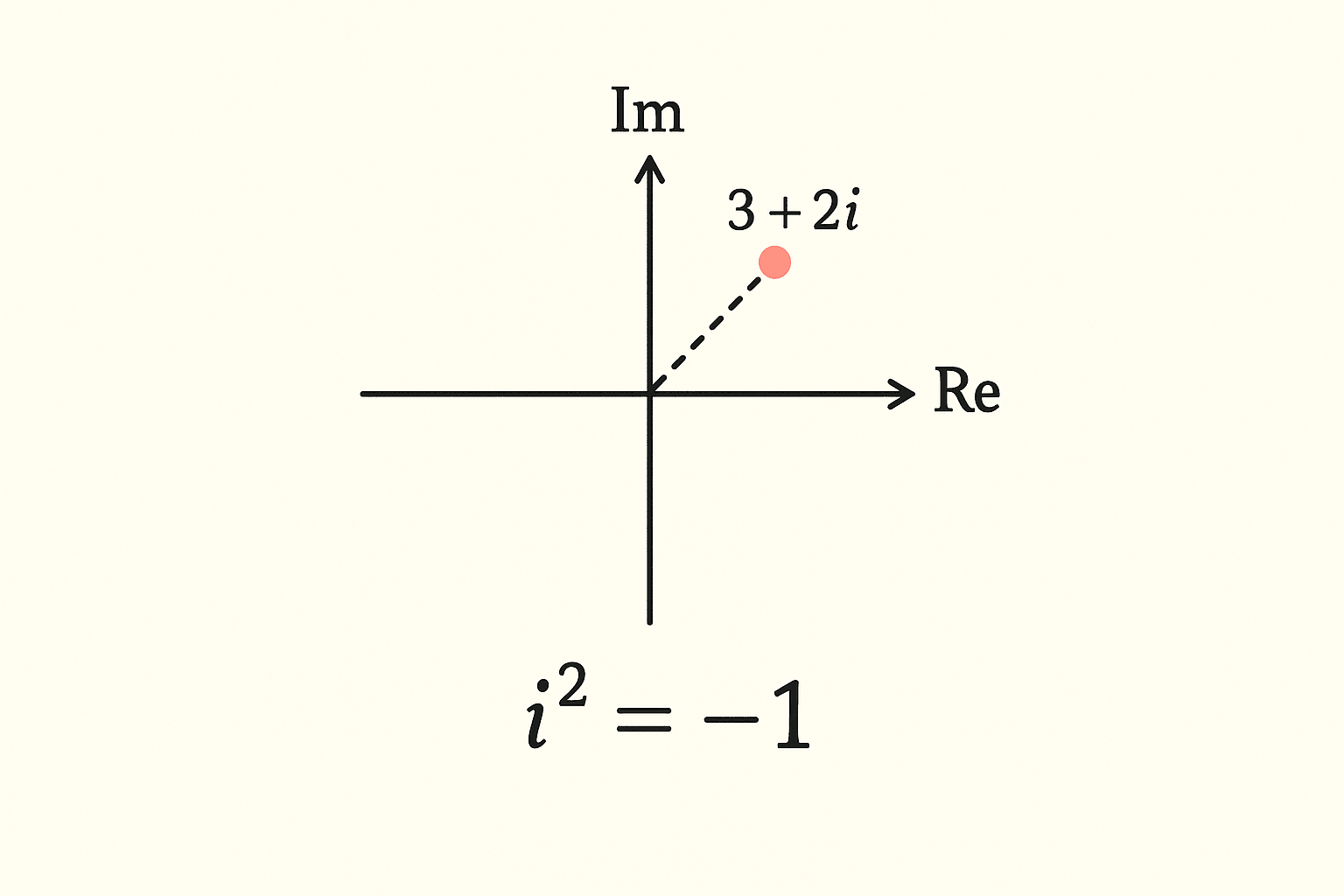
A complex number combines a real and imaginary part: \( z = a + bi \), where \( a \) is the real part and \( b \) is the imaginary part. Complex numbers are written with addition and multiplication that follow ordinary algebra plus the rule \( i^2 = -1 \).
Addition: \( (a + bi) + (c + di) = (a+c) + (b+d)i \).
Multiplication: \( (a + bi)(c + di) = ac + adi + bci + bdi^2 = (ac – bd) + (ad + bc)i \).
Complex conjugate: \( \overline{a+bi} = a – bi \). Multiplying a number by its conjugate gives a real number: \( (a+bi)(a-bi) = a^2 + b^2 \).
The Complex Plane
Just as real numbers fit on a number line, complex numbers fit on a 2D plane: the real part on the horizontal axis, the imaginary part on the vertical axis. Each complex number \( a + bi \) corresponds to the point \( (a, b) \). The distance from the origin is the modulus \( |z| = \sqrt{a^2 + b^2} \), and the angle from the positive real axis is the argument \( \arg(z) = \arctan(b/a) \).
Multiplying complex numbers becomes geometric: their moduli multiply and their arguments add. This is what makes complex numbers the natural language for rotation.
Why They Matter
- Algebra. Every non-constant polynomial with complex coefficients has a complex root (Fundamental Theorem of Algebra). The reals don’t have this property, \( x^2 + 1 = 0 \) has no real solution.
- Electrical engineering. AC circuits are analyzed using complex impedance \( Z = R + jX \) (engineers use \( j \) instead of \( i \) to avoid clashing with current). Voltage, current, and impedance combine via complex algebra rather than separate amplitude and phase equations.
- Quantum mechanics. The wave function \( \psi \) is fundamentally complex. The Schrödinger equation has \( i \) on the left-hand side; without imaginary numbers, quantum mechanics doesn’t exist.
- Signal processing. The Fourier transform decomposes signals into complex exponentials \( e^{i\omega t} \), a single complex equation that handles amplitude and phase simultaneously.
- Euler’s identity. \( e^{i\pi} + 1 = 0 \) connects the five fundamental constants in one line. It’s a special case of \( e^{i\theta} = \cos\theta + i\sin\theta \), which links exponentials to trigonometry.
Related study notes: Complex Numbers, Quadratic Equations, Euler’s Identity, Fourier Series.
The related OpenStax mathematics textbooks provide additional explanations and exercises for the mathematical definitions used here.
Powers and Square Roots
The powers \(i,i^2,i^3,i^4\) are \(i,-1,-i,1\), and the cycle repeats every 4 powers. Since 27 leaves remainder 3 on division by 4, \(i^{27}=-i\).
Solving \(z^2=-9\) gives the 2 roots \(z=\pm3i\). A principal square-root notation selects 1 root by convention, while an equation asks for all solutions. Also, the real positive-number rule for multiplying square roots cannot be applied indiscriminately to negative or complex arguments.
The points to check in this example are:
- i squared is -1 by definition.
- Complex solutions should be substituted into the original equation.
- A square-root function value and the solution set of a square equation are distinct.
Check Your Understanding
Try the questions before reading the answers.
Question 1. What is \(i^{100}\)?
Answer. 1.
Question 2. What is \((2i)(-3i)\)?
Answer. 6, since -6 times i squared is 6.
Practice Questions
Work each question before reading its solution. The set runs from direct recall and substitution to the applied questions that exams actually use to separate grades. The downloadable PDF includes these questions and their solutions.
Question 1. Define \(i\), and simplify \(\sqrt{-25}\).
Solution. \(i = \sqrt{-1}\), so \(i^2 = -1\) by definition, a genuinely new mathematical object rather than a real number in disguise. \(\sqrt{-25} = \sqrt{25}\times\sqrt{-1} = 5i\).
Question 2. Compute \(i^2\), \(i^3\), \(i^4\), and \(i^5\), and identify the pattern.
Solution. \(i^2 = -1\), \(i^3 = i^2\times i = -i\), \(i^4 = i^2\times i^2 = 1\), \(i^5 = i^4\times i = i\). The powers of \(i\) cycle with period 4: \(i, -1, -i, 1\), repeating forever. Any power of \(i\) reduces instantly by finding the remainder when the exponent is divided by 4.
Question 3. Find \(i^{47}\) using the cyclic pattern.
Solution. \(47 = 4\times11 + 3\), remainder 3, so \(i^{47} = i^3 = -i\). Massive imaginary powers collapse instantly once you know only the remainder mod 4 matters.
Question 4. Add \((3+4i) + (5-2i)\) and multiply \((3+4i)\times(5-2i)\).
Solution. Addition combines like terms: \((3+5) + (4-2)i = 8+2i\). Multiplication uses FOIL and \(i^2=-1\): \(15 -6i+20i-8i^2 = 15+14i-8(-1) = 15+14i+8 = 23+14i\). Complex arithmetic follows ordinary algebra rules, with the single extra fact \(i^2=-1\) folded in wherever it appears.
Question 5. Simplify \(\dfrac{1}{3+2i}\) by rationalizing the denominator.
Solution. Multiply top and bottom by the conjugate \(3-2i\): \(\dfrac{3-2i}{(3+2i)(3-2i)} = \dfrac{3-2i}{9+4} = \dfrac{3-2i}{13} = \dfrac{3}{13}-\dfrac{2}{13}i\). Multiplying by the conjugate always eliminates \(i\) from the denominator, because \((a+bi)(a-bi)=a^2+b^2\), a real number.
Question 6. Solve \(x^2+9=0\) over the complex numbers, and explain why this equation has no real solution.
Solution. \(x^2 = -9\), so \(x = \pm\sqrt{-9} = \pm3i\). No real number squares to a negative value, since any real number squared is nonnegative; imaginary numbers exist precisely to complete this gap, letting EVERY polynomial equation have a full set of roots.
Question 7. Use the quadratic formula to solve \(x^2 – 4x + 13 = 0\), and identify the resulting complex conjugate pair.
Solution. \(x = \dfrac{4 \pm \sqrt{16-52}}{2} = \dfrac{4\pm\sqrt{-36}}{2} = \dfrac{4\pm6i}{2} = 2\pm3i\). Whenever a quadratic’s discriminant is negative, the 2 roots always come as a complex conjugate pair, \(a+bi\) and \(a-bi\), never as unrelated complex numbers.
Question 8. State the Fundamental Theorem of Algebra, and explain its connection to imaginary numbers.
Solution. Every polynomial equation of degree \(n\) has exactly \(n\) roots (counted with multiplicity) over the COMPLEX numbers. Real numbers alone are insufficient, as \(x^2+1=0\) shows; only by extending to complex numbers does every polynomial’s root count match its degree exactly, making the complex numbers, not the reals, the natural complete arena for algebra.
Question 9. Explain 1 genuine engineering application of complex/imaginary numbers: how electrical engineers use \(j\) (their notation for \(i\)) to describe AC circuit impedance.
Solution. Resistors, capacitors, and inductors each affect an AC signal differently: resistors resist in-phase, but capacitors and inductors shift the current’s phase relative to voltage by 90° in OPPOSITE directions. Representing impedance as a complex number \(Z = R + jX\) (with \(X\) positive for inductors, negative for capacitors) captures both the magnitude AND the phase shift in a single algebraic object, letting engineers combine circuit elements using ordinary complex-number arithmetic instead of separate trigonometric phase-tracking.
Question 10. The Mandelbrot set, a famous fractal, is defined using the complex iteration \(z_{n+1} = z_n^2 + c\). Explain in general terms why complex numbers, rather than just real numbers, are essential for this iteration to produce its characteristic 2-dimensional fractal structure.
Solution. A single real number lives on a 1-dimensional number line, so real-number iteration can only ever produce a 1-dimensional pattern. A complex number \(a+bi\) inherently carries 2 independent real components (its real and imaginary parts), letting it represent a point in a full 2-dimensional PLANE; iterating in this plane is what allows the Mandelbrot set’s famously intricate, infinitely detailed 2-dimensional boundary to emerge, a structure that a purely real-valued iteration could never generate.
Frequently Asked Questions
What is an imaginary number?
An imaginary number is a multiple of the imaginary unit i, where i is defined by i² = -1. Examples: 3i, -7i, i√5. The square root of any negative number is imaginary: √(-16) = 4i. Imaginary numbers don’t appear on the standard real number line, they live on a perpendicular axis.
Are imaginary numbers real?
Yes, they’re as mathematically valid as any other numbers. The label ‘imaginary’ is a 17th-century historical accident, Descartes used it dismissively. Today, imaginary and complex numbers are essential in physics (quantum mechanics, electromagnetism), engineering (AC circuits, signal processing), and pure mathematics. They describe real, measurable phenomena.
What is i squared?
i² = -1, by definition. From this single rule, you can derive everything else about imaginary and complex numbers. Higher powers cycle: i¹ = i, i² = -1, i³ = -i, i⁴ = 1, and then they repeat.
What’s the difference between imaginary and complex numbers?
An imaginary number is purely a multiple of i (like 5i or -2i). A complex number is the sum of a real part and an imaginary part: a + bi where a and b are real. Every imaginary number is also complex (with a = 0), and every real number is also complex (with b = 0). The complex numbers contain both as special cases.
Why use imaginary numbers in physics?
They make the math cleaner. AC circuit analysis collapses into single complex equations instead of paired amplitude and phase calculations. Quantum mechanics fundamentally requires complex wave functions, the Schrödinger equation has an i in it. Fourier analysis (used in audio, image, and signal processing) is naturally expressed using complex exponentials. In each case, two real equations become one complex equation.
Who invented imaginary numbers?
They emerged in 16th-century Italy during the search for solutions to cubic equations. Cardano (1545) encountered them but called them ‘sophistic’. Rafael Bombelli (1572) worked out their algebra. Euler introduced the symbol i in the 1700s and showed e^(iπ) + 1 = 0. Gauss popularized the geometric interpretation as points on a plane and coined ‘complex number’. Today they’re foundational across mathematics and physics.
Browse more in Mathematics.