by
by
The Fundamental Theorem of Algebra states that every non-constant polynomial with complex coefficients has at least one complex root. As a direct consequence, a polynomial of degree \( n \) has exactly \( n \) complex roots, counted with multiplicity. Conjectured by Albert Girard in 1629, the theorem was given its first widely accepted (though still incomplete) proof by Gauss in 1799 and made fully rigorous in the 20th century. It’s the reason mathematicians work over the complex numbers, \( \mathbb{C} \) is the smallest number system where polynomials always factor completely.
The theorem counts roots with multiplicity over the complex numbers. Distinct roots and repeated roots should be kept separate.
Statement
Every non-constant polynomial \( P(z) = a_n z^n + a_{n-1} z^{n-1} + \cdots + a_0 \) with complex coefficients (and \( a_n \neq 0 \)) has at least one complex root. Equivalently, \( P(z) \) factors completely over \( \mathbb{C} \) as:
$$ P(z) = a_n (z – r_1)(z – r_2) \cdots (z – r_n) $$
where the \( r_i \) are complex numbers (the roots, possibly with repetition).
Why It Matters
Over the real numbers, not every polynomial factors. \( x^2 + 1 \) has no real roots, it stays strictly positive. To factor it, you need to extend the number system to include \( i = \sqrt{-1} \). The remarkable surprise is that this single extension is enough: once you have \( \mathbb{C} \), every polynomial of any degree factors completely. No further extension is necessary. Mathematicians call this property algebraic closure, and \( \mathbb{C} \) is the algebraic closure of \( \mathbb{R} \).
Counting Roots with Multiplicity
A polynomial of degree \( n \) has exactly \( n \) roots when each root is counted by its multiplicity. The multiplicity of a root \( r \) is the largest power \( k \) such that \( (z – r)^k \) divides \( P(z) \).
Example. \( P(z) = (z – 2)^3 (z + 1) \) has degree 4. Roots: 2 (multiplicity 3) and \( -1 \) (multiplicity 1). Total = 4 = degree.
Real Polynomials and Conjugate Pairs
If a polynomial has real coefficients, complex roots come in conjugate pairs: if \( z = a + bi \) is a root, so is \( \bar{z} = a – bi \). So a real polynomial of odd degree always has at least one real root (an odd-degree polynomial graph crosses the x-axis). A real polynomial of even degree may have no real roots, all \( n \) roots can be in conjugate pairs.
Example. \( P(x) = x^2 + 1 \) has degree 2, real coefficients, no real roots, the two complex roots are \( i \) and \( -i \), conjugates.
Why the Theorem Is True (Sketch)
The cleanest modern proof uses the fact that \( |P(z)| \to \infty \) as \( |z| \to \infty \). So \( |P(z)| \) has a minimum somewhere in the complex plane. Suppose for contradiction that the minimum value is positive (i.e., \( P \) has no zeros). A clever local argument shows that \( |P(z)| \) can always be decreased slightly by moving \( z \) in the right direction, contradiction. So the minimum must be zero, meaning \( P \) has a root. Gauss gave several different proofs, but they all use topology of the plane in some form.
Real and Complex Roots: A Worked Example
Find all roots of \( P(z) = z^4 – 1 \).
Factor: \( z^4 – 1 = (z^2 – 1)(z^2 + 1) = (z-1)(z+1)(z-i)(z+i) \). The four roots are \( 1, -1, i, -i \). Total = 4 = degree, as the theorem promises. The two real roots and two imaginary roots form conjugate pairs because the coefficients are all real.
Limits of the Theorem
The theorem guarantees the existence of roots but doesn’t give a formula for finding them. For degree 2, the quadratic formula works. For degrees 3 and 4, Cardano and Ferrari gave closed-form solutions in the 1500s. But Galois (1832) proved that no general formula in radicals exists for polynomials of degree 5 or higher, the famous unsolvability of the quintic. Roots still exist by the Fundamental Theorem of Algebra; they just can’t always be expressed using +, -, ·, ÷, and \\( n \\)-th roots.
Applications
- Algorithm design. Many numerical methods (Durand-Kerner, Jenkins-Traub, Aberth) approximate all roots of a polynomial, they’re guaranteed by the Fundamental Theorem to exist.
- Signal processing. Filter design analyzes the roots (poles and zeros) of transfer functions. Knowing all roots exist in the complex plane is essential for stability analysis.
- Control systems. Pole placement uses the fact that any desired closed-loop polynomial can be assigned by feedback, the theorem guarantees the corresponding roots exist.
- Pure mathematics. The theorem underpins much of algebra and complex analysis, the algebraic closure property of \( \mathbb{C} \) is constantly used in proofs.
Related study notes: Imaginary Numbers, Complex Numbers, Quadratic Equations, Polynomials.
The related OpenStax mathematics textbooks provide additional explanations and exercises for the mathematical definitions used here.
Five Roots and Multiplicity
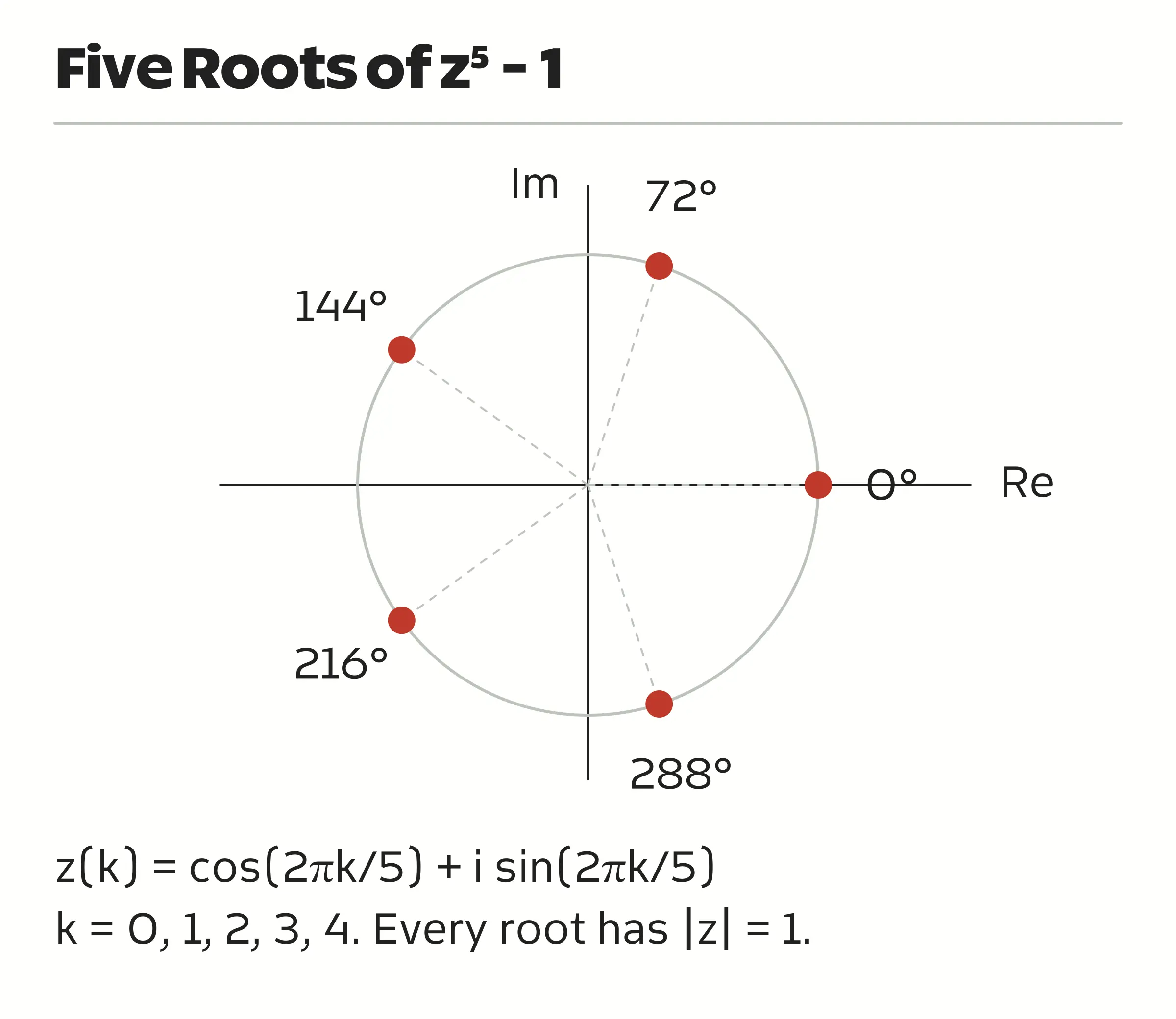
The roots of \(z^5-1\) are \(z_k=e^{2\pi ik/5}\) for \(k=0,1,2,3,4\). Their angles are 0°, 72°, 144°, 216° and 288°, all on the unit circle. Raising each to the fifth power gives 1. There are 5 distinct roots because none is repeated.
Compare \((z-2)^3(z+1)^2\). It has degree 5 but only 2 distinct roots. Their multiplicities 3 and 2 add to 5, which is the count guaranteed by the theorem. The theorem establishes existence over the complex numbers; it does not promise a formula using radicals for every polynomial.
The points to check in this example are:
- The polynomial must be nonconstant.
- Roots are counted with algebraic multiplicity.
- A real-coefficient polynomial has its nonreal roots in conjugate pairs.
Check Your Understanding
Try the questions before reading the answers.
Question 1. How many roots does \(z^4+1\) have over the complex numbers?
Answer. 4, counted with multiplicity.
Question 2. Can a degree-five real polynomial have no real root?
Answer. No. Its nonreal roots occur in conjugate pairs, leaving at least 1 real root.
Frequently Asked Questions
What is the Fundamental Theorem of Algebra?
Every non-constant polynomial with complex coefficients has at least one complex root. By induction, a polynomial of degree n has exactly n complex roots, counted with multiplicity. This makes the complex numbers algebraically closed, no further number system is needed for polynomial factoring.
Why is it called the ‘fundamental’ theorem?
Because it answers the most basic question in algebra: do polynomial equations have solutions? Over the integers, rationals, or reals, the answer is sometimes no. Over the complex numbers, the answer is always yes. This makes ℂ the natural setting for algebra and is why complex numbers, once dismissed as ‘imaginary’, are essential to modern mathematics.
Who proved the Fundamental Theorem of Algebra?
Carl Friedrich Gauss gave the first widely accepted proof in his 1799 doctoral dissertation, though by modern standards it still had a gap (closed in 1920). The theorem had been conjectured much earlier by Albert Girard (1629) and stated by others including d’Alembert. Gauss gave several proofs over his career, each using different ideas.
Does the theorem apply to real polynomials?
Yes, any polynomial with real coefficients is also a complex polynomial (with imaginary parts of coefficients equal to zero). So a real polynomial of degree n has exactly n complex roots. Some may be real; the rest occur in complex conjugate pairs. A real polynomial of odd degree always has at least one real root.
Can I always find the roots explicitly?
No, the theorem only guarantees existence, not a formula. Degree 2 has the quadratic formula; degrees 3 and 4 have Cardano’s and Ferrari’s formulas. Évariste Galois proved in 1832 that no formula in radicals exists for the general quintic (degree 5) or higher. Roots still exist; numerical methods can approximate them to arbitrary precision.
What does ‘multiplicity’ mean for roots?
The multiplicity of a root r is the largest exponent k for which (z − r)^k divides the polynomial. P(z) = (z − 3)²(z + 1) has root 3 with multiplicity 2 and root −1 with multiplicity 1. When you count by multiplicity, a degree-n polynomial has exactly n roots.
Browse more in Mathematics.