by
by
The golden ratio, denoted by the Greek letter \( \varphi \) (phi), is an irrational number approximately equal to 1.6180339887. It appears as the ratio of consecutive Fibonacci numbers in the limit, as the proportion of certain nested rectangles that stay similar to themselves, and as a convenient approximation in art and architecture. Like most mathematical celebrities, the golden ratio is widely mythologized and frequently overclaimed, this note covers what it really is, what it really does, and which of the famous applications are actually backed by the math.
The golden ratio comes from a precise proportionality condition. Its decimal value should not be used as evidence that every pleasing object follows that condition.
The Definition
The golden ratio is the unique positive number satisfying:
$$ \dfrac{a + b}{a} = \dfrac{a}{b} = \varphi $$
In words: take a line segment and divide it so the ratio of the longer part to the shorter part equals the ratio of the whole to the longer part. That ratio is \( \varphi \).
Solving the equation \( \dfrac{a+b}{a} = \dfrac{a}{b} \) gives:
$$ \varphi = \dfrac{1 + \sqrt{5}}{2} = 1.6180339887\ldots $$
This is an exact algebraic value, not a decimal approximation. \( \varphi \) is irrational and is the positive root of the quadratic equation \( x^2 – x – 1 = 0 \).
Key Properties
- Self-similarity: \( \varphi^2 = \varphi + 1 \). Squaring \( \varphi \) gives \( \varphi \) plus 1.
- Reciprocal property: \( 1/\varphi = \varphi – 1 \approx 0.6180339887 \). The reciprocal differs from \( \varphi \) by exactly 1.
- Recursion: \( \varphi = 1 + 1/\varphi \). \( \varphi \) is its own continued fraction’s limit.
- Continued fraction: \( \varphi = 1 + \cfrac{1}{1 + \cfrac{1}{1 + \cfrac{1}{1 + \cdots}}} \). The simplest infinite continued fraction in mathematics.
- Powers: \( \varphi^n = F_n \varphi + F_{n-1} \), where \( F_n \) is the \( n \)-th Fibonacci number. Each power of \( \varphi \) is a linear combination of \( \varphi \) and 1 with Fibonacci coefficients.
Connection to the Fibonacci Sequence
The most striking property of \( \varphi \) is its connection to the Fibonacci sequence. The ratio of consecutive Fibonacci numbers approaches \( \varphi \):
$$ \lim_{n \to \infty} \dfrac{F_{n+1}}{F_n} = \varphi $$
Numerically: 2/1 = 2.0, 3/2 = 1.5, 5/3 ≈ 1.667, 8/5 = 1.6, 13/8 = 1.625, 21/13 ≈ 1.615, 34/21 ≈ 1.619, 55/34 ≈ 1.618. Convergence to four decimal places by the 10th term.
Binet’s formula expresses Fibonacci numbers in terms of \( \varphi \) directly: \( F_n = (\varphi^n – \psi^n)/\sqrt{5} \), where \( \psi = (1 – \sqrt{5})/2 \). Because \( |\psi| < 1 \), the \( \psi^n \) term shrinks rapidly, and for practical purposes \( F_n \approx \varphi^n / \sqrt{5} \) rounded to the nearest integer.
The Golden Rectangle and Golden Spiral
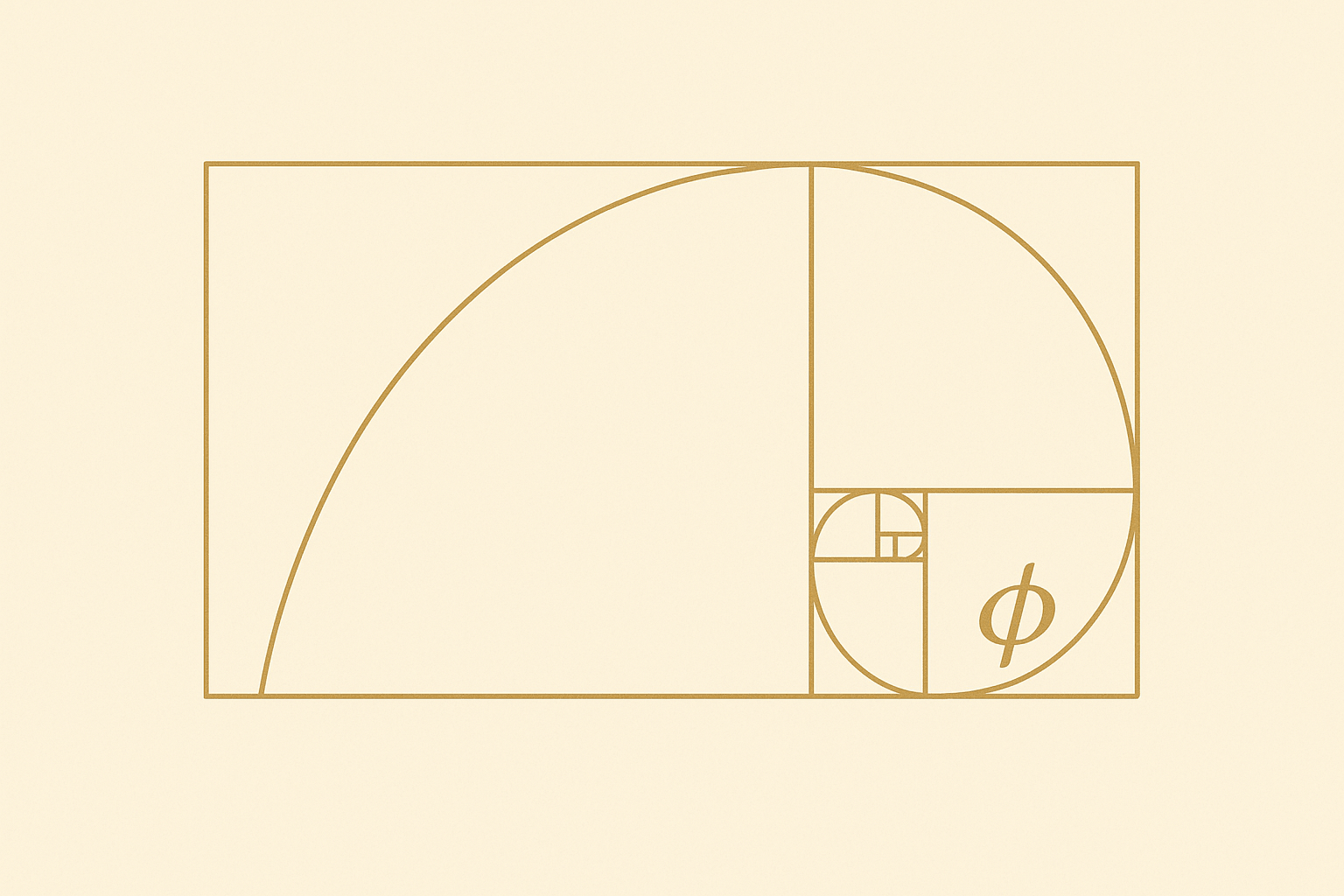
A golden rectangle has side ratio \( \varphi : 1 \). Its defining property: if you cut a square off one end, the remaining rectangle is also golden, same proportions, smaller. You can keep cutting squares off forever and every remaining rectangle stays golden.
Connect quarter-circle arcs through each successive square and you get the golden spiral, a piecewise approximation of the true logarithmic spiral with growth factor \( \varphi \) per quarter turn. The two curves are not identical (the golden spiral is built from circular arcs, the true logarithmic spiral is smooth), but they look visually similar at typical scales.
Where the Golden Ratio Actually Shows Up
- Phyllotaxis. The arrangement of leaves, seeds, and petals on plants often follows the golden angle (137.5° = 360° / \( \varphi^2 \)). Turning by the golden angle between successive structures maximizes light capture and packing efficiency. Sunflower heads, pinecones, and pineapples show this clearly. This is real and well-documented.
- Pentagonal symmetry. The regular pentagon’s diagonal-to-side ratio is exactly \( \varphi \). This appears in starfish, certain viruses (HIV capsid), and quasicrystals (Shechtman’s 2011 Nobel).
- Logarithmic spirals in shells. Nautilus and snail shells grow in approximately logarithmic spirals, but most natural spirals are not golden spirals. The growth factor varies by species; nautilus is closer to 1.33, not \( \varphi \).
- Number theory. \( \varphi \) is the ‘most irrational’ number in a precise sense: of all irrational numbers, it is the hardest to approximate by rationals. This makes it useful in random-number generation and certain numerical methods.
- Algorithms. The golden-section search algorithm uses \( \varphi \) to efficiently find the maximum or minimum of a unimodal function.
Where the Golden Ratio Is Overclaimed
The golden ratio is the most overhyped number in mathematics. Several famous claims do not survive close examination.
- The Parthenon does not use \( \varphi \). The proportions cited as golden depend heavily on which measurements you pick. Different historians get different numbers; the ratio of the facade is closer to 9/5 (1.8) than to \( \varphi \) (1.618).
- Da Vinci’s Vitruvian Man uses integer ratios, not \( \varphi \). The proportions are explicitly 1:8 (head to body), 1:10 (head to fingertip), and so on. Da Vinci’s notes refer to Vitruvius’s integer proportions, not to the golden ratio.
- The human body does not match \( \varphi \) ratios reliably. Claims about navel-to-foot ratios, finger bones, facial proportions, etc., are usually motivated reasoning. Pick enough measurements and some will be close to 1.618 by chance.
- The Great Pyramid is not built on \( \varphi \). The slope angle approximates \( \arctan(4/\pi) \), which is close to \( \varphi \) but not equal to it. Whether the Egyptians intended either is debated; most likely they used integer ratios.
- Stock market ‘Fibonacci retracements’ (23.6%, 38.2%, 50%, 61.8%) are widely used by technical traders. The predictive value is heavily debated and most academic studies find no statistical edge.
Why the Overclaim Exists
Three reasons the golden ratio gets mythologized far beyond what the math justifies:
- It’s irrational and recursive. The continued-fraction expression \( \varphi = 1 + 1/(1 + 1/(1 + \ldots)) \) feels deep, and humans find irrational constants intriguing.
- It really does show up in phyllotaxis and quasicrystals. Those genuine appearances give cover for many more spurious claims.
- Pareidolia in numbers. Take enough measurements of any complex structure (a building, a body, a painting) and some ratios will land near 1.618 by chance. Confirmation bias does the rest.
Related study notes: Fibonacci Sequence, Complex Numbers, Quadratic Formula, Triangle Inequality.
The related OpenStax mathematics textbooks provide additional explanations and exercises for the mathematical definitions used here.
Deriving the Rectangle Ratio
Let a rectangle have height 1 and width \(\varphi>1\). Removing a unit square leaves a rectangle with sides 1 and \(\varphi-1\). Requiring the smaller rectangle to have the same proportions gives \(\varphi=1/(\varphi-1)\), hence \(\varphi^2-\varphi-1=0\).
The positive solution is \((1+\sqrt5)/2\), approximately 1.618. The other root is negative and is rejected for a positive length ratio. This construction explains the number mathematically; an approximate visual resemblance in a building or painting needs separate measurements before it establishes intentional use.
The points to check in this example are:
- The ratio is dimensionless.
- The identity φ squared = φ + 1 follows from the defining quadratic.
- Fibonacci ratios approach φ; finite consecutive terms do not equal it exactly.
Check Your Understanding
Try the questions before reading the answers.
Question 1. What is 1/φ in terms of φ?
Answer. φ – 1.
Question 2. Can a rectangle with ratio 1.60 be exactly golden?
Answer. No. It may approximate the ratio, but its measured ratio is different.
Practice Questions
Work each question before reading its solution. The set runs from direct recall and substitution to the applied questions that exams actually use to separate grades. The downloadable PDF includes these questions and their solutions.
Question 1. Define the golden ratio from its self-similarity property and compute its value.
Solution. Divide a segment into parts \(a > b\) so the whole relates to the large part as the large part relates to the small: \(\frac{a+b}{a} = \frac{a}{b}\). Calling the ratio \(\varphi\) gives \(\varphi = 1 + \frac{1}{\varphi}\), so \(\varphi^2 = \varphi + 1\) and \(\varphi = \frac{1 + \sqrt{5}}{2} \approx 1.6180\).
Question 2. Verify algebraically that \(\varphi^2 = \varphi + 1\).
Solution. \(\varphi^2 = \left(\frac{1+\sqrt{5}}{2}\right)^2 = \frac{6 + 2\sqrt{5}}{4} = \frac{3 + \sqrt{5}}{2}\), and \(\varphi + 1 = \frac{3 + \sqrt{5}}{2}\). Equal. This single identity generates the whole arithmetic of \(\varphi\): every power of \(\varphi\) reduces to \(a\varphi + b\).
Question 3. Show that \(1/\varphi = \varphi – 1\), and note why that is unusual.
Solution. Divide \(\varphi^2 = \varphi + 1\) by \(\varphi\): \(\varphi = 1 + 1/\varphi\), so \(1/\varphi = \varphi – 1 \approx 0.618\). The reciprocal keeps the same decimal digits, a property no other positive number has.
Question 4. Compute \(\varphi^3\) in the form \(a\varphi + b\).
Solution. \(\varphi^3 = \varphi \cdot \varphi^2 = \varphi(\varphi + 1) = \varphi^2 + \varphi = (\varphi + 1) + \varphi = 2\varphi + 1 \approx 4.236\). Every power collapses this way, with Fibonacci numbers as the coefficients: \(\varphi^n = F_n\varphi + F_{n-1}\).
Question 5. How do the Fibonacci numbers approach \(\varphi\)? Compute 2 consecutive ratios to show the alternation.
Solution. \(F_9/F_8 = 34/21 \approx 1.6190\) sits above \(\varphi\); \(F_{10}/F_9 = 55/34 \approx 1.6176\) sits below. Consecutive Fibonacci ratios close in on \(\varphi\) from alternating sides, and the error shrinks by roughly a factor of \(\varphi^2 \approx 2.6\) each step.
Question 6. A golden rectangle has its short side equal to 1. Remove the largest possible square. What are the proportions of the leftover rectangle?
Solution. The rectangle is \(\varphi \times 1\); removing a \(1 \times 1\) square leaves \((\varphi – 1) \times 1\), which is \(\frac{1}{\varphi} \times 1\). Its long-to-short ratio is \(1 : (\varphi – 1) = \varphi\) again. The leftover is another golden rectangle, which is why the square-removal process repeats forever and hosts the classic spiral.
Question 7. What is the golden angle, and why does it matter in plant growth?
Solution. It divides the full circle in the golden ratio: \(360°/\varphi^2 \approx 137.5°\). A plant placing each new leaf or floret at this angle never repeats a direction exactly, because \(\varphi\) is the number least well approximated by fractions. The result is the most even packing, and spiral counts come out as Fibonacci numbers.
Question 8. Solve \(x^2 = x + 1\) and identify both roots in golden-ratio terms.
Solution. \(x = \frac{1 \pm \sqrt{5}}{2}\): the positive root is \(\varphi \approx 1.618\), the negative is \(-1/\varphi \approx -0.618\), often written \(\psi\). Both roots power Binet’s Fibonacci formula.
Question 9. The continued fraction \(1 + \cfrac{1}{1 + \cfrac{1}{1 + \cdots}}\) equals what, and what does it imply?
Solution. Calling it \(x\) gives \(x = 1 + 1/x\), the golden equation, so \(x = \varphi\). All-ones is the slowest-converging continued fraction possible, which makes \(\varphi\) the “most irrational” number: the hardest to approximate by fractions. That is precisely the property plants exploit.
Question 10. The Parthenon and the Mona Lisa are often claimed to embody the golden ratio. What does the evidence say?
Solution. Careful measurement does not support most of these claims: the fits require cherry-picked framing lines, and no design documents mention \(\varphi\). Genuine appearances are mathematical (pentagons, Fibonacci, phyllotaxis, quasicrystals). Treat art-and-architecture claims as folklore unless the artist documented the construction, as Dalí did.
Frequently Asked Questions
What is the golden ratio in simple words?
The golden ratio φ (phi) is the irrational number (1 + √5) / 2, approximately 1.6180339887. It’s defined by the property that if you split a line segment so the longer part divided by the shorter part equals the whole divided by the longer part, both ratios equal φ. It’s the unique positive solution to the equation x² = x + 1.
Why is the golden ratio called ‘golden’?
The name ‘golden ratio’ (sectio aurea in Latin) became widespread in the 19th century. Earlier names included ‘divine proportion’ (Luca Pacioli, 1509) and ‘extreme and mean ratio’ (going back to Euclid). The ‘golden’ label reflects the aesthetic mystique it acquired in Renaissance Europe, not any specific mathematical property.
How is φ related to the Fibonacci sequence?
The ratio of consecutive Fibonacci numbers approaches φ in the limit: F(n+1)/F(n) → φ as n → ∞. So 2/1 = 2, 3/2 = 1.5, 5/3 ≈ 1.667, 8/5 = 1.6… → 1.618. Binet’s formula expresses Fibonacci numbers directly as F(n) = (φⁿ – ψⁿ)/√5.
Does the golden ratio really appear in nature?
Yes, but for specific reasons. The arrangement of leaves and seeds (phyllotaxis) often uses the golden angle (137.5°) because turning by that angle between successive structures maximizes light capture and packing efficiency. Pentagonal symmetry in starfish and HIV capsids is genuinely related to φ. But many famous claims (Parthenon proportions, body ratios, Da Vinci paintings) don’t survive scrutiny.
Is the golden ratio in the Parthenon and Mona Lisa?
Almost certainly not. The Parthenon’s proportions don’t match φ when you measure them carefully, the facade ratio is closer to 9/5 (1.8). Da Vinci’s notebooks reference Vitruvius’s integer proportions, not the golden ratio. The ‘golden rectangle overlaid on the Mona Lisa’ images circulating online are post-hoc constructions, not Da Vinci’s design.
What is the golden angle?
The golden angle is approximately 137.5077°. It is 360° divided by φ², or equivalently 360° × (1 – 1/φ). It is the smaller of the two angles created when a circle’s circumference is divided in the golden ratio. The golden angle shows up in phyllotaxis: when leaves or seeds are added by rotating this angle between each new one, the result is the most efficient packing possible.
Browse more in Mathematics.