by
by
Isotopes are atoms of the same element with different numbers of neutrons. Same number of protons (so same element, same chemistry), different number of neutrons (so different mass, different nuclear behavior). Carbon, for example, has three naturally-occurring isotopes: carbon-12 (6 protons + 6 neutrons, 99% of natural carbon), carbon-13 (6+7, about 1%), and carbon-14 (6+8, trace amounts, radioactive). Understanding isotopes is the foundation of radiocarbon dating, medical PET scans, nuclear power, and the mass-spectrometry techniques behind drug discovery.
Isotopes retain the same proton count while differing in neutron count. Mass number is an integer count, while tabulated relative atomic mass can be an abundance-weighted value.
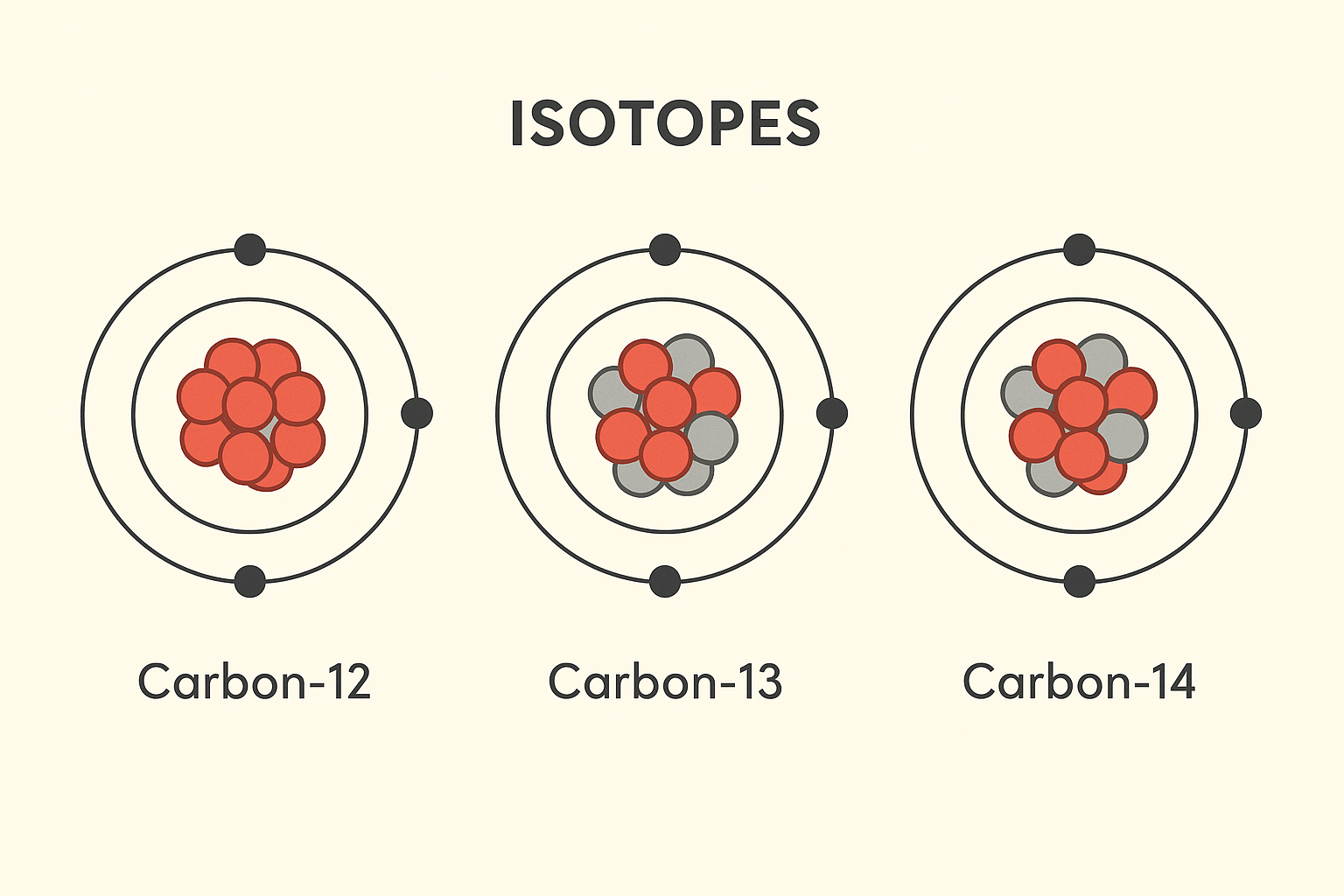
What Isotopes Are
Two key numbers describe any atomic nucleus:
- Atomic number (Z) = number of protons. This defines the element. Every carbon atom has Z = 6. Every gold atom has Z = 79. Z never changes for a given element.
- Mass number (A) = total nucleons = protons + neutrons. This can vary among atoms of the same element. Carbon-12 has A = 12, carbon-13 has A = 13, carbon-14 has A = 14.
Isotopes are atoms with the same Z but different A, same element, different mass numbers. The notation is the element symbol with the mass number as a superscript on the left: ¹²C, ¹³C, ¹⁴C. Sometimes written as ‘carbon-12’ in text.
Number of neutrons (N) = A – Z. For carbon-14: 14 – 6 = 8 neutrons.
How Isotopes Differ
- Chemistry: nearly identical. Chemical reactions depend on electron configuration, which depends on Z, not A. So isotopes of the same element react chemically in essentially the same way. The mass difference produces tiny kinetic isotope effects, but these are negligible for most purposes.
- Mass: slightly different. A carbon-13 atom is about 8.3% heavier than a carbon-12 atom. The difference matters for density calculations, separation techniques, and any process that depends on mass directly (mass spectrometry, centrifugation).
- Nuclear stability: varies significantly. Some isotopes are stable (no radioactive decay). Others are radioactive (unstable nuclei that decay over time with characteristic half-lives). Carbon-12 and carbon-13 are stable; carbon-14 is radioactive with a half-life of 5,730 years.
Stable vs Radioactive Isotopes
Whether an isotope is stable depends on its proton-to-neutron ratio. For light elements (Z < 20), stability favors roughly equal numbers of protons and neutrons. For heavier elements, more neutrons are needed to dilute the proton-proton electrostatic repulsion, the ratio shifts above 1.5 for elements like uranium.
Of the 118 known elements, only 80 have at least one stable isotope. The other 38 (all elements with Z = 43 = technetium, 61 = promethium, and 84-118 = polonium through oganesson) are entirely radioactive, every isotope of every one of these elements decays over time.
Of the roughly 3,300 known isotopes, only about 270 are stable. The rest, about 90%, are radioactive.
Radioactive Decay Modes
Unstable nuclei decay in three main ways, each named for the kind of radiation emitted:
- Alpha decay (α). The nucleus emits an alpha particle (a helium-4 nucleus: 2 protons + 2 neutrons). The atomic number drops by 2, the mass number drops by 4. Common in heavy elements (Z > 82). Uranium-238 decays this way: ²³⁸U → ²³⁴Th + α.
- Beta decay (β). A neutron converts to a proton (β⁻ decay) or a proton converts to a neutron (β⁺ decay). Mass number stays the same; atomic number changes by ±1. Carbon-14 undergoes β⁻ decay: ¹⁴C → ¹⁴N + electron + antineutrino.
- Gamma decay (γ). The nucleus is in an excited state and drops to the ground state by emitting a high-energy photon (gamma ray). No change in Z or A. Often follows alpha or beta decay as the daughter nucleus settles.
Half-Life
Radioactive decay is statistical: any individual unstable nucleus has a fixed probability of decaying per unit time, but you can’t predict exactly when. The macroscopic measure is the half-life \\( t_{1/2} \\): the time for half of a sample to decay. Half-lives range from microseconds to billions of years depending on the isotope.
The number of remaining radioactive nuclei after time \\( t \\) is:
$$ N(t) = N_0 \left(\frac{1}{2}\right)^{t/t_{1/2}} = N_0 e^{-\lambda t} $$
Where \\( \\lambda = \\ln 2 / t_{1/2} \\) is the decay constant. After 1 half-life, 50% remains. After 2, 25%. After 10 half-lives, less than 0.1% remains.
Selected half-lives: carbon-14 = 5,730 years, iodine-131 = 8 days, polonium-214 = 164 microseconds, uranium-238 = 4.5 billion years, bismuth-209 = 2 × 10¹⁹ years (so long it was thought stable until 2003).
Real-World Uses of Isotopes
- Radiocarbon dating. Carbon-14’s 5,730-year half-life makes it ideal for dating organic material up to about 50,000 years old. Used in archaeology, geology, and forensic science.
- Medical imaging (PET scans). Inject a small amount of fluorine-18 attached to a glucose analog. The fluorine emits positrons that annihilate with electrons, producing detectable gamma rays. Reveals metabolic activity in real time, heavily used in cancer diagnosis.
- Radiation therapy. Cobalt-60 and iodine-131 are used to kill cancer cells with targeted radiation.
- Nuclear power. Uranium-235 is fissile (sustains a chain reaction); uranium-238 is not. Enriched uranium fuel contains a higher percentage of U-235 than natural uranium.
- Smoke detectors. Americium-241 (alpha emitter) ionizes air molecules; smoke particles disrupt the ionization current and trigger the alarm.
- Stable isotope tracers. Deuterium (²H) and ¹³C are used in biochemistry and pharmacology to trace metabolic pathways without involving radioactivity.
Related study notes: Periodic Table, Avogadro’s Number, Exponential Function, Electronegativity.
The OpenStax chemistry textbooks provide further explanations of the chemical principles used in this note.
Neutrons and an Average Mass
Carbon-12 has 6 protons and 6 neutrons; carbon-14 has 6 protons and 8 neutrons. Both are carbon because their atomic number is 6. A carbon ion changes its electron count rather than becoming a new isotope.
For a hypothetical element with isotope masses 10 and 11 in abundance proportions 20% and 80%, the weighted mass is 0.2 × 10 + 0.8 × 11 = 10.8. A fractional periodic-table value therefore does not describe an atom with a fractional neutron. Real isotope masses need not equal their integer mass numbers exactly.
The points to check in this example are:
- Neutron count is mass number minus atomic number.
- Isotopes can differ in stability and nuclear behavior.
- Their chemistry is broadly similar, with isotope effects possible because their masses differ.
Check Your Understanding
Try the questions before reading the answers.
Question 1. How many neutrons are in carbon-13?
Answer. 7.
Question 2. Does removing an electron change the carbon isotope?
Answer. No. It changes the ionization state.
Frequently Asked Questions
What are isotopes?
Isotopes are atoms of the same chemical element that have different numbers of neutrons. They share the same number of protons (so they are the same element with the same chemistry) but different mass numbers. Carbon has three naturally-occurring isotopes: carbon-12, carbon-13, and carbon-14, differing by neutron count.
How are isotopes chemically different?
Barely. Chemical reactions depend on electron configuration, which depends only on the number of protons (atomic number). Different isotopes of the same element have the same electron configuration and react chemically in essentially the same way. The mass difference produces tiny kinetic isotope effects but these are negligible for most everyday chemistry.
Why are some isotopes radioactive and others stable?
Nuclear stability depends on the proton-to-neutron ratio. For light elements (Z < 20), roughly equal numbers of protons and neutrons are stable. For heavier elements, more neutrons are needed to dilute the proton-proton electrostatic repulsion. Isotopes outside the 'stability band' undergo radioactive decay to move toward more stable configurations. About 270 of the ~3,300 known isotopes are stable; the rest are radioactive.
What is half-life?
Half-life is the time it takes for half of a sample of a radioactive isotope to decay. After one half-life, 50% remains; after two, 25%; after ten, less than 0.1%. Carbon-14 has a half-life of 5,730 years. Iodine-131 has 8 days. Uranium-238 has 4.5 billion years. The half-life is a constant for a given isotope, independent of sample size or external conditions.
How does radiocarbon dating work?
Living organisms continuously exchange carbon with the atmosphere, maintaining a constant ratio of carbon-14 to carbon-12. When the organism dies, the exchange stops and the carbon-14 decays at a known rate (half-life 5,730 years). Measuring the remaining ratio gives the time since death. Useful for organic materials up to about 50,000 years old.
What are the main types of radioactive decay?
Alpha decay (emission of a helium-4 nucleus, reduces Z by 2 and A by 4), beta decay (a neutron converts to a proton or vice versa, changes Z by ±1 with no change in A), and gamma decay (emission of a high-energy photon, no change in Z or A). Heavy elements typically alpha-decay; medium-weight isotopes typically beta-decay; gamma decay usually follows another decay.
Browse more in Chemistry.