
 by
byThe periodic table is the central organizing chart of chemistry. It arranges every known element by atomic number and groups elements with similar chemical properties into vertical columns. Knowing how to read it gives you immediate predictions about element behavior, reactivity, bonding, ionization energy, and more.
The table’s structure isn’t arbitrary. The groupings reflect electron configurations: elements in the same column have the same outer-shell electron arrangement, and that’s what controls their chemistry. The periodic table is the macroscopic shadow of quantum mechanics applied to atoms, every recurring chemical pattern traces back to recurring electron orbital patterns.
This study note covers the structure, the meaning of groups and periods, how to read element boxes, periodic trends, the four blocks (s, p, d, f), the history of how the table was constructed, the underlying quantum mechanical reason for its structure, and the most important practical implications.
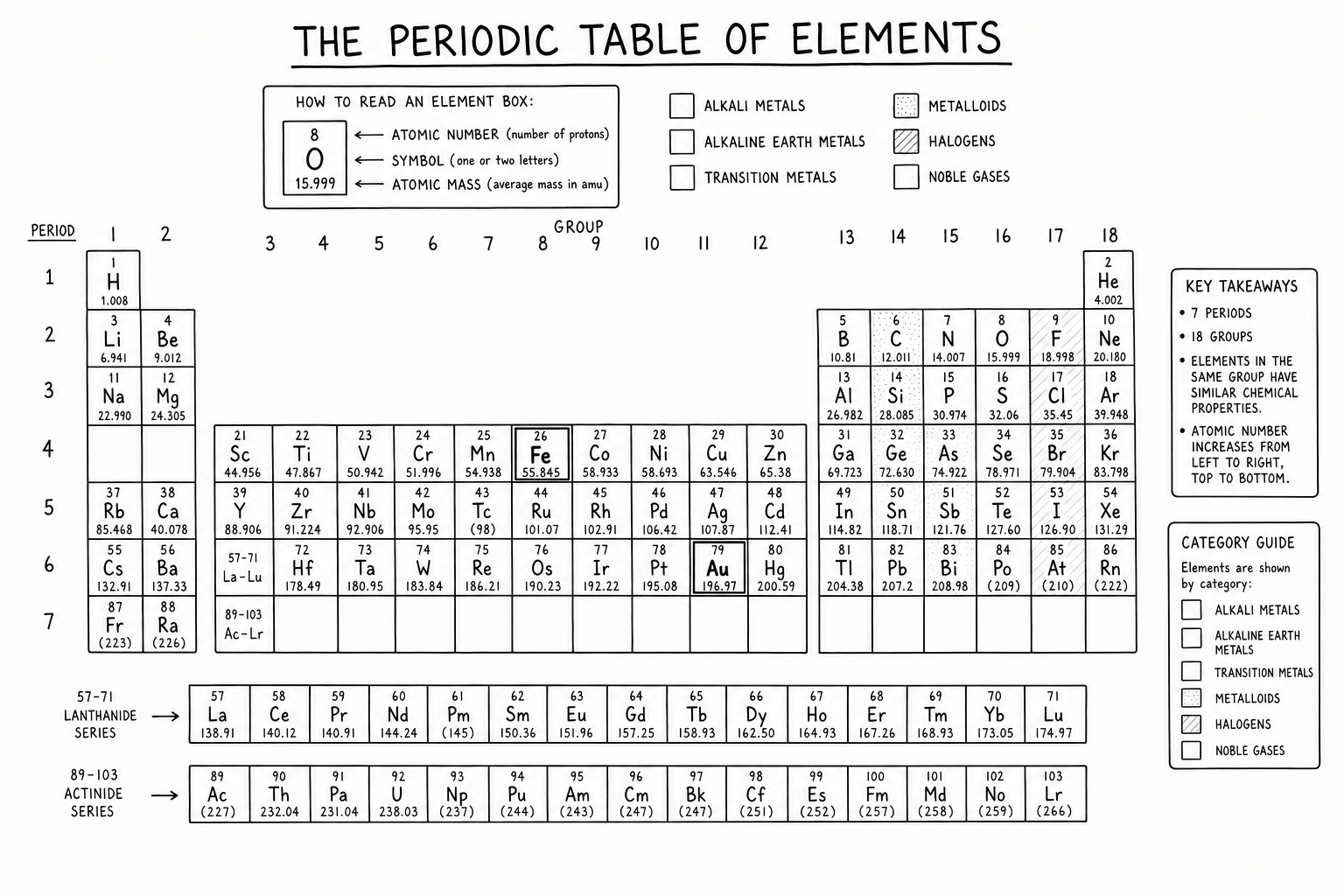
Structure of the Periodic Table
The periodic table has 18 columns (groups) and 7 rows (periods) in its standard form. Each box holds one element, identified by its symbol, atomic number, and atomic mass. Elements are ordered left to right by atomic number, the number of protons in the nucleus.
Going across a period, atomic number increases by one with each element. Going down a group, atomic number jumps by 8, 18, or 32 depending on which orbitals fill in between. The table also has a separate two-row block for the lanthanides and actinides, which would otherwise stretch the main table too wide for printing.
Groups (Columns)
Elements in the same group have similar chemical properties because they share the same outer-shell electron configuration. The vertical organization is what makes the table “periodic”, properties recur as you move down a column.
Important named groups: Group 1 (alkali metals), Group 2 (alkaline earth metals), Group 17 (halogens), Group 18 (noble gases). Each name reflects a shared chemistry: alkali metals form +1 cations easily; halogens form −1 anions; noble gases barely react at all. Knowing the group usually tells you the element’s characteristic behavior.
Periods (Rows)
Periods are horizontal rows. As you move across a period, atomic number increases by 1, and one electron is added per element. The electrons fill specific orbitals (s, p, d, or f) determined by quantum mechanics.
Period 1 has only 2 elements (H, He) because the 1s orbital holds only 2 electrons. Periods 2 and 3 each have 8 elements (filling 2s, 2p or 3s, 3p). Periods 4 and 5 have 18 elements each (s, p, d orbitals). Periods 6 and 7 have 32 elements (s, p, d, f orbitals), with the f-block elements relegated to the bottom of the table for layout reasons.
Reading an Element Box
Each element box typically shows three things: the chemical symbol (one or two letters), the atomic number (top, smaller number, number of protons), and the atomic mass (bottom, larger decimal, average mass weighted by isotope abundance).
For example, the carbon box shows C, 6, 12.011. Carbon has 6 protons (and in neutral atoms, 6 electrons), with an average atomic mass of about 12.011 atomic mass units. The decimal reflects the natural mixture of carbon-12 and carbon-13 isotopes.
Some periodic tables also include electron configuration, oxidation states, and electronegativity, all useful for predicting chemistry. Modern interactive tables show much more (melting point, density, discovery year, applications) when you click on an element.
Element Categories
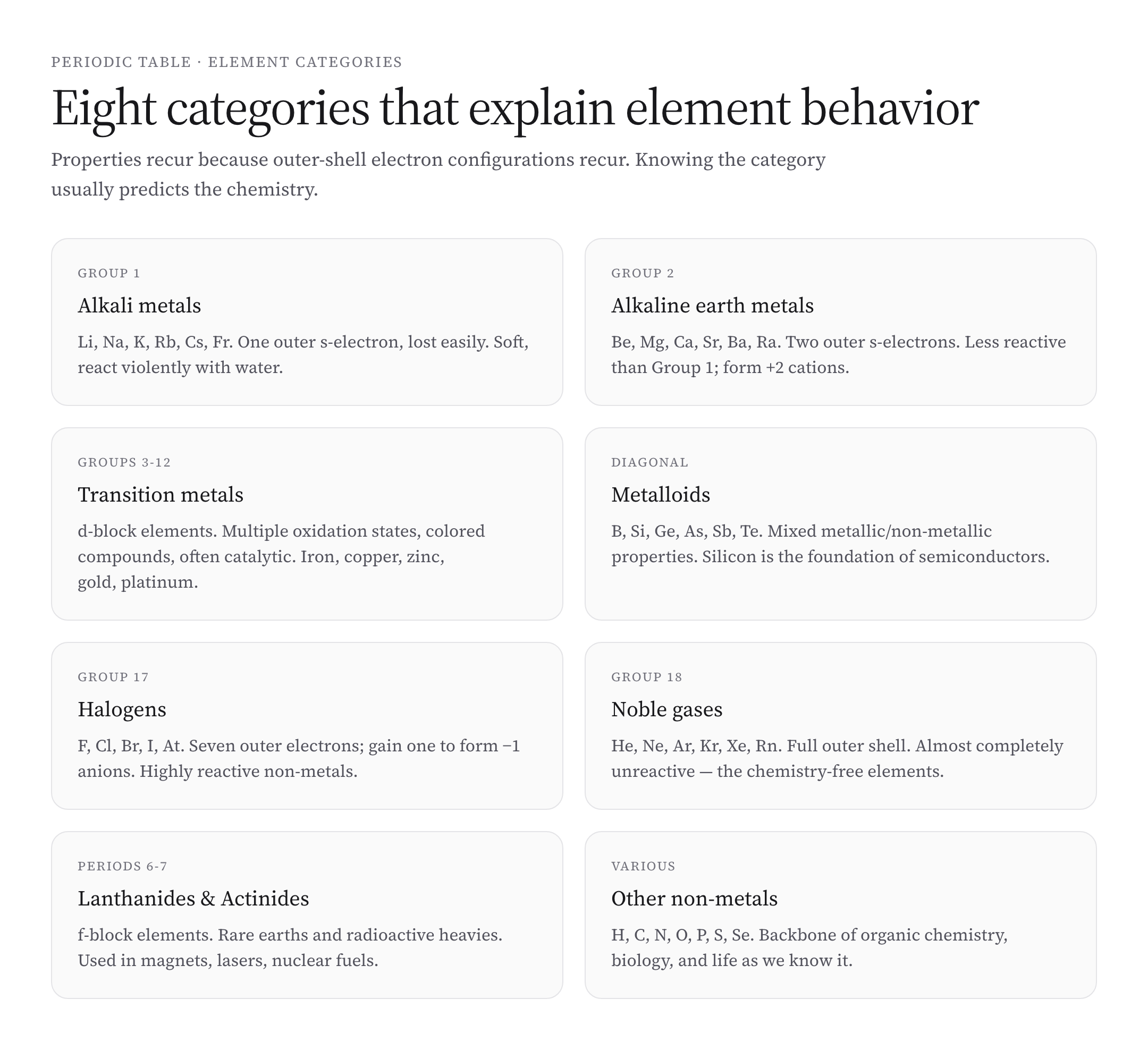
Beyond groups and periods, elements fall into broad categories based on properties:
- Alkali metals (Group 1): soft, react violently with water, form +1 cations.
- Alkaline earth metals (Group 2): less reactive than Group 1, form +2 cations.
- Transition metals (Groups 3-12): multiple oxidation states, often colored compounds, frequently catalytic.
- Metalloids: along the diagonal between metals and non-metals (B, Si, Ge, As, Sb, Te). Mixed properties.
- Halogens (Group 17): highly reactive non-metals, form −1 anions.
- Noble gases (Group 18): full outer shell, almost completely unreactive.
- Lanthanides and Actinides: f-block elements at the bottom; rare earths and radioactive heavies.
Periodic Trends
Several properties vary predictably across the table:
- Atomic radius: increases down a group (more shells), decreases across a period (greater nuclear charge pulls electrons inward).
- Ionization energy: energy to remove the outermost electron. Decreases down a group (outer electron is farther from nucleus), increases across a period.
- Electronegativity: tendency to attract bonding electrons. Decreases down a group, increases across a period. Fluorine is the most electronegative element.
- Electron affinity: energy released when an atom gains an electron. Generally most negative for halogens.
- Metallic character: increases down a group, decreases across a period.
These trends let you predict element behavior without memorizing every detail. They emerge directly from the underlying quantum mechanics of electron orbitals and effective nuclear charge.
The Four Blocks
Elements are grouped by which orbital their highest-energy electron occupies:
- s-block: Groups 1 and 2. Outermost electrons in s orbitals. Includes hydrogen, helium, alkali metals, alkaline earth metals.
- p-block: Groups 13-18. Outermost electrons in p orbitals. Includes most non-metals, metalloids, halogens, noble gases.
- d-block: Groups 3-12. Outermost (or near-outermost) electrons in d orbitals. The transition metals.
- f-block: Lanthanides and actinides. Outermost electrons in f orbitals. The rare earths and radioactive heavy elements.
The block structure is what makes the table its characteristic shape. Each block has its own typical chemistry, s-block forms simple ionic compounds, p-block forms covalent and ionic, d-block has variable oxidation states, f-block is dominated by +3 oxidation state and similar reactivity within each block.
History of the Periodic Table
Russian chemist Dmitri Mendeleev published his version of the periodic table in 1869, ordering elements by atomic mass and grouping them by chemical similarity. Crucially, he left gaps for elements he predicted must exist, and was vindicated when those elements (gallium, germanium, scandium) were discovered with properties matching his predictions.
Earlier attempts existed: Newlands’ “law of octaves” (1864), Dobereiner’s triads (1817). But Mendeleev’s table was the first that worked at the periodic scale and had predictive power. It’s the canonical periodic table that students learn today.
Henry Moseley (1913) refined the ordering by switching from atomic mass to atomic number, fixing several anomalies (e.g., tellurium and iodine) where atomic-mass ordering disagreed with chemical periodicity. The atomic-number ordering is what every modern table uses.
Ionization Energy as a Diagnostic
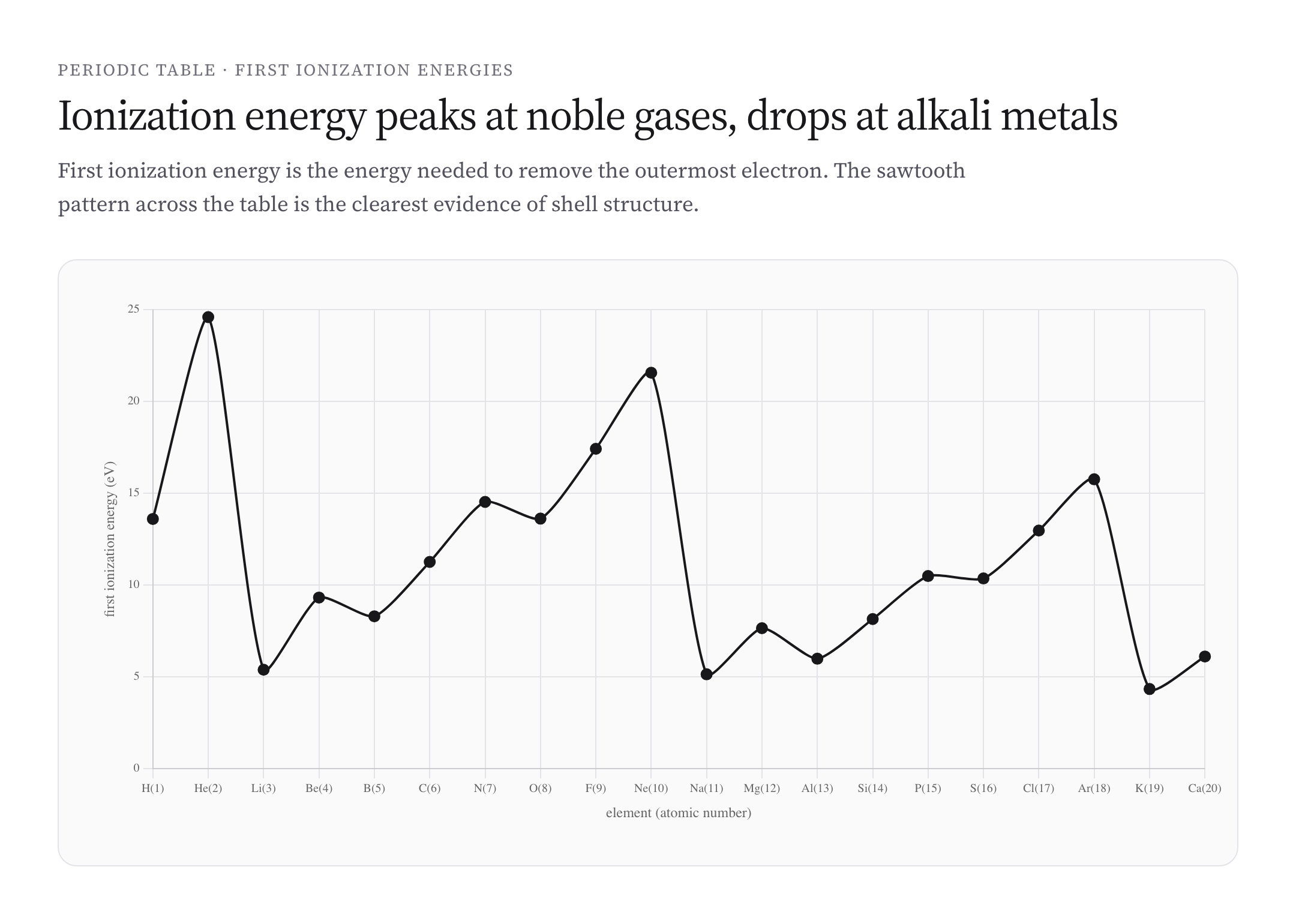
First ionization energy, the energy needed to remove the outermost electron, is one of the cleanest experimental confirmations of the table’s structure. Plot ionization energy against atomic number and you see a sawtooth pattern: peaks at noble gases (full shells, hard to ionize), troughs at alkali metals (one easily-removed outer electron).
The sawtooth pattern repeats with each new period because the same outer-shell electron pattern recurs. Ionization energy is direct experimental evidence that the periodic table reflects something real about atomic structure, not just a clever organization scheme.
Electron Configuration and Quantum Origin
The periodic structure ultimately comes from quantum mechanics. Electrons in atoms occupy orbitals with quantum numbers n, ℓ, m_ℓ, m_s. The Pauli exclusion principle says no two electrons share all four. As atomic number increases, electrons fill orbitals in order (1s, 2s, 2p, 3s, 3p, 4s, 3d, 4p…), and each orbital can hold at most 2 electrons.
The table’s row lengths (2, 8, 8, 18, 18, 32, 32) come directly from how many electrons fit in each “shell” determined by these quantum numbers. The block structure (s, p, d, f) is the orbital-type structure of quantum mechanics. The chemistry recurs because the outer-shell electron arrangements recur as you move through the table.
Without quantum mechanics, the periodic table is empirical. With quantum mechanics, every feature of the table, group structure, block structure, trends, falls out as a consequence of the Schrödinger equation applied to electrons in atoms.
Worked Example: Predicting Element Behavior
Without looking it up, what should you predict about strontium (Sr, atomic number 38)?
Sr is in Group 2 (alkaline earth metals), Period 5. Predictions:
- Forms +2 cations (loses two outer s-electrons).
- Reacts with water to form Sr(OH)₂ + H₂.
- Less reactive than barium (Ba, below it) but more reactive than calcium (Ca, above it).
- Larger atomic radius than Ca, smaller than Ba.
- Lower ionization energy than Ca, higher than Ba.
Every prediction comes from the periodic table’s structure alone, without any specific memorization about strontium. This is why chemists value the table so highly, it’s a compact predictive tool that scales across all elements.
The Modern Table: 118 Elements and Counting
The first 92 elements (hydrogen through uranium) occur naturally on Earth. Elements 93 through 118 (neptunium through oganesson) are synthetic, created in particle accelerators by colliding lighter nuclei. They’re typically unstable, with half-lives ranging from years (for some actinides) down to milliseconds.
The current periodic table ends at oganesson (Z = 118). Whether elements 119 and beyond can exist is an open question in nuclear physics. The “island of stability” hypothesis predicts pockets of relatively stable superheavy elements around Z ≈ 114-126, but searches so far haven’t found long-lived examples. The race to synthesize element 119 and 120 is ongoing in labs in Russia, the US, Japan, and Germany.
Common Mistakes With the Periodic Table
- Reading atomic mass as atomic number. Atomic number is the integer; atomic mass is the decimal. Confusing them gives wrong electron counts.
- Forgetting that hydrogen is a special case. H is sometimes placed with Group 1 (one outer electron) and sometimes with Group 17 (one electron short of helium). It belongs to neither cleanly.
- Assuming all transition metals form the same charges. Transition metals have multiple oxidation states; iron can be Fe²⁺ or Fe³⁺, copper Cu⁺ or Cu²⁺. Always check the specific compound.
- Ignoring effective nuclear charge. Trends in atomic radius and ionization energy depend on shielding by inner electrons, not just total proton count. The effective nuclear charge increases more slowly than total charge.
- Confusing electron affinity sign conventions. Some textbooks use positive values (energy released); others use negative (energy added). Always check the convention.
Where the Periodic Table Shows Up
- Chemistry classrooms: first thing on every chemistry classroom wall, used in every problem.
- Materials science: selecting elements for alloys, semiconductors, catalysts, and superconductors.
- Pharmaceutical research: understanding drug-protein binding involves predictable element behavior.
- Geology and astronomy: spectral analysis identifies elements in stars and rocks via known emission/absorption lines.
- Nuclear engineering: isotope selection for reactors, weapons, and radiotracers.
- Environmental science: heavy metal toxicity, pollutant tracking, water purification chemistry.
Modern Significance
Despite being 150+ years old, the periodic table remains one of chemistry’s most important tools. Every undergraduate chemistry course teaches it; every working chemist references it. New element discoveries (the most recent confirmed in 2016) extend it but don’t change its fundamental structure.
The periodic table’s enduring power is that it compresses a vast amount of chemical knowledge into a single chart. Anyone who can read it can predict the basic chemistry of any element, a skill no other organizational scheme matches. Mendeleev’s intuition in 1869 has held up better than almost any other scientific framework of comparable age.
How Properties Trend in Practice
If you need a quick chemistry estimate without memorizing specific values, the trends are reliable:
- Need a soft, very reactive metal? Look down Group 1.
- Need a hard, less-reactive metal? Look at Group 2 or transition metals.
- Need an unreactive gas? Look at Group 18 (noble gases).
- Need a strong oxidizing agent? Look at Group 17 (halogens), especially F and Cl.
- Need a good conductor of heat or electricity? Look at metals, and specifically Cu, Ag, Au.
- Need a semiconductor? Look at the metalloid diagonal, Si, Ge first.
These intuitions are why chemists internalize the table early. Once internalized, you stop looking up properties and start predicting them.
Worked Example: Predicting Halogen Reactivity
Within Group 17 (halogens), reactivity decreases going down the group: F > Cl > Br > I. Why? Smaller atoms (higher up the column) attract incoming electrons more strongly because the nucleus is closer to the outer shell, and there’s less inner-shell shielding. Fluorine, with its compact 2p valence shell, grabs electrons hardest.
This trend explains chemical observations directly. Fluorine displaces chlorine, bromine, and iodine from their salts (F₂ + 2NaCl → 2NaF + Cl₂); chlorine displaces bromine and iodine; bromine displaces only iodine. The “displacement series” of the halogens is a textbook demonstration of periodic trends in action.
Modern Periodic Table Layouts
The standard 18-column periodic table is the most common, but several alternative layouts exist. The “long form” includes f-block elements in their proper position (Period 6 stretches across 32 columns); the “ADOMAH” table arranges elements by quantum number; spiral periodic tables emphasize continuity rather than period boundaries.
None replaces the standard table for everyday use, but each highlights different relationships. The standard 18-column form is a compromise: compact enough to print on classroom walls, structured enough to encode the most important chemistry. It’s the table that’s been the working tool for over a century.
FAQs
Who invented the periodic table?
Russian chemist Dmitri Mendeleev published the canonical version in 1869. He arranged elements by atomic mass and chemical similarity, leaving gaps for predicted but undiscovered elements (gallium, germanium, scandium), all of which were later found with the predicted properties. Henry Moseley refined the ordering using atomic number in 1913.
What’s the difference between groups and periods?
Groups are vertical columns (1-18); elements in the same group have similar chemistry because they share the same outer-shell electron configuration. Periods are horizontal rows (1-7); going across a period, electrons fill specific orbitals (s, p, d, or f) one at a time as atomic number increases.
How is the periodic table organized?
By increasing atomic number from left to right and top to bottom. Elements with similar chemical properties are stacked vertically into groups. The shape reflects how electrons fill orbitals: s-block (Groups 1-2), p-block (Groups 13-18), d-block (Groups 3-12, transition metals), f-block (lanthanides and actinides at the bottom).
What is atomic number?
The number of protons in an atom’s nucleus, which uniquely identifies the element. Hydrogen has atomic number 1 (one proton); carbon has 6; uranium has 92. Atomic number determines the element’s identity and (for neutral atoms) its electron count.
What are periodic trends?
Predictable variations in element properties across the table. Atomic radius decreases left to right and increases top to bottom. Ionization energy and electronegativity show the opposite pattern. Trends emerge from quantum mechanics applied to electron orbitals and effective nuclear charge.
Why are elements in the same group similar?
Because they have the same outer-shell electron configuration. Chemistry is dominated by valence electrons (outer shell), so elements with the same valence configuration form similar bonds, have similar reactivities, and produce similar compounds.
What are the noble gases?
Group 18 elements (He, Ne, Ar, Kr, Xe, Rn, Og). They have full outer electron shells, making them extremely unreactive. Used in lighting (neon, xenon), inert atmospheres for welding (argon), cryogenics (helium), and as carrier gases in chromatography.
What are transition metals?
The d-block elements in Groups 3-12. They’re characterized by partially filled d orbitals, multiple oxidation states, often colored compounds, and frequent catalytic activity. Iron, copper, zinc, gold, silver, platinum, and titanium are all transition metals.
Why is hydrogen sometimes placed with Group 1 and sometimes Group 17?
Hydrogen has one electron, like Group 1 alkali metals, but only one electron short of a full shell, like Group 17 halogens. It can form +1 cations (like alkali metals) or −1 hydride anions (like halogens). It belongs cleanly to neither group; some tables show it floating above both.
What is ionization energy?
The energy required to remove an electron from a gaseous atom. First ionization energy removes the outermost electron. Generally increases across a period (greater nuclear charge) and decreases down a group (outer electrons are farther from the nucleus). Sawtooth patterns peak at noble gases, dip at alkali metals.
How many elements are in the periodic table?
Currently 118 confirmed elements (hydrogen through oganesson). The first 92 (up through uranium) occur naturally on Earth; elements 93-118 are synthetic, created in particle accelerators. The ‘island of stability’ hypothesis predicts longer-lived superheavy elements around Z ≈ 114-126; searches are ongoing.
What is electronegativity?
An element’s tendency to attract electrons in a chemical bond. Fluorine is the most electronegative (4.0 on the Pauling scale); francium is the least. Electronegativity differences between bonded atoms determine bond polarity, large difference means ionic, small difference means covalent.
What’s the connection between the periodic table and quantum mechanics?
The table’s structure (group columns, period rows, blocks) directly reflects how electrons fill atomic orbitals predicted by the Schrödinger equation. Each row corresponds to a quantum ‘shell’; each block corresponds to a type of orbital (s, p, d, or f). The Pauli exclusion principle limits orbital occupancy and produces the periodic recurrence of properties.
Why are some periodic table boxes shaded different colors?
Color coding shows element categories: alkali metals, alkaline earth metals, transition metals, metalloids, non-metals, halogens, noble gases, lanthanides, actinides. Different sources use different color conventions, but the categories are standard and reflect shared chemical behavior within each group.
Why does halogen reactivity decrease going down the group?
Smaller atoms higher in the group attract incoming electrons more strongly because the nucleus is closer to the outer shell with less inner-shell shielding. Fluorine grabs electrons hardest, so it’s the most reactive halogen. This explains the displacement series F > Cl > Br > I.
Browse more in Chemistry.