by
by
Avogadro’s number is the bridge between the atomic world and the everyday one. It is the number of atoms or molecules in exactly one mole of any substance: \( N_A = 6.02214076 \times 10^{23}\ \mathrm{mol^{-1}} \). That’s about 600 sextillion. A teaspoon of water contains roughly 7 × 10²² water molecules, close to an eighth of a mole. The number is so large it almost defies intuition, but it is what makes chemistry calculations work at the scale we actually measure things, grams, liters, moles, not individual atoms.
The Avogadro constant fixes the number of specified entities in a mole. The entity can be an atom, a molecule, an ion or another explicitly named unit.
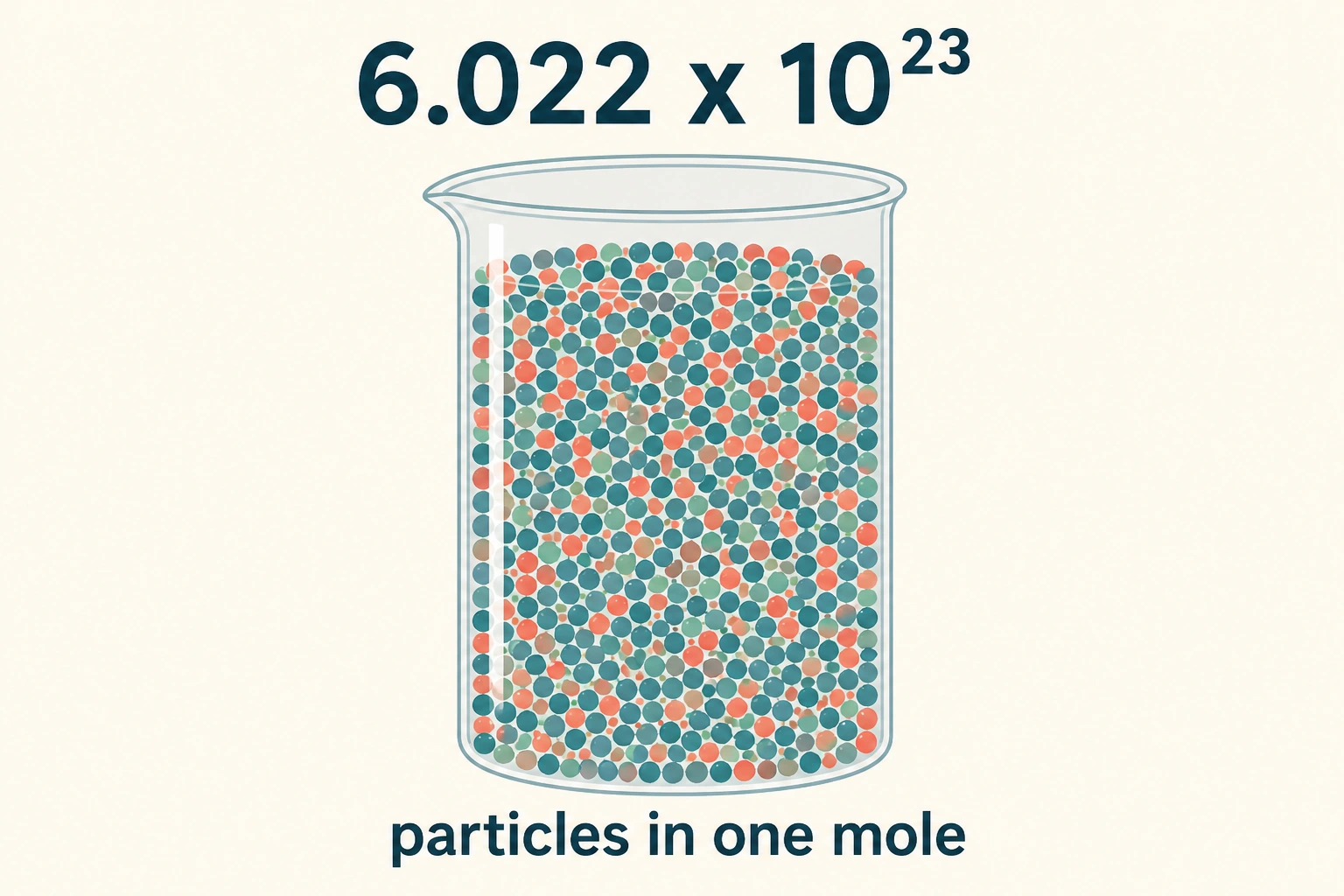
The Number Itself
Avogadro’s number, also called Avogadro’s constant, has the precise modern value:
$$ N_A = 6.02214076 \times 10^{23} \;\text{mol}^{-1} $$
Since the 2019 redefinition of the SI base units, the value of \( N_A \) is fixed by definition, it’s not measured anymore. The mole is now defined as the amount of substance containing exactly \( 6.02214076 \times 10^{23} \) elementary entities. Whatever you’re counting (atoms, molecules, ions, electrons), \( N_A \) of them is one mole.
What a Mole Means
A mole is just a counting unit, like a dozen (12) or a gross (144), except much larger. A mole of anything is \( 6.022 \times 10^{23} \) of that thing:
- 1 mole of carbon atoms = 6.022 × 10²³ carbon atoms
- 1 mole of water molecules = 6.022 × 10²³ H₂O molecules
- 1 mole of electrons = 6.022 × 10²³ electrons
- 1 mole of golf balls = 6.022 × 10²³ golf balls (a quantity larger than every grain of sand on Earth)
Chemists use moles instead of counting individual atoms because atoms are far too small to weigh one at a time. A mole of anything weighs a measurable, useful amount, typically a few grams to a few hundred grams. The mole connects the microscopic to the macroscopic.
Molar Mass, the Practical Connection
The molar mass of an element is the mass of one mole of its atoms, expressed in grams per mole. The number on the periodic table under each element symbol is the molar mass:
- Hydrogen (H): molar mass 1.008 g/mol → 6.022 × 10²³ H atoms weigh 1.008 g
- Carbon (C): molar mass 12.011 g/mol → 6.022 × 10²³ C atoms weigh 12.011 g
- Oxygen (O): molar mass 16.00 g/mol → 6.022 × 10²³ O atoms weigh 16.00 g
- Iron (Fe): molar mass 55.85 g/mol → 6.022 × 10²³ Fe atoms weigh 55.85 g
For compounds, add up the molar masses of all atoms in the formula. Water (H₂O) has molar mass \( 2 \times 1.008 + 16.00 = 18.02 \) g/mol. A mole of water is 18.02 g, about a tablespoon.
Using Avogadro’s Number in Calculations
The three quantities, mass, moles, and number of particles, connect through two ratios:
$$ \text{moles} = \dfrac{\text{mass (g)}}{\text{molar mass (g/mol)}} $$
$$ \text{number of particles} = \text{moles} \times N_A $$
Worked example
How many water molecules are in 36 grams of water?
- Convert mass to moles: \( 36 \,\text{g} \div 18.02 \,\text{g/mol} \approx 2.00 \,\text{mol} \).
- Convert moles to molecules: \( 2.00 \,\text{mol} \times 6.022 \times 10^{23} \,\text{mol}^{-1} \approx 1.20 \times 10^{24} \) molecules.
That’s a lot of molecules in two tablespoons of water. The same logic works for every chemical calculation, convert to moles first, then convert moles to whatever you need.
How Avogadro’s Number Was Measured
The number is named after Amedeo Avogadro, the Italian physicist who proposed in 1811 that equal volumes of gases at the same temperature and pressure contain the same number of particles. Avogadro himself never calculated the number, he died in 1856, before anyone knew how.
The first credible estimate came from Johann Josef Loschmidt in 1865, who used kinetic theory of gases and the size of molecules to estimate the number per unit volume. In German chemistry, the constant is sometimes still called the Loschmidt number.
Jean Perrin’s 1908 experiments on Brownian motion of small particles in water gave a value accurate to a few percent. His work also confirmed the reality of atoms, a question that was still genuinely debated in serious scientific circles at that time. Perrin won the 1926 Nobel Prize in Physics partly for this.
Modern measurements use silicon crystal lattices: a near-perfect sphere of pure silicon-28 is measured precisely for mass, volume, and lattice spacing, and \( N_A \) is calculated from the result. The 2019 SI redefinition then fixed \( N_A \) at exactly \( 6.02214076 \times 10^{23} \), turning a measured quantity into a defined one.
Why the Number Is So Large
Avogadro’s number is large because atoms are very small. The diameter of a typical atom is about \( 10^{-10} \) m. To stack enough atoms to make a substance you can hold in your hand and weigh on a kitchen scale, you need on the order of \( 10^{23} \) of them. The specific value comes from the conjunction of the atomic mass unit (1/12 the mass of a carbon-12 atom) and the gram (an arbitrary human-scale unit). If we had picked a different mass unit, Avogadro’s number would be different, there’s nothing fundamental about the specific value, just about its order of magnitude.
Related study notes: Mole Concept, Periodic Table, Stoichiometry, Chemical Bonding.
The OpenStax chemistry textbooks provide further explanations of the chemical principles used in this note.
Molecules and Atoms in a Sample
A sample containing 2 mol of water contains 2NA water molecules and 4NA hydrogen atoms. The oxygen-atom count is 2NA. Counting the atoms requires reading the chemical formula after the molecular amount has been established.
The exact Avogadro constant is 6.02214076 × 10²³ mol⁻¹. Using a rounded value such as 6.022 × 10²³ is appropriate for many classroom calculations, provided it is identified as rounded. A mole is an amount-of-substance unit; its mass depends on which entities are being counted.
The points to check in this example are:
- The specified entity is part of an amount-of-substance statement.
- A molecular formula converts molecule counts to constituent-atom counts.
- Avogadro’s constant and molar mass perform different conversions.
Check Your Understanding
Try the questions before reading the answers.
Question 1. How many oxygen atoms are in 1 mol of CO2?
Answer. 2NA oxygen atoms.
Question 2. Do 1 mol of helium atoms and 1 mol of water molecules have equal masses?
Answer. No. Their entity counts agree but their molar masses differ.
Practice Questions
Work each question before reading its solution. The set runs from direct recall and substitution to the applied questions that exams actually use to separate grades. The downloadable PDF includes these questions and their solutions.
Question 1. State Avogadro’s number and what it counts.
Solution. \(N_A = 6.02214076 \times 10^{23}\) per mole, exact by the 2019 SI definition. It is the number of elementary entities, atoms, molecules, ions, electrons, whatever is specified, in 1 mole. The mole is to chemists what the dozen is to bakers, scaled to atomic reality.
Question 2. Why does 1 mole of carbon-12 weigh about 12 g? What links the atomic mass unit to the gram?
Solution. \(N_A\) was historically chosen so that 1 mole of atoms of mass 12 u weighs 12 g: the mole is the bridge \(1 \text{ u} \approx 1.6605 \times 10^{-24}\) g \(= 1/N_A\) g. Atomic masses read from the periodic table in u become gram masses per mole unchanged. That numerical coincidence is the entire convenience of the unit.
Question 3. How many molecules are in 36 g of water?
Solution. Molar mass of H\(_2\)O \(= 18\) g/mol, so 36 g is 2 mol: \(2 \times 6.022 \times 10^{23} = 1.204 \times 10^{24}\) molecules. And 3 times as many atoms, \(3.6 \times 10^{24}\), since each molecule carries 3.
Question 4. What is the mass of a single water molecule?
Solution. \(m = \dfrac{18\ \text{g/mol}}{6.022 \times 10^{23}\ \text{/mol}} = 2.99 \times 10^{-23}\) g. Division by \(N_A\) converts any molar mass to a per-particle mass; multiplication converts back. That two-way bridge is most of stoichiometry.
Question 5. How many moles, and how many atoms, are in 5.4 g of aluminium (\(M = 27\) g/mol)?
Solution. \(n = 5.4/27 = 0.2\) mol; atoms \(= 0.2 \times 6.022 \times 10^{23} = 1.2 \times 10^{23}\). The chain mass \(\to\) moles \(\to\) particles always runs through the molar mass first.
Question 6. At STP, 1 mole of any ideal gas fills 22.4 L. How many CO\(_2\) molecules occupy 5.6 L at STP?
Solution. \(n = 5.6/22.4 = 0.25\) mol, so \(0.25 \times 6.022 \times 10^{23} = 1.5 \times 10^{23}\) molecules. Avogadro’s own insight: equal gas volumes at equal conditions hold equal counts, regardless of the gas. The molar volume turns gas measurement into particle counting.
Question 7. Give 2 comparison anchors that make the size of \(N_A\) graspable.
Solution. A mole of water is 18 mL, a sip; a mole of marbles would bury the Earth kilometers deep. \(6 \times 10^{23}\) millimeters is about 63 million light-years, far past the Andromeda galaxy. The number is ordinary in the lab only because atoms are that small.
Question 8. A drop of water (0.05 mL) evaporates. Roughly how many molecules leave, and what does this say about “trace amounts”?
Solution. 0.05 g is \(0.05/18 \approx 2.8 \times 10^{-3}\) mol \(\approx 1.7 \times 10^{21}\) molecules. Even a vanishing residue contains astronomical particle counts, which is why contamination matters in chemistry and why “chemical-free” is a marketing phrase, not a physical possibility.
Question 9. Balance meets count: how many grams of oxygen react completely with 4 g of hydrogen in 2H\(_2\) + O\(_2\) \(\rightarrow\) 2H\(_2\)O?
Solution. 4 g H\(_2\) is 2 mol; the equation demands half as many moles of O\(_2\), 1 mol, which is 32 g. Equations balance in moles, never in grams: the mole is what lets a mass ratio (4 g : 32 g) come from a simple count ratio (2 : 1).
Question 10. How was \(N_A\) measured well enough to become an exact definition? Name 1 classical and 1 modern route.
Solution. Perrin’s 1908 analysis of Brownian motion in colloids gave the first solid values and made atoms respectable, earning the 1926 Nobel. The modern route counted atoms in a nearly perfect 1 kg silicon-28 sphere by X-ray crystallography: lattice spacing plus sphere volume yields the atom count to 9 digits. In 2019 the measured value was frozen into the definition.
Frequently Asked Questions
What is Avogadro’s number?
Avogadro’s number is the number of atoms or molecules in exactly one mole of any substance, 6.02214076 × 10²³. It is the conversion factor between the atomic and the macroscopic scale: any time you count particles by the mole, you multiply by Avogadro’s number to get the count.
Why is Avogadro’s number 6.022 × 10²³?
Because that’s how many atomic mass units fit in one gram. Specifically, one mole of carbon-12 has a mass of exactly 12 grams, and one carbon-12 atom has a mass of 12 atomic mass units. So 6.022 × 10²³ amu = 1 gram by construction. The specific number isn’t a fundamental constant of nature; it just connects the human-scale gram to the atomic mass unit.
How big is Avogadro’s number really?
Absurdly big. 6.022 × 10²³ is roughly 600 sextillion. If you had 6.022 × 10²³ grains of sand, you could cover the entire surface of the Earth in sand more than 50 meters deep. If you had 6.022 × 10²³ seconds since the Big Bang, you would still be off by 12 orders of magnitude, there have only been about 4.3 × 10¹⁷ seconds since the universe began.
What is a mole in chemistry?
A mole is a counting unit equal to Avogadro’s number, 6.022 × 10²³ of whatever you’re counting. Chemists use moles because individual atoms are too small to weigh one at a time, but one mole of any element weighs a measurable amount in grams (equal to that element’s atomic mass on the periodic table).
How do you calculate the number of atoms in a sample?
Convert mass to moles first, then multiply by Avogadro’s number. Step 1: divide the sample mass in grams by the molar mass in grams per mole to get moles. Step 2: multiply moles by 6.022 × 10²³ to get the number of atoms or molecules. Example: 36 g of water = 2 moles = 1.2 × 10²⁴ water molecules.
Is Avogadro’s number measured or defined?
Defined, as of the 2019 SI redefinition. The value 6.02214076 × 10²³ mol⁻¹ is now an exact, fixed value, the mole is defined to contain exactly that many entities. Before 2019 it was a measured constant with some uncertainty. The redefinition was based on incredibly precise silicon-sphere measurements and made the mole independent of any specific reference object.
Browse more in Chemistry.