
 by
byChemical bonding holds atoms together to form molecules, ionic crystals, and metals. Without bonding, matter wouldn’t exist as anything more interesting than free atoms. Three main bond types, ionic, covalent, and metallic, account for nearly all of chemistry, with intermolecular forces (hydrogen bonds, van der Waals) handling the weaker interactions that determine boiling points, viscosities, and biological recognition.
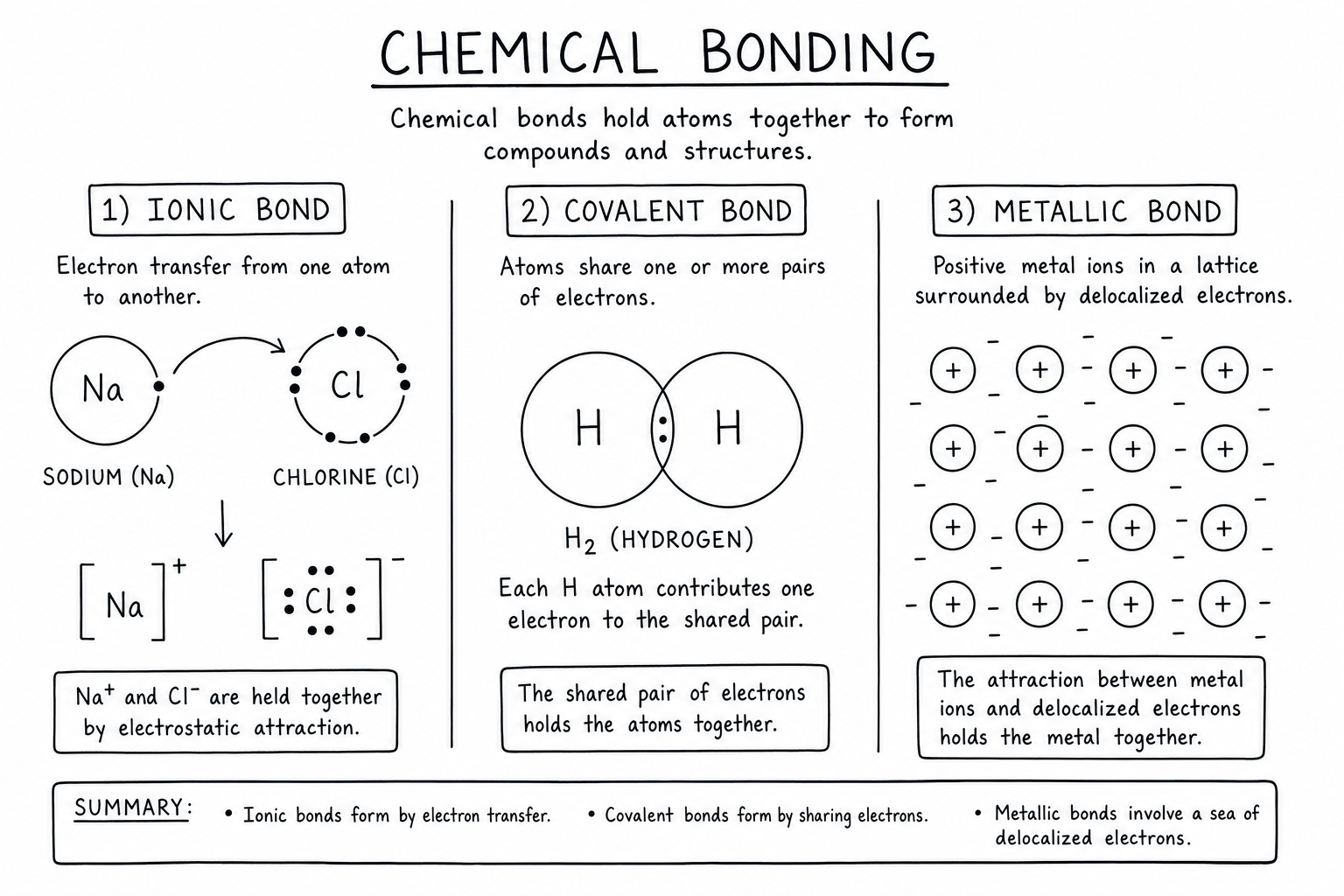
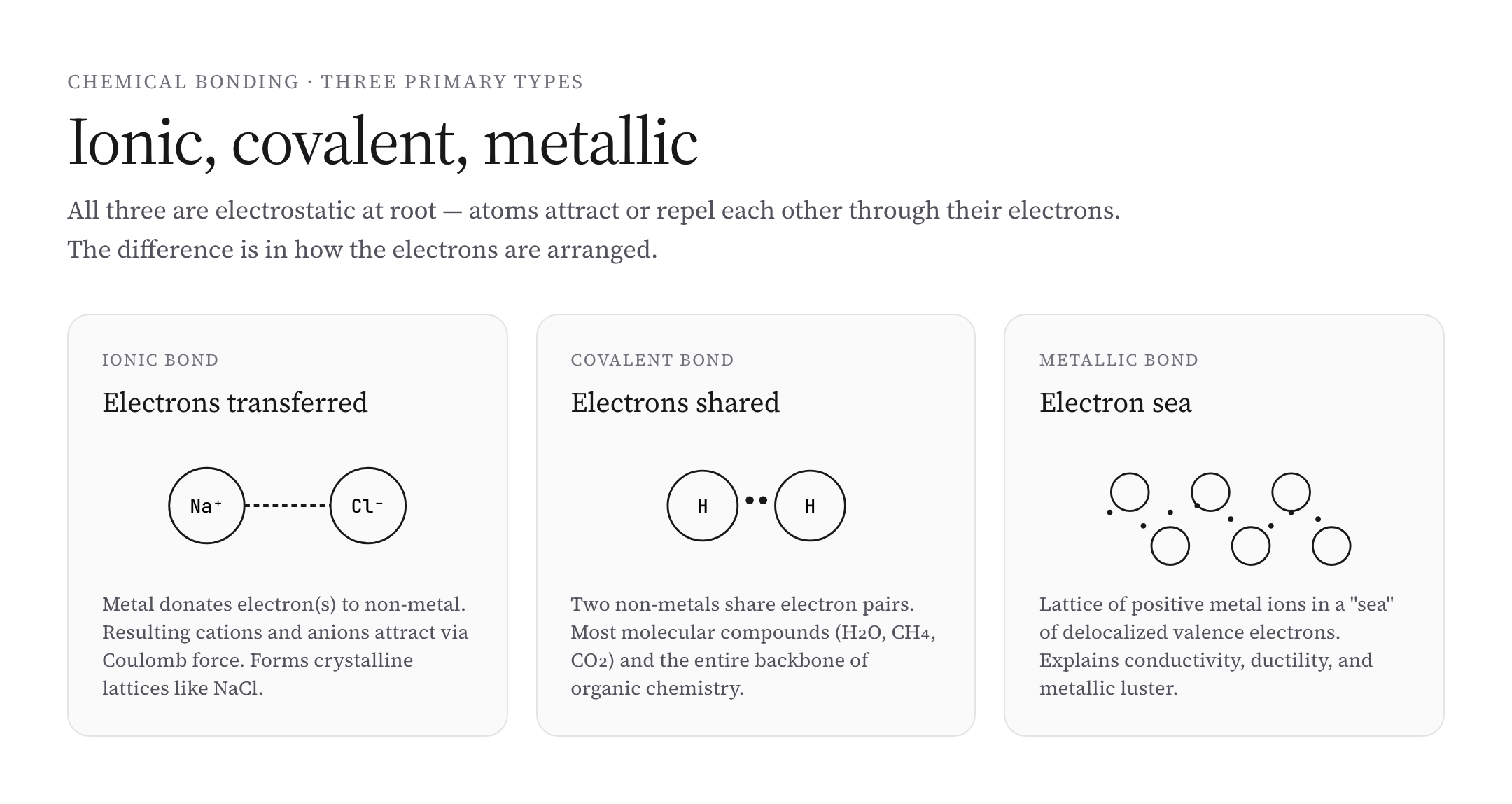
All chemical bonds are fundamentally electrostatic, atoms attract each other through their electrons. The differences between bond types come from how the electrons are arranged: transferred (ionic), shared (covalent), or delocalized (metallic). Knowing the bond type lets you predict melting point, conductivity, solubility, hardness, and reactivity.
Free download: Chemical Bonding Study Notes (PDF)
The full note as a print-ready PDF: every section and worked example, the 10-question practice set with solutions, an answer key, and a 1-page revision sheet for last-minute revision.
Why Atoms Bond
Isolated atoms (except noble gases) have incomplete outer electron shells, which makes them unstable. Bonding lets atoms achieve more stable electron arrangements, usually by completing or emptying outer shells to match the nearest noble-gas configuration (the octet rule). This is the chemical motivation behind almost all bonding.
The energetic motivation: bonded atoms are at lower potential energy than isolated atoms. The energy released when atoms bond is the bond energy. To break a bond, you have to put energy back in, which is why chemical reactions involve energy changes proportional to how many bonds are broken vs formed.
Ionic Bonding
Ionic bonds form when one atom transfers electrons to another, creating positive and negative ions held together by electrostatic attraction. Typically a metal (which loses electrons easily) bonds with a non-metal (which gains electrons easily).
Classic example: NaCl. Sodium loses its single 3s electron to chlorine, forming Na⁺ and Cl⁻. The two ions attract each other strongly through Coulomb force, and many such pairs arrange into a crystalline lattice with alternating cations and anions.
Properties of ionic compounds: high melting point, brittle, often water-soluble, conducts electricity when molten or dissolved (ions are free to move), generally non-conducting as a solid. Most “salts”, NaCl, CaCl₂, KNO₃, MgSO₄, are ionic.
Covalent Bonding
Covalent bonds form when two atoms share electron pairs rather than transfer them. Most molecular compounds, water, methane, glucose, DNA, proteins, are held together by covalent bonds. Two non-metals sharing electrons is the typical pattern.
Single bond: one shared pair (H-H, C-C). Double bond: two shared pairs (O=O, C=O in CO₂). Triple bond: three shared pairs (N≡N, C≡N). Bond strength generally increases with multiplicity; bond length decreases.
Properties of covalent compounds: lower melting points than ionic (covalent molecules attract each other only through weaker intermolecular forces, not bond-strength attraction), often non-conducting, vary widely in solubility based on polarity. The huge diversity of organic chemistry exists because carbon forms strong, stable, versatile covalent bonds.
Metallic Bonding
Metallic bonds hold metal atoms together through delocalized electrons. The picture: a lattice of positive metal ions sits in a “sea” of valence electrons that move freely throughout the entire metal. The electrostatic attraction between cations and the electron sea holds the structure together.
This bonding model explains why metals are good electrical conductors (free electrons carry current), good thermal conductors (free electrons transport heat), malleable and ductile (the electron sea adapts when atoms slide past each other), and have characteristic metallic luster (free electrons reflect light efficiently).
Metallic bonding strengths vary enormously, from very soft (Cs, Hg) to very hard (W, Os). Alloys (mixtures of metals) often have different properties from their constituents because added atoms disrupt the regular lattice in useful ways (steel = iron + carbon; brass = copper + zinc; bronze = copper + tin).
Three Bond Types Side by Side
The three primary bond types differ in how electrons are arranged. Ionic transfers electrons between very different atoms (large electronegativity difference). Covalent shares electrons between similar atoms (small electronegativity difference). Metallic delocalizes electrons across many atoms (uniformly low electronegativity).
The boundaries are fuzzy. There’s a continuum from purely ionic to purely covalent based on the electronegativity difference between bonded atoms. There’s no sharp line saying “above this difference it’s ionic, below it’s covalent”, chemists describe bonds as having “ionic character” or “covalent character” on a sliding scale.
Electronegativity and Bond Polarity
Electronegativity measures an atom’s tendency to attract electrons in a bond. Fluorine is the most electronegative (4.0 on the Pauling scale); francium is the least (~0.7). Electronegativity differences between bonded atoms determine bond polarity:
- ΔEN < 0.4: nonpolar covalent (electrons shared roughly equally).
- 0.4 < ΔEN < 1.7: polar covalent (electrons shared but unequally; partial charges develop).
- ΔEN > 1.7: ionic (electrons effectively transferred).
Polar covalent bonds have partial charges (δ+ on the less electronegative atom, δ- on the more electronegative). Water (H-O) is famously polar, the O-H bond pulls electrons toward oxygen, making O slightly negative and H slightly positive. This polarity drives water’s extraordinary properties (high boiling point, surface tension, solvent power).
Lewis Structures
Lewis structures (or electron-dot diagrams) show valence electrons explicitly. Each atom is represented by its symbol surrounded by dots representing valence electrons. Bonded electron pairs are shown as lines between atoms; lone pairs (non-bonding electrons) remain as dots on individual atoms.
Drawing Lewis structures: count total valence electrons, place atoms with the central atom in the middle, distribute pairs to form bonds, then add lone pairs to satisfy the octet rule for each atom (8 electrons, with hydrogen as a 2-electron exception).
Lewis structures help predict molecular geometry, polarity, and reactivity. They’re not always unique, resonance structures show different ways of arranging the same electrons (benzene’s alternating single/double bonds is the textbook example). The actual molecule is a hybrid of all valid resonance structures.
VSEPR Theory and Molecular Shape
Valence Shell Electron Pair Repulsion (VSEPR) theory predicts molecular geometry based on the idea that electron pairs around the central atom arrange themselves to minimize repulsion. The geometry depends on the number of bonded pairs and lone pairs.
- 2 pairs: linear (e.g., CO₂).
- 3 pairs: trigonal planar (e.g., BF₃).
- 4 pairs: tetrahedral (e.g., CH₄).
- 5 pairs: trigonal bipyramidal (e.g., PCl₅).
- 6 pairs: octahedral (e.g., SF₆).
Lone pairs occupy more space than bonding pairs, distorting the ideal geometries. Water has 4 electron pairs around oxygen (2 bonding + 2 lone), giving a bent shape rather than tetrahedral. Ammonia (NH₃) has 4 pairs (3 bonding + 1 lone), giving a trigonal pyramidal shape. Molecular geometry directly determines polarity, biological activity, and many physical properties.
Intermolecular Forces
Intermolecular forces (IMFs) act between molecules, not within them. They’re much weaker than chemical bonds but determine boiling points, melting points, viscosity, surface tension, and many biological recognition events.
- Hydrogen bonding: strong dipole-dipole attraction when H is bonded to N, O, or F. Responsible for water’s high boiling point and DNA’s double helix.
- Dipole-dipole: attraction between polar molecules. Strength depends on dipole moment.
- Dispersion (London) forces: instantaneous dipole-induced dipole attractions. Present in all molecules; dominant for nonpolar substances like noble gases and hydrocarbons.
- Ion-dipole: attraction between an ion and a polar molecule. Drives the dissolution of salts in water.
The strength hierarchy is roughly: ionic ≫ covalent ≫ hydrogen bonds > dipole-dipole > dispersion. Bond energies are typically 100-1000 kJ/mol; intermolecular forces are 1-50 kJ/mol. The two scales are very different.
Bonding and Material Properties
Bond type largely determines material properties:
- Ionic crystals: high melting point (must overcome strong electrostatic lattice), hard but brittle, conducts only when molten or dissolved.
- Molecular covalent solids: low melting point (only weak IMFs to overcome), generally non-conducting.
- Network covalent solids (diamond, quartz, silicon carbide): extremely hard, very high melting point, non-conducting (or semiconducting). Each atom covalently bonded to multiple neighbors in a 3D network.
- Metals: conductive, malleable, ductile, lustrous. Range from soft (Na, Hg) to very hard (W, Cr).
- Polymers: long covalent chains held by IMFs. Properties depend on chain length, branching, and crystallinity.
This is why materials scientists pay so much attention to bond type, it sets the design space for what a material can do.
Quantum Mechanical Origin
Bonding ultimately emerges from quantum mechanics. When two atoms approach each other, their atomic orbitals overlap and combine to form molecular orbitals. The Schrödinger equation for the combined system gives lower energy than the sum of isolated atoms’ energies, that lowering is the bond energy.
Two main approximations: valence bond theory (electron pairs localized between two specific atoms) and molecular orbital theory (electrons distributed across the entire molecule). Both work; modern computational chemistry uses molecular orbital methods because they handle delocalization and excited states better.
Modern quantum chemistry (DFT, Hartree-Fock, post-Hartree-Fock methods) numerically solves the Schrödinger equation for molecules with hundreds of atoms, predicting bond energies, geometries, and reaction pathways with remarkable accuracy. The Lewis-structure picture is a simplified view of the underlying quantum reality.
Worked Example: Bond Type Prediction
What kind of bond forms between magnesium and chlorine?
Mg has electronegativity 1.31; Cl has electronegativity 3.16. ΔEN = 1.85, well above 1.7, so the bond is essentially ionic. Mg loses 2 electrons (becoming Mg²⁺); Cl gains 1 (becoming Cl⁻). The compound is MgCl₂, with formula reflecting the 1:2 cation-anion ratio needed for charge balance.
Predictions for MgCl₂: high melting point (714°C), brittle, dissolves in water giving conductive solution, doesn’t conduct as solid. All consistent with ionic bonding. The electronegativity rule plus charge balance gives you the formula and properties without memorization.
Carbon’s Special Versatility
Carbon forms the largest variety of compounds of any element, millions of distinct organic molecules versus thousands for any other element. The reason: carbon has four valence electrons, perfect for forming four covalent bonds, and bonds equally well to itself, hydrogen, oxygen, nitrogen, and many other elements.
Carbon-carbon single bonds are stable (348 kJ/mol), so chains and rings of arbitrary length form readily. Multiple bonds (C=C, C≡C) add structural variety. Three-dimensional sp³ tetrahedral geometry, planar sp² geometry, and linear sp geometry give carbon access to every shape, enabling the vast diversity of biological molecules.
This is why life is carbon-based. Silicon (just below carbon) has similar valence properties but weaker, less varied bonds. No other element comes close to carbon’s versatility for building stable, complex molecules.
Common Mistakes With Chemical Bonding
- Treating ionic vs covalent as binary. The boundary is a continuum based on electronegativity difference. Most “ionic” compounds have some covalent character; most “covalent” compounds have some ionic character.
- Forgetting that bonds break to form new bonds. Reactions are bond-breaking and bond-making in concert. The energy difference determines whether the reaction is exothermic or endothermic.
- Confusing bond polarity with molecular polarity. A molecule can have polar bonds but be nonpolar overall if the bond dipoles cancel by symmetry (CO₂, BF₃). Geometry matters.
- Misapplying the octet rule. The octet rule has exceptions: hydrogen wants 2 electrons; expanded octets (PCl₅, SF₆) and incomplete octets (BF₃) violate it for chemical reasons. Use VSEPR and quantum reasoning, not just the octet rule mechanically.
- Conflating bond strength and bond polarity. Polar bonds aren’t necessarily stronger than nonpolar ones. Bond strength depends on multiplicity and atom sizes; polarity depends on electronegativity difference.
Where Chemical Bonding Shows Up
- Drug design: understanding which bonds form between drug and target protein guides every molecular optimization step.
- Materials science: bond type and strength determine alloy design, polymer properties, semiconductor behavior, and ceramic engineering.
- Biology: hydrogen bonds hold DNA’s double helix together. Disulfide bonds shape protein structure. Peptide bonds link amino acids. All of life is bonded chemistry.
- Combustion: energy released by burning fuel comes from breaking weak C-H and C-C bonds in fuel and forming stronger C=O and O-H bonds in products (CO₂, H₂O).
- Electrochemistry: batteries store energy in bonds. Charging adds electrons that change bonding; discharging releases the stored bond energy.
- Solubility: “like dissolves like” works because polar solvents dissolve polar solutes via similar IMFs; nonpolar solvents dissolve nonpolar solutes via dispersion forces.
Bond Energy and Reaction Energetics
Bond energy is the energy required to break one mole of bonds in the gas phase. Typical bond energies (kJ/mol):
- H-H: 436
- C-H: 413
- C-C: 348
- C=C: 614
- C≡C: 839
- O-H: 463
- O=O: 498
- N≡N: 945
For reactions, ΔH ≈ Σ(bonds broken) − Σ(bonds formed). Stronger bonds in products (relative to reactants) means exothermic reaction; weaker bonds in products means endothermic. Bond energy estimates give first-pass reaction enthalpies useful in synthesis planning, combustion analysis, and biochemistry.
Modern Computational Bonding Analysis
Modern computational chemistry uses density functional theory (DFT) and post-Hartree-Fock methods to compute molecular bonding from first principles. Software packages like Gaussian, ORCA, and NWChem solve the Schrödinger equation numerically for molecules with hundreds of atoms.
These calculations predict bond energies, geometries, vibrational spectra, and electronic spectra to chemical accuracy (within ~1 kcal/mol). They’ve become essential tools in drug discovery (predicting binding modes), materials design (computing properties of hypothetical compounds before synthesizing), and reaction mechanism studies (mapping transition states that experiments can’t capture directly). The classical Lewis-structure picture is the conceptual scaffolding; DFT is the precision tool that backs it up.
Practice Questions
Work each question before reading its solution. The set runs from direct recall and substitution to the applied questions that exams actually use to separate grades. All 10 also appear in the downloadable PDF with a separate answer key.
Question 1. Why do atoms bond at all? State the energy principle.
Solution. A bond forms when the bonded arrangement has LOWER total energy than the separated atoms: nuclei attracting shared or transferred electrons more than the pieces repel. The octet rule, filling s and p valence shells, is a bookkeeping shortcut for that energy accounting, useful and imperfect.
Question 2. Classify the bonding in NaCl, Cl\(_2\), and copper wire, with the electron behavior in each.
Solution. NaCl: ionic, sodium surrenders an electron to chlorine and the resulting ions stack in a lattice. Cl\(_2\): covalent, 2 atoms share a pair. Copper: metallic, cations sit in a delocalized electron sea. Transfer, share, pool: the 3 verbs of bonding.
Question 3. Use electronegativity differences to place H-H, H-Cl, and Na-Cl on the bonding continuum.
Solution. \(\Delta EN\): 0 for H-H, pure covalent; 0.9 for H-Cl, polar covalent with partial charges \(\delta^+\)H-Cl\(\delta^-\); 2.1 for Na-Cl, effectively ionic. The rough fences: below 0.4 nonpolar, 0.4 to 1.7 polar, above 1.7 ionic. Bond types are a spectrum, not boxes.
Question 4. Explain why ionic compounds are brittle, high-melting solids that conduct only when molten or dissolved.
Solution. The lattice binds every ion to neighbors of opposite charge, so melting must break order throughout: high melting points. A hammer blow shifts layers, slamming like charges together, and the crystal cleaves: brittleness. Fixed ions carry no current; freed by melting or dissolving, they conduct. Every property reads straight off the lattice picture.
Question 5. Contrast single, double, and triple covalent bonds in length and strength, with N\(_2\) as the showcase.
Solution. More shared pairs pull nuclei closer: triple < double < single in length, and the reverse in strength. N\(\equiv\)N's triple bond stores 945 kJ/mol, which is why nitrogen gas is nearly inert and why splitting it, industrially in Haber ammonia synthesis or biologically by nitrogenase, is such expensive chemistry.
Question 6. Predict the shapes and bond angles of CH\(_4\), NH\(_3\), and H\(_2\)O using VSEPR, and explain the trend.
Solution. All 3 have 4 electron domains arranged tetrahedrally. Methane: 4 bonds, tetrahedral, 109.5°. Ammonia: 3 bonds + 1 lone pair, trigonal pyramidal, 107°. Water: 2 bonds + 2 lone pairs, bent, 104.5°. Lone pairs hug the nucleus and squeeze bonding pairs closer: each added lone pair shaves the angle.
Question 7. CO\(_2\) contains 2 polar bonds yet is a nonpolar molecule; water is bent and strongly polar. Reconcile.
Solution. Polarity is a vector sum. CO\(_2\) is linear: the 2 C=O dipoles point oppositely and cancel exactly. Water’s bent geometry leaves a net dipole along its bisector. Molecular polarity therefore requires BOTH polar bonds AND an asymmetric shape, which is why geometry questions matter beyond aesthetics.
Question 8. Rank the intermolecular forces and use them to explain why water boils at 100°C while similar-sized methane boils at \(-162\)°C.
Solution. London dispersion (all molecules) < dipole-dipole (polar) < hydrogen bonds (H on N, O, F). Methane, nonpolar, has only dispersion. Each water molecule donates and accepts hydrogen bonds, forming a sticky network that takes enormous energy to tear into vapor. A 262-degree boiling gap from forces a tenth the strength of a covalent bond, multiplied everywhere.
Question 9. Metallic bonding explains 3 signature metal properties. Connect the electron sea to each.
Solution. Conduction: delocalized electrons drift under any voltage. Malleability: cations slide past each other while the sea re-cements them, so metals deform instead of shattering. Luster: the mobile sea interacts with all visible light frequencies and re-radiates. One model, three storefront properties.
Question 10. Diamond and graphite are both pure carbon. Explain their opposite personalities through bonding.
Solution. Diamond: every carbon bonds tetrahedrally to 4 neighbors in a continuous covalent network, making the hardest common material, an insulator with no free electrons. Graphite: each carbon bonds to 3 in flat hexagonal sheets; the 4th electron delocalizes across the sheet (conduction), and sheets held only by dispersion slide freely (lubricant, pencil lead). Same atoms, different wiring, opposite materials.
FAQs
What are the three main types of chemical bonding?
Ionic (electrons transferred between very different atoms, forming + and − ions), covalent (electrons shared between similar atoms), and metallic (electrons delocalized across a metal lattice). Most chemistry uses these three categories, with intermolecular forces (hydrogen bonds, van der Waals) handling weaker interactions between molecules.
What is electronegativity?
An atom’s tendency to attract electrons in a chemical bond. Fluorine is most electronegative (4.0); francium is least (~0.7). Electronegativity differences predict bond type: large difference → ionic; medium → polar covalent; small → nonpolar covalent. Polar bonds drive water’s special properties, drug binding, and many other phenomena.
What is a covalent bond?
A bond formed when two atoms share electron pairs. Single bond shares one pair; double shares two; triple shares three. Most molecular compounds (H₂O, CH₄, glucose, DNA, proteins) are held together by covalent bonds. Generally weaker intermolecular forces between molecules give lower melting points than ionic compounds.
What is an ionic bond?
A bond formed when one atom transfers electrons to another, creating cation and anion held together by electrostatic attraction. Typically metal + non-metal. Ionic compounds have high melting points, are often water-soluble, and conduct electricity when molten or dissolved (free ions can move) but not as solids.
What is a metallic bond?
A bond in which valence electrons are delocalized across many metal atoms, a lattice of positive ions sitting in a ‘sea’ of free electrons. Explains metals’ electrical and thermal conductivity, malleability, ductility, and metallic luster. Found in pure metals and alloys.
How do I predict molecular shape?
Use VSEPR theory: count electron pairs around the central atom (bonded + lone), and the geometry follows from minimizing pair-pair repulsion. 4 pairs → tetrahedral, 3 → trigonal planar, 2 → linear, etc. Lone pairs occupy more space than bonding pairs and distort the ideal geometry, giving water its bent shape and ammonia its pyramidal shape.
What is a Lewis structure?
A diagram showing all valence electrons in a molecule, with bonded electron pairs as lines between atoms and lone pairs as dots on individual atoms. Used to predict shape, polarity, and reactivity. Drawing Lewis structures is a foundational skill in introductory chemistry.
What’s the difference between intramolecular and intermolecular forces?
Intramolecular forces (chemical bonds: ionic, covalent, metallic) hold atoms together within a molecule or compound. Intermolecular forces (hydrogen bonding, dipole-dipole, dispersion) act between separate molecules. Bonds are typically 100-1000 kJ/mol; IMFs are 1-50 kJ/mol, two orders of magnitude weaker.
What is hydrogen bonding?
A particularly strong dipole-dipole attraction when H is bonded to N, O, or F. The polar H-X bond gives H a strong partial positive charge, which attracts lone pairs on N, O, or F atoms in nearby molecules. Responsible for water’s anomalously high boiling point, ice’s lower density than liquid water, DNA’s double helix structure, and protein folding.
Why is carbon so versatile in forming compounds?
Carbon has four valence electrons, perfect for forming four covalent bonds. C-C bonds are stable, allowing chains and rings of arbitrary length. Carbon bonds equally well to itself and to H, O, N, and other elements. Single, double, and triple bonds give every shape (sp³ tetrahedral, sp² planar, sp linear). The combination produces millions of distinct organic compounds, far more than any other element.
What is the octet rule?
The observation that atoms tend to gain, lose, or share electrons to achieve eight valence electrons (a noble-gas configuration). Useful for predicting bond formation in main-group elements but has exceptions: hydrogen seeks 2; some compounds have expanded octets (SF₆, PCl₅) or incomplete ones (BF₃, BeCl₂). Use as a guideline, not an iron law.
How do bond polarities determine molecular polarity?
Sum the bond dipoles vectorially. Polar bonds in symmetric arrangements can cancel out (CO₂ has polar C=O bonds but is overall nonpolar because the dipoles point opposite). Polar bonds in asymmetric arrangements give a net molecular dipole (water, ammonia). Molecular polarity drives solubility, intermolecular forces, and many physical properties.
What is bond energy?
The energy needed to break one mole of bonds in the gas phase, typically 100-1000 kJ/mol. Reactions release energy when stronger bonds form than break (exothermic) and absorb energy when weaker bonds form than break (endothermic). Bond energies tabulated in chemistry references let you estimate reaction enthalpies.
How do quantum mechanics explain bonding?
When atomic orbitals overlap, they combine to form molecular orbitals. Two main models: valence bond theory (localized electron pairs) and molecular orbital theory (delocalized electrons). The Schrödinger equation predicts lower energy for the bonded system than for isolated atoms, the energy difference is the bond energy. Modern computational chemistry numerically solves these equations to predict molecular properties.
Browse more in Chemistry.