by
by
A Lewis structure (also called a Lewis dot structure or electron-dot diagram) is a 2D representation of a molecule that shows which atoms are bonded to which, where the lone pairs sit, and how many bonds exist between each pair of atoms. Introduced by Gilbert N. Lewis in 1916, it is still the most useful molecule-drawing technique in chemistry. A complete Lewis structure tells you the molecular geometry (with VSEPR theory), the polarity (with electronegativity), the reactive sites, and the resonance possibilities. Master Lewis structures and you have decoded the language of organic and inorganic chemistry.
A Lewis structure starts with a total valence-electron count. Formal charges help compare possible arrangements but do not replace a full bonding model.
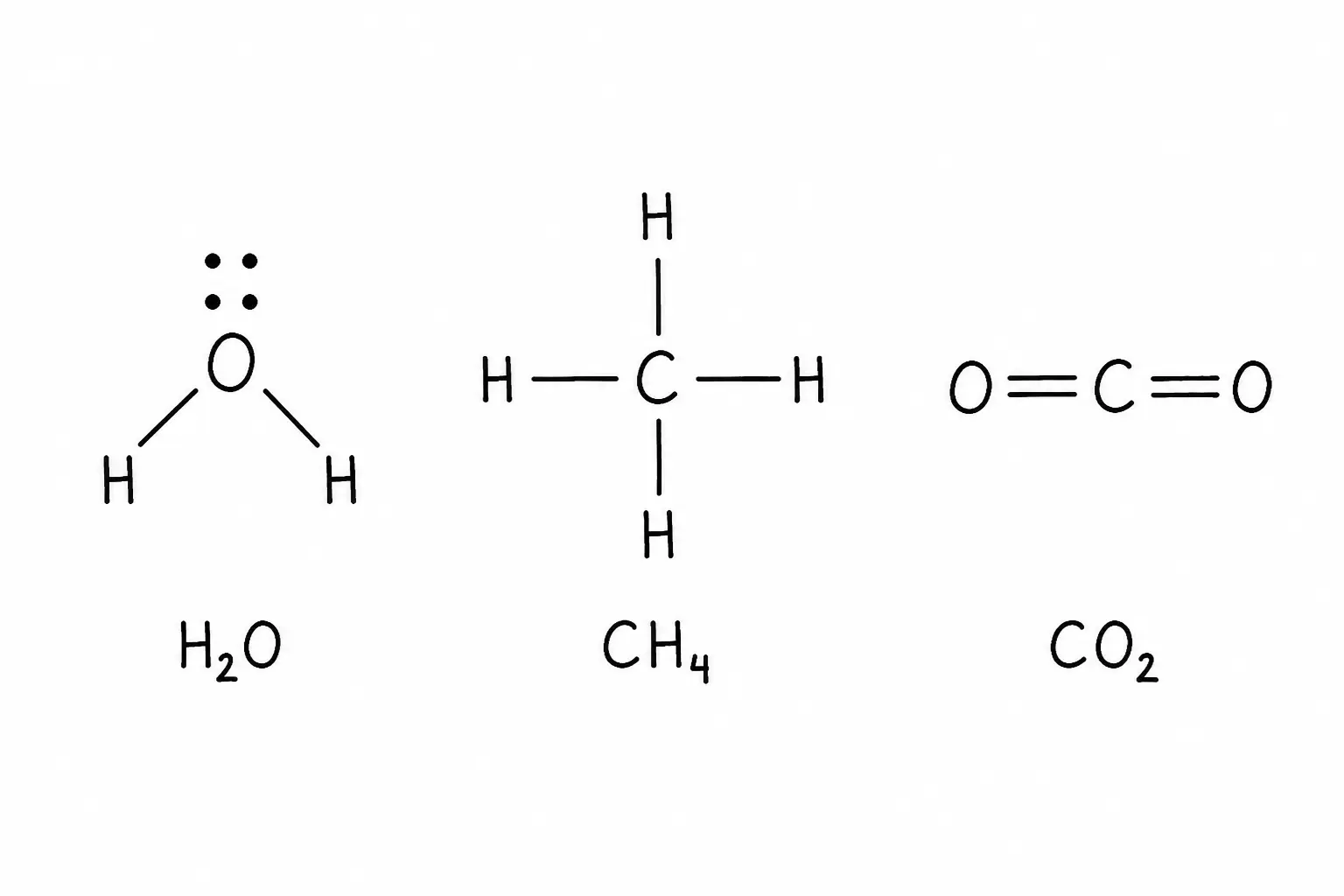
The Building Blocks
A Lewis structure shows three things:
- Atoms represented by their chemical symbol (H, C, N, O, etc.).
- Bonds represented by lines between atoms. A single line = single bond (2 shared electrons). Two parallel lines = double bond (4 shared electrons). Three lines = triple bond (6 shared electrons).
- Lone pairs represented by pairs of dots placed around the atom symbol. These are valence electrons that are not part of any bond.
Every valence electron in the molecule must be accounted for somewhere, either in a bond between two atoms or as a lone pair on one atom. The total is fixed by the sum of valence electron counts plus any charge.
Step-by-Step Procedure
A reliable method that works for most main-group molecules:
- Count total valence electrons. Add up the valence electrons from each atom. For ions, add electrons if it’s a negative ion or subtract if it’s a positive ion. Example: SO₄²⁻ has 6 (S) + 4×6 (O) + 2 (charge) = 32 valence electrons.
- Identify the central atom. Usually the least electronegative atom (excluding hydrogen, which never goes central). For ABx-type molecules, the lone A is central.
- Draw single bonds from the central atom to each surrounding atom. Each bond uses 2 electrons from your total.
- Place remaining electrons as lone pairs on surrounding atoms first, filling each to an octet (or duet for H).
- Place any leftover electrons on the central atom as lone pairs.
- If the central atom doesn’t have a full octet, form double or triple bonds by moving lone pairs from surrounding atoms into bonding positions. This is when you create multiple bonds.
- Verify formal charges. The sum of formal charges must equal the molecule’s overall charge. Best Lewis structure has formal charges closest to zero on all atoms.
Worked Examples
Water (H₂O)
Total valence electrons: 1+1+6 = 8. Central atom: O. Two O-H single bonds use 4 electrons. Remaining 4 electrons placed as two lone pairs on O. Final structure: H-O-H with two dots above and two dots below the O. Oxygen has 2 bonding pairs + 2 lone pairs = full octet. Each H has 1 bonding pair = duet.
Methane (CH₄)
Total valence electrons: 4 + 4×1 = 8. Central atom: C. Four C-H single bonds use all 8 electrons. No lone pairs on anyone. Each H has its duet; C has 4 bonding pairs = full octet.
Carbon dioxide (CO₂)
Total valence electrons: 4 + 2×6 = 16. Central atom: C. Start with two single bonds (4 electrons used). Place remaining 12 as lone pairs on the two O atoms (6 each), giving each O a full octet. But now C has only 2 bonding pairs = only 4 electrons, not 8. Move one lone pair from each O into a bond with C, creating two C=O double bonds. Final: O=C=O, with two lone pairs on each O. C has 4 bonding pairs (counting double bonds as 2) = full octet.
Formal Charges
Formal charge tells you whether an atom in a Lewis structure has the ‘right’ number of electrons. Calculate it as:
$$ \text{Formal Charge} = (\text{group number}) – (\text{lone pair electrons}) – \dfrac{1}{2}(\text{bonding electrons}) $$
Example: in carbonate ion CO₃²⁻ written with one C=O double bond and two C-O single bonds, the double-bonded O has formal charge 0, each single-bonded O has -1, and C has 0. Sum = -2, matching the ion’s charge. The ‘best’ Lewis structure usually has formal charges closest to zero on all atoms, with any non-zero formal charges on the most electronegative atoms.
Resonance Structures
Sometimes a molecule cannot be represented by a single Lewis structure, multiple equivalent structures are possible, differing only in the placement of electrons (not atoms). These are called resonance structures, and the real molecule is a hybrid of all of them.
Carbonate (CO₃²⁻) has three equivalent resonance structures, each with the C=O double bond on a different oxygen. The actual molecule has three equivalent C-O bonds of bond order 1.33, not one double and two single. Resonance structures are connected by double-headed arrows (↔) in chemistry notation.
Other classic examples: nitrate (NO₃⁻), sulfate (SO₄²⁻), benzene (C₆H₆), ozone (O₃).
Exceptions to the Octet Rule
Three categories of exceptions appear regularly:
- Incomplete octet. Boron compounds like BF₃ are stable with only 6 valence electrons around B. The empty orbital makes them Lewis acids, electron-pair acceptors.
- Expanded octet. Phosphorus and sulfur (period 3 and below) can have 10, 12, or even more valence electrons around them by using d-orbitals. PCl₅ has 10 electrons around P; SF₆ has 12 around S.
- Odd-electron molecules. NO (nitric oxide) and NO₂ (nitrogen dioxide) have an odd total number of valence electrons, so they can’t satisfy the octet rule. The unpaired electron makes them free radicals.
Related study notes: Valence Electrons, Chemical Bonding, Electronegativity, Periodic Table.
The OpenStax chemistry textbooks provide further explanations of the chemical principles used in this note.
Drawing Carbon Dioxide
CO2 has 16 valence electrons: 4 from carbon and 6 from each oxygen. A skeleton O-C-O uses 4 electrons in single bonds. Completing oxygen octets uses the remaining electrons, but carbon then lacks an octet.
Forming a double bond to each oxygen gives O=C=O. Each oxygen retains 2 lone pairs and all formal charges are zero. The electron count remains 16: moving a lone pair into a bond changes its placement without creating new electrons. Other species can require resonance, exceptions to the octet pattern or radical electrons.
The points to check in this example are:
- Count ionic charge before placing electrons.
- A bond contains 2 electrons in this representation.
- Formal charge uses assigned bonding electrons rather than actual measured charge density.
Check Your Understanding
Try the questions before reading the answers.
Question 1. How many valence electrons are in NH4+?
Answer. 8.
Question 2. Are resonance structures different molecules rapidly switching back and forth?
Answer. No. They are contributing representations of one electronic structure.
Frequently Asked Questions
What is a Lewis structure?
A Lewis structure (or Lewis dot structure) is a 2D diagram of a molecule showing which atoms are bonded, where the lone pairs sit, and how many bonds exist between each pair. Atoms are shown as element symbols; bonds as lines (single, double, or triple); lone pairs as paired dots. Lewis structures were introduced by Gilbert N. Lewis in 1916 and remain the standard molecule-drawing technique in chemistry.
How do you draw a Lewis structure?
Six-step procedure: 1) Count total valence electrons. 2) Pick the central atom (usually the least electronegative, never hydrogen). 3) Draw single bonds from central to each surrounding atom. 4) Fill surrounding atom octets with lone pairs first. 5) Put leftover electrons as lone pairs on the central atom. 6) If the central atom is short of an octet, convert lone pairs from surrounding atoms into double or triple bonds.
What is the octet rule in Lewis structures?
The octet rule says most main-group atoms in Lewis structures should have 8 valence electrons (counting both bonding and lone-pair electrons). Hydrogen is the exception, it aims for a duet (2 electrons). Boron is comfortable with 6 (incomplete octet). Period 3 and below can have expanded octets (10, 12, or more). Odd-electron molecules like NO can’t satisfy the rule at all.
What are resonance structures?
Resonance structures are multiple equivalent Lewis structures that differ only in electron placement, not atom positions. The actual molecule is a hybrid of all the resonance forms, not flipping between them, but a single structure with bond orders between integer values. Carbonate (CO3²⁻), nitrate (NO3⁻), benzene, and ozone are classic examples. Drawn with double-headed arrows between forms.
What is formal charge in Lewis structures?
Formal charge is calculated as (group number) – (lone pair electrons) – (1/2 × bonding electrons). It tells you whether an atom in a particular Lewis structure has the ‘right’ number of electrons. The best Lewis structure for a molecule has formal charges closest to zero on all atoms, with any non-zero formal charges on the most electronegative atoms. Sum of all formal charges must equal the molecule’s overall charge.
Why does carbon dioxide have double bonds?
Carbon dioxide has 16 valence electrons (4 from C + 12 from two O). Starting with two single bonds (4 electrons), you have 12 left. Distributing them as lone pairs gives each O a full octet but leaves C with only 4 electrons (2 bonds). To give C a full octet, you move one lone pair from each O into a bonding position with C, creating two C=O double bonds. Each O now has 2 lone pairs and a double bond; C has 4 bonding pairs.
Browse more in Chemistry.