by
by
VSEPR theory, Valence Shell Electron Pair Repulsion, predicts the three-dimensional shapes of molecules from a single simple rule: electron pairs around a central atom arrange themselves so as to be as far apart as possible. Developed by Ronald Gillespie and Ronald Nyholm in the 1950s, VSEPR is the standard tool for predicting molecular geometry from a Lewis structure alone, and it gives the right answer for the vast majority of small molecules without any quantum mechanics.
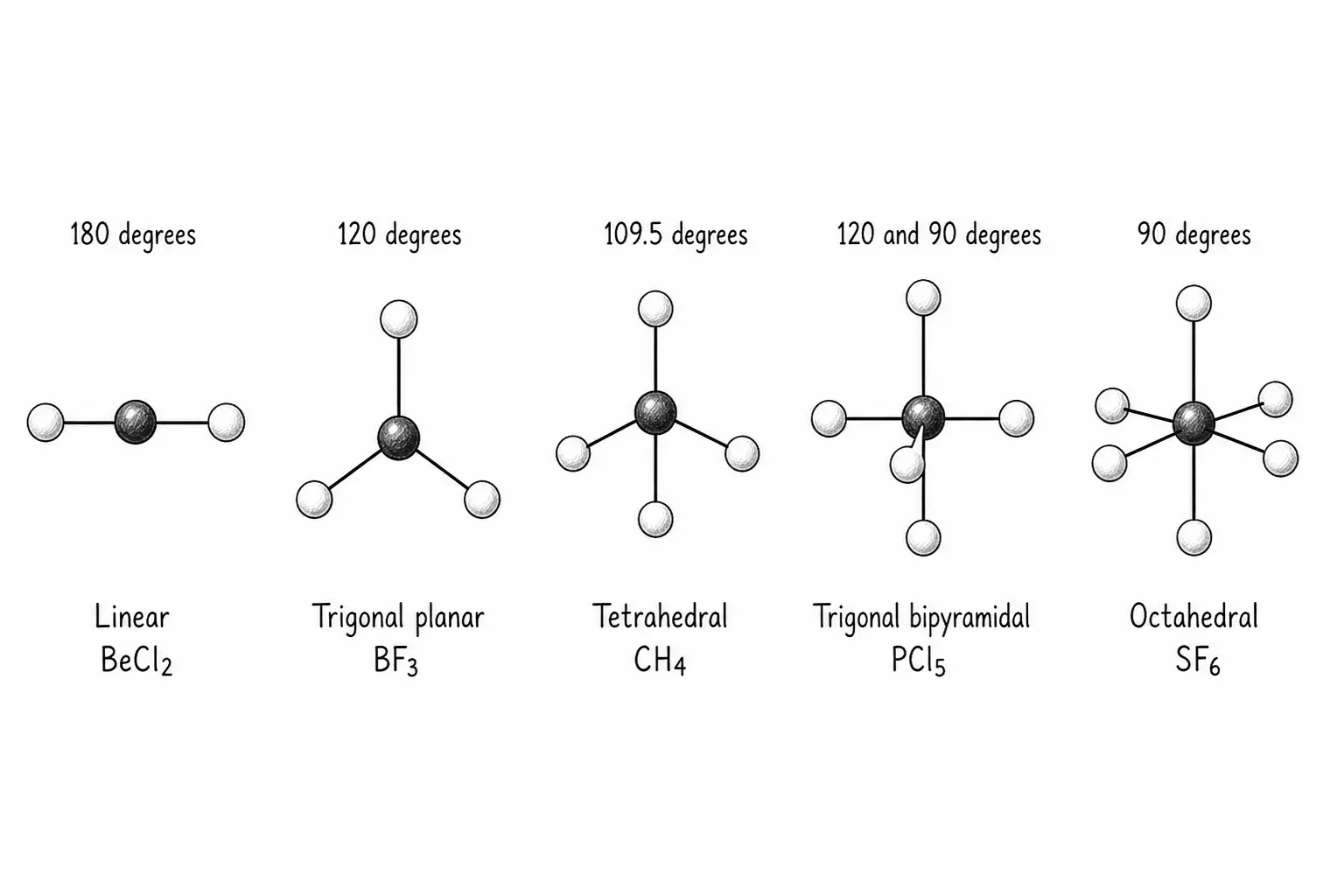
VSEPR uses electron-domain arrangement to predict a molecular shape. Lone pairs affect the shape without appearing as bonded atoms.
The Core Idea
Electron pairs in the valence shell of a central atom (whether bonding or lone) repel each other electrostatically. They settle into the geometry that puts them as far apart as possible. The molecular shape that results depends on:
- The number of bonding pairs (single, double, or triple bond all count as one pair for VSEPR).
- The number of lone pairs.
- The fact that lone pairs are ‘fatter’ (they spread out more, taking more space) than bonding pairs, so lone-pair-bonding-pair repulsion is greater than bonding-bonding repulsion.
Steric Number and Electron Geometry
The steric number is the total number of electron-pair domains (bonds + lone pairs) around the central atom. For each steric number, the electron pairs adopt a specific arrangement:
| Steric number | Electron geometry | Bond angle (ideal) |
|---|---|---|
| 2 | Linear | 180° |
| 3 | Trigonal planar | 120° |
| 4 | Tetrahedral | 109.5° |
| 5 | Trigonal bipyramidal | 90° / 120° |
| 6 | Octahedral | 90° |
The molecular geometry, the shape described by the atom positions alone, depends on how many of those domains are lone pairs versus bonds. Lone pairs are invisible in the shape; they just push the atoms into a different arrangement.
Common Geometries
| Steric # | Lone pairs | Molecular geometry | Example | Bond angle |
|---|---|---|---|---|
| 2 | 0 | Linear | BeCl₂, CO₂ | 180° |
| 3 | 0 | Trigonal planar | BF₃ | 120° |
| 3 | 1 | Bent | SO₂ | ~118° |
| 4 | 0 | Tetrahedral | CH₄ | 109.5° |
| 4 | 1 | Trigonal pyramidal | NH₃ | 107° |
| 4 | 2 | Bent | H₂O | 104.5° |
| 5 | 0 | Trigonal bipyramidal | PCl₅ | 90° / 120° |
| 5 | 2 | T-shaped | ClF₃ | ~87° |
| 6 | 0 | Octahedral | SF₆ | 90° |
| 6 | 2 | Square planar | XeF₄ | 90° |
Worked Example: Water
Water is H₂O. Lewis structure: oxygen is central, two O-H bonds, two lone pairs on oxygen. Steric number = 2 + 2 = 4. Electron geometry is tetrahedral. With two of the four corners occupied by lone pairs, the molecular geometry is bent.
The ideal tetrahedral angle is 109.5°, but the two lone pairs on oxygen exert extra repulsion on the bonding pairs, squeezing the H-O-H angle down to about 104.5°. This bent shape, combined with the high electronegativity of oxygen, gives water its polarity, hydrogen bonding, and unusual physical properties.
Worked Example: Ammonia
Ammonia is NH₃. Lewis structure: nitrogen central, three N-H bonds, one lone pair. Steric number = 3 + 1 = 4. Electron geometry is tetrahedral; with one corner taken by the lone pair, the molecular geometry is trigonal pyramidal. The bond angle is 107°, slightly less than 109.5° because the one lone pair pushes the bonding pairs together.
Limitations of VSEPR
- Transition metals. d-orbital chemistry doesn’t follow VSEPR cleanly. Crystal field theory and ligand field theory are the right tools for transition-metal complexes.
- Heavily strained molecules. Cyclopropane (60° angles) and other small rings show that the lowest-energy molecular geometry sometimes is not the one VSEPR predicts.
- Inert pair effect. Heavy main-group elements (lead, thallium, bismuth) sometimes keep their outer s electrons as a ‘inert’ lone pair that doesn’t behave like a normal lone pair, distorting predictions.
- Bond order subtleties. VSEPR treats double and triple bonds the same as single bonds in terms of count, which oversimplifies the geometry of conjugated and highly multiply-bonded species.
Why VSEPR Matters
- Reactivity. A molecule’s shape determines which functional groups are exposed, which face other molecules in collisions, and therefore which reactions are easy.
- Polarity. Bent, pyramidal, and asymmetric molecules can have net dipole moments; symmetric ones (linear, planar) don’t. This determines solubility, intermolecular forces, and boiling points.
- Biology. Enzymes and substrates fit by shape complementarity. A tetrahedral or planar fit at the active site can mean the difference between catalysis and no reaction.
- Drug design. Whether a drug binds its target depends on shape. VSEPR gives a fast first-pass estimate of a candidate molecule’s geometry before any computational chemistry.
Related study notes: Ionic vs Covalent Bonds, Electronegativity, Lewis Structures, Molecular Polarity.
The OpenStax chemistry textbooks provide further explanations of the chemical principles used in this note.
Water and Ammonia
Water has 4 electron domains around oxygen: 2 bonds and 2 lone pairs. The electron-domain arrangement is approximately tetrahedral, while the molecular shape is bent. Ammonia has 3 bonds and 1 lone pair, giving a trigonal-pyramidal molecular shape.
A double or triple bond counts as 1 domain for the basic shape prediction, although it can affect repulsion and bond angles. CO2 therefore has 2 domains around carbon and a linear shape. Identifying the domains from a sound Lewis structure should come before memorizing a shape label.
The points to check in this example are:
- Electron geometry and molecular geometry answer different questions.
- Lone pairs influence repulsion and observed angles.
- The model is useful but has limits, especially for some transition-metal and delocalized bonding situations.
Check Your Understanding
Try the questions before reading the answers.
Question 1. What is the molecular shape of methane?
Answer. Tetrahedral.
Question 2. How many domains surround carbon in CO2?
Answer. 2.
Frequently Asked Questions
What is VSEPR theory?
VSEPR (Valence Shell Electron Pair Repulsion) is a model for predicting molecular geometry. Electron pairs around a central atom repel each other and arrange themselves to be as far apart as possible. The geometry that results, combined with the position of lone pairs, determines the molecule’s shape.
How do you determine molecular geometry using VSEPR?
Draw the Lewis structure. Count electron-pair domains around the central atom (each bond is one domain regardless of order; each lone pair is one domain). That gives the steric number, which sets the electron geometry. Subtract the lone pairs to get the molecular geometry, the shape described by atom positions alone.
Why is water bent?
Oxygen has two bonding pairs (to hydrogen) and two lone pairs, four electron domains, so the electron geometry is tetrahedral. With two of the four corners occupied by lone pairs, the molecular geometry (the shape made by the atoms alone) is bent. The ideal tetrahedral angle is 109.5°, but lone-pair repulsion squeezes the H-O-H angle to ~104.5°.
Why are lone pairs more repulsive than bonding pairs?
A lone pair is held by only one nucleus, so it occupies more space and ‘spreads’ wider near the central atom. A bonding pair is held tightly between two nuclei. The fatter lone pair pushes against bonding pairs more strongly, compressing the bond angles below the ideal values.
Does VSEPR work for transition metals?
Not very well. Transition metals have partially filled d-orbitals, and the geometry of their complexes is shaped more by d-orbital splitting in the ligand field than by simple electrostatic repulsion. Crystal field theory and ligand field theory are the right tools for transition-metal coordination compounds.
Who developed VSEPR theory?
Ronald Gillespie and Ronald Nyholm at University College London formulated the modern VSEPR model in 1957, building on earlier work by Sidgwick and Powell (1940). It has become the standard introductory model for predicting molecular shape and remains remarkably effective for the great majority of main-group molecules.
Browse more in Chemistry.