by
by
Electronegativity is how strongly an atom pulls bonded electrons toward itself. It is the single most useful concept for predicting whether a bond will be covalent or ionic, where a molecule’s partial charges will sit, and how reactive atoms are likely to be in chemical reactions. The Pauling scale, introduced by Linus Pauling in 1932, runs from 0.7 (cesium) to 3.98 (fluorine). Once you know an atom’s electronegativity, you can predict a remarkable amount about its chemistry without doing any further work.
Electronegativity compares the attraction for shared electrons in a bonding context. A difference is a guide to bond polarization rather than a sharp physical boundary between all bond types.
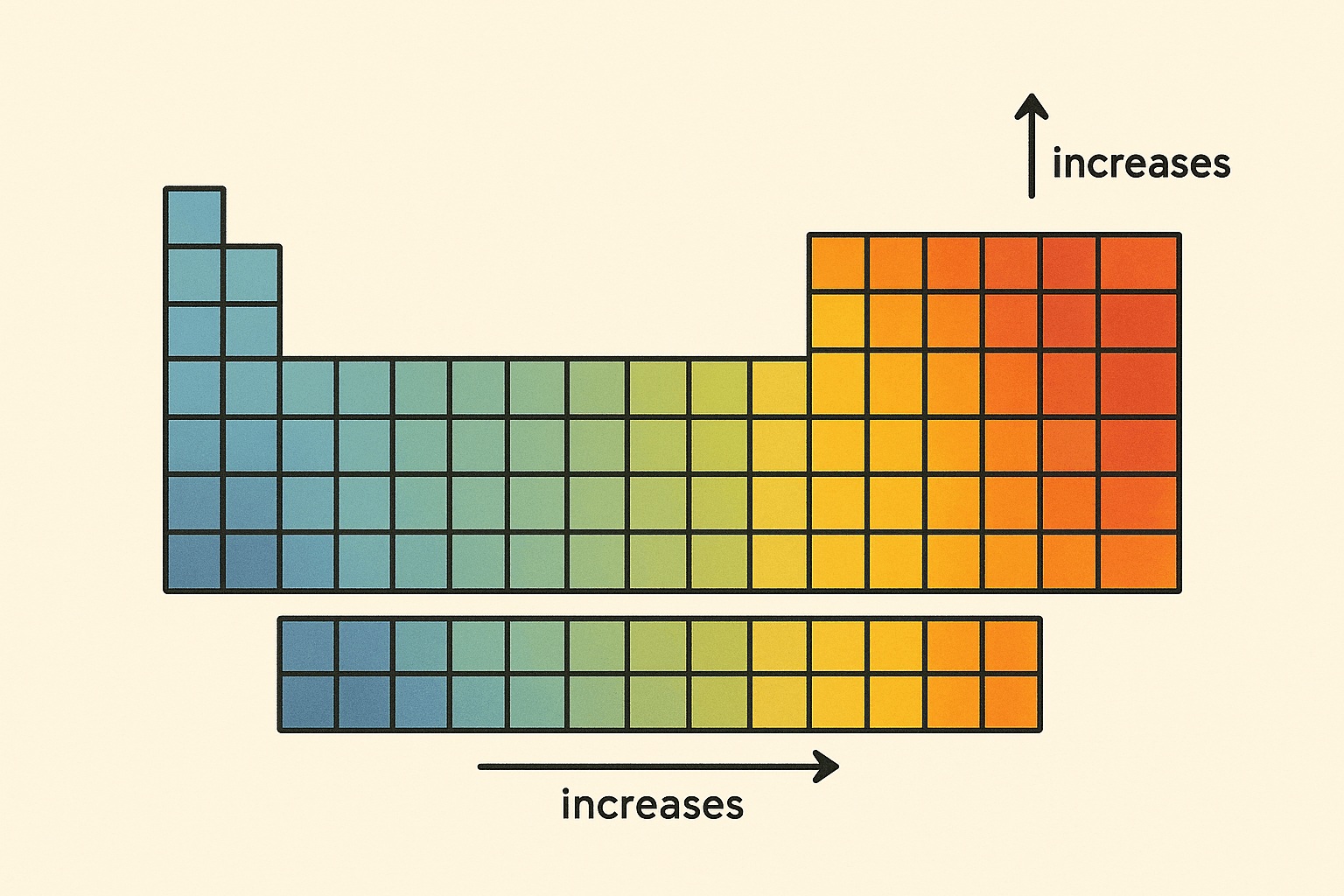
The Pauling Scale
Linus Pauling defined electronegativity in 1932 by comparing bond energies. He noticed that an A-B bond between atoms of different electronegativity is stronger than the average of A-A and B-B bonds, the extra strength is the ionic character of the bond. From the bond-energy difference he derived a dimensionless scale anchored so that hydrogen has electronegativity 2.20.
Selected values on the modern Pauling scale:
| Element | Electronegativity | Element | Electronegativity |
|---|---|---|---|
| Fluorine (F) | 3.98 (highest) | Hydrogen (H) | 2.20 |
| Oxygen (O) | 3.44 | Carbon (C) | 2.55 |
| Chlorine (Cl) | 3.16 | Sodium (Na) | 0.93 |
| Nitrogen (N) | 3.04 | Potassium (K) | 0.82 |
| Bromine (Br) | 2.96 | Cesium (Cs) | 0.79 (lowest) |
Other electronegativity scales exist, Mulliken (averaging ionization energy and electron affinity), Allred-Rochow (based on effective nuclear charge), Allen (spectroscopic). They differ in details but agree on the basic trends. Pauling is the most widely used.
The Two Trends on the Periodic Table
Electronegativity follows two clean trends across the periodic table:
- Increases across a period (left to right). Atoms in the same row have the same number of electron shells, but the nuclear charge increases as you go right. More protons pulling on the same number of shells means a stronger pull on bonded electrons. Sodium (0.93) → magnesium (1.31) → … → chlorine (3.16). The jump from left to right is large.
- Decreases down a group (top to bottom). Atoms in the same column have similar valence-electron arrangements, but more electron shells are added as you go down. The bonded electrons sit farther from the nucleus and are also shielded by inner-shell electrons. So the pull weakens. Fluorine (3.98) → chlorine (3.16) → bromine (2.96) → iodine (2.66).
Combining the two trends, the most electronegative elements sit in the top right (excluding the noble gases, which usually do not form bonds): fluorine, oxygen, chlorine, nitrogen. The least electronegative sit at the bottom left: cesium, francium, rubidium.
Predicting Bond Type from Electronegativity Difference
The most useful application of electronegativity is predicting whether a bond between two atoms will be nonpolar covalent, polar covalent, or ionic. The rule of thumb based on electronegativity difference (Δχ):
| Δχ range | Bond type | Example |
|---|---|---|
| 0 to 0.4 | Nonpolar covalent | H-H (Δχ = 0), C-H (Δχ = 0.35) |
| 0.5 to 1.7 | Polar covalent | O-H (Δχ = 1.24), C-O (Δχ = 0.89) |
| 1.8 and above | Ionic | Na-Cl (Δχ = 2.23), K-F (Δχ = 3.16) |
The 1.7 cutoff is a convention, not a hard rule. In reality, bond character lies on a continuum from pure covalent to pure ionic, and many bonds (like HF, Δχ = 1.78) sit awkwardly at the boundary. The general lesson stands: bigger electronegativity difference means more ionic character.
Polar Molecules and Dipoles
In polar covalent bonds, the more electronegative atom carries a partial negative charge (\(\\delta^-\)), and the less electronegative atom carries a partial positive charge (\(\\delta^+\)). The result is a bond dipole. The dipole’s magnitude is roughly proportional to the electronegativity difference.
Whether a whole molecule has a net dipole depends on geometry. Water (H-O-H) has two polar O-H bonds, and the molecule is bent rather than linear, so the dipoles add to a net molecular dipole. Carbon dioxide (O=C=O) also has polar C-O bonds, but the molecule is linear and the two dipoles point in opposite directions, they cancel, so CO₂ has no net dipole. Geometry matters.
Why Electronegativity Matters in Chemistry
- Predicting reactivity. Electronegative atoms attract electrons, which is why the most reactive nonmetals (F, O, Cl) are the most electronegative.
- Understanding acid strength. The acidity of HX (where X is a halogen) is influenced by the H-X bond strength and the stability of X⁻, both relate to electronegativity.
- Drawing Lewis structures. Formal charges and resonance structures depend on knowing which atom is more electronegative.
- Predicting intermolecular forces. Hydrogen bonding requires a hydrogen bonded to N, O, or F, all highly electronegative.
- Organic chemistry mechanisms. Nucleophiles attack electrophilic (electron-poor) sites; electrophiles attack nucleophilic (electron-rich) sites. Both concepts trace back to electronegativity gradients within molecules.
Related study notes: Periodic Table, Chemical Bonding, Avogadro’s Number, Mole Concept.
The OpenStax chemistry textbooks provide further explanations of the chemical principles used in this note.
A Polar Bond and a Nonpolar Molecule
Each carbon-oxygen bond in CO2 is polar because oxygen attracts the shared electrons more strongly. The molecule is linear and its 2 equal bond dipoles point oppositely, so the net molecular dipole cancels.
Water also has polar bonds, but its bent geometry prevents the 2 bond dipoles from canceling. Predicting molecular polarity therefore needs both bond polarization and geometry. Electronegativity differences alone cannot establish the whole-molecule result.
The points to check in this example are:
- An electronegativity scale is a comparative model.
- Bond polarity and molecular polarity are distinct.
- Symmetry can cancel individual dipoles.
Check Your Understanding
Try the questions before reading the answers.
Question 1. Can a molecule with polar bonds have zero net dipole?
Answer. Yes. Linear CO2 is an example.
Question 2. Does a numerical cutoff make all bonds on either side perfectly ionic or covalent?
Answer. No. Bonding character forms a continuum.
Practice Questions
Work each question before reading its solution. The set runs from direct recall and substitution to the applied questions that exams actually use to separate grades. The downloadable PDF includes these questions and their solutions.
Question 1. Define electronegativity, and name the scale most commonly used to quantify it.
Solution. Electronegativity measures an atom’s tendency to attract shared electrons toward itself within a covalent bond. The Pauling scale, running roughly from 0.7 (cesium) to 4.0 (fluorine), is the standard quantitative reference, derived originally from bond energy comparisons.
Question 2. State the periodic trends for electronegativity across a period and down a group, and explain both using nuclear charge and shielding.
Solution. Electronegativity INCREASES left to right across a period, because nuclear charge grows while shielding stays roughly constant, pulling valence electrons in harder. It DECREASES down a group, because added electron shells increase distance and shielding, weakening the nucleus’s grip on any shared pair despite the larger charge.
Question 3. Which element has the highest electronegativity, and which region of the periodic table generally has the lowest?
Solution. Fluorine, at 4.0, sits at the top-right corner where the trends peak together. The lowest values cluster in the bottom-left, the alkali metals (cesium and francium near 0.7), where both trends work against high electronegativity: far from the nucleus, heavily shielded.
Question 4. Using electronegativity differences, classify the bonds H-F (\(\Delta = 1.9\)), C-H (\(\Delta = 0.4\)), and Na-F (\(\Delta = 3.1\)) as nonpolar covalent, polar covalent, or ionic.
Solution. C-H: essentially nonpolar covalent (right at the borderline). H-F: clearly polar covalent. Na-F: ionic, the difference is large enough that electron transfer, not sharing, is the better description. The rough boundaries: below 0.4 nonpolar, 0.4-1.7 polar covalent, above 1.7 ionic.
Question 5. In the molecule H-Cl, which atom carries the partial negative charge, and how is this indicated in notation?
Solution. Chlorine (electronegativity 3.16) pulls the shared electron pair harder than hydrogen (2.20), so chlorine carries \(\delta^-\) and hydrogen carries \(\delta^+\). This is written \(H^{\delta+}-Cl^{\delta-}\), and the arrow-over-the-bond notation points toward the more electronegative atom, matching where the electron density actually shifts.
Question 6. CCl\(_4\) has 4 polar C-Cl bonds, yet the molecule as a whole is nonpolar. Explain, and contrast with CHCl\(_3\).
Solution. Molecular polarity is a vector sum of bond dipoles. CCl\(_4\)’s tetrahedral, fully symmetric shape makes the 4 equal C-Cl dipoles cancel exactly. CHCl\(_3\) breaks that symmetry, 1 hydrogen instead of chlorine, so the dipoles do NOT cancel and the molecule is polar overall. Same bond type, opposite molecular outcome, purely from geometry.
Question 7. Why is water’s high electronegativity difference (O-H, \(\Delta \approx 1.4\)) combined with its bent shape responsible for many of its unusual properties?
Solution. The large electronegativity gap makes each O-H bond strongly polar, and water’s bent (not linear) geometry means those bond dipoles reinforce rather than cancel, producing a strong net molecular dipole. That dipole drives extensive hydrogen bonding between water molecules, which explains water’s unusually high boiling point, its surface tension, and its excellence as a solvent for polar and ionic substances.
Question 8. Fluorine is more electronegative than oxygen, yet oxygen more commonly forms hydrogen bonds central to biology. Resolve this by naming what else determines hydrogen-bond strength and prevalence.
Solution. Hydrogen bonding requires H attached to a small, highly electronegative atom WITH available lone pairs to accept the bond, standardly N, O, or F. Oxygen appears throughout biology (water, alcohols, carbonyls, phosphate backbones) far more often than fluorine, which is rare in biological molecules; electronegativity ranks the pulling strength, but abundance and molecular context decide how often that strength gets used.
Question 9. Estimate the ionic character of a bond with \(\Delta EN = 2.0\) using the rough empirical relation that 1.7 corresponds to about 50% ionic character, scaling roughly linearly for a first estimate.
Solution. Scaling from the reference point: \(\frac{2.0}{1.7} \times 50\% \approx 59\%\) ionic character. Real ionic-character curves are not perfectly linear, but this estimate correctly signals that a bond with \(\Delta EN = 2.0\), such as many metal-oxygen bonds, sits solidly past the halfway point toward ionic behavior, useful for predicting solubility and conductivity trends.
Question 10. Predict, using electronegativity trends alone, which is the stronger acid: HF or HI, and explain the apparent paradox that fluorine’s HIGH electronegativity does not make HF the stronger acid.
Solution. HI is actually the far stronger acid, despite iodine’s LOWER electronegativity, because acid strength in this series is dominated by bond length and bond energy, not polarity: the H-I bond is much longer and weaker, breaking far more readily to release H\(^+\). This is the classic trap: electronegativity predicts bond POLARITY reliably, but acid strength (a kinetic and thermodynamic question about bond breaking) is a separate property that can run opposite to the polarity trend.
Frequently Asked Questions
What is electronegativity in simple terms?
Electronegativity is how strongly an atom in a chemical bond pulls the shared electrons toward itself. A more electronegative atom (like fluorine or oxygen) hogs the electrons; a less electronegative atom (like sodium or hydrogen) lets them go. The difference between two bonded atoms’ electronegativities determines whether the bond is nonpolar covalent, polar covalent, or ionic.
Which element has the highest electronegativity?
Fluorine, with a Pauling-scale electronegativity of 3.98. This makes sense, fluorine is in the top right of the periodic table, where electronegativity peaks. Oxygen is second at 3.44, then chlorine at 3.16. Cesium has the lowest at 0.79 (or francium at 0.7, though francium’s value is debated since it’s radioactive and rarely measured).
What are the periodic table trends in electronegativity?
Electronegativity increases as you go LEFT to RIGHT across a period (more protons pulling on the same electron shells) and DECREASES as you go DOWN a group (electrons sit farther from the nucleus with more shielding). The result: the top-right corner of the periodic table has the most electronegative elements; the bottom-left has the least.
How does electronegativity predict bond type?
Calculate the electronegativity difference (Δχ) between two atoms. If Δχ is 0 to 0.4, the bond is nonpolar covalent (like H-H or C-H). If Δχ is 0.5 to 1.7, the bond is polar covalent (like O-H or C-O). If Δχ is 1.8 or higher, the bond is mostly ionic (like Na-Cl or K-F). The 1.7 cutoff is a convention; real bond character lies on a continuum.
Why is fluorine the most electronegative?
Fluorine sits in the top-right of the periodic table, just before the noble gases. It has 9 protons but only 2 electron shells, so the nuclear pull on bonded electrons is intense. Fluorine is also one electron short of a full octet (the noble-gas configuration of neon), so it ‘wants’ to grab one more electron, this makes it both extremely reactive and the most electronegative element.
What is the difference between electronegativity and electron affinity?
Electron affinity is the energy released when a free, neutral atom picks up an extra electron in the gas phase, it is measurable in kJ/mol. Electronegativity is a dimensionless property of an atom WITHIN a bond, describing how it pulls bonded electrons. The two are related (electronegative atoms generally have high electron affinity), but they describe different physical situations.
Browse more in Chemistry.