by
by
Redox reactions, short for reduction-oxidation, are chemical reactions in which electrons are transferred from one substance to another. One species loses electrons (oxidation), and another gains them (reduction). Both happen simultaneously; you cannot have one without the other. Redox chemistry powers batteries, drives respiration and photosynthesis, causes corrosion, and underlies most of industrial chemistry.
Oxidation and reduction track electron accounting and oxidation-state changes. Both occur together in the overall balanced reaction.
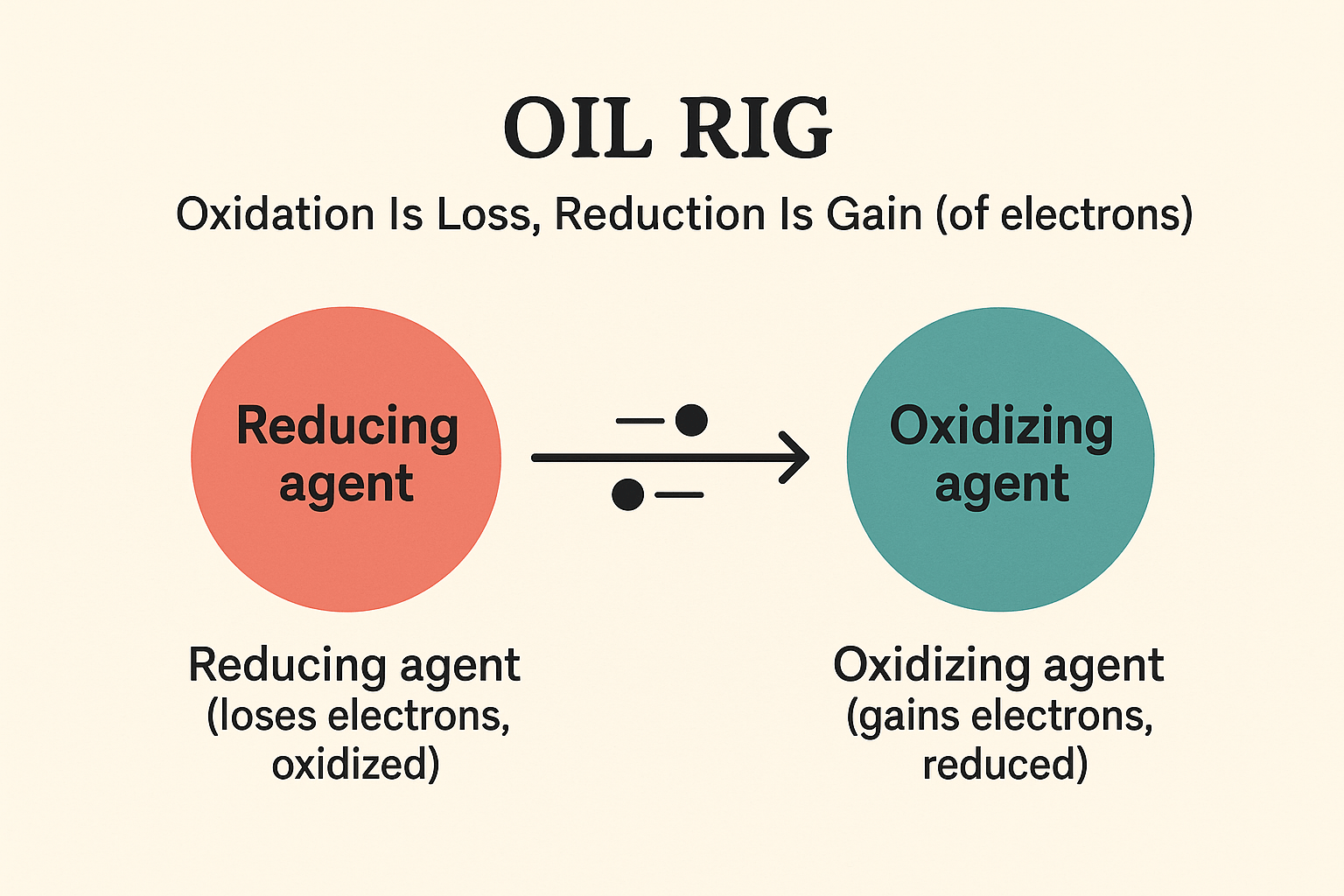
Oxidation and Reduction
The modern definition is purely about electron transfer:
- Oxidation is the loss of electrons.
- Reduction is the gain of electrons.
- OIL RIG is the standard mnemonic: Oxidation Is Loss, Reduction Is Gain.
Example: \( \text{Zn} + \text{Cu}^{2+} \rightarrow \text{Zn}^{2+} + \text{Cu} \). Zinc loses two electrons (oxidized). Copper(II) gains two electrons (reduced).
Oxidizing and Reducing Agents
- Oxidizing agent (oxidant): the species that gains electrons. By gaining them, it causes something else to be oxidized. In the example above, \( \text{Cu}^{2+} \) is the oxidizing agent.
- Reducing agent (reductant): the species that loses electrons. By losing them, it causes something else to be reduced. Zn is the reducing agent.
Common oxidizing agents: \( \text{O}_2 \), \( \text{Cl}_2 \), \( \text{H}_2\text{O}_2 \), \( \text{KMnO}_4 \), \( \text{K}_2\text{Cr}_2\text{O}_7 \). Common reducing agents: H₂, C (carbon, including coke), CO, Na, Mg, Al, NaBH₄.
Oxidation States
To track electron transfer in molecules where ions aren’t obvious, chemists assign oxidation states (oxidation numbers). The rules:
- Free elements have oxidation state 0 (e.g., O₂, Cu, Fe).
- Monatomic ions equal their charge (Na⁺ = +1, Cl⁻ = -1).
- Oxygen is usually -2 (except in peroxides, where it’s -1).
- Hydrogen is usually +1 (except in metal hydrides, where it’s -1).
- The sum of oxidation states in a neutral compound equals 0; in an ion, it equals the charge.
Example: in \( \text{KMnO}_4 \), K = +1, four O = -8, so Mn = +7. After reaction in acidic solution, Mn²⁺ has oxidation state +2, Mn was reduced by 5 units (gained 5 electrons).
Balancing Redox Equations
The half-reaction method splits the equation into two halves, one for oxidation and one for reduction, then balances atoms and charges separately before recombining.
Example: \( \text{MnO}_4^- + \text{Fe}^{2+} \rightarrow \text{Mn}^{2+} + \text{Fe}^{3+} \) in acid.
- Reduction half: \( \text{MnO}_4^- + 8\text{H}^+ + 5e^- \rightarrow \text{Mn}^{2+} + 4\text{H}_2\text{O} \)
- Oxidation half: \( \text{Fe}^{2+} \rightarrow \text{Fe}^{3+} + e^- \)
- Multiply the oxidation half by 5 so electrons cancel.
- Combined: \( \text{MnO}_4^- + 5\text{Fe}^{2+} + 8\text{H}^+ \rightarrow \text{Mn}^{2+} + 5\text{Fe}^{3+} + 4\text{H}_2\text{O} \).
Real-World Examples
- Rusting. \( 4\text{Fe} + 3\text{O}_2 \rightarrow 2\text{Fe}_2\text{O}_3 \). Iron is oxidized; oxygen is reduced.
- Combustion. \( \text{CH}_4 + 2\text{O}_2 \rightarrow \text{CO}_2 + 2\text{H}_2\text{O} \). Carbon is oxidized from -4 to +4; oxygen is reduced from 0 to -2.
- Cellular respiration. Glucose is oxidized to CO₂; oxygen is reduced to water. The released energy drives ATP synthesis.
- Photosynthesis. The reverse, CO₂ is reduced to glucose; water is oxidized to O₂. Sunlight provides the energy.
- Batteries. Every battery is a controlled redox reaction. A lithium-ion battery oxidizes lithium at the anode and reduces a transition-metal oxide at the cathode while electrons flow through the external circuit.
Related study notes: Electrolysis, Electronegativity, Cellular Respiration, Photosynthesis.
The OpenStax chemistry textbooks provide further explanations of the chemical principles used in this note.
A Half-Reaction Check
For Zn + Cu²⁺ → Zn²⁺ + Cu, zinc loses 2 electrons and copper(II) gains them. The half-reactions are Zn → Zn²⁺ + 2e⁻ and Cu²⁺ + 2e⁻ → Cu. Adding them cancels the electrons.
The oxidizing agent is Cu²⁺ because it accepts electrons; the reducing agent is zinc because it supplies them. In covalent reactions, oxidation states are an accounting model and should not always be interpreted as complete localized electron transfer between isolated atoms.
The points to check in this example are:
- Oxidation increases oxidation state.
- Reduction decreases oxidation state.
- The total electrons lost and gained must balance.
Check Your Understanding
Try the questions before reading the answers.
Question 1. Which species is oxidized here?
Answer. Zinc.
Question 2. Is the oxidizing agent itself reduced?
Answer. Yes. Cu²⁺ gains electrons.
Frequently Asked Questions
What is a redox reaction?
A redox (reduction-oxidation) reaction is a chemical reaction in which electrons are transferred between species. One substance loses electrons (oxidation), another gains them (reduction). Both half-processes happen together, you can’t have one without the other.
What does OIL RIG stand for?
OIL RIG is the standard mnemonic for redox: Oxidation Is Loss, Reduction Is Gain (of electrons). If a species loses electrons in a reaction, it has been oxidized. If it gains them, it has been reduced.
What is the difference between an oxidizing agent and a reducing agent?
The oxidizing agent gains electrons (and is therefore reduced); it causes the other species to be oxidized. The reducing agent loses electrons (and is therefore oxidized); it causes the other species to be reduced. They’re named for what they do to the other reactant, not for what happens to them.
How do you assign oxidation states?
Use a set of priority rules: free elements = 0, monatomic ion = its charge, oxygen usually -2, hydrogen usually +1, sum equals charge of species. Working through these rules tells you the oxidation state of any atom in a compound, which is what you compare before and after to identify redox changes.
Why is rusting a redox reaction?
Because iron loses electrons (Fe → Fe³⁺ + 3e⁻), it’s oxidized. Oxygen gains electrons (O₂ + 4e⁻ → 2O²⁻), it’s reduced. The overall reaction 4Fe + 3O₂ → 2Fe₂O₃ transfers electrons from iron to oxygen. Moisture accelerates the process by enabling ion transport.
How does a battery use redox?
A battery has two electrodes separated by an electrolyte. Oxidation happens at the anode (electrons released into the external circuit); reduction happens at the cathode (electrons absorbed from the circuit). The electron flow through the circuit is the electric current you use. When the reactive materials are exhausted, the battery is dead.
Browse more in Chemistry.