by
by
Titration is a precise quantitative analytical technique where a solution of known concentration (the titrant) is added drop by drop to a solution of unknown concentration (the analyte) until the chemical reaction between them is complete. By measuring the volume of titrant required, you can calculate the unknown concentration. Acid-base titration is the most common type and the one every chemistry student learns first, but the same principle works for redox, complexometric, and precipitation titrations. The technique has barely changed since Karl Friedrich Mohr standardized it in the 1850s.
An endpoint is an observed signal, while an equivalence point is the stoichiometric condition. The indicator should make those conditions agree as closely as the method requires.
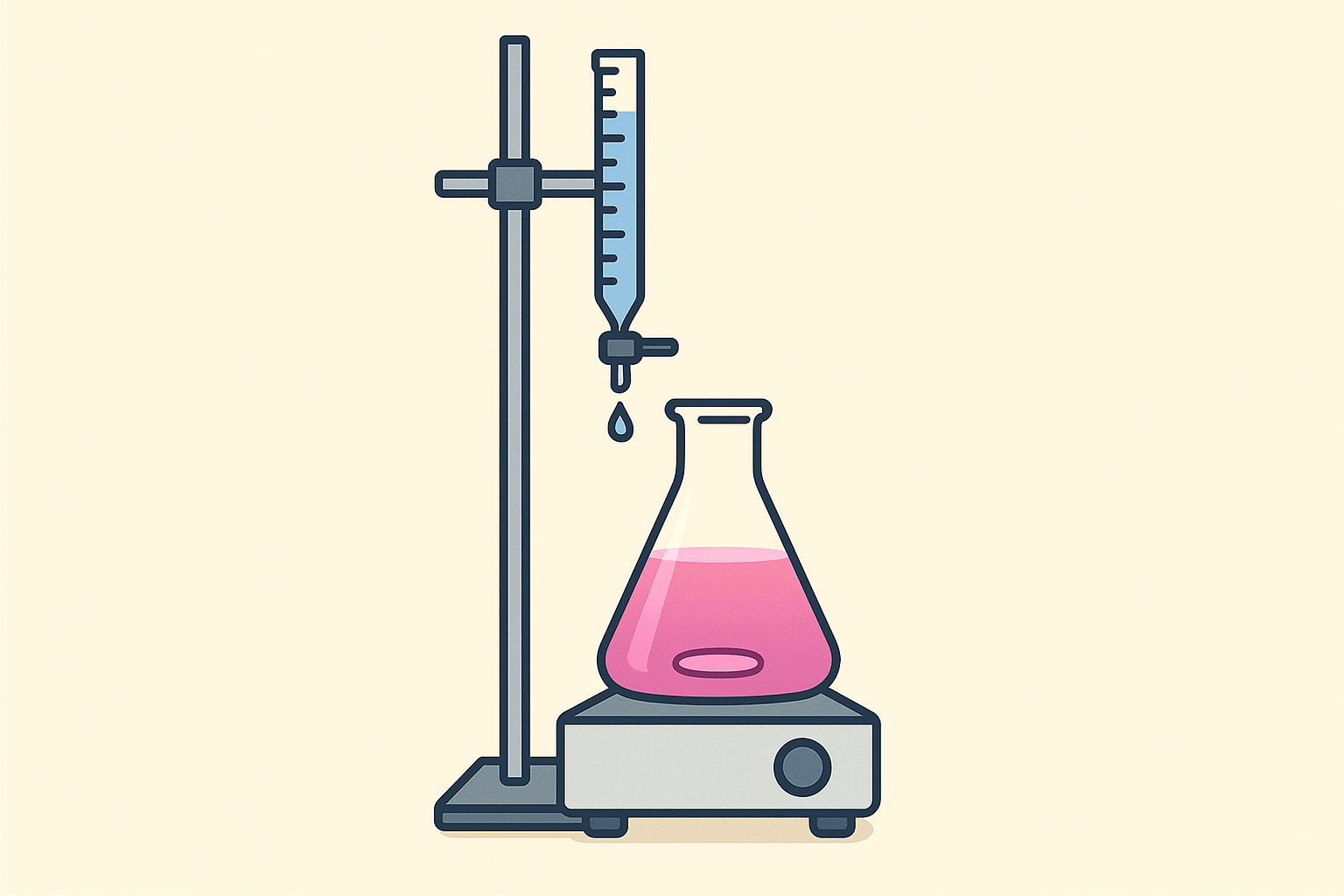
How Titration Works
The basic idea is straightforward: react a measured volume of unknown-concentration solution with a known-concentration solution until the reaction is exactly complete. The volume needed plus the known concentration tells you the unknown concentration via stoichiometry.
The standard setup has three pieces of equipment:
- Burette: a long graduated glass tube with a stopcock at the bottom. Holds the titrant. The stopcock lets you add it one drop at a time and measure the exact volume used.
- Erlenmeyer flask: holds the analyte (unknown solution) plus a small amount of indicator. The conical shape lets you swirl without spilling.
- Indicator: a substance that changes color at the endpoint, signaling the reaction is complete. For acid-base titrations, phenolphthalein (colorless in acid, pink in base) and methyl orange (red in acid, yellow in base) are the workhorses.
The Acid-Base Calculation
For a strong acid-strong base titration (e.g., HCl with NaOH), the reaction is:
$$ HCl + NaOH \;\longrightarrow\; NaCl + H_2O $$
At the equivalence point, moles of acid equal moles of base (in a 1:1 reaction):
$$ M_{acid} V_{acid} = M_{base} V_{base} $$
Where \( M \) is molarity and \( V \) is volume. Solve for whichever concentration is unknown.
Example. 25.0 mL of HCl is titrated to the endpoint with 32.5 mL of 0.100 M NaOH. What is the HCl concentration?
\( M_{HCl} = M_{base} V_{base} / V_{acid} = (0.100)(32.5)/25.0 = 0.130 \,\text{M} \).
For acids or bases with multiple protons (like H₂SO₄ or Ca(OH)₂), include the stoichiometric ratio:
$$ n_{acid} \cdot M_{acid} V_{acid} = n_{base} \cdot M_{base} V_{base} $$
For H₂SO₄ + 2 NaOH → Na₂SO₄ + 2 H₂O, the n values are 1 and 2 respectively, so you need twice as many moles of base as acid.
Equivalence Point vs Endpoint
Two terms that students often confuse, but they refer to different things.
- Equivalence point: the theoretical point where the moles of titrant exactly equal the stoichiometric requirement to react with all the analyte. A specific, mathematically defined point.
- Endpoint: the observed point where the indicator changes color, signaling the reaction is complete. The endpoint is your best practical approximation of the equivalence point.
In a well-chosen titration, the endpoint and the equivalence point are within a fraction of a drop of each other. In a poorly chosen one (wrong indicator), the gap can be significant. The art is picking an indicator whose color change happens at the pH of the equivalence point.
Titration Curves and Indicator Selection
Plotting pH against volume of titrant added gives a titration curve. The shape depends on the strengths of the acid and base.
- Strong acid + strong base. Equivalence point at pH = 7. The curve has a sharp vertical rise from about pH 4 to pH 10 around the equivalence point. Use either phenolphthalein (pKa ~9.4) or methyl orange (pKa ~3.7), both indicators change color within this sharp rise.
- Weak acid + strong base. Equivalence point above pH 7 (the conjugate base of the weak acid is basic). Use phenolphthalein, which changes in the basic range.
- Strong acid + weak base. Equivalence point below pH 7 (conjugate acid of the weak base is acidic). Use methyl orange or methyl red.
- Weak acid + weak base. No sharp pH change at the equivalence point. Titration is difficult; use a pH meter rather than an indicator.
Other Types of Titration
- Redox titration. Titrant and analyte exchange electrons rather than protons. Permanganate (KMnO₄) titrations are a classic, the deep purple permanganate turns colorless as it is reduced, providing its own built-in indicator.
- Complexometric titration. Uses a chelating agent like EDTA to bind metal ions. Used to determine water hardness (Ca²⁺ and Mg²⁺ concentrations).
- Precipitation titration. The analyte and titrant form an insoluble precipitate. Mohr’s method for chloride uses AgNO₃ as titrant; the endpoint is signaled by the formation of red Ag₂CrO₄ once Cl⁻ is fully consumed.
- Back titration. Two-step variant where excess titrant is added, then the unreacted excess is titrated with a second reagent. Useful when the analyte reacts slowly or when no good direct indicator exists.
Common Sources of Error
- Not rinsing the burette with titrant first: residual water dilutes the titrant slightly.
- Air bubble in burette tip: gives a false initial volume reading.
- Parallax error reading the meniscus: always read at eye level, at the bottom of the meniscus for transparent solutions.
- Wrong indicator: endpoint pH doesn’t match equivalence point pH, leading to systematic over- or under-titration.
- Adding past the endpoint: one drop too many and you’ve overshot. Best practice is to slow down to half-drops near the expected endpoint.
Related study notes: pH, Acids and Bases, Chemical Equilibrium, Stoichiometry, Mole Concept.
The OpenStax chemistry textbooks provide further explanations of the chemical principles used in this note.
Including the Reaction Ratio
A 25.0 mL sulfuric-acid sample requires 30.0 mL of 0.100 M NaOH for complete neutralization under the stated reaction. The base amount is 0.00300 mol. Since 1 mol of H2SO4 consumes 2 mol of NaOH, the acid amount is 0.00150 mol and its concentration is 0.0600 M.
Using the simple equality MacidVacid = MbaseVbase would give the wrong answer here because it assumes a 1:1 reaction. The balanced equation provides the factor of 2. An experimental titration also needs a suitable endpoint method, calibrated measurements and attention to systematic errors.
The points to check in this example are:
- The balanced equation determines the mole relationship.
- Equivalence pH need not be 7 for every acid-base pair.
- The observed endpoint can differ slightly from the exact equivalence point.
Check Your Understanding
Try the questions before reading the answers.
Question 1. How much NaOH is used in the example?
Answer. 0.00300 mol.
Question 2. Why divide that amount by 2 to find acid moles?
Answer. Each acid molecule supplies 2 acidic equivalents in the stated complete-neutralization reaction.
Frequently Asked Questions
What is titration in chemistry?
Titration is a quantitative analytical technique where a solution of known concentration (titrant) is added drop by drop to a solution of unknown concentration (analyte) until the reaction between them is exactly complete. By measuring the volume of titrant needed, you can calculate the unknown concentration. It is the standard way to determine the concentration of an acid or base in a solution.
What is the difference between equivalence point and endpoint?
The equivalence point is the theoretical point where moles of titrant exactly match the stoichiometric requirement to react with all the analyte. The endpoint is the observed point where the indicator changes color, signaling the reaction is complete. In a well-designed titration, the endpoint and equivalence point are within a fraction of a drop of each other; in a poorly chosen one, they can diverge significantly.
How do you calculate concentration from titration?
For a 1:1 acid-base reaction, use M(acid) × V(acid) = M(base) × V(base). Solve for the unknown molarity. For reactions with different stoichiometric ratios (like H2SO4 + 2 NaOH), include the ratio: n(acid) × M(acid) × V(acid) = n(base) × M(base) × V(base). Use consistent volume units (mL is fine if both are in mL).
Which indicator should I use for acid-base titration?
Match the indicator’s color change pH to the equivalence point pH. For strong acid + strong base (equivalence at pH 7), either phenolphthalein or methyl orange works. For weak acid + strong base (equivalence above pH 7), use phenolphthalein. For strong acid + weak base (equivalence below pH 7), use methyl orange. For weak acid + weak base, skip the indicator and use a pH meter, the titration curve doesn’t have a sharp inflection.
What is a titration curve?
A titration curve is a graph of pH versus volume of titrant added. It shows how the pH changes throughout the titration. The curve has an S-shape with a steep vertical rise around the equivalence point. The position and shape of the rise depend on the acid and base strengths involved, and the curve is the key to picking the right indicator.
What are the common mistakes in titration?
Not rinsing the burette with titrant first (residual water dilutes the titrant), air bubble in the burette tip (false initial volume reading), parallax error reading the meniscus (always read at eye level), wrong choice of indicator (endpoint pH does not match equivalence pH), and overshooting the endpoint by adding too fast near the end (slow to half-drops as you approach).
Browse more in Chemistry.