
 by
bypH and acids and bases are central to chemistry, biology, and everyday life. The pH scale measures hydrogen ion concentration logarithmically, compressing a billion-fold range of acidity into a 0-14 number that’s easy to read and reason about. Acid-base chemistry governs blood chemistry, ocean acidification, drug absorption, food preservation, and industrial processes from steel pickling to fertilizer production.
Three different theories define what counts as an acid or base, Arrhenius, Brønsted-Lowry, and Lewis, each progressively more general. The Brønsted-Lowry view (proton donors and acceptors) is the workhorse for aqueous chemistry; the Lewis view (electron-pair acceptors and donors) extends acid-base concepts to non-aqueous systems and organic chemistry.
This study note covers pH definition and the scale, all three acid-base theories, strong vs weak acids and bases, conjugate pairs, buffers and the Henderson-Hasselbalch equation, titration curves, common pitfalls, and the biological and industrial applications that make pH one of the most-measured chemical quantities in the world.

Defining pH
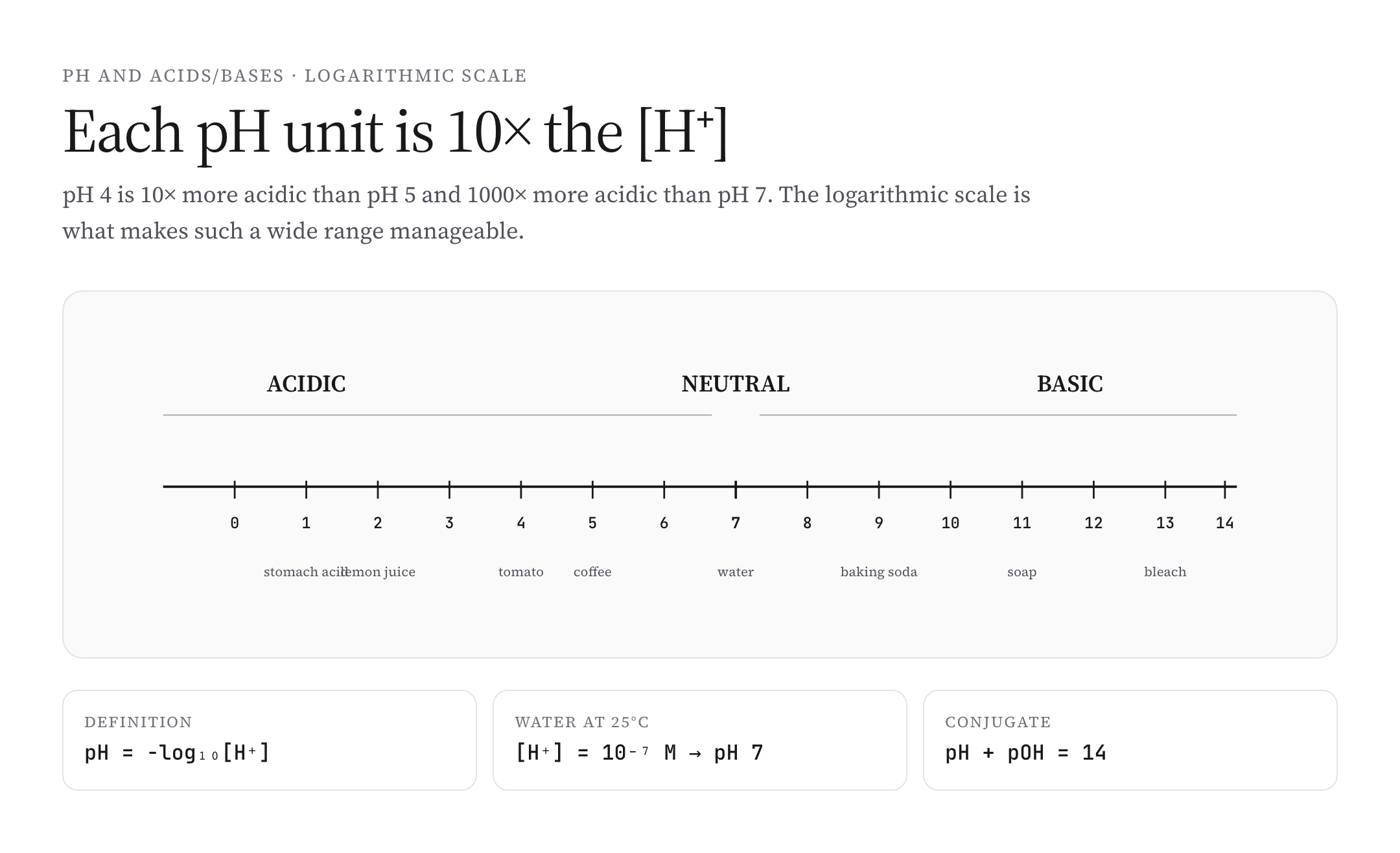
pH is the negative base-10 logarithm of hydrogen ion concentration:
$$\text{pH} = -\log_{10}[H^+]$$For pure water at 25°C, [H⁺] = 10⁻⁷ M, giving pH 7 (neutral). Acidic solutions have higher [H⁺] and lower pH; basic (alkaline) solutions have lower [H⁺] and higher pH.
The logarithmic scale compresses an enormous range. Stomach acid at pH 1 has [H⁺] = 0.1 M; bleach at pH 13 has [H⁺] = 10⁻¹³ M. The two differ by a factor of 10¹² in hydrogen ion concentration but only by 12 pH units on the scale. Without the log, acidity numbers would span a trillion-fold range and be almost unreadable.
The pH Scale
Standard pH ranges from 0 (very acidic) to 14 (very basic), centered on 7 (neutral water). The scale isn’t strictly bounded, superacids can have negative pH; superbases can exceed 14, but most everyday chemistry stays within 0-14.
Common substances on the scale: stomach acid (1), lemon juice (2), vinegar (2.5), tomato juice (4), coffee (5), pure water (7), seawater (8), baking soda (9), ammonia (11), bleach (13). A useful intuition: acids taste sour (think lemon, vinegar); bases taste bitter and feel slippery (soap).
pH varies significantly across biology. Stomach: 1-2 (digestion). Blood: 7.35-7.45 (tightly regulated). Saliva: 6.5-7.5. Urine: 4.5-8 (variable). Maintaining narrow pH ranges is essential, even small deviations cause serious physiological problems.
Three Acid-Base Theories
Three increasingly general definitions of acid and base:
- Arrhenius (1887): acids release H⁺ in water; bases release OH⁻. Simple but limited to aqueous solutions and to bases that contain OH.
- Brønsted-Lowry (1923): acids donate protons (H⁺); bases accept protons. Works in any solvent. The most-used theory in introductory and aqueous chemistry.
- Lewis (1923): acids accept electron pairs; bases donate electron pairs. The most general, extends to non-aqueous solvents, organic chemistry, transition metal chemistry, and many cases without proton transfer.
The three theories overlap for most everyday chemistry. HCl is an Arrhenius acid (releases H⁺ in water), a Brønsted acid (donates H⁺), and a Lewis acid in some contexts. Boron trifluoride (BF₃) is a Lewis acid (accepts electron pairs) but isn’t an Arrhenius or Brønsted acid because it doesn’t have H to donate.
Strong vs Weak Acids and Bases
Strong acids and bases ionize completely in water. HCl + H₂O → H₃O⁺ + Cl⁻; the reaction goes essentially to completion. Common strong acids: HCl, HBr, HI, HNO₃, H₂SO₄, HClO₄. Common strong bases: NaOH, KOH, LiOH, Ca(OH)₂, Ba(OH)₂.
Weak acids and bases ionize only partially. Acetic acid CH₃COOH equilibrates with H⁺ and CH₃COO⁻; only a small fraction is ionized at any moment. Ammonia NH₃ similarly equilibrates with NH₄⁺ and OH⁻. Most acids and bases in biology and everyday life are weak.
The distinction matters because pH calculations differ. For a strong acid at concentration C: pH = −log(C). For a weak acid: pH depends on the equilibrium constant Ka and follows from quadratic or approximate equations. Vinegar (5% acetic acid) has pH ~2.5, much higher than 5% HCl (pH ~0.3) because acetic acid is weak.
The pH Scale: Practical Reference
Knowing what’s around what pH range is part of basic chemical literacy:
- 0-2: very strong acids (battery acid, stomach acid, concentrated HCl).
- 3-5: moderately acidic (lemon juice, vinegar, soda, coffee, wine).
- 6-7: mildly acidic to neutral (rain water, milk, pure water, blood).
- 8-10: mildly basic (seawater, baking soda solution, hand soap).
- 11-13: strongly basic (ammonia, household bleach).
- 14: very strong bases (concentrated NaOH, oven cleaner).
This rough mapping lets you estimate the pH of unfamiliar substances by analogy. Anything tasting clearly sour is below pH 5; anything feeling slippery is above pH 8. Be careful, most lab acids and bases at extreme pH are corrosive and dangerous to handle without proper training.
Conjugate Acid-Base Pairs
In Brønsted-Lowry theory, every acid has a conjugate base (what’s left after donating H⁺) and every base has a conjugate acid (what forms after accepting H⁺). HCl ↔ Cl⁻; NH₃ ↔ NH₄⁺; H₂O ↔ H₃O⁺ and H₂O ↔ OH⁻ (water is amphoteric, both an acid and a base).
Strong acid → very weak conjugate base (Cl⁻ doesn’t grab H⁺ back from water). Weak acid → relatively strong conjugate base. The strengths are inversely related: pKa + pKb = 14 for conjugate pairs in water.
This conjugate-pair structure is what makes buffers work and what controls equilibrium positions in acid-base reactions. Every acid-base reaction is really a competition between two conjugate pairs for the proton.
Buffers and the Henderson-Hasselbalch Equation
A buffer is a solution that resists pH changes when small amounts of acid or base are added. Buffers contain a weak acid and its conjugate base (or weak base and its conjugate acid) in similar concentrations. Adding H⁺ shifts equilibrium toward the weak acid; adding OH⁻ shifts it toward the conjugate base. Either way, the pH changes only slightly.
The Henderson-Hasselbalch equation gives the buffer pH:
$$\text{pH} = \text{p}K_a + \log\left(\frac{[\text{conjugate base}]}{[\text{weak acid}]}\right)$$Buffers are most effective when [conjugate base] ≈ [weak acid], i.e., when pH ≈ pKa. The buffer capacity (how much added acid or base it can absorb) is highest at this 1:1 ratio. Choose a weak acid with pKa near your target pH for the best buffer.
Biological buffers are essential. Blood maintains pH 7.4 via the bicarbonate buffer system (HCO₃⁻ / H₂CO₃, pKa ≈ 6.1). Cells use phosphate buffers (H₂PO₄⁻ / HPO₄²⁻, pKa ≈ 7.2). Without buffers, biological pH would swing wildly with every metabolic event.
Titration
Titration is the controlled addition of a solution of known concentration (titrant) to a solution of unknown concentration (analyte) until reaction is complete. For acid-base titration, you add base to acid (or vice versa) and watch pH change. The equivalence point is where moles of base equal moles of acid.
Indicators are dyes that change color at specific pH ranges (litmus 4.5-8.3, phenolphthalein 8.2-10, methyl orange 3.1-4.4). Choose an indicator whose color-change range brackets the equivalence-point pH. For modern lab work, pH meters give continuous numerical readings throughout the titration, making indicator choice less critical.
Titration curves (pH vs volume of titrant added) reveal a lot: the equivalence point appears as a sharp pH jump; the half-equivalence point gives pKa for weak acids; multiple equivalence points indicate polyprotic acids (H₂SO₄, H₃PO₄). Titration is the standard analytical method for measuring acid or base concentration.
Acid-Base Reactions in Biology
Almost every biological process depends on pH:
- Blood pH: maintained at 7.35-7.45 by the bicarbonate buffer system. Acidosis (low pH) and alkalosis (high pH) are medical emergencies.
- Stomach acid: pH 1-2 from HCl, essential for protein digestion and killing pathogens. Antacids (Tums, milk of magnesia) neutralize excess stomach acid.
- Enzyme activity: each enzyme has an optimal pH; deviations alter shape and function. Pepsin works at pH 2; trypsin at pH 8.
- Drug absorption: weak acid drugs are absorbed better in acidic environments (protonated, lipid-soluble); weak base drugs in basic environments. pH-driven absorption underlies many drug pharmacokinetics.
- Cell membrane gradients: the inside of a cell is slightly more basic than outside; mitochondria use pH gradients to drive ATP synthesis.
Industrial and Environmental pH
pH matters across industrial chemistry:
- Water treatment: drinking water adjusted to slightly basic (pH ~7-8) to prevent pipe corrosion. Wastewater treated to neutral before discharge.
- Agriculture: soil pH affects nutrient availability. Most crops prefer pH 6-7; lime is added to raise pH, sulfur to lower it.
- Food preservation: low pH (pickling, fermentation) inhibits bacterial growth. Most preserved foods are below pH 4.6.
- Steel processing: “pickling” with strong acid removes rust and scale before further processing.
- Textile dyeing: dye uptake depends on pH; many dyes work only within narrow pH ranges.
- Ocean acidification: CO₂ absorption from atmosphere is lowering ocean pH (down ~0.1 since pre-industrial times). Affects coral reefs and shell-forming organisms.
Common Mistakes With pH
- Treating pH as additive. Mixing a pH 4 solution with a pH 6 solution doesn’t give pH 5. You have to convert to [H⁺], average the concentrations weighted by volume, and re-take the log.
- Forgetting that pH is logarithmic. A change from pH 5 to pH 6 is a 10× decrease in [H⁺], not a 1.2× decrease.
- Confusing strong vs concentrated. Strong = ionizes completely; concentrated = high amount per volume. A dilute solution of HCl (strong) can have higher pH than a concentrated solution of acetic acid (weak).
- Ignoring water autoionization at extreme pH. Very dilute strong acids/bases need to account for water’s contribution: pH never quite reaches the pure-water value 7 from either side.
- Misinterpreting buffer capacity. Buffers don’t prevent all pH change, they slow it. Adding enough acid or base will eventually overwhelm any buffer.
History of Acid-Base Chemistry
Antoine Lavoisier coined “oxygen” believing it was the key element in acidity. Humphry Davy disproved this. Svante Arrhenius (1887) proposed that acids release H⁺ in water, the first quantitative theory of acidity. Søren Sørensen (1909) introduced the pH scale at the Carlsberg laboratory in Denmark for monitoring beer fermentation.
Johannes Brønsted and Thomas Lowry independently formulated the proton-transfer definition in 1923, broadening acid-base chemistry beyond aqueous solutions. Gilbert Lewis published his electron-pair acceptor/donor definition the same year, generalizing further. All three theories remain in use, applied to different problem types.
Worked Example: Calculating pH
What’s the pH of 0.01 M HCl?
HCl is a strong acid, fully ionized. [H⁺] = 0.01 M = 10⁻² M. pH = −log(10⁻²) = 2.
What about 0.1 M acetic acid (Ka = 1.8 × 10⁻⁵)?
Acetic acid is weak, only partially ionized. Set up equilibrium: CH₃COOH ⇌ H⁺ + CH₃COO⁻. With initial concentration C and ionization fraction x: \(K_a = x^2 / (C – x) \approx x^2 / C\) for small x.
Solving: \(x = \sqrt{K_a \cdot C} = \sqrt{1.8 \times 10^{-5} \times 0.1} = \sqrt{1.8 \times 10^{-6}} \approx 1.34 \times 10^{-3}\) M. pH = −log(1.34 × 10⁻³) ≈ 2.87.
Same molarity (0.1 M for HCl gives pH 1, acetic acid gives pH 2.87), very different pH because of strength.
Polyprotic Acids
Polyprotic acids can donate more than one proton. H₂SO₄ donates two (very strong for the first, strong for the second). H₃PO₄ donates three, with successively weaker dissociation: pKa₁ = 2.15, pKa₂ = 7.20, pKa₃ = 12.35.
For polyprotic acids, each successive ionization is weaker because removing a proton from an already-negative species costs more energy. Titration curves of polyprotic acids show multiple equivalence points and inflections.
Phosphate is biologically important because pKa₂ ≈ 7.2, almost exactly the cellular pH. The phosphate buffer system H₂PO₄⁻ / HPO₄²⁻ is one of the body’s primary intracellular buffers, working in tandem with bicarbonate for blood-pH regulation.
Worked Example: Buffer Calculation
Design a buffer at pH 7.4 (blood pH) using a phosphate system. Phosphate has pKa₂ = 7.20, close to the target. Use the Henderson-Hasselbalch equation:
$$\text{pH} = \text{p}K_a + \log\left(\frac{[\text{HPO}_4^{2-}]}{[\text{H}_2\text{PO}_4^-]}\right)$$Plug in: 7.4 = 7.2 + log(ratio). So log(ratio) = 0.2, ratio = 10^0.2 ≈ 1.58. Need [HPO₄²⁻] / [H₂PO₄⁻] = 1.58. For a 0.1 M total phosphate buffer: [H₂PO₄⁻] = 0.039 M, [HPO₄²⁻] = 0.061 M. Mix the two in this ratio at the desired total concentration.
Phosphate buffers are widely used in biochemistry for exactly this reason, pKa₂ close to physiological pH means efficient buffering at biological conditions. The Henderson-Hasselbalch equation handles all the buffer math.
Acid Rain and Environmental pH
Acid rain (pH 4-5) forms when SO₂ and NOₓ from fossil fuel combustion react with atmospheric water to form sulfuric and nitric acids. Normal rain is mildly acidic (pH 5.6) due to dissolved CO₂ forming carbonic acid; “acid rain” specifically refers to anthropogenic acidification beyond the natural baseline.
Effects: dissolves limestone monuments and stone buildings; leaches calcium and magnesium from soil; acidifies lakes and harms fish populations; releases aluminum from soil minerals (toxic to plants). Mitigation came through Clean Air Act amendments (US 1990) and similar legislation requiring scrubbers on power plants and catalytic converters on cars. Acid rain has decreased substantially in North America and Europe since the 1990s, demonstrating that pH-driven environmental problems can be solved by attacking the chemistry directly.
FAQs
What is pH?
The negative base-10 logarithm of hydrogen ion concentration: pH = −log[H⁺]. Pure water at 25°C has [H⁺] = 10⁻⁷ M, giving pH 7. Acidic solutions have lower pH; basic (alkaline) solutions have higher pH. The scale is logarithmic, so each unit represents a 10× change in [H⁺].
What’s the difference between strong and weak acids?
Strong acids ionize completely in water (HCl, H₂SO₄, HNO₃); weak acids ionize only partially (acetic acid, citric acid, carbonic acid). Strong vs weak refers to ionization completeness, not concentration. A dilute strong acid can have higher pH than a concentrated weak acid.
What is a buffer?
A solution that resists pH changes when small amounts of acid or base are added. Buffers contain a weak acid and its conjugate base in similar concentrations. The Henderson-Hasselbalch equation gives buffer pH. Buffers are most effective when pH ≈ pKa of the weak acid component.
What’s the difference between Arrhenius, Brønsted-Lowry, and Lewis acids?
Arrhenius: releases H⁺ in water. Brønsted-Lowry: donates protons (more general; works in any solvent). Lewis: accepts electron pairs (most general; covers cases without proton transfer). Each theory progressively broadens the definition. Brønsted-Lowry is the workhorse for aqueous chemistry; Lewis extends to organic and inorganic chemistry.
Why is blood pH so tightly controlled?
Because enzymes and proteins are extremely sensitive to pH. Even small deviations from pH 7.35-7.45 cause acidosis or alkalosis, which can be fatal. The bicarbonate buffer system (H₂CO₃ / HCO₃⁻) and respiration (CO₂ exhalation) work together to keep blood pH in this narrow range.
What is the equivalence point of a titration?
The point in a titration where moles of titrant equal moles of analyte (acid and base have neutralized each other in stoichiometric proportion). Marked by a sharp pH change. Indicators or pH meters identify the equivalence point experimentally.
Can pH be negative?
Yes, for superacids with very high [H⁺]. Concentrated sulfuric acid (~18 M) has pH around −1; fluoroantimonic acid HSbF₆ has pH around −20 in some preparations. Standard pH meters can’t measure below pH 1; specialized methods are needed for superacid measurements.
Why does acid taste sour?
Sour taste receptors on the tongue respond directly to H⁺ ions. Higher [H⁺] (lower pH) triggers stronger sour sensation. This is why acidic foods (citrus, vinegar, sour candies) taste sour. The detection threshold is around pH 4 for most people.
What is ocean acidification?
Decreasing ocean pH due to CO₂ absorption from the atmosphere. CO₂ + H₂O ⇌ H₂CO₃ ⇌ H⁺ + HCO₃⁻. Ocean pH has dropped from ~8.2 (pre-industrial) to ~8.1 today, a 30% increase in [H⁺]. Threatens coral reefs, shell-forming organisms, and broader marine ecosystems.
How do antacids work?
By neutralizing excess stomach acid. Common antacids contain weak bases like calcium carbonate (CaCO₃), magnesium hydroxide (Mg(OH)₂), or sodium bicarbonate (NaHCO₃). They react with HCl in the stomach to form water and a salt, raising stomach pH from ~1 toward 4-5 and relieving heartburn.
What’s the relationship between pH and pOH?
pH + pOH = 14 at 25°C. The product [H⁺][OH⁻] = 10⁻¹⁴ for water at 25°C (the ion product Kw), so taking the negative log of both sides gives the pH + pOH = 14 relationship. Knowing one gives the other.
Why does adding water to a strong acid lower its strength but not concentration alone?
Diluting a strong acid keeps its strength constant (it still fully ionizes) but lowers concentration, hence raises pH. A 10× dilution raises pH by 1 unit. For weak acids, dilution affects ionization equilibrium more subtly, but pH still rises with dilution.
What is the Henderson-Hasselbalch equation?
pH = pKa + log([A⁻]/[HA]) for a buffer made of weak acid HA and its conjugate base A⁻. Used to calculate buffer pH and to design buffers with target pH near a chosen weak acid’s pKa. Universal in biochemistry, drug formulation, and analytical chemistry.
Why are some acids polyprotic?
Some acids have multiple ionizable hydrogens (H₂SO₄, H₃PO₄, citric acid). Each ionization step has its own pKa, with successively weaker dissociation because removing a proton from an already-negatively-charged species costs more energy. Titration curves of polyprotic acids show multiple inflection points corresponding to each ionization step.
What causes acid rain?
SO₂ and NOₓ pollution from fossil fuel burning reacts with atmospheric water to form sulfuric and nitric acids. Resulting precipitation has pH 4-5, more acidic than the natural pH 5.6 from dissolved CO₂. Acid rain damages stone buildings, leaches soil minerals, and acidifies lakes. Clean Air Act regulations have substantially reduced acid rain since the 1990s.
Browse more in Chemistry.