
 by
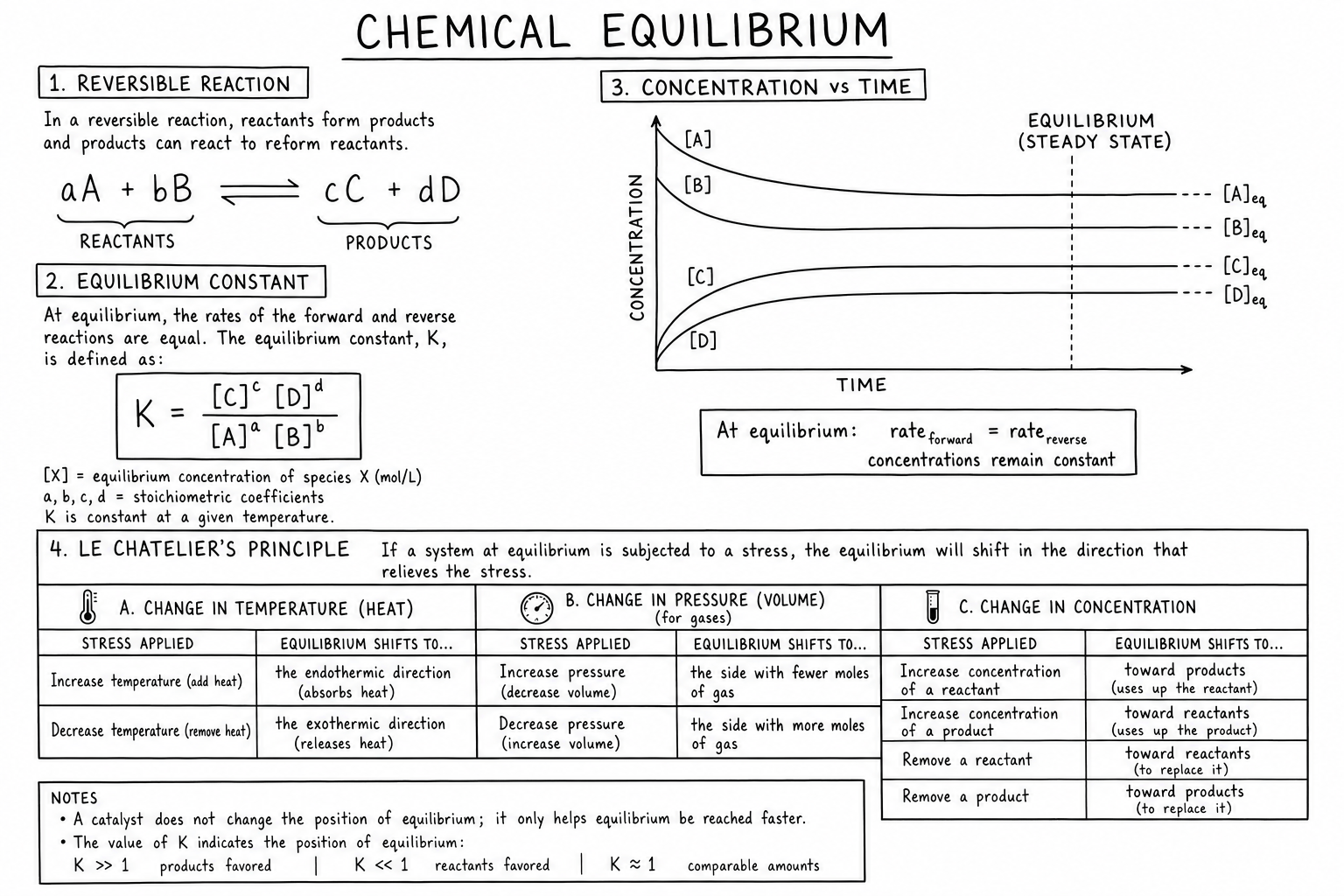
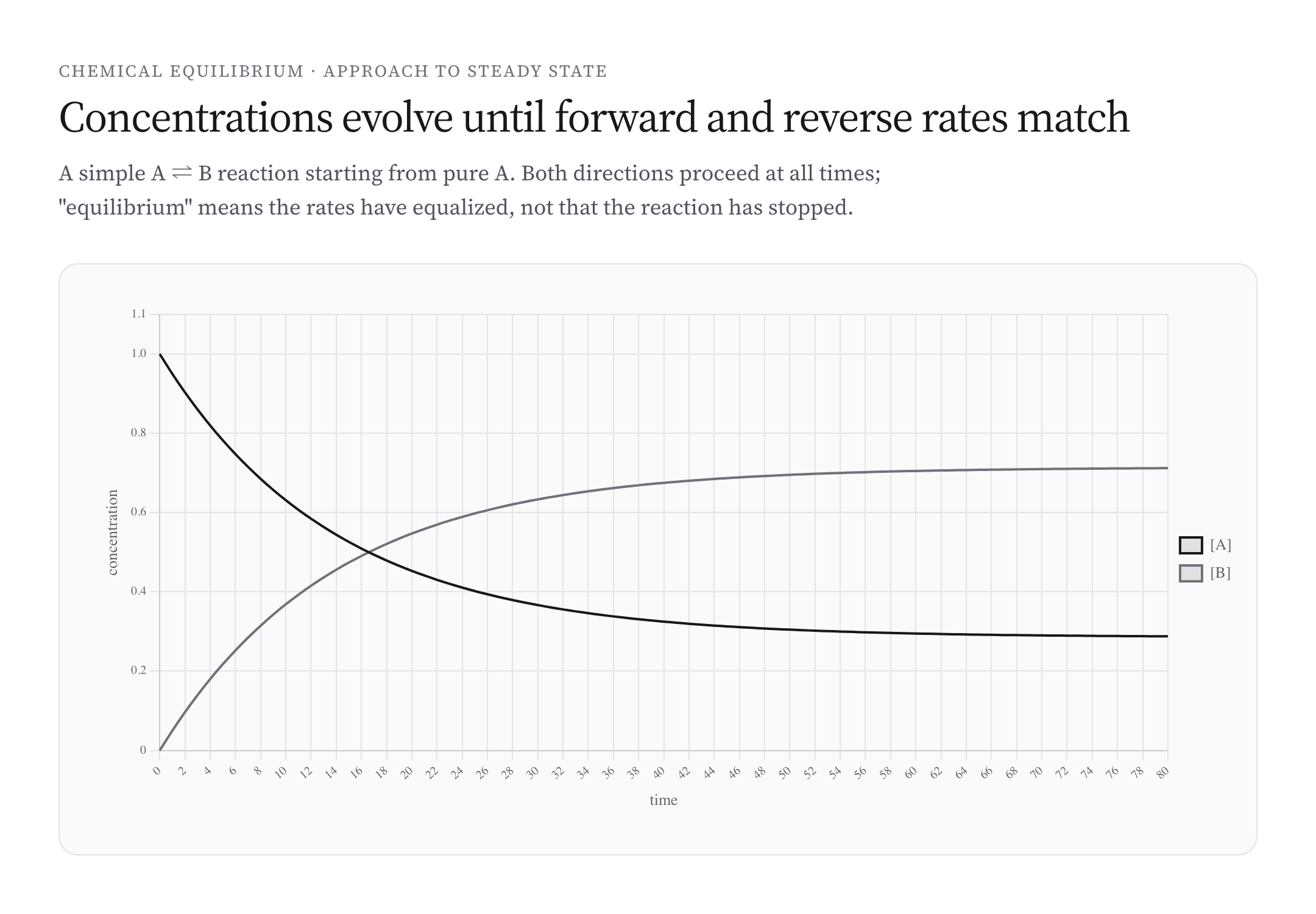
byChemical equilibrium describes reversible reactions in steady state, the forward and reverse reactions proceed at equal rates, so the concentrations of reactants and products stop changing. Equilibrium isn’t a static “stopped” state; it’s a dynamic balance where both directions are still happening, just at matching rates.
Most real chemical reactions are reversible to some degree. Industrial chemistry depends on understanding equilibrium to maximize product formation, minimize waste, and choose the right operating conditions. Le Chatelier’s principle gives the qualitative roadmap; the equilibrium constant gives the quantitative answer.
This study note covers the equilibrium concept, the equilibrium constant K, Le Chatelier’s principle, ICE tables for solving equilibrium problems, special cases (Ksp, Ka, Kw), worked examples, applications across industry and biology, common pitfalls, and the historical context.
What Equilibrium Means
For a reversible reaction \(aA + bB \rightleftharpoons cC + dD\), equilibrium is the state where the forward reaction rate equals the reverse reaction rate. Concentrations stop changing, but molecules are still reacting in both directions. The “stopping” is at the macroscopic level only; microscopically, both directions are continuously active.
Equilibrium is dynamic, not static. Add labeled atoms to the reactant side at equilibrium and they show up on the product side, proof that the reactions are still occurring. The labels just don’t shift the macroscopic concentrations because the rates are balanced.
The Equilibrium Constant K
For \(aA + bB \rightleftharpoons cC + dD\) at equilibrium, the equilibrium constant is:
$$K = \frac{[C]^c [D]^d}{[A]^a [B]^b}$$The bracket notation [X] means molar concentration of species X. K depends on temperature but not on initial concentrations. A specific reaction at a specific temperature has one K value.
Large K (>> 1): equilibrium favors products; the reaction goes nearly to completion. Small K (<< 1): equilibrium favors reactants; the reaction barely proceeds. K ≈ 1: significant amounts of both reactants and products at equilibrium.
For gas-phase reactions, you can also write \(K_p\) using partial pressures instead of concentrations. They’re related by \(K_p = K_c (RT)^{\Delta n}\), where Δn is the change in moles of gas across the reaction.
The Reaction Quotient Q
The reaction quotient Q has the same form as K but uses current (not equilibrium) concentrations. Comparing Q to K tells you which direction the reaction will shift to reach equilibrium:
- Q < K: not enough product. Reaction shifts forward (right) to make more product.
- Q > K: too much product. Reaction shifts reverse (left) to consume product.
- Q = K: system is at equilibrium. No net change.
Q is the diagnostic that tells you what the reaction will do next. K tells you the destination; Q tells you which way you’re moving relative to that destination.
Le Chatelier’s Principle
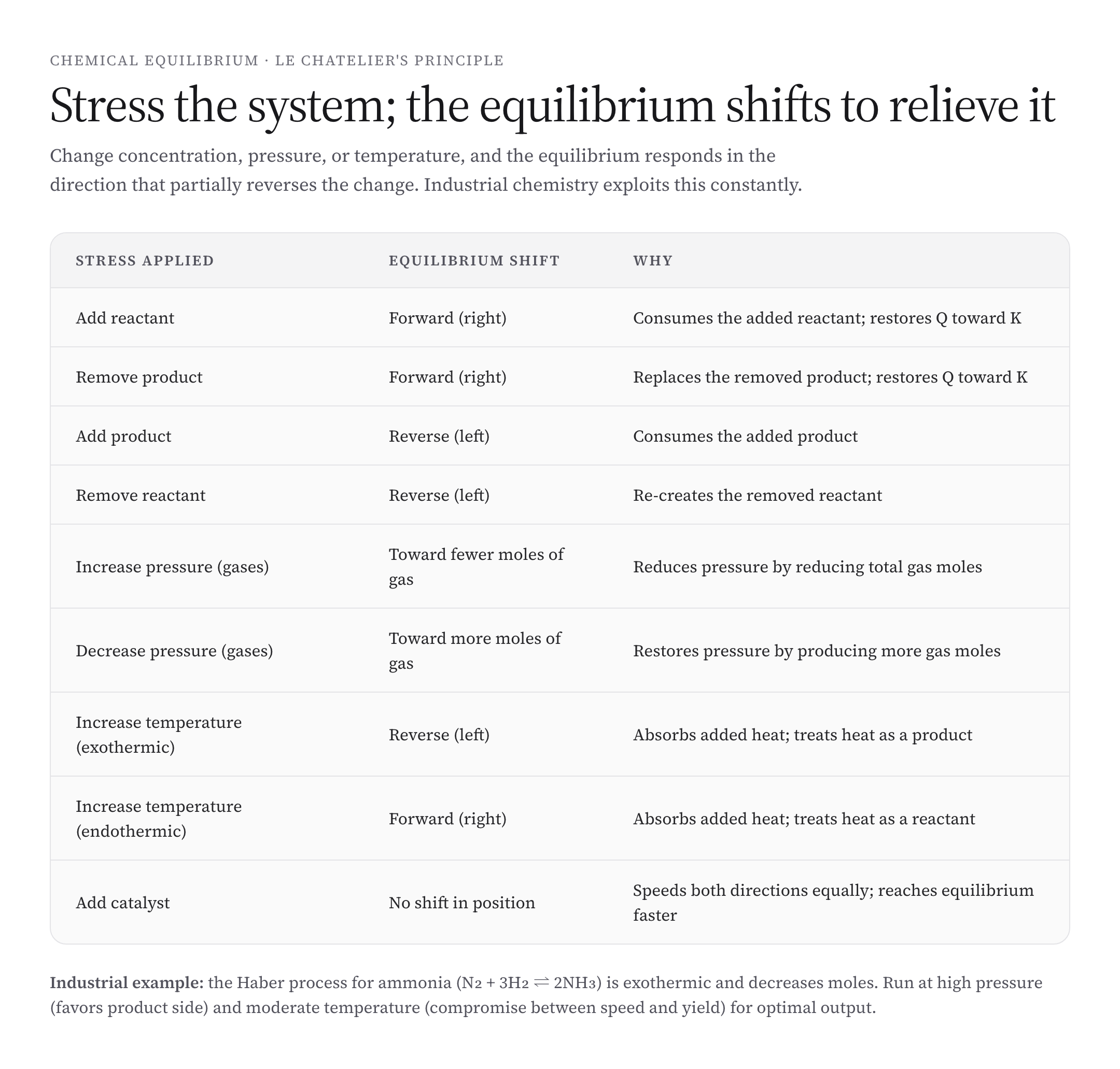
Le Chatelier’s principle (1888): when a system at equilibrium is disturbed, it shifts to partially relieve the disturbance. Specific predictions:
- Add reactant: shifts forward (consume the added reactant).
- Add product: shifts reverse.
- Remove reactant: shifts reverse (re-form the removed reactant).
- Remove product: shifts forward (replace removed product).
- Increase pressure (gases): shifts toward fewer moles of gas.
- Decrease pressure: shifts toward more moles of gas.
- Increase temperature: shifts in the endothermic direction (absorbs added heat).
- Decrease temperature: shifts in the exothermic direction.
- Add catalyst: doesn’t shift equilibrium (speeds both directions equally), but reaches equilibrium faster.
This single principle, applied carefully, lets you predict every standard equilibrium-disturbance scenario without quantitative calculation.
Le Chatelier in Industrial Practice
The Haber process for ammonia (\(N_2 + 3H_2 \rightleftharpoons 2NH_3\), exothermic) is the textbook example. The reaction reduces gas moles (4 → 2), so high pressure shifts equilibrium toward NH₃. It’s exothermic, so low temperature would also favor NH₃, but at low temperature, the rate is too slow. Industry compromises: moderate temperature (~450°C) for reasonable rate plus high pressure (~150-300 atm) for favorable equilibrium, plus an iron catalyst to speed both directions equally.
This kind of Le Chatelier-driven optimization runs through nearly every industrial chemistry process: choose temperature, pressure, and concentrations to push equilibrium where you want it without sacrificing rate or wasting energy.
ICE Tables
ICE (Initial, Change, Equilibrium) tables are the standard tool for solving quantitative equilibrium problems. Set up a table with three rows (initial concentrations, change toward equilibrium, equilibrium concentrations) and columns for each reactant and product. Use stoichiometry to relate the changes; let “x” denote the unknown amount that reacts.
Example: 0.5 M A and 0.5 M B start in a vessel; reaction A + B ⇌ C has K = 4. Set up ICE table. Initial: [A] = 0.5, [B] = 0.5, [C] = 0. Change: −x, −x, +x. Equilibrium: 0.5 − x, 0.5 − x, x. Plug into K equation: \(4 = x / [(0.5-x)^2]\). Solve for x; that’s the amount that reacted.
ICE tables handle every standard equilibrium problem. The math reduces to algebra, often quadratic. For systems where x is small relative to initial concentrations, you can approximate (0.5 − x) ≈ 0.5, simplifying the algebra dramatically.
Special Equilibrium Constants
- K_w (water autoionization): \(K_w = [H^+][OH^-] = 10^{-14}\) at 25°C. The product of [H⁺] and [OH⁻] in pure water and any aqueous solution.
- K_a (acid ionization): equilibrium constant for an acid donating a proton. Larger K_a means stronger acid. pK_a = −log K_a.
- K_b (base ionization): equilibrium constant for a base accepting a proton. K_a × K_b = K_w for conjugate pairs.
- K_sp (solubility product): equilibrium constant for dissolution of a sparingly soluble salt. AgCl(s) ⇌ Ag⁺ + Cl⁻ has K_sp = [Ag⁺][Cl⁻] ≈ 1.8 × 10⁻¹⁰.
- K_f (formation constant): equilibrium constant for complex ion formation. Used in coordination chemistry.
- K_eq (equilibrium constant): the general symbol for any equilibrium constant.
All are species-specific applications of the same equilibrium concept, with notation tailored to the reaction type.
Worked Example: Equilibrium Calculation
For the reaction \(N_2O_4 \rightleftharpoons 2NO_2\) at 100°C, K = 0.36. Start with 0.10 M N₂O₄ and no NO₂. Find equilibrium concentrations.
ICE table: Initial [N₂O₄] = 0.10, [NO₂] = 0. Change: −x, +2x. Equilibrium: 0.10 − x, 2x.
K equation: \(0.36 = (2x)^2 / (0.10 – x) = 4x^2 / (0.10 – x)\).
Solve: \(4x^2 = 0.36 (0.10 – x) = 0.036 – 0.36 x\). Rearrange: \(4x^2 + 0.36x – 0.036 = 0\). Quadratic formula: \(x = (-0.36 + \sqrt{0.1296 + 0.576}) / 8 \approx 0.062\).
Equilibrium concentrations: [N₂O₄] = 0.038 M, [NO₂] = 0.124 M. Verify: K = (0.124)² / 0.038 ≈ 0.40, close to 0.36 (rounding errors).
Equilibrium and Le Chatelier Together
The equilibrium constant K tells you the destination; Le Chatelier tells you which way the system will move when disturbed. Together they give complete predictions.
If you compress a gas-phase equilibrium, Le Chatelier says it shifts toward fewer moles of gas. The K value doesn’t change (K depends only on temperature), but the new equilibrium concentrations correspond to the K value applied to the new total pressure.
If you heat an exothermic reaction, Le Chatelier says it shifts toward reactants. The K value also changes (K decreases for exothermic reactions as T increases). Both effects work together to give the new equilibrium state.
This combination of qualitative reasoning (Le Chatelier) and quantitative calculation (K, ICE tables) handles essentially every equilibrium problem you’ll encounter.
Equilibrium in Biology
Biology is built on near-equilibrium chemistry. Hemoglobin binding oxygen, enzyme-substrate interactions, and metabolite concentrations all involve equilibria in the cellular environment.
- Hemoglobin and O₂: Hb + 4O₂ ⇌ Hb(O₂)₄. Equilibrium shifts toward bound oxygen at high pO₂ (lungs) and toward release at low pO₂ (tissues). Le Chatelier in action.
- Enzyme catalysis: enzymes don’t change reaction equilibrium; they just speed both directions equally to reach equilibrium faster. This is why some metabolic reactions are reversible while others (like ATP hydrolysis) are essentially irreversible due to far-from-equilibrium initial conditions.
- Buffer systems: blood pH is regulated by carbonic acid/bicarbonate equilibrium, an exact application of acid-base equilibrium and Le Chatelier’s principle.
- Drug binding: drug-receptor interactions are equilibria. Drug efficacy depends on the binding constant K_d (a kind of K applied to drug-receptor systems).
Equilibrium and Free Energy
The equilibrium constant connects directly to thermodynamic free energy:
$$\Delta G° = -RT \ln K$$where ΔG° is the standard free energy change of reaction. Negative ΔG° means K > 1 (products favored); positive ΔG° means K < 1 (reactants favored); ΔG° = 0 means K = 1 (equal amounts at equilibrium).
This relationship ties reaction spontaneity (a thermodynamic concept) to equilibrium position (a kinetic/concentration concept). Together they let you predict whether a reaction will proceed from given initial conditions and where it will end up at equilibrium.
Common Mistakes With Equilibrium
- Confusing equilibrium with completion. At equilibrium, both forward and reverse reactions are still happening; concentrations just aren’t changing. It’s not “the reaction has stopped.”
- Forgetting that K depends only on temperature. Adding catalyst, changing concentrations, or changing pressure don’t change K. Only temperature changes K.
- Including pure solids and liquids in K. Their “concentrations” are essentially constant and absorbed into K. Don’t include them in the K expression.
- Using initial concentrations in K. K uses equilibrium concentrations only. Initial concentrations go in the I row of an ICE table; equilibrium concentrations go in the E row and into K.
- Misapplying Le Chatelier to catalysts. Catalysts speed both directions equally; they don’t shift equilibrium. They just reach the same equilibrium faster.
- Forgetting the small-x approximation works only when justified. If x turns out to be more than ~5% of the initial concentration, the approximation isn’t valid and you need the full quadratic.
Heterogeneous Equilibria
Heterogeneous equilibria involve species in different phases (e.g., solid + gas, or solid + liquid). The K expression includes only the gas-phase or solution-phase species; pure solids and pure liquids don’t appear because their “concentrations” (essentially densities) are constant.
Example: \(CaCO_3(s) \rightleftharpoons CaO(s) + CO_2(g)\). The equilibrium constant is just \(K = [CO_2]\) (or \(K_p = P_{CO_2}\)). The two solids don’t appear in the expression because their activities are 1.
This simplifies many equilibrium calculations and explains why some reactions go to completion in practice, once a solid product precipitates or a gas product escapes, equilibrium can’t be re-established and the reaction continues.
Worked Example: Le Chatelier on the Haber Process
Predict the effect of each change on the equilibrium of \(N_2 + 3H_2 \rightleftharpoons 2NH_3\) (exothermic):
- Increase pressure: shifts right (4 mol gas → 2 mol gas; reducing moles relieves pressure).
- Increase temperature: shifts left (exothermic reaction; absorbing heat shifts away from products).
- Add N₂: shifts right (consumes added N₂).
- Remove NH₃: shifts right (replaces removed product).
- Add catalyst (iron): no shift; reaches equilibrium faster.
To maximize NH₃ yield, you’d want low temperature and high pressure. Industry runs at moderate temperature (~450°C, sacrificing yield for rate) and high pressure (~200 atm), a compromise designed by applying Le Chatelier’s principle alongside rate considerations.
Worked Example: Solubility Product
The K_sp of silver chloride is 1.8 × 10⁻¹⁰ at 25°C. Find the molar solubility of AgCl in water.
Dissolution: AgCl(s) ⇌ Ag⁺ + Cl⁻. Let s = solubility. Then [Ag⁺] = s, [Cl⁻] = s. K_sp = [Ag⁺][Cl⁻] = s² = 1.8 × 10⁻¹⁰. So s = √(1.8 × 10⁻¹⁰) ≈ 1.34 × 10⁻⁵ M.
About 1.34 × 10⁻⁵ moles per liter, or about 1.9 mg per liter. AgCl is essentially insoluble, which is why it’s the classic precipitate in halide tests and the active ingredient in photographic emulsions (where it’s precipitated out by mixing AgNO₃ and KCl solutions).
The same K_sp framework predicts whether two solutions will form a precipitate when mixed: compute Q = [Ag⁺][Cl⁻] from initial mixing concentrations; if Q > K_sp, precipitate forms.
Equilibrium and Reaction Kinetics
Equilibrium tells you where a reaction ends up; kinetics tells you how fast it gets there. The two are independent, a reaction can be highly favorable thermodynamically (large K) but kinetically slow (high activation energy), or unfavorable but fast.
The combination matters in practice. Diamond is thermodynamically less stable than graphite at room temperature, but the conversion is kinetically prohibited (would take billions of years). Nitric oxide formation in air is thermodynamically favored at high temperatures but kinetically slow at room temperature, which is why we breathe N₂ and O₂ separately rather than NO. Catalysts speed up rate without changing equilibrium, exploiting this independence.
Le Chatelier in Biology
Le Chatelier’s principle drives many biological processes. Hemoglobin binding O₂ in the lungs (high pO₂) and releasing it in tissues (low pO₂) is exactly Le Chatelier, increased reactant shifts equilibrium toward product (bound oxygen); decreased reactant shifts the equilibrium back. CO₂ transport works the same way through the bicarbonate equilibrium in red blood cells.
Enzyme kinetics, hormone signaling, and most metabolic regulation lean on equilibrium-style responses to concentration changes. Living systems can’t violate the second law of thermodynamics, but they exploit equilibrium shifts continuously to maintain steady states far from chemical equilibrium, a defining feature of life.
Equilibrium and Industrial Optimization
Industrial chemistry routinely picks operating conditions to push equilibrium toward desired products. The Haber-Bosch process for ammonia uses pressure ~150-300 atm and temperature ~400-500°C, a deliberate compromise. Higher pressure favors NH₃ (per Le Chatelier, fewer gas moles); lower temperature also favors NH₃ (exothermic), but lower temperature also slows the reaction. Industry settles on the temperature that gives an acceptable rate while keeping the equilibrium yield high enough to be economical.
Similar trade-offs appear in the contact process for sulfuric acid (V₂O₅ catalyst at moderate temperature; high pressure unnecessary because the equilibrium is already favorable), in methanol synthesis from CO and H₂ (high pressure, copper-zinc catalyst), and in the Solvay process for sodium carbonate (carefully chosen ammonia recycling to avoid byproduct accumulation). The toolbox is the same across processes: balance Le Chatelier predictions against rate, equipment cost, and energy cost.
Worked Example: ICE Table with Quadratic
For \(2NO_2 \rightleftharpoons N_2O_4\) at 100°C, K = 0.21. Start with 0.50 M NO₂ and no N₂O₄. Find equilibrium concentrations.
ICE table: Initial [NO₂] = 0.50, [N₂O₄] = 0. Change: −2x, +x. Equilibrium: 0.50 − 2x, x.
K equation: \(0.21 = x / (0.50 – 2x)^2\). Multiply through: \(0.21(0.50 – 2x)^2 = x\). Expand: \(0.21(0.25 – 2x + 4x^2) = x\), giving \(0.0525 – 0.42x + 0.84x^2 = x\), so \(0.84x^2 – 1.42x + 0.0525 = 0\). Quadratic formula: \(x = (1.42 \pm \sqrt{2.016 – 0.176}) / 1.68 = (1.42 \pm 1.357) / 1.68\). Take the physically meaningful root (smaller, positive): x ≈ 0.0375.
Equilibrium: [N₂O₄] = 0.0375 M, [NO₂] = 0.50 − 0.075 = 0.425 M. Verify: K = 0.0375 / (0.425)² ≈ 0.21 ✓.
FAQs
What does chemical equilibrium mean?
A state where the forward and reverse reactions of a reversible process proceed at equal rates, so the concentrations of all species stop changing. Equilibrium is dynamic, both reactions are still occurring at the molecular level, not static. It’s a balance, not a stop.
What is the equilibrium constant K?
K = [products]^coefficients / [reactants]^coefficients at equilibrium. K depends on temperature but not on initial concentrations. Large K means equilibrium favors products; small K favors reactants; K ≈ 1 means significant amounts of both.
What is Le Chatelier’s principle?
When a system at equilibrium is disturbed, it shifts to partially counteract the disturbance. Add a reactant: shifts forward to consume it. Add a product: shifts reverse. Increase pressure: shifts toward fewer moles of gas. Increase temperature: shifts in the endothermic direction. The principle predicts qualitative responses to all common disturbances.
How do I use an ICE table?
Set up three rows for Initial, Change, and Equilibrium concentrations. Use stoichiometry to relate the changes (let x be the unknown extent of reaction). Plug equilibrium expressions into K and solve for x. ICE tables handle essentially every quantitative equilibrium problem.
What’s the difference between K and Q?
Both have the same form (products / reactants raised to coefficients), but K uses equilibrium concentrations while Q uses current (any) concentrations. Compare Q to K to predict which way the reaction will shift: Q K shifts reverse, Q = K means at equilibrium.
Does temperature change K?
Yes. K depends on temperature. For exothermic reactions, K decreases as T increases (equilibrium shifts toward reactants). For endothermic reactions, K increases as T increases. The Van’t Hoff equation gives the quantitative relationship between K and T.
Do catalysts change equilibrium?
No. Catalysts speed up both forward and reverse reactions equally, so they don’t shift the equilibrium position. They just allow the system to reach equilibrium faster. The equilibrium constant K is unchanged.
What is K_sp?
Solubility product, the equilibrium constant for dissolution of a sparingly soluble ionic compound. For AgCl(s) ⇌ Ag⁺ + Cl⁻, K_sp = [Ag⁺][Cl⁻]. Used to predict precipitation, calculate solubility, and design separation processes.
How does the Haber process use Le Chatelier’s principle?
Ammonia synthesis (N₂ + 3H₂ ⇌ 2NH₃) is exothermic and reduces gas moles (4 → 2). Le Chatelier predicts that high pressure favors NH₃ and low temperature favors NH₃. Industry uses ~200 atm pressure but moderate ~450°C temperature (compromise: low T gives more equilibrium yield but slower rate). Iron catalyst speeds both directions.
Can a catalyst shift the equilibrium position?
No. Catalysts speed both forward and reverse reactions by the same factor, so they don’t change the equilibrium concentrations or K. They just let equilibrium be reached more quickly. Mistaking catalysts as shifting equilibrium is a very common error.
How is equilibrium related to free energy?
ΔG° = −RT ln K. Negative standard free energy change means K > 1 (products favored at equilibrium). Positive ΔG° means K < 1 (reactants favored). The equation directly connects thermodynamics (energy) to equilibrium (concentrations).
What is dynamic equilibrium?
Equilibrium where both forward and reverse reactions still occur at equal rates, even though concentrations don’t change macroscopically. This is the standard chemical equilibrium concept. Adding labeled atoms to one side of an equilibrium reveals their appearance on the other side, confirming the reactions are still going on.
Why don’t pure solids appear in K?
Because their ‘concentrations’ (essentially their densities) are constant and absorbed into K. Pure liquids in heterogeneous equilibria are treated the same way. The K expression includes only species whose concentrations can change in the reaction, gases and dissolved solutes.
How do I know if my equilibrium calculation is right?
Check that your equilibrium concentrations satisfy K within rounding error. If you used a small-x approximation, verify x is less than ~5% of the initial concentration; otherwise solve the full quadratic. Make sure you didn’t include solids or liquids in K and that you used the correct stoichiometric coefficients.
What’s K_sp and how is it used?
K_sp is the solubility product, the equilibrium constant for dissolution of a sparingly soluble ionic compound. K_sp = [cation][anion] at saturation. Smaller K_sp means lower solubility. Compare ion concentration product to K_sp to predict precipitation: if Q > K_sp, the compound precipitates; if Q < K_sp, more can dissolve.
Are equilibrium and reaction rate the same?
No. Equilibrium tells you where the reaction ends up (concentration ratios). Kinetics tells you how fast it gets there (rate). They’re independent: a reaction can be highly favored thermodynamically but kinetically slow (diamond → graphite), or unfavored but fast. Catalysts change rate without affecting equilibrium.
Browse more in Chemistry.