by
by
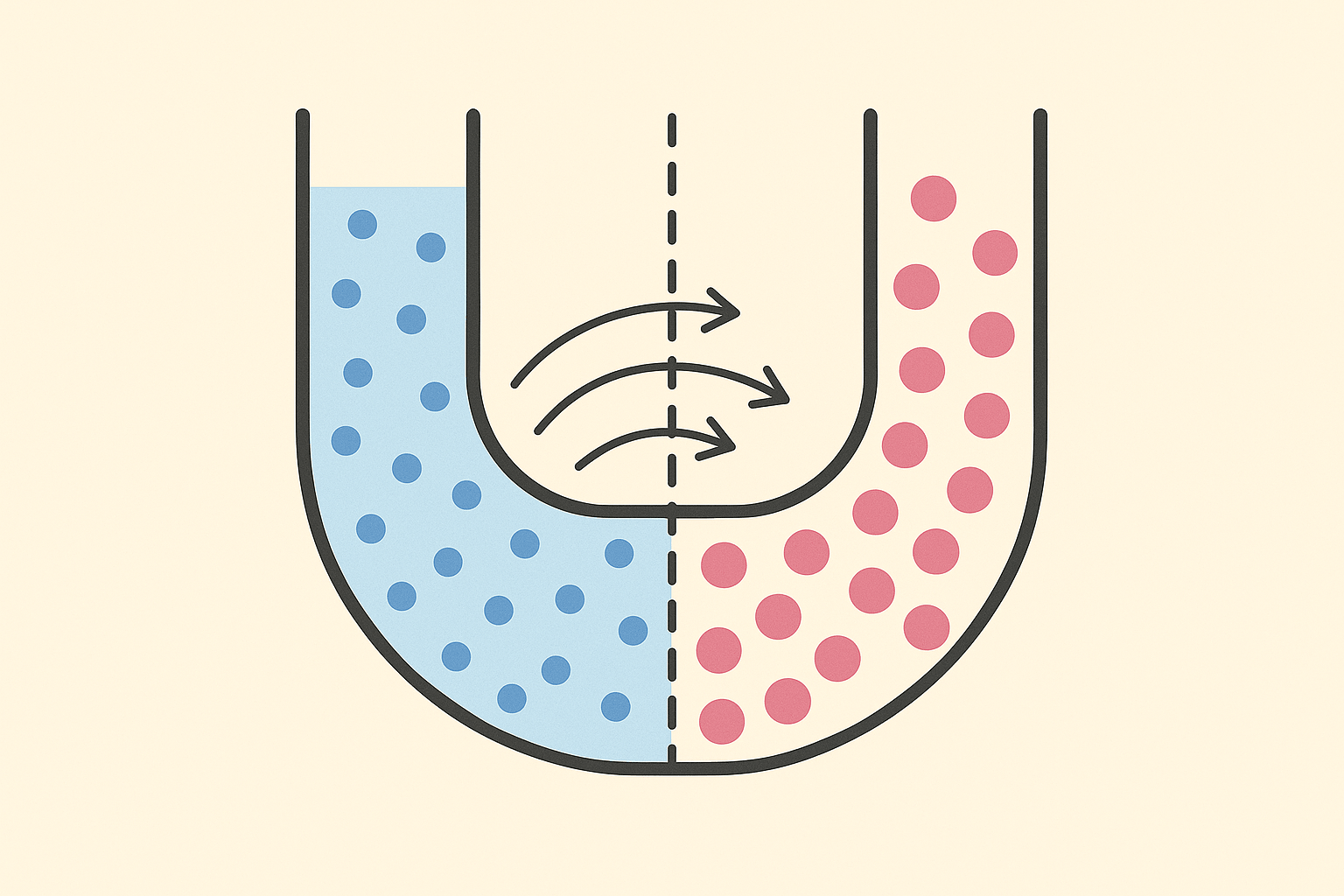
Osmosis is the passive movement of water across a semipermeable membrane, from a region of lower solute concentration to a region of higher solute concentration, until the water-potential difference is balanced, which can involve an opposing pressure difference. It is one of the most fundamental physical processes in biology. Every cell in your body depends on osmosis to maintain its size, shape, and chemical environment. Get it wrong and cells either shrivel (in salty water) or burst (in pure water). Get it right and you have the basis for cellular homeostasis, kidney function, plant turgor, and intravenous medicine.
Net water movement follows water-potential differences. Solute concentration and pressure both contribute, so equilibrium does not always mean equal solute concentrations.
The Definition Precisely
Osmosis is the net movement of solvent (typically water) across a semipermeable membrane down its concentration gradient. The membrane allows the solvent through but blocks the solute. Two important properties define the process:
- It is passive. No energy (ATP) is required. The movement is driven entirely by the concentration gradient.
- It moves water, not solute. The membrane is selectively permeable, water passes freely, dissolved particles (salt, sugar, proteins) do not.
- Direction is from low solute to high solute concentration. Equivalently, from high water concentration to low water concentration. The two statements describe the same gradient.
- It continues until equilibrium: equal solute concentrations on both sides, OR until something (a wall, a hydrostatic pressure) stops the flow.
Why Water Moves
Water doesn’t have intent. It moves because of pure statistics. Water molecules on both sides of a semipermeable membrane are constantly bouncing into the membrane and (sometimes) passing through it. On the side with more dissolved solute, fewer water molecules are bouncing per unit volume because the solute particles take up some of the space. So fewer water molecules cross from that side to the low-solute side than vice versa. Net movement: water from low-solute to high-solute side. The asymmetry persists until the solute concentrations equalize, at which point the bounce rates match and net flow stops.
Tonicity, the Vocabulary You Need
Tonicity describes the relative solute concentration of a solution compared to the inside of a cell.
- Hypotonic: solution has lower solute concentration than the cell interior. Water moves INTO the cell. Cells in hypotonic solutions swell. Animal cells can burst (lyse); plant cells become turgid (firm, healthy).
- Hypertonic: solution has higher solute concentration than the cell interior. Water moves OUT of the cell. Cells in hypertonic solutions shrink. Animal cells crenate; plant cells become flaccid and plasmolyzed.
- Isotonic: solution has the same solute concentration as the cell interior. No net water movement. Cells maintain normal shape. Saline IV fluid (0.9% NaCl) is isotonic to human blood, that is why it does not damage red blood cells.
Osmotic Pressure
Osmotic pressure (π) is the pressure that must be applied to the high-solute side of a membrane to prevent water from flowing into it. For dilute solutions, the van’t Hoff equation gives:
$$ \pi = i M R T $$
Where \( i \) is the van’t Hoff factor (the number of particles a solute dissociates into, 1 for sucrose, 2 for NaCl), \( M \) is the molar concentration, \( R \) is the gas constant (0.0821 L·atm/(mol·K)), and \( T \) is the absolute temperature in kelvin. The formula has the same structure as the ideal gas law, which is not a coincidence, both arise from the kinetic theory of particles.
Example: a 0.3 M sucrose solution at 37°C (310 K) has osmotic pressure π = 1 × 0.3 × 0.0821 × 310 ≈ 7.6 atm. That is roughly 100 psi. A small concentration difference across a membrane can drive enormous pressure, which is exactly why reverse osmosis desalination works, and why turgor pressure in plants can lift water meters up tree trunks.
Osmosis in Biology
Cell Volume Regulation
Every cell continuously regulates its internal osmotic balance. Animal cells in pure water would burst within minutes. To prevent this, they actively pump ions out (via Na+/K+ ATPase) to keep internal solute concentration matched to surroundings. Freshwater protists (paramecia, amoebas) have contractile vacuoles that continuously pump excess water back out.
Plant Turgor Pressure
Plant cells have rigid cell walls that prevent bursting. When a plant cell is placed in a hypotonic solution (or pure water), water rushes in by osmosis until the cell membrane is pressed firmly against the cell wall. The resulting pressure is turgor pressure, and it is what makes plant stems stand upright and leaves stay firm. A wilted plant is a plant whose cells have lost turgor, usually because the soil dried out and the cells became hypertonic to their environment.
Kidney Function
The kidneys use osmotic gradients to concentrate urine. Salts (especially urea and NaCl) are actively pumped into the medullary interstitium of the kidney, making it hypertonic. Water in the collecting duct then flows out by osmosis, concentrating the urine. The hormone ADH (antidiuretic hormone) controls how permeable the collecting duct is to water, high ADH means concentrated urine and water retention; low ADH means dilute urine and water loss. This is how the body regulates blood water levels.
Intravenous Fluids
Hospital IV fluids must be isotonic to blood. Pure water would cause red blood cells to burst. Concentrated salt would shrink them. Standard ‘normal saline’ is 0.9% NaCl, chosen specifically because it matches human blood plasma osmolarity (~285-295 mOsm/kg). Hypertonic saline (3%, 5%) is sometimes used to treat severe hyponatremia, but it must be administered carefully because rapid correction can damage brain cells.
Diffusion vs Osmosis
Both are passive transport processes driven by concentration gradients. The difference:
- Diffusion is the movement of solute particles down their concentration gradient. The solute moves; the membrane (if present) is permeable to it. Example: oxygen diffusing from lungs into blood.
- Osmosis is the movement of solvent (water) down its concentration gradient. The solvent moves; the membrane is impermeable to the solute. Example: water moving into a salt-soaked cucumber slice.
Osmosis is sometimes called ‘the diffusion of water.’ That is technically correct but obscures the practical distinction. In biology, the two terms refer to different scenarios with different consequences.
Related study notes: Homeostasis, Cellular Respiration, Protein, Enzyme.
The OpenStax biology textbooks develop the biological processes discussed here with additional diagrams and explanations.
Pressure Opposing Water Movement
A membrane separates pure water from a solution of an impermeant solute. With initially equal pressure, net water movement favors the solution side. If that side develops enough additional hydrostatic pressure, the pressure contribution can balance the osmotic tendency.
The system can then have zero net water movement while the solute concentrations still differ. Tonicity also depends on membrane permeability to the relevant solutes. A solute that readily crosses a cell membrane does not have the same sustained volume effect as an otherwise similar impermeant solute.
The points to check in this example are:
- Osmolarity counts osmotically relevant particles in a solution.
- Tonicity describes the sustained volume effect across a particular membrane.
- An isotonic cell can still have individual water molecules moving in both directions.
Check Your Understanding
Try the questions before reading the answers.
Question 1. Does osmotic equilibrium require water molecules to stop crossing?
Answer. No. It requires no net movement.
Question 2. Can pressure balance a solute-driven water-potential difference?
Answer. Yes.
Frequently Asked Questions
What is osmosis in simple terms?
Osmosis is the movement of water through a semipermeable membrane from a region of lower solute concentration (more water) to a region of higher solute concentration (less water). It happens automatically without using any energy, and it continues until the concentrations on both sides balance.
Why does water move from low solute to high solute side?
Because there are more free water molecules per unit volume on the low-solute side, more of them bounce against and pass through the membrane than do the same in reverse. The asymmetry produces a net flow of water toward the high-solute side. The flow continues until enough water has moved that the concentrations equalize and the bounce rates match.
What does hypotonic, hypertonic, and isotonic mean?
Hypotonic means lower solute concentration than the inside of the cell, water flows INTO the cell, which swells. Hypertonic means higher solute concentration than the cell interior, water flows OUT, the cell shrinks. Isotonic means equal solute concentrations on both sides, no net water movement, cells maintain normal shape. Hospital IV saline (0.9% NaCl) is isotonic to human blood for exactly this reason.
Does osmosis require energy?
No. Osmosis is a passive process driven entirely by the concentration gradient. No ATP is consumed. This is the major distinction from active transport (like Na+/K+ ATPase pumping ions against their gradient), which does require ATP.
What is osmotic pressure?
Osmotic pressure is the pressure that must be applied to the high-solute side of a membrane to prevent water from flowing into it. For dilute solutions, it is calculated as π = iMRT (van’t Hoff equation). Osmotic pressure can be surprisingly large, even a few hundred mM solute concentration produces several atmospheres of pressure, which is what drives reverse osmosis water purification and turgor pressure in plants.
What is the difference between osmosis and diffusion?
Diffusion is the movement of solute particles down their concentration gradient (oxygen into blood, perfume across a room). Osmosis is the movement of water (solvent) across a semipermeable membrane down the water concentration gradient. In osmosis, the membrane blocks the solute but lets water through; in diffusion, either there’s no membrane or the membrane is permeable to whatever’s moving.
Browse more in Biology.