
 by
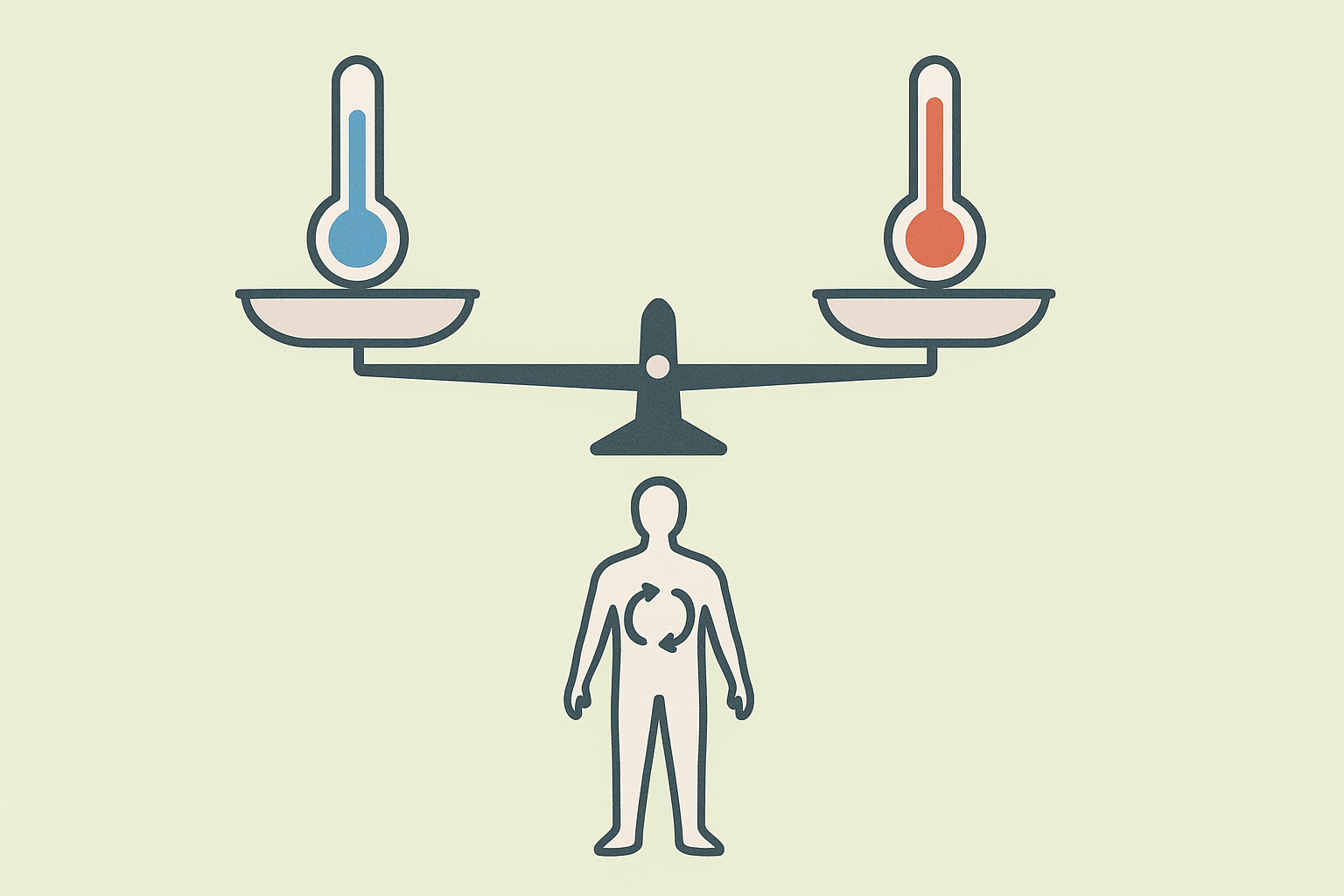
byHomeostasis is the maintenance of relatively stable internal conditions inside an organism, even when the outside world changes. Body temperature stays around 37 °C whether you are in Delhi in May or Reykjavik in February. Blood glucose stays within a tight band whether you skipped lunch or just ate a slice of cake. Blood pH stays between 7.35 and 7.45 across nearly every situation. The fact that any of this works is the central organizing principle of physiology.
Free download: Homeostasis Study Notes (PDF)
The full note as a print-ready PDF: every section and worked example, the 10-question practice set with solutions, an answer key, and a 1-page revision sheet for last-minute revision.
What Homeostasis Is
Homeostasis is the regulation of internal conditions so the body’s cells stay close to an optimal operating point. The term was coined by Walter Cannon in 1926, building on Claude Bernard’s earlier concept of the milieu intérieur, the internal environment. The principle applies to temperature, blood glucose, blood pH, water balance, salt concentration, blood pressure, oxygen and CO₂ levels, hormone concentrations, and dozens of other variables.
Homeostasis does not mean perfectly constant. Most variables fluctuate within a narrow range around a setpoint. Body temperature varies by about 1 °C through a 24-hour cycle; blood glucose rises after meals and falls between them. What matters is that excursions stay bounded and that mechanisms exist to pull the value back toward the setpoint.
The Components of a Homeostatic Loop
Every homeostatic mechanism has the same four components arranged in a feedback loop.
- Setpoint. The target value the system tries to maintain (e.g., 37 °C body temperature, 90 mg/dL fasting blood glucose).
- Sensor. A receptor that measures the current value of the variable (e.g., thermoreceptors in the skin and hypothalamus, glucose-sensing β cells in the pancreas).
- Control center. The structure that compares the sensor reading to the setpoint and decides whether action is needed (usually the hypothalamus for temperature; the pancreas for glucose).
- Effector. The structure that actually changes the variable back toward the setpoint (sweat glands, blood vessels, liver, muscle, hormones).
Negative Feedback, The Standard Mode
Most homeostatic loops use negative feedback. A change in the variable triggers a response that opposes the change. The classic example is body temperature.
- If body temperature rises (e.g., during exercise), the hypothalamus triggers sweating, vasodilation in the skin, and reduced muscle activity. Heat is dissipated. Temperature falls back toward 37 °C.
- If body temperature falls (e.g., in a cold room), the hypothalamus triggers shivering, vasoconstriction, and increased metabolic rate. Heat is generated. Temperature rises back toward 37 °C.
The same pattern applies to blood glucose. After a meal, blood glucose rises; the pancreas secretes insulin; cells take up glucose and the liver stores excess as glycogen; blood glucose falls. Between meals, blood glucose drops; the pancreas secretes glucagon; the liver releases stored glucose; blood glucose rises. The two opposing hormones (insulin/glucagon) keep blood glucose in a tight band.
Positive Feedback, The Exception
Positive feedback amplifies a change rather than opposing it. This is destabilizing by definition, so the body uses it only sparingly and only for processes that should run to completion once started.
- Childbirth. Uterine contractions stretch the cervix. Stretching triggers oxytocin release. Oxytocin causes stronger contractions. Stronger contractions stretch the cervix more. The loop runs away until the baby is delivered, at which point the trigger disappears.
- Blood clotting. An injury exposes collagen. Platelets stick to collagen and release chemicals that activate more platelets. The clot grows rapidly until it seals the wound.
- Lactation reflex. An infant suckling triggers prolactin and oxytocin release, which causes milk ejection. Continued suckling sustains the response.
Examples of Homeostatic Variables
| Variable | Setpoint range | Sensor | Effectors |
|---|---|---|---|
| Body temperature | 36.5-37.5 °C | Hypothalamus, skin | Sweat glands, vasculature, muscles (shivering) |
| Blood glucose | 70-110 mg/dL fasting | Pancreatic α and β cells | Liver, muscle, adipose (insulin / glucagon) |
| Blood pH | 7.35-7.45 | Chemoreceptors | Kidneys, lungs |
| Blood pressure | ~120/80 mmHg | Baroreceptors in aorta and carotids | Heart rate, vessel diameter, kidneys |
| Blood O₂ / CO₂ | PaO₂ ~95 mmHg, PaCO₂ ~40 mmHg | Chemoreceptors | Lungs (breathing rate and depth) |
| Osmolarity / water | ~285-295 mOsm/kg | Hypothalamus | Kidneys (ADH), thirst |
When Homeostasis Fails
Disease often is homeostasis failure. Type 1 diabetes is loss of the insulin-producing β cells, so the glucose loop loses its main negative-feedback signal. Hyperthermia and hypothermia are temperature loops overwhelmed by external conditions. Hypertension is sustained failure of the blood-pressure setpoint. Acidosis and alkalosis are pH-loop failures. Most chronic disease management is, at heart, augmenting a failing homeostatic mechanism, insulin shots for diabetes, dialysis for kidney failure, beta-blockers for hypertension.
Related study notes: Nervous System, Enzyme, Protein.
Practice Questions
Work each question before reading its solution. The set runs from direct recall and substitution to the applied questions that exams actually use to separate grades. All 10 also appear in the downloadable PDF with a separate answer key.
Question 1. Define homeostasis and explain why it is described as a dynamic, not static, equilibrium.
Solution. The maintenance of relatively stable internal conditions (temperature, pH, glucose, water balance) despite a constantly changing external environment. It is dynamic because the body is continuously making small corrections in both directions around a set point, never sitting perfectly motionless; stability emerges from constant active adjustment, not from an absence of change.
Question 2. Name the 3 components of every negative feedback loop and their function.
Solution. A RECEPTOR detects a deviation from the set point (a sensor). A CONTROL CENTER (often the brain or a gland) compares the detected value to the set point and decides on a response. An EFFECTOR carries out the response that pushes the variable back toward the set point. Every homeostatic mechanism in the body, thermoregulation, blood glucose, blood pressure, is built from this same 3-part loop.
Question 3. Explain the negative feedback loop for body temperature regulation when you get too hot.
Solution. Thermoreceptors in the skin and hypothalamus detect rising temperature above the 37°C set point. The hypothalamus (control center) triggers effectors: sweat glands increase sweating (evaporative cooling) and blood vessels near the skin dilate (vasodilation, releasing heat faster). As temperature falls back toward 37°C, the original stimulus weakens and the response subsides, the defining “negative” (self-limiting) signature of the loop.
Question 4. Why is negative feedback, rather than positive feedback, the dominant regulatory strategy for maintaining stable internal conditions?
Solution. Negative feedback opposes and dampens deviations, actively pulling a variable back toward its set point, which is exactly what stability requires. Positive feedback AMPLIFIES a deviation further in the same direction, useful only for events that need to be pushed rapidly to completion and then explicitly stopped (childbirth contractions, blood clotting, a nerve action potential), never for maintaining a steady baseline, which is why runaway positive feedback in a homeostatic system usually signals dangerous physiological failure.
Question 5. Explain blood glucose regulation: what do insulin and glucagon each do, and which glands release them?
Solution. The pancreas releases INSULIN when blood glucose rises (after eating), signaling cells to absorb glucose from the blood and liver to store it as glycogen, lowering blood glucose back toward the set point. When glucose falls too low, the pancreas releases GLUCAGON, triggering the liver to break glycogen back down into glucose and release it into the blood, raising the level back up. The 2 hormones are antagonistic partners bracketing the set point from both sides.
Question 6. Type 1 diabetes destroys the pancreatic cells that produce insulin. Trace the homeostatic consequence: what specifically fails, and why does blood glucose rise dangerously after a meal without treatment?
Solution. Without insulin, cells cannot efficiently absorb glucose from the bloodstream and the liver is not signaled to store the excess as glycogen, so glucose from digested food accumulates in the blood with no functioning mechanism to remove it. The negative feedback LOOP itself is intact (the pancreas still detects high glucose), but the EFFECTOR arm is broken, illustrating that a homeostatic failure can arise at any single link in the 3-part chain, not just from a bad sensor or bad control center.
Question 7. Give 1 clear example of a POSITIVE feedback loop in the human body, and explain why it must eventually be shut off externally rather than self-limiting.
Solution. Childbirth: uterine contractions push the baby’s head against the cervix, triggering oxytocin release, which INTENSIFIES contractions further, which pushes harder against the cervix, escalating the loop. This deliberately amplifying cycle only stops once the baby is delivered, an external endpoint outside the loop’s own variables; a positive feedback loop with no external stopping event would simply escalate without limit, which is why unchecked positive feedback is dangerous when it appears in error (such as a fever spiraling out of control).
Question 8. Explain osmoregulation: what triggers the release of ADH (antidiuretic hormone), and what effect does it have on urine output?
Solution. Osmoreceptors in the hypothalamus detect rising blood solute concentration (dehydration, or high salt intake). This triggers ADH release from the pituitary gland, which signals the kidneys to reabsorb MORE water back into the blood rather than excreting it, concentrating and reducing urine output. The result dilutes the blood back toward its normal solute concentration, closing the loop, which is exactly why urine becomes darker and more concentrated when you are dehydrated.
Question 9. A fever represents a temporary RESETTING of the hypothalamic temperature set point upward (say from 37°C to 39°C), rather than a simple failure of thermoregulation. Explain why the person then feels cold and shivers even though their actual body temperature is already elevated above normal.
Solution. Once the set point is reset to 39°C, the body’s own thermoreceptors compare the CURRENT temperature (say, still climbing from 37°C toward 39°C) against the NEW, higher target and detect a deficit, triggering shivering (muscle contraction generates heat) and vasoconstriction, exactly the responses the body uses when genuinely too cold. The regulatory machinery is working correctly; only the target itself has moved, illustrating that “set points” are not fixed forever, they can be deliberately adjusted by the body (often via pyrogens signaling infection).
Question 10. Explain calcium homeostasis briefly: name the 2 antagonistic hormones involved and their source glands, paralleling the insulin/glucagon pattern.
Solution. PARATHYROID HORMONE (PTH), from the parathyroid glands, raises blood calcium when it falls too low, by stimulating bone breakdown (releasing stored calcium), increasing kidney reabsorption, and activating vitamin D. CALCITONIN, from the thyroid gland, lowers blood calcium when it rises too high, by promoting calcium deposition back into bone. The antagonistic-hormone-pair pattern (1 hormone raises, 1 lowers, bracketing a set point) recurs across the body’s major homeostatic systems, not just glucose.
Frequently Asked Questions
What is homeostasis in simple words?
Homeostasis is the body’s ability to keep its internal conditions stable even when the outside world changes. Body temperature stays around 37 °C, blood glucose stays in a tight range, blood pH stays between 7.35 and 7.45, all regardless of what you ate, where you went, or what you did.
What are the four components of a homeostatic loop?
A setpoint (target value), a sensor (measures the current value), a control center (compares sensor reading to setpoint), and an effector (changes the variable back toward setpoint). The four components are connected in a feedback loop.
What is negative feedback?
Negative feedback is when a change in a variable triggers a response that opposes that change. If body temperature rises, sweating and vasodilation cool the body. If it falls, shivering and vasoconstriction warm it. Negative feedback is the default mode of nearly every homeostatic loop in the body.
What is the difference between negative and positive feedback?
Negative feedback opposes the change and stabilizes the variable around a setpoint. Positive feedback amplifies the change and pushes the variable further away from baseline. Negative feedback is the standard mode of homeostasis. Positive feedback is used sparingly for processes that need to run to completion once started, childbirth, blood clotting, lactation.
What is the most important organ for homeostasis?
The hypothalamus is often called the master regulator. It senses temperature, osmolarity, glucose, and hormone levels, and controls the autonomic nervous system and the endocrine pituitary gland. Most homeostatic loops route through the hypothalamus at some point.
Can homeostasis fail?
Yes. Failure of homeostatic mechanisms is the root of many diseases: Type 1 diabetes (glucose loop), hyperthermia (temperature loop), hypertension (blood pressure setpoint), acidosis (pH loop), kidney failure (water and salt balance). Modern medicine spends most of its effort augmenting failing homeostatic mechanisms.
Browse more in Biology.