by
by
The immune system is the body’s defense against pathogens, bacteria, viruses, fungi, parasites, and transformed cells (cancer). It has two coordinated branches: an innate system that responds rapidly but non-specifically, and an adaptive system that responds more slowly but with extraordinary precision. Together they protect every organ continuously. When the system fails (autoimmune disease) or is overwhelmed (sepsis, AIDS), the consequences are severe. Many protective immune responses happen without obvious symptoms. Their effectiveness depends on the pathogen, the exposure and the person’s immune state.
Immune protection depends on interacting barriers, cells and molecules. Innate and adaptive responses coordinate rather than acting as isolated systems.
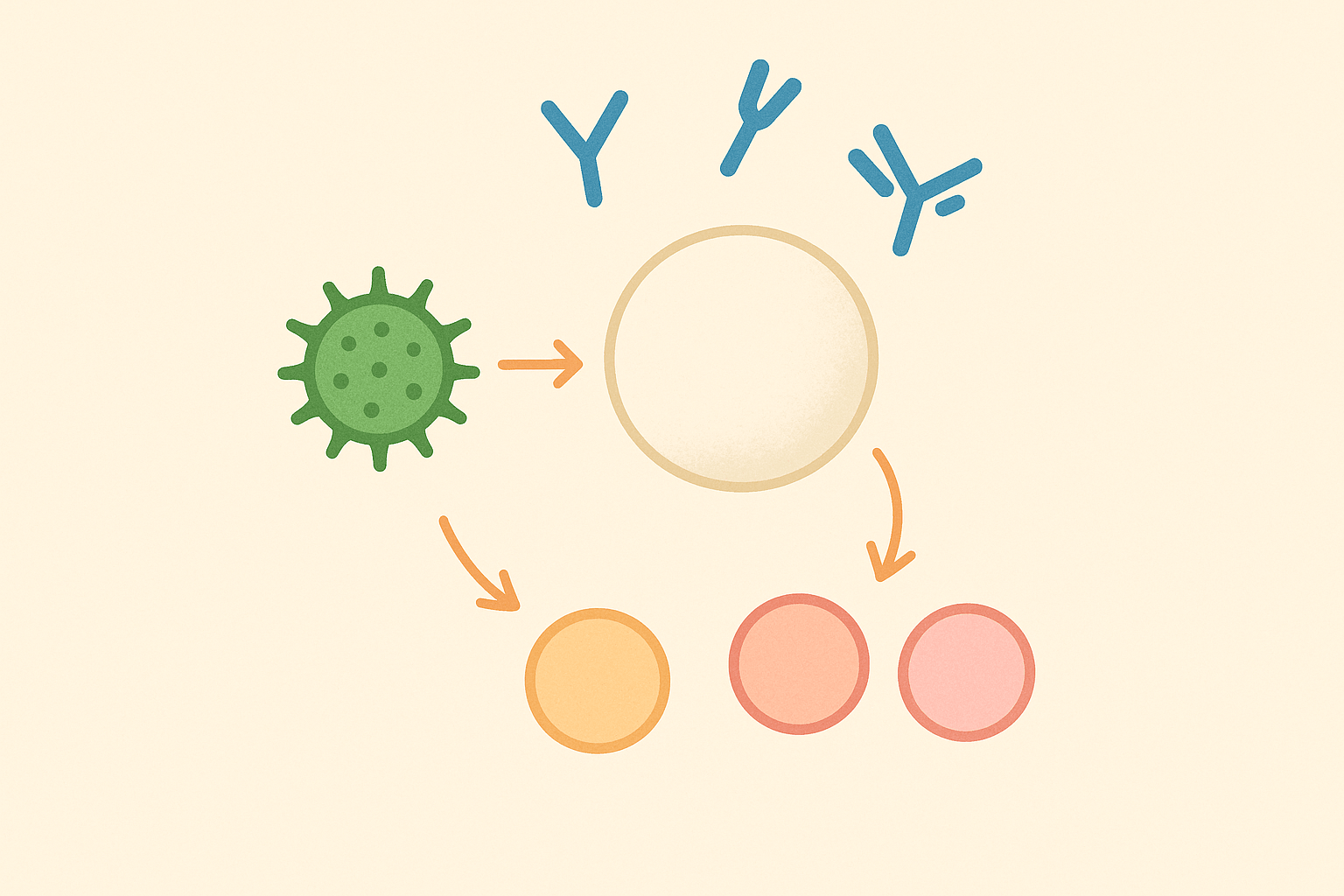
Two Branches: Innate and Adaptive
The immune system has two functionally distinct branches that work together.
Innate Immunity
The first line of defense. Innate immunity is present from birth, recognizes general molecular patterns that pathogens share (called PAMPs, pathogen-associated molecular patterns), and responds within minutes to hours. It is non-specific (does not target specific pathogens) and does not use the same antigen-specific lymphocyte memory system as adaptive immunity. The main innate components:
- Physical barriers: skin, mucous membranes, stomach acid, tears, saliva. The first line of defense.
- Phagocytes: macrophages and neutrophils that engulf and digest pathogens.
- Natural killer (NK) cells: destroy virus-infected cells and tumor cells.
- Complement system: about 30 plasma proteins that punch holes in bacterial membranes and tag pathogens for destruction.
- Inflammation: local response involving redness, swelling, heat, and pain. Brings immune cells to the site of infection.
Adaptive Immunity
The second line of defense, slower but enormously more specific. Adaptive immunity develops over days, targets specific pathogens, and produces lasting immunological memory. It has two main lymphocyte populations:
- B cells: produce antibodies (immunoglobulins) that recognize specific antigens. Each B cell makes one specific antibody. Activated B cells become plasma cells (high-volume antibody factories) or memory B cells (long-term recall).
- T cells: come in two flavors. Helper T cells (CD4+) coordinate immune responses by activating B cells and macrophages. Cytotoxic T cells (CD8+) directly kill virus-infected or cancerous cells. T cells recognize fragments of antigens presented to them on MHC molecules.
Antibodies, the Y-Shaped Molecules
Antibodies (immunoglobulins) are Y-shaped proteins produced by plasma cells (mature B cells). Each Y has two antigen-binding sites at the tips that recognize a specific molecular shape on a pathogen. There are five classes (isotypes), each with different functions:
| Antibody class | Where found | Main function |
|---|---|---|
| IgM | Blood, lymph | First responder; large pentameric structure |
| IgG | Blood, tissues | Most abundant; long-term protection; crosses placenta |
| IgA | Mucous membranes, breast milk | Defends mucosal surfaces |
| IgE | Tissues | Allergy and parasite responses |
| IgD | B cell surfaces | B cell activation |
The body can produce roughly 10¹¹ different antibody specificities by randomly rearranging gene segments during B cell development. That diversity is what lets the immune system recognize essentially any molecular shape a pathogen might present.
Immunological Memory and Vaccination
After an initial infection, some activated B and T cells become memory cells that persist for years to decades. On a second encounter with the same pathogen, memory cells mount a faster, stronger response, the secondary immune response. Immune memory can reduce the likelihood or severity of some reinfections. Its duration and protection depend on the pathogen, the exposure and the host.
Vaccination exploits immunological memory directly. A vaccine presents pathogen-derived antigens (whole inactivated virus, attenuated live virus, viral protein subunits, or mRNA encoding viral proteins) without causing disease. The immune system mounts a primary response and generates memory cells. When the real pathogen arrives later, the secondary response is ready. Smallpox eradication (1980), polio near-eradication, and the rapid mRNA COVID vaccines all rest on this single mechanism.
How Immune Cells Recognize Self from Non-Self
A core problem: the immune system needs to attack foreign cells and molecules while leaving the body’s own cells alone. Three mechanisms enforce self-tolerance:
- Negative selection in the thymus. Developing T cells that bind too strongly to self-antigens are killed (apoptosis) before leaving the thymus. The thymus deletes most self-reactive T cells.
- Regulatory T cells (Tregs): a subset of T cells that actively suppress self-reactive responses that escape thymic selection.
- Peripheral tolerance: additional mechanisms that anergize (inactivate) self-reactive cells encountered outside the thymus.
When self-tolerance breaks down, the result is autoimmune disease: type 1 diabetes (T cells attack pancreatic β cells), rheumatoid arthritis (joint cells), multiple sclerosis (myelin), Hashimoto’s thyroiditis, systemic lupus, and over 100 others.
When the Immune System Fails
Several distinct failure modes:
- Immunodeficiency: too little immune response. AIDS (HIV destroys CD4+ T cells), severe combined immunodeficiency (SCID), chemotherapy-induced immunosuppression. Pathogens that healthy people clear easily become life-threatening.
- Hyperactivity: too much response. Allergies are IgE-mediated overreactions to harmless antigens (pollen, peanuts, dust). Anaphylaxis is the extreme form, with systemic vasodilation and bronchoconstriction within minutes.
- Autoimmunity: misdirected response, attacking self. Type 1 diabetes, multiple sclerosis, lupus, rheumatoid arthritis. Often involves both genetic susceptibility and environmental triggers.
- Sepsis: runaway systemic inflammation in response to infection. The immune response itself damages the body. Sepsis remains a leading cause of in-hospital mortality despite modern treatment.
- Cancer immune evasion: tumors that successfully hide from immune surveillance. Modern checkpoint inhibitors (anti-PD-1, anti-CTLA-4) work by re-enabling immune cells to recognize and attack tumors.
Related study notes: Protein, Nucleic Acid, Nervous System, Homeostasis.
The OpenStax biology textbooks develop the biological processes discussed here with additional diagrams and explanations.
Recognition and Memory
An innate response can recognize patterns associated with microbes or tissue damage and recruit protective activity. Adaptive lymphocyte responses provide antigen-specific recognition and can generate long-lived memory. Those descriptions should not be turned into a claim that every innate response is permanently unchanged by earlier exposures.
After an initial antigen encounter, memory populations can support a faster or stronger later response, but protection depends on the antigen, the host and the kind of immunity involved. A single success percentage cannot summarize all immune encounters. Vaccination is designed to establish useful immune protection with an appropriate antigen presentation.
The points to check in this example are:
- Innate recognition and adaptive specificity have different organizing principles.
- Antibodies and T-cell responses have distinct roles.
- Immune memory does not imply that every infection or vaccine produces lifelong complete protection.
Check Your Understanding
Try the questions before reading the answers.
Question 1. Are antibodies the only part of adaptive immunity?
Answer. No. T-cell responses are also important.
Question 2. Does immune memory guarantee that reinfection is impossible?
Answer. No.
Frequently Asked Questions
What is the immune system?
The immune system is the body’s defense against pathogens, bacteria, viruses, fungi, parasites, and transformed cells like cancers. It has two branches: an innate system that responds rapidly but non-specifically, and an adaptive system that responds more slowly but with extraordinary precision and long-term memory.
What is the difference between innate and adaptive immunity?
Innate immunity is present from birth, recognizes general molecular patterns shared by many pathogens, responds within minutes to hours, and does not use the same antigen-specific lymphocyte memory system as adaptive immunity. Adaptive immunity is more specific, takes days to fully respond, recognizes specific antigens, and produces long-lasting memory cells that mount a faster response on future encounters.
What are T cells and B cells?
T cells and B cells are the two main types of lymphocytes (adaptive immune cells). B cells produce antibodies that recognize specific antigens. T cells come in two flavors: helper T cells (CD4+) coordinate immune responses, and cytotoxic T cells (CD8+) directly kill virus-infected cells and cancer cells. Both develop from bone marrow but T cells mature in the thymus.
How do vaccines work?
Vaccines present pathogen-derived antigens, inactivated virus, attenuated virus, viral proteins, or mRNA encoding viral proteins, without causing disease. The immune system mounts a primary response and generates memory B and T cells. When the real pathogen arrives later, memory cells mount a faster, stronger secondary response that often clears the pathogen before symptoms develop.
Why do allergies happen?
Allergies are mistakes by the adaptive immune system. The system mistakes a harmless antigen (pollen, peanut protein, dust mite waste) for a parasite and produces IgE antibodies against it. On re-exposure, IgE triggers mast cells to release histamine and other inflammatory mediators, causing the runny nose, itching, swelling, and (in severe cases) anaphylaxis we recognize as allergic reactions.
What is autoimmune disease?
Autoimmune disease happens when the immune system attacks the body’s own tissues. Examples include type 1 diabetes (T cells destroy pancreatic β cells), multiple sclerosis (attack on myelin), rheumatoid arthritis (joint tissue), and systemic lupus erythematosus. Autoimmunity involves a breakdown of self-tolerance and usually requires both a genetic susceptibility and an environmental trigger.
Browse more in Biology.