by
by
The human nervous system is the body’s electrical and chemical communication network. About 86 billion neurons connect through roughly 150 trillion synapses to coordinate everything you do: every thought, every muscle movement, every sensation, every breath, every heartbeat. This study note covers the structural divisions (CNS, PNS, somatic, autonomic, sympathetic, parasympathetic), the cellular components (neurons, glia), how action potentials and synapses actually work, and what happens when the system fails.
Nervous-system signals involve electrical changes within cells and chemical or electrical communication between cells. Their timing and effect depend on the circuit.
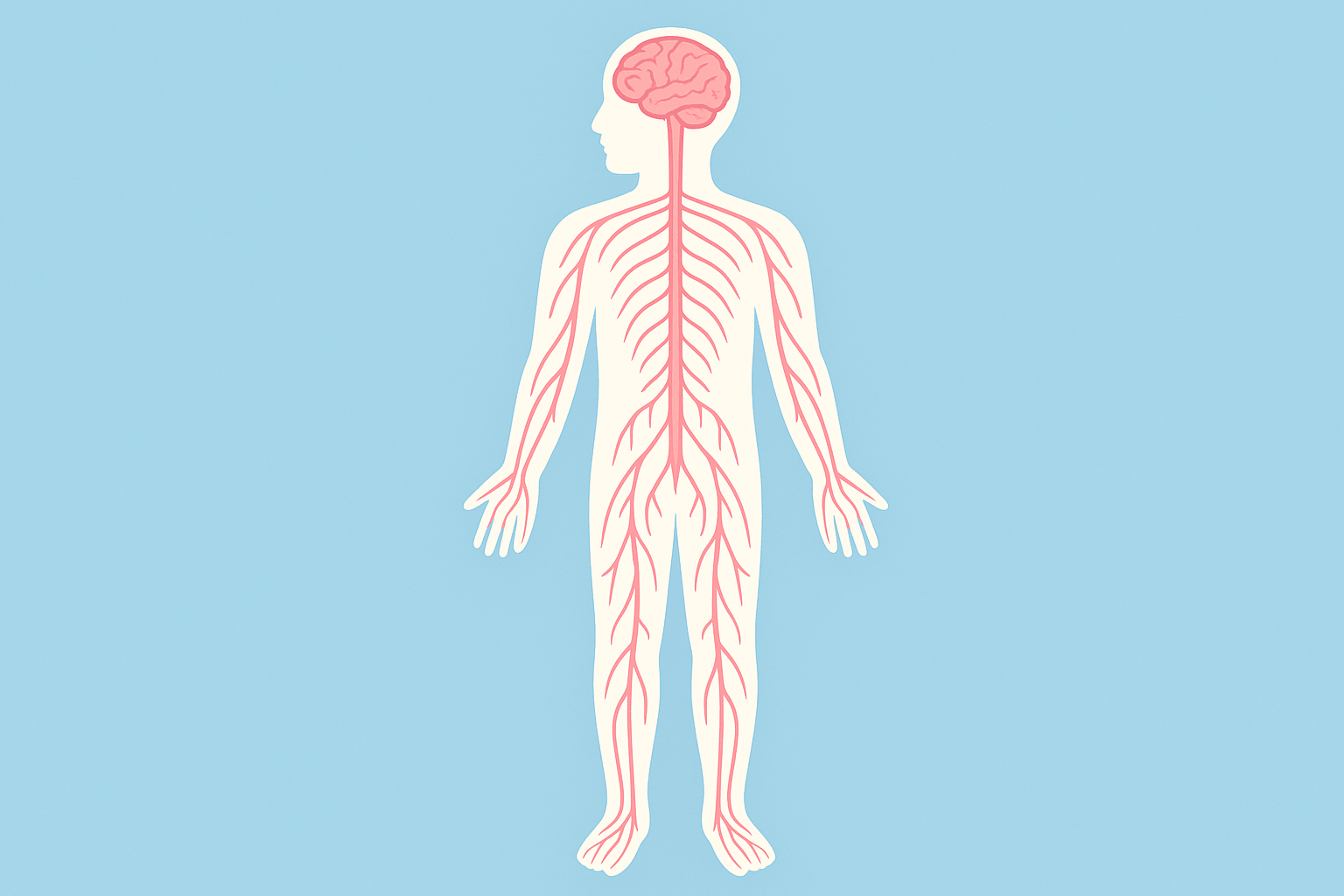
Structural Divisions
Anatomically, the nervous system divides into two parts.
- Central nervous system (CNS). The brain and spinal cord. The processing center where information is integrated, memories are stored, decisions are made, and motor commands originate.
- Peripheral nervous system (PNS). Every nerve outside the CNS. Cranial nerves, spinal nerves, and the autonomic ganglia. The PNS carries sensory information from the body to the CNS, and motor commands from the CNS to the body.
Functional Divisions
Functionally, the PNS divides further into voluntary and involuntary subsystems.
Somatic Nervous System
Controls voluntary movement of skeletal muscle. When you decide to lift your arm, motor neurons in your spinal cord send signals through somatic motor nerves to your arm muscles. Somatic sensory nerves carry touch, pain, temperature, and proprioception back to the CNS.
Autonomic Nervous System
Controls involuntary functions: heart rate, blood pressure, digestion, sweating, pupil dilation, glandular secretion. You do not consciously direct any of it. The autonomic system itself divides into two branches that usually oppose each other.
- Sympathetic (fight-or-flight). Activated under stress, exercise, or perceived threat. Increases heart rate and blood pressure, dilates pupils and bronchi, redirects blood from gut to muscle, releases adrenaline and noradrenaline. Prepares the body for action.
- Parasympathetic (rest-and-digest). Activated during relaxation, eating, sleeping. Slows heart rate, increases digestion, constricts pupils, conserves energy. The main effector is the vagus nerve, which alone carries about 75% of parasympathetic outflow.
Most organs receive input from both branches and respond to whichever is currently dominant. A healthy autonomic system shifts smoothly between them depending on the situation.
The Neuron
The functional unit of the nervous system is the neuron. A typical neuron has four distinct parts.
- Dendrites. Branching extensions that receive signals from other neurons. A single neuron may have thousands of dendritic inputs.
- Cell body (soma). Contains the nucleus and most organelles. Integrates incoming signals.
- Axon. A long thin projection that carries the outgoing electrical signal. Axons can be over a meter long in tall humans (the sciatic nerve from spinal cord to toe).
- Axon terminals. The endings where the axon meets the next cell, forming a synapse. Most synapses release neurotransmitters into the synaptic cleft.
Many axons are wrapped in myelin, a fatty insulating sheath produced by glial cells (oligodendrocytes in the CNS, Schwann cells in the PNS). Myelin dramatically speeds up signal conduction, myelinated axons conduct at 100 m/s, unmyelinated at 0.5-2 m/s. This is why multiple sclerosis (a demyelinating disease) produces such severe neurological symptoms.
Action Potentials
Neurons communicate via action potentials, brief electrical pulses that travel down the axon.
- Resting potential. A neuron at rest has a membrane potential of about -70 mV, with the inside negative compared to the outside. This gradient is maintained by the Na⁺/K⁺ ATPase pump and selective ion channels.
- Depolarization. If incoming signals push the membrane potential above the threshold (around -55 mV), voltage-gated Na⁺ channels open. Sodium rushes in, the membrane potential briefly reverses to about +30 mV.
- Repolarization. Sodium channels close. Voltage-gated K⁺ channels open. Potassium flows out, restoring the negative interior.
- Hyperpolarization and recovery. The membrane briefly overshoots to about -80 mV. The Na⁺/K⁺ ATPase pump restores the original ion balance. The neuron is ready for another action potential.
The entire action potential lasts about 1-2 milliseconds. A myelinated axon then conducts it down the length of the axon via saltatory conduction (jumping between nodes of Ranvier) at speeds up to 100 m/s.
Synapses and Neurotransmitters
Action potentials end at the axon terminal, where the neuron meets the next cell at a synapse. Most synapses are chemical: the arriving action potential triggers vesicles full of neurotransmitter to release into the synaptic cleft. Neurotransmitters bind receptors on the next cell, opening ion channels and either exciting (depolarizing) or inhibiting (hyperpolarizing) that cell.
The major neurotransmitters:
- Glutamate: the main excitatory neurotransmitter in the CNS
- GABA: the main inhibitory neurotransmitter; benzodiazepines and alcohol act here
- Acetylcholine: neuromuscular junction; many CNS roles; nicotine acts on its receptors
- Dopamine: reward, motivation, motor control; Parkinson’s disease is dopamine loss in the substantia nigra
- Serotonin: mood, sleep, appetite; SSRIs increase its synaptic availability
- Noradrenaline: arousal, attention, fight-or-flight response
Glial Cells, the Other 50%
Until the 1980s, neurons got most of the attention. We now know that glial cells outnumber neurons in many parts of the brain and do far more than passive support.
- Astrocytes regulate the blood-brain barrier, supply nutrients to neurons, and recycle neurotransmitters.
- Oligodendrocytes (CNS) and Schwann cells (PNS) produce myelin.
- Microglia are the brain’s resident immune cells, clearing debris and dead cells, and orchestrating responses to injury and infection.
- Ependymal cells line the ventricles and produce cerebrospinal fluid.
Related study notes: Homeostasis, Protein, Enzyme.
The OpenStax biology textbooks develop the biological processes discussed here with additional diagrams and explanations.
An Action Potential and a Synapse
In a typical neuronal action potential, changing ion-channel conductances alter the membrane voltage. A rising phase commonly involves sodium entry, followed by processes including potassium efflux that restore the voltage. The channels and conditions of the cell determine the details.
At a chemical synapse, an arriving signal can trigger transmitter release. The transmitter’s effect depends on the postsynaptic receptor and ion gradients, so a neurotransmitter name alone does not always determine an excitatory or inhibitory response. Glial cells also support and regulate neuronal function rather than serving as passive packing material.
The points to check in this example are:
- A membrane potential is an electrical difference across the membrane.
- An action potential and a graded potential are different signal forms.
- The central and peripheral divisions describe anatomical organization.
Check Your Understanding
Try the questions before reading the answers.
Question 1. Does a stronger stimulus normally make an individual action potential proportionally taller?
Answer. Not in the usual all-or-none model; firing pattern and frequency can change.
Question 2. Are all synapses chemical?
Answer. No. Electrical synapses also exist.
Frequently Asked Questions
What are the two main parts of the human nervous system?
The central nervous system (CNS), which consists of the brain and spinal cord, and the peripheral nervous system (PNS), which includes every nerve outside the CNS. The CNS processes information; the PNS carries sensory input to the CNS and motor commands from the CNS to the body.
What is the difference between somatic and autonomic nervous systems?
The somatic nervous system controls voluntary movement of skeletal muscle, when you decide to walk, lift, or speak. The autonomic nervous system controls involuntary functions like heart rate, digestion, blood pressure, and sweating. You direct the somatic; the autonomic runs on its own.
What is the sympathetic vs parasympathetic nervous system?
The sympathetic branch handles fight-or-flight, it activates under stress, increases heart rate, dilates pupils, and prepares the body for action. The parasympathetic branch handles rest-and-digest, it dominates during relaxation and digestion, slows the heart, and conserves energy. Most organs receive input from both, and the body shifts smoothly between them.
How fast does a nerve signal travel?
It depends on the axon. Myelinated axons (with the fatty insulating sheath) conduct at 50-100 m/s. Unmyelinated axons conduct at 0.5-2 m/s. The fastest neural signals in humans travel about 268 mph in myelinated nerves, which is why your reflex from foot to spinal cord and back can fire in under 50 milliseconds.
How many neurons are in the human brain?
About 86 billion neurons, connected by approximately 150 trillion synapses. Earlier estimates of 100 billion were based on extrapolation; the 86 billion figure comes from a 2009 study by Suzana Herculano-Houzel using actual cell counting (the isotropic fractionator method).
What is a synapse?
A synapse is the junction where one neuron passes a signal to another cell (another neuron, a muscle cell, or a gland cell). Most synapses are chemical: the arriving action potential releases neurotransmitter into a narrow gap (the synaptic cleft), and the neurotransmitter binds receptors on the next cell, exciting or inhibiting it.
Browse more in Biology.