
 by
by
Carbohydrates are sugars, sugar polymers, and chemically modified sugar derivatives that organisms use for energy, storage, structure, and cell recognition. Their behavior depends on molecular structure, especially the position of the carbonyl group, the configuration of a sugar ring, and the type of glycosidic linkage.
A carbohydrate’s linkage can change its digestibility and function even when it uses the same monosaccharide building block.
The easiest way to learn carbohydrates is to follow one chain of reasoning: identify the monosaccharide unit, locate its anomeric carbon, read the linkage, and then predict the molecule’s properties. That approach explains why glucose fuels cells, why starch stores energy, why cellulose forms strong fibers, and why sucrose is nonreducing.
What Are Carbohydrates?
Carbohydrate is a broad chemical term. It includes monosaccharides, oligosaccharides, polysaccharides, and compounds derived from monosaccharides by reactions such as oxidation, reduction, deoxygenation, or replacement of a hydroxyl group. The word saccharide is often used for the sugar part of this family.
Many common carbohydrates follow the empirical pattern Cx(H2O)y. Glucose, C6H12O6, fits it neatly. The pattern explains the old name “hydrate of carbon,” but it cannot define the group by itself:
- Some carbohydrates do not fit it: deoxyribose is C5H10O4.
- Some non-carbohydrates do fit it: acetic acid, C2H4O2, has the same 1:2:1 atomic ratio.
- Structure decides the class: functional groups, stereochemistry, and linkages matter more than the ratio alone.
Treat Cx(H2O)y as a useful pattern, not a chemical test for carbohydrates.
Classification of Carbohydrates
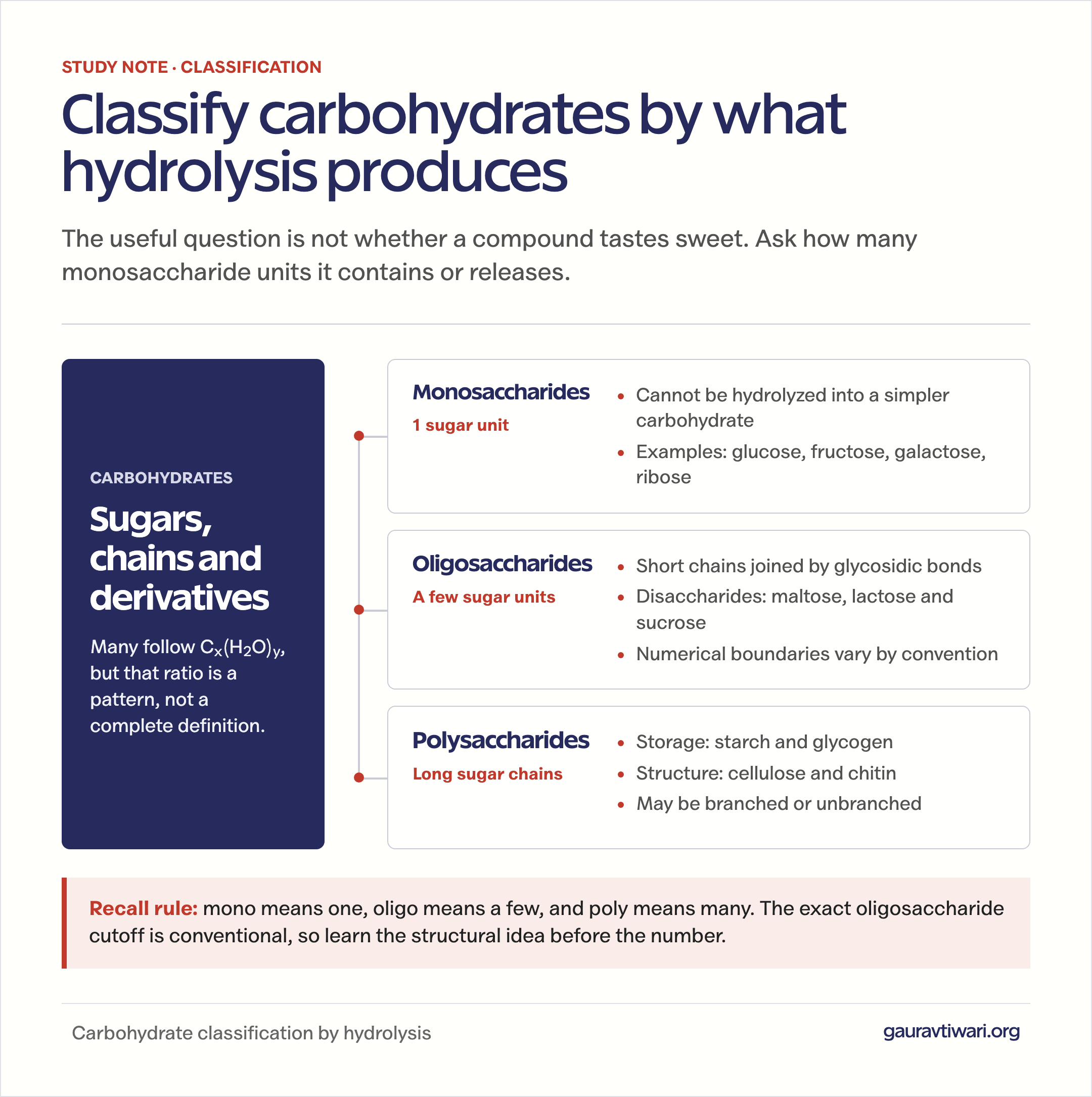
Carbohydrates are commonly classified by the number of monosaccharide units they contain or yield on hydrolysis. Taste is unreliable: some sugars are sweet, while major polysaccharides such as starch and cellulose are not.
| Class | Structural idea | Hydrolysis | Examples |
|---|---|---|---|
| Monosaccharide | One sugar unit | Cannot be hydrolyzed into a simpler carbohydrate | Glucose, fructose, galactose, ribose |
| Oligosaccharide | A short chain of sugar units | Yields a few monosaccharides | Maltose, lactose, sucrose, raffinose |
| Polysaccharide | A long chain, branched or unbranched | Yields many monosaccharides or derivatives | Starch, glycogen, cellulose, chitin |
The numerical boundary for an oligosaccharide varies across textbooks. Some use 2-10 units; others reserve the word for 3-10 and list disaccharides separately. The stable idea is a short, defined chain between a single monosaccharide and a large polysaccharide.
Monosaccharides: the Units Carbohydrates Are Built from
In its open-chain form, a typical monosaccharide has one carbonyl group and several hydroxyl groups. Two features classify it: the position of the carbonyl group and the number of carbon atoms.
- An aldose has an aldehyde carbonyl at the end of its open chain.
- A ketose has a ketone carbonyl within the chain.
- A triose, pentose, or hexose has three, five, or six carbon atoms.
- The two labels combine. Glucose is an aldohexose; fructose is a ketohexose.
| Carbon atoms | Class name | Aldose example | Ketose example |
|---|---|---|---|
| 3 | Triose | Glyceraldehyde | Dihydroxyacetone |
| 4 | Tetrose | Erythrose | Erythrulose |
| 5 | Pentose | Ribose | Ribulose |
| 6 | Hexose | Glucose, galactose | Fructose |
| 7 | Heptose | Glucoheptose | Sedoheptulose |
Important monosaccharides
The most useful examples are the ones that reappear in larger biomolecules:
- Glucose: an aldohexose and a central cellular fuel. It is the monomer of starch, glycogen, and cellulose.
- Fructose: a ketohexose found free in many fruits and joined to glucose in sucrose.
- Galactose: an aldohexose that differs from glucose at C4. It joins glucose to form lactose.
- Ribose: an aldopentose in RNA, ATP, and several coenzymes.
- 2-deoxyribose: a ribose derivative in DNA. It lacks the hydroxyl group at C2.
Ribose and deoxyribose connect carbohydrate chemistry to nucleic acids. Amino sugars, sugar acids, and sugar alcohols show why the carbohydrate family is broader than ordinary dietary sugar.
D/L configuration is not optical rotation
In a Fischer projection, D or L is assigned from the stereocenter farthest from the carbonyl group. If its hydroxyl group points right, the sugar belongs to the D series; if it points left, it belongs to the L series.
This label does not predict whether the compound rotates plane-polarized light clockwise (+) or counterclockwise (-). Optical rotation must be measured. D-fructose, for example, is levorotatory under standard conditions.
Ring formation, anomers, and mutarotation
Five- and six-carbon monosaccharides exist mainly as rings in aqueous solution. In glucose, the C5 hydroxyl reacts with the C1 aldehyde to form a six-membered cyclic hemiacetal. The former carbonyl carbon, C1, becomes the anomeric carbon.
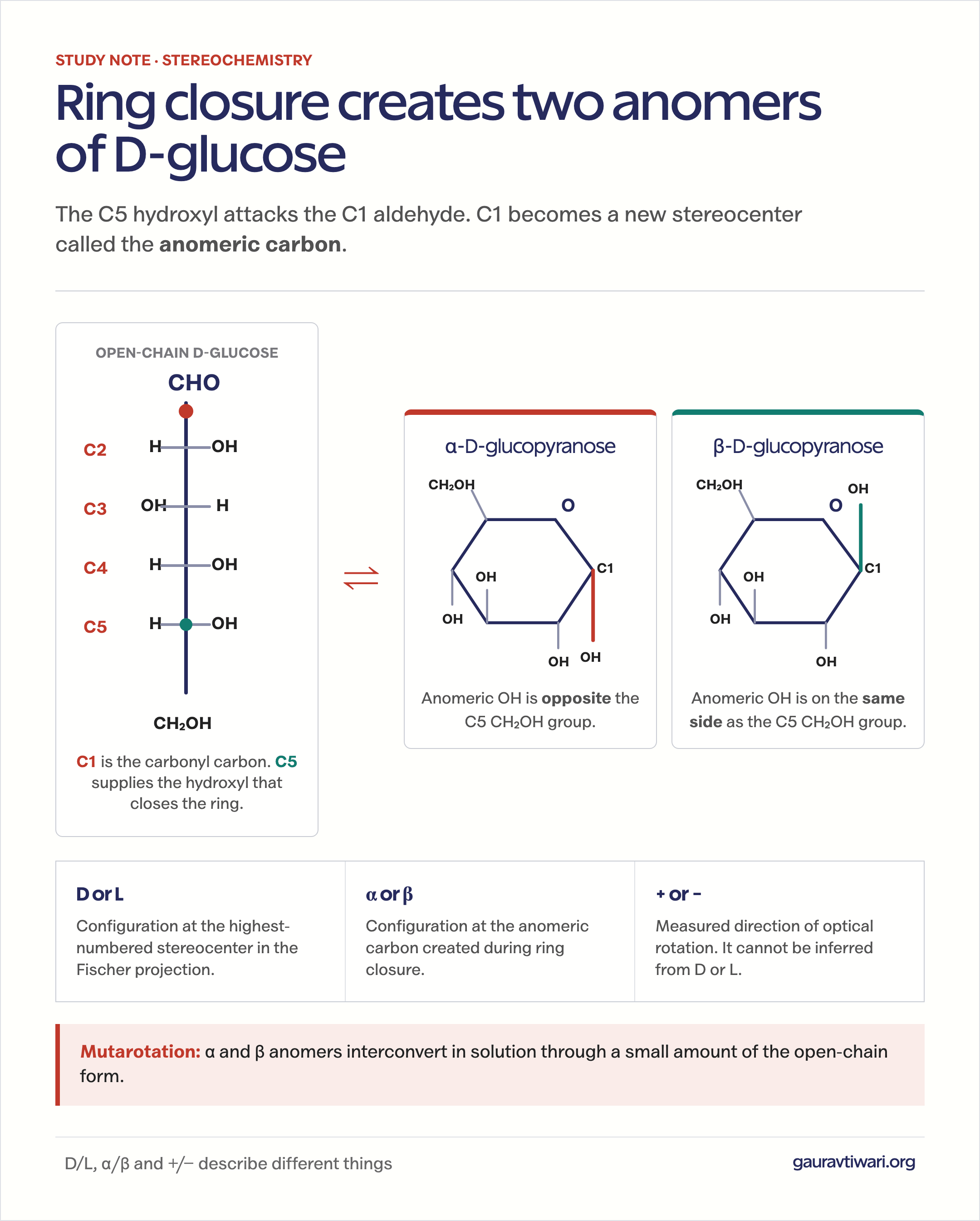
- Alpha and beta anomers differ only at the anomeric carbon.
- For a D-sugar in a Haworth projection, the alpha anomer has its anomeric OH opposite the CH2OH group; the beta anomer has them on the same side.
- Mutarotation is the change in optical rotation as alpha and beta forms interconvert through the open-chain form in solution.
- In fructose, the carbonyl carbon is C2, so C2 becomes the anomeric carbon. Fructose can form both five-membered and six-membered rings.
Glycosidic Bonds and Oligosaccharides
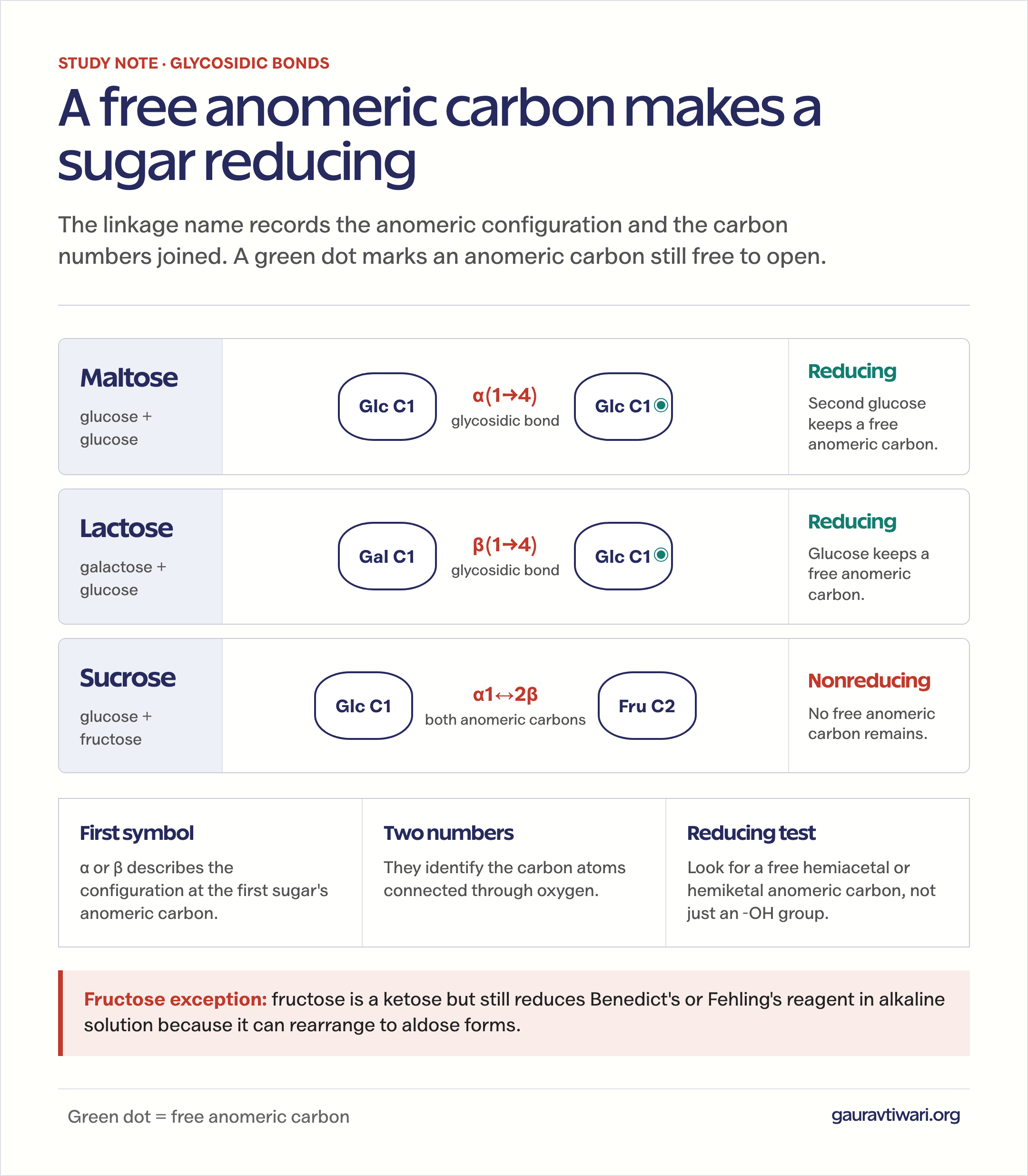
A glycosidic bond joins the anomeric carbon of a sugar to an oxygen or another atom in a second molecule. When two monosaccharides form an O-glycosidic bond, the shorthand states both the anomeric configuration and the carbon positions involved.
- α(1→4) means the first sugar contributes its alpha-configured C1, which joins C4 of the second sugar.
- β(1→4) uses the beta configuration at the first sugar’s C1.
- α(1→6) commonly marks a branch point because C1 of one glucose joins C6 of another.
- Bond formation is a condensation reaction; hydrolysis adds water to split the bond.
| Disaccharide | Components | Linkage | Reducing? | Common context |
|---|---|---|---|---|
| Maltose | Glucose + glucose | α(1→4) | Yes | Produced during starch digestion |
| Lactose | Galactose + glucose | β(1→4) | Yes | Milk sugar |
| Sucrose | Glucose + fructose | α(1↔2)β | No | Table sugar and plant transport sugar |
Reducing and nonreducing sugars
A reducing sugar has a free anomeric carbon that can return to a reactive open-chain form. This structural test is more reliable than memorizing a list.
- All common monosaccharides are reducing sugars under Benedict’s or Fehling’s alkaline test conditions.
- Maltose and lactose are reducing because one anomeric carbon remains free.
- Sucrose is nonreducing because its glycosidic bond uses the anomeric carbon of both glucose and fructose.
- Fructose is a ketose, but it can rearrange to aldose forms in alkaline solution and therefore reduces these reagents.
Benedict’s and Fehling’s tests detect reducing substances. They are not specific tests for glucose and should not be treated as modern clinical diagnostic methods.
Polysaccharides: Storage Versus Structure
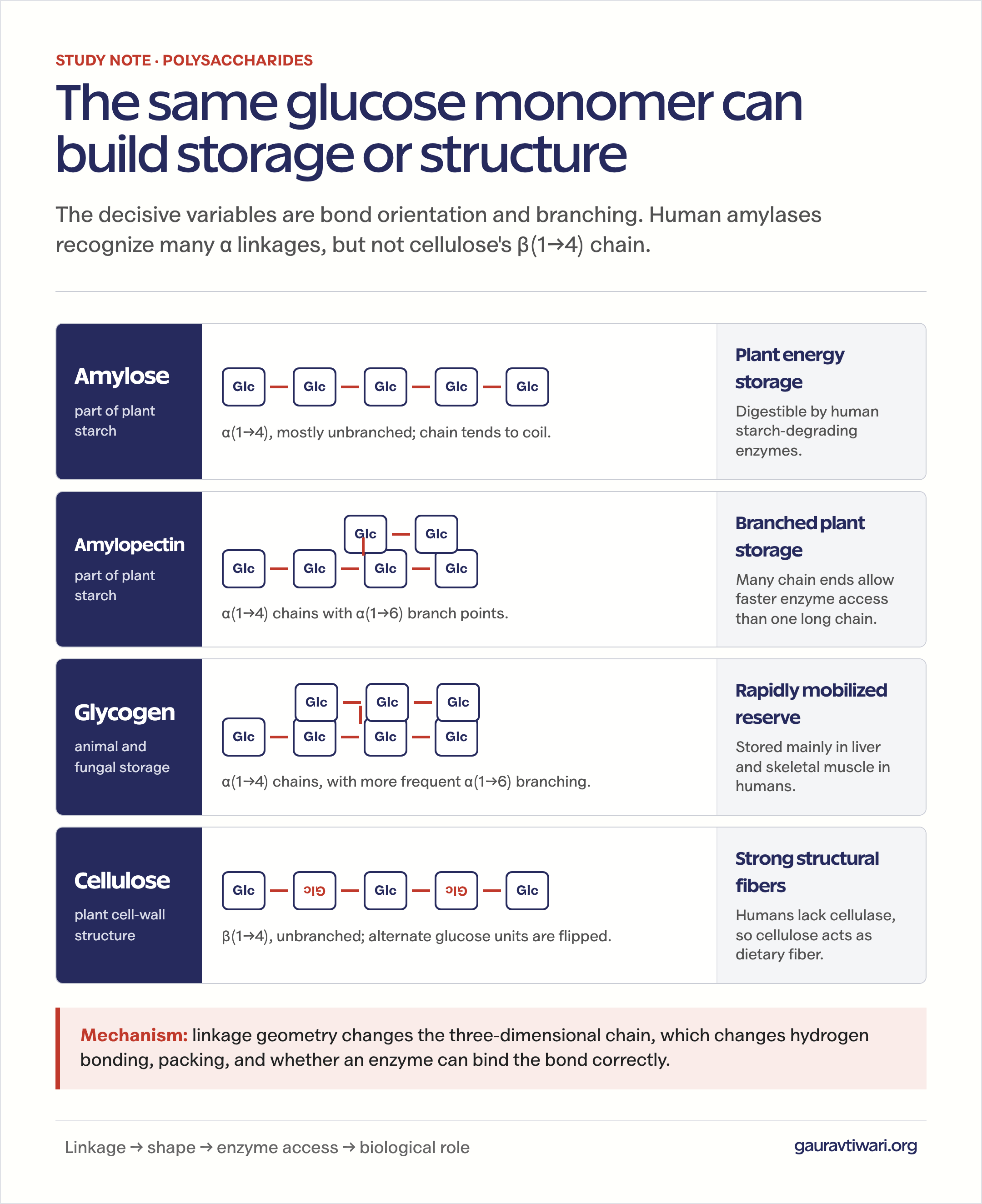
Polysaccharides contain many monosaccharide residues linked into long chains. A homopolysaccharide uses one main monomer; a heteropolysaccharide uses two or more. Function depends on the linkage, branching pattern, and interactions between neighboring chains.
| Polysaccharide | Main building unit | Key linkage or pattern | Role | Human digestion |
|---|---|---|---|---|
| Amylose | Glucose | α(1→4), mostly unbranched | Part of plant starch | Digestible |
| Amylopectin | Glucose | α(1→4) with α(1→6) branches | Part of plant starch | Digestible |
| Glycogen | Glucose | α(1→4), frequently branched by α(1→6) | Animal and fungal glucose reserve | Digestible |
| Cellulose | Glucose | β(1→4), unbranched | Plant cell-wall structure | Not digested by human enzymes |
| Chitin | N-acetylglucosamine | β(1→4) | Arthropod exoskeletons and fungal cell walls | Not substantially digested |
| Inulin | Mostly fructose units | Usually β(2→1) fructan | Plant storage carbohydrate and dietary fiber | Not digested in the small intestine; can be fermented by gut microbes |
Why starch, glycogen, and cellulose differ
Starch and glycogen contain alpha-linked glucose. Their chains can coil or branch, and human starch-degrading enzymes can position these bonds in their active sites. Cellulose contains beta(1→4)-linked glucose. Alternate units are flipped, producing extended chains that hydrogen-bond into strong fibers. Humans lack cellulase, so cellulose passes through the small intestine as dietary fiber.
The difference is not the monomer. All three use glucose. The difference is how glucose units are connected and how the resulting chain interacts with enzymes and neighboring chains.
Carbohydrate Digestion and Absorption
Digestible carbohydrates must be reduced to monosaccharides before intestinal cells can absorb them. Starch digestion and disaccharide digestion use different enzyme steps:
- Mouth: salivary alpha-amylase begins hydrolyzing internal α(1→4) bonds in starch.
- Stomach: low pH greatly reduces salivary amylase activity.
- Small-intestinal lumen: pancreatic alpha-amylase produces maltose, maltotriose, and branched alpha-limit dextrins. It does not simply convert starch directly into glucose.
- Brush border: maltase-glucoamylase, sucrase-isomaltase, and lactase complete digestion to glucose, galactose, and fructose.
- Absorption: glucose and galactose enter through SGLT1, fructose mainly through GLUT5, and the monosaccharides leave the enterocyte through GLUT2.
Absorbed glucose can enter cellular respiration to support ATP production or be stored as glycogen. Non-digestible carbohydrates continue to the colon, where some, including inulin, can be fermented by microbes into short-chain fatty acids.
Functions of Carbohydrates
Carbohydrates do far more than supply dietary energy. Across the major classes of biomolecules, they contribute to six recurring biological jobs:
- Immediate fuel: glucose is a central substrate for ATP-producing pathways.
- Energy storage: starch stores glucose in plants; glycogen stores it in animals and fungi.
- Structural support: cellulose strengthens plant cell walls, while chitin strengthens fungal walls and arthropod exoskeletons.
- Nucleic-acid structure: ribose forms part of RNA and ATP; deoxyribose forms part of DNA.
- Cell recognition: short oligosaccharides on glycoproteins and glycolipids act as molecular labels. ABO blood-group antigens are familiar examples.
- Extracellular protection and signaling: glycosaminoglycans help organize hydrated extracellular matrices and cell surfaces.
- Dietary fiber: non-digestible carbohydrates add bulk or feed gut microbes, depending on their structure and fermentability.
These functions make carbohydrates central to cell structure and function, not merely a synonym for bread, rice, or sugar.
Fast Revision: Distinctions That Prevent Mistakes
Most carbohydrate errors come from mixing labels that answer different questions. Keep these pairs separate:
| Do not confuse | Correct distinction |
|---|---|
| D/L and +/− | D/L describes relative configuration; +/− is measured optical rotation. |
| Aldose/ketose and alpha/beta | Aldose/ketose locates the open-chain carbonyl; alpha/beta describes the anomeric carbon in a ring or glycosidic bond. |
| Sweetness and carbohydrate class | Classification depends on structure and hydrolysis, not taste. |
| Free -OH and reducing behavior | A reducing sugar needs a free anomeric carbon that can access a reactive open-chain form. |
| Starch and cellulose monomers | Both use glucose; alpha versus beta linkage geometry creates different shapes and digestibility. |
| Amylase and complete glucose release | Amylase produces smaller carbohydrates; brush-border enzymes complete digestion to monosaccharides. |
Test Your Recall
Try to answer each question before opening it. Retrieval is more useful than rereading the same paragraph.
Why does the formula Cx(H2O)y not define a carbohydrate?
Some carbohydrates, including deoxyribose, do not fit the ratio, while some non-carbohydrates do. Functional groups, stereochemistry, and chemical relationships define the family more reliably.
How can you decide whether a disaccharide is reducing?
Look for a free anomeric carbon. If one sugar unit retains a hemiacetal or hemiketal anomeric carbon that can open, the disaccharide is reducing. Sucrose is nonreducing because both anomeric carbons form the glycosidic bond.
What is the difference between D/L and alpha/beta?
D/L describes configuration relative to glyceraldehyde at the stereocenter farthest from the carbonyl group. Alpha/beta describes configuration at the anomeric carbon created during ring formation.
Why can humans digest starch but not cellulose?
Starch contains alpha-linked glucose that human amylases can hydrolyze. Cellulose contains beta(1-to-4)-linked glucose and humans lack cellulase. The linkage changes chain shape and enzyme recognition.
Does amylase convert starch directly into glucose?
No. Alpha-amylase first produces smaller carbohydrates such as maltose, maltotriose, and alpha-limit dextrins. Brush-border enzymes then release absorbable monosaccharides.
Further Reading
For deeper chemical definitions and mechanisms, use the IUPAC Gold Book carbohydrate entry, OpenStax Biology 2e on carbohydrates, OpenStax Organic Chemistry on disaccharides, and the NCBI overview of nutrient absorption.
Starch and Cellulose
Starch and cellulose both contain glucose units. Their different glycosidic arrangements produce different structures and biological roles. Human digestive enzymes can hydrolyze the relevant starch linkages but do not directly digest cellulose with cellulase.
The reducing-sugar question also depends on structure. A free anomeric carbon can open into a reactive carbonyl form; tying the relevant anomeric centers into a glycosidic linkage can remove that behavior. Counting carbon, hydrogen and oxygen alone cannot decide whether a sugar is reducing.
The points to check in this example are:
- Monosaccharide identity and linkage arrangement both matter.
- A reducing end is a structural feature, not a synonym for sweetness.
- Storage and structural polysaccharides can use closely related building blocks.
Check Your Understanding
Try the questions before reading the answers.
Question 1. Does sharing glucose units make starch and cellulose nutritionally equivalent for humans?
Answer. No. Their linkages and digestive handling differ.
Question 2. Is every disaccharide nonreducing?
Answer. No. The anomeric-carbon arrangement determines the answer.
Browse more in Biology.