by
by
Supremum and infimum are two of the most fundamental concepts you will encounter in real analysis. They generalize the familiar ideas of maximum and minimum to situations where a set may not actually contain its largest or smallest element. Without these concepts, you cannot state the Completeness Axiom, and without the Completeness Axiom, most of the theorems in analysis (convergence of sequences, existence of limits, the Intermediate Value Theorem) simply fall apart. If you want to understand why the real numbers behave differently from the rationals, this is where it starts.
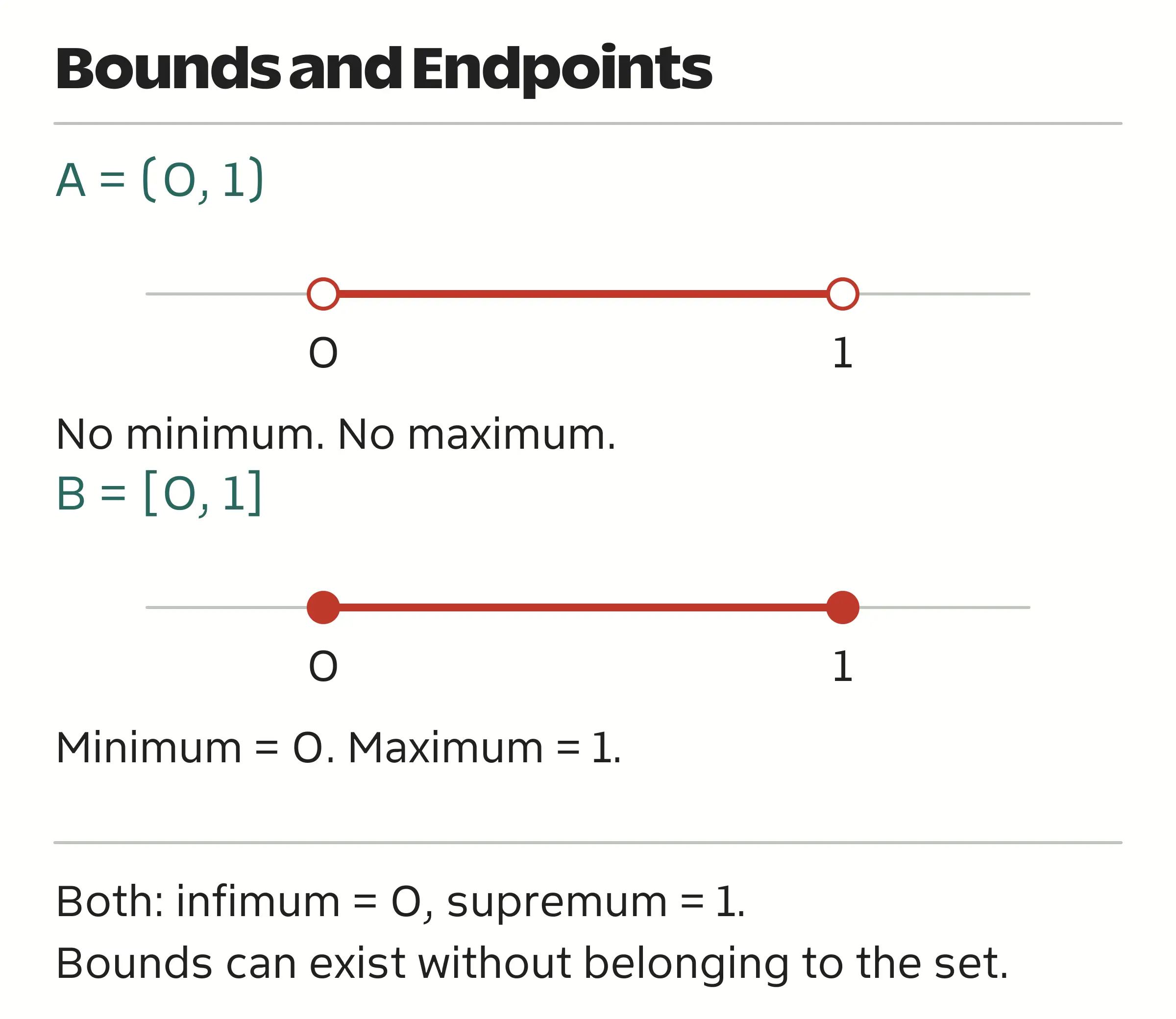
A bound can exist even when the set never reaches it. The membership requirement is what separates a maximum from a supremum.
Upper and Lower Bounds
Before we can define supremum and infimum, we need to understand what it means for a set to be bounded. The idea is straightforward: you are looking for numbers that “fence in” a set from above or below.
Upper Bound
A set \( A \subset \mathbb{R} \) of real numbers is bounded from above if there exists a real number \( a \in \mathbb{R} \), called an upper bound of \( A \), such that \( x \le a \) for every \( x \in A \).
Notice that an upper bound does not need to belong to the set \( A \) itself. It just needs to be greater than or equal to every element of \( A \). Also notice that upper bounds are never unique. If \( a \) is an upper bound of \( A \), then so is \( a + 1 \), \( a + 100 \), and every real number greater than \( a \).
Example: Consider the set \( A = \{1, 2, 3, 4, 5\} \). The number 5 is an upper bound, and so is 6, 10, or 1000. The number 4 is not an upper bound because \( 5 \in A \) and \( 5 > 4 \).
Lower Bound
Similarly, \( A \) is bounded from below if there exists \( b \in \mathbb{R} \), called a lower bound of \( A \), such that \( x \ge b \) for every \( x \in A \).
Again, the lower bound does not need to be in the set. And just like upper bounds, lower bounds are not unique. If \( b \) is a lower bound, then so is \( b – 1 \), \( b – 50 \), and every real number less than \( b \).
Example: For the open interval \( A = (0, 1) \), the number 0 is a lower bound even though \( 0 \notin A \). So is \( -5 \) or \( -100 \). Any non-positive real number works as a lower bound for this set.
Supremum (Least Upper Bound)
Among all the upper bounds of a set, there is a natural question: is there a smallest one? That smallest upper bound, if it exists, is called the supremum.
Formal Definition
Let \( A \subset \mathbb{R} \) be a non-empty set that is bounded above. A real number \( s \) is called the supremum (or least upper bound) of \( A \), written \( s = \sup(A) \), if:
- \( s \) is an upper bound of \( A \): for every \( x \in A \), we have \( x \le s \).
- \( s \) is the least such upper bound: if \( t \) is any upper bound of \( A \), then \( s \le t \).
An equivalent and extremely useful characterization of the supremum is this: \( s = \sup(A) \) if and only if \( s \) is an upper bound of \( A \) and for every \( \epsilon > 0 \), there exists some \( x \in A \) such that \( x > s – \epsilon \). In plain language, you can always find elements of \( A \) arbitrarily close to \( s \) from below.
The epsilon characterization is the workhorse of supremum proofs. Whenever you need to show \( s = \sup(A) \), don’t just say “it’s the least upper bound.” Instead, prove that for every \( \epsilon > 0 \), you can produce an element of \( A \) in the interval \( (s – \epsilon, s] \). This two-step technique works in virtually every real analysis proof involving the supremum.
This \( \epsilon \)-characterization is the version you will use most often in proofs. It captures the idea that the supremum is “tight” against the set: you cannot push it down, not even by the tiniest amount, without some element of the set poking above.
Example: Consider \( A = (0, 1) \). Every number greater than or equal to 1 is an upper bound. The smallest such number is 1 itself. So \( \sup(A) = 1 \), even though \( 1 \notin A \). For any \( \epsilon > 0 \), the number \( 1 – \epsilon/2 \) belongs to \( A \) (assuming \( \epsilon < 2 \)) and satisfies \( 1 – \epsilon/2 > 1 – \epsilon \).
Infimum (Greatest Lower Bound)
The infimum is the mirror image of the supremum. Among all the lower bounds of a set, we ask: is there a greatest one?
Formal Definition
Let \( A \subset \mathbb{R} \) be a non-empty set that is bounded below. A real number \( l \) is called the infimum (or greatest lower bound) of \( A \), written \( l = \inf(A) \), if:
- \( l \) is a lower bound of \( A \): for every \( x \in A \), we have \( x \ge l \).
- \( l \) is the greatest such lower bound: if \( t \) is any lower bound of \( A \), then \( l \ge t \).
The \( \epsilon \)-characterization for the infimum is: \( l = \inf(A) \) if and only if \( l \) is a lower bound of \( A \) and for every \( \epsilon > 0 \), there exists some \( x \in A \) such that \( x < l + \epsilon \). You can always find elements of \( A \) arbitrarily close to \( l \) from above.
Example: For the set \( A = (0, 1) \), the infimum is 0. The number 0 is a lower bound (every element of \( A \) is positive), and no larger number can serve as a lower bound (for any \( \epsilon > 0 \), the element \( x=\min(\epsilon/2,1/2) \in A \) satisfies \( x < \epsilon \)). Note that \( 0 \notin A \), so the set has no minimum, but it still has an infimum.
The supremum of a set is its least upper bound, and the infimum is its greatest lower bound. Both are unique when they exist, and neither needs to belong to the set.
Bounded Sets
A set \( A \subset \mathbb{R} \) is said to be bounded if it is both bounded above and bounded below. When a set is bounded, there exist real numbers \( m \) and \( M \) such that \( m \le x \le M \) for all \( x \in A \). In this case, both \( \sup(A) \) and \( \inf(A) \) exist, and we have:
$$ \inf(A) \le x \le \sup(A) \quad \text{for all } x \in A $$
A set that is bounded above but not below (like \( (-\infty, 5] \)) has a supremum but no infimum in \( \mathbb{R} \). We sometimes write \( \inf(A) = -\infty \) in such cases, though this is a notational convention rather than claiming \( -\infty \) is a real number.
Similarly, a set bounded below but not above (like \( [3, \infty) \)) has an infimum but no finite supremum. We write \( \sup(A) = +\infty \).
The empty set is a special case. By convention, \( \sup(\emptyset) = -\infty \) and \( \inf(\emptyset) = +\infty \), since every real number is vacuously an upper bound and a lower bound of the empty set.
Worked Examples
Let us work through several concrete examples. Finding the supremum and infimum of specific sets is one of the best ways to build intuition for these definitions. If you’re building your foundation in this area, a solid real analysis textbook will give you dozens more practice problems like these.
Example 1: The Half-Open Interval (0, 1]
Let \( A = (0, 1] \).
Finding \( \sup(A) \): The number 1 belongs to \( A \), and every element of \( A \) satisfies \( x \le 1 \). So 1 is an upper bound. Is there a smaller upper bound? No, because \( 1 \in A \), and any number less than 1 would fail to be an upper bound. Therefore \( \sup(A) = 1 \). Since 1 actually belongs to \( A \), this set also has a maximum: \( \max(A) = 1 \).
Finding \( \inf(A) \): Every element of \( A \) satisfies \( x > 0 \), so 0 is a lower bound. Is there a larger lower bound? Suppose \( b > 0 \). Then \( \min(b/2, 1) \in A \) (since \( b/2 > 0 \)) and \( b/2 < b \), so \( b \) is not a lower bound. Therefore \( \inf(A) = 0 \). Since \( 0 \notin A \), this set has no minimum.
Example 2: The Set {1/n : n in N}
Let \( A = \{1/n : n \in \mathbb{N}\} = \{1, 1/2, 1/3, 1/4, \ldots\} \).
Finding \( \sup(A) \): The largest element is \( 1/1 = 1 \), and every element satisfies \( 1/n \le 1 \). So 1 is an upper bound, and since \( 1 \in A \), no smaller upper bound exists. Therefore \( \sup(A) = 1 = \max(A) \).
Finding \( \inf(A) \): Every element is positive, so 0 is a lower bound. Is 0 the greatest lower bound? Yes: for any \( \epsilon > 0 \), by the Archimedean Property, there exists \( n \in \mathbb{N} \) with \( 1/n < \epsilon \), which means \( 1/n \in A \) and \( 1/n < 0 + \epsilon \). Therefore \( \inf(A) = 0 \). Since \( 0 \notin A \) (there is no natural number \( n \) with \( 1/n = 0 \)), this set has no minimum.
Example 3: The Closed Interval [-3, 5]
Let \( A = [-3, 5] \).
This is the simplest case. Both endpoints belong to the set. Every \( x \in A \) satisfies \( -3 \le x \le 5 \). The number 5 is the least upper bound, and \( -3 \) is the greatest lower bound. So:
$$ \sup(A) = 5 = \max(A), \quad \inf(A) = -3 = \min(A) $$
When a set is a closed and bounded interval, the supremum equals the right endpoint and the infimum equals the left endpoint, and both are attained as maximum and minimum.
Example 4: The Set {x in R : x^2 < 2}
Let \( A = \{x \in \mathbb{R} : x^2 < 2\} = (-\sqrt{2}, \sqrt{2}) \).
Finding \( \sup(A) \): Since \( x^2 < 2 \) implies \( |x| < \sqrt{2} \), we have \( x < \sqrt{2} \) for all \( x \in A \). So \( \sqrt{2} \) is an upper bound. For any \( \epsilon > 0 \), the number \( \sqrt{2} – \epsilon/2 \) has square \( 2 – \epsilon\sqrt{2} + \epsilon^2/4 < 2 \) (for small enough \( \epsilon \)), so it belongs to \( A \). Therefore \( \sup(A) = \sqrt{2} \).
Finding \( \inf(A) \): By symmetry, \( \inf(A) = -\sqrt{2} \).
This example is historically important. In the rational numbers \( \mathbb{Q} \), the set \( \{x \in \mathbb{Q} : x^2 < 2\} \) has no supremum within \( \mathbb{Q} \), because \( \sqrt{2} \) is irrational. This failure is precisely what the Completeness Axiom fixes in \( \mathbb{R} \).
Important Properties
Here are the key properties of supremum and infimum that you should know for any real analysis course.
Uniqueness
If the supremum of a set exists, it is unique. The proof is a one-liner: suppose \( s_1 \) and \( s_2 \) are both suprema of \( A \). Since \( s_1 \) is a least upper bound and \( s_2 \) is an upper bound, \( s_1 \le s_2 \). By the same reasoning with roles reversed, \( s_2 \le s_1 \). Therefore \( s_1 = s_2 \). The same argument applies to the infimum.
Relationship to Maximum and Minimum
If \( A \) has a maximum (a largest element that belongs to \( A \)), then \( \sup(A) = \max(A) \). But the converse is false: the supremum can exist even when the maximum does not. The set \( (0, 1) \) has \( \sup = 1 \) but no maximum.
Similarly, if \( A \) has a minimum, then \( \inf(A) = \min(A) \), but the infimum can exist without a minimum. In short, every maximum is a supremum, but not every supremum is a maximum. This distinction is the entire reason the supremum concept exists.
The Completeness Axiom
The Completeness Axiom (also called the Least Upper Bound Property) states: every non-empty subset of \( \mathbb{R} \) that is bounded above has a supremum in \( \mathbb{R} \). This is not a theorem you prove; it is an axiom that defines the real numbers and distinguishes them from the rationals.
A consequence of the Completeness Axiom is that every non-empty subset of \( \mathbb{R} \) that is bounded below has an infimum in \( \mathbb{R} \). You can prove this by considering the set \( -A = \{-x : x \in A\} \) and applying the axiom to \( -A \).
Almost every major theorem in real analysis depends on this axiom, either directly or indirectly. The Monotone Convergence Theorem, the Bolzano-Weierstrass Theorem, the Nested Intervals Theorem, and the existence of limits for Cauchy sequences all trace back to the Completeness Axiom. This is why understanding real sequences and their convergence behavior requires a solid grasp of the supremum and infimum first.
The Completeness Axiom is the single property that separates \( \mathbb{R} \) from \( \mathbb{Q} \). The rationals satisfy every other ordered field axiom, but they fail the Least Upper Bound Property. That one gap is why calculus doesn’t work over \( \mathbb{Q} \), and it’s why supremum and infimum aren’t just abstract definitions. They’re the foundation that makes limits, continuity, and integration possible.
Supremum and Infimum of Subsets
If \( B \subset A \) and both sets are non-empty and bounded, then:
$$ \inf(A) \le \inf(B) \le \sup(B) \le \sup(A) $$
This makes intuitive sense: a smaller set is “squeezed” within the bounds of the larger set, so its supremum cannot exceed that of the larger set, and its infimum cannot be smaller.
Common Mistakes to Avoid
Students frequently make the following errors when working with supremum and infimum. Being aware of them will save you marks on exams and confusion in proofs.
Confusing Supremum with Maximum
The supremum does not need to belong to the set. If someone asks you for \( \sup(0, 1) \), the answer is 1, even though 1 is not in the open interval \( (0, 1) \). The maximum of a set, by definition, must belong to the set. The set \( (0, 1) \) has a supremum but no maximum.
Assuming “Bounded” Means the Set is Finite
The set \( \{1/n : n \in \mathbb{N}\} \) is infinite but bounded (it sits inside \( [0, 1] \)). Boundedness is about the values of the elements, not the number of elements.
Forgetting the Epsilon Characterization
Many students can state the definition of supremum as “least upper bound” but struggle with proofs because they don’t use the \( \epsilon \)-characterization. In practice, showing \( s = \sup(A) \) almost always comes down to two steps: (1) show \( s \) is an upper bound, and (2) show that for every \( \epsilon > 0 \), there exists \( x \in A \) with \( x > s – \epsilon \). Master this technique early.
Applying Sup to Unbounded Sets
The supremum only exists (as a real number) for sets that are bounded above. The set \( \mathbb{N} = \{1, 2, 3, \ldots\} \) has no supremum in \( \mathbb{R} \). Writing \( \sup(\mathbb{N}) = \infty \) is a notational shorthand, not a claim that the supremum is a real number.
Mixing Up Inf and Sup in Proofs
The infimum is the greatest lower bound, and the supremum is the least upper bound. Students sometimes write the inequalities backwards. A helpful mnemonic: the supremum is “small for an upper bound” (least), and the infimum is “big for a lower bound” (greatest). They are extreme in opposite directions from what the words “upper” and “lower” might suggest.
Further Reading
Supremum and infimum connect directly to nearly every topic you’ll encounter next in real analysis. The behavior of real sequences depends on these concepts, since the limit of a bounded monotone sequence equals its supremum or infimum. Understanding function notation and rules becomes important when you start working with suprema of function values over intervals, which is how Riemann integration gets defined.
For a deeper dive into measure-theoretic extensions where supremum and infimum appear in even more abstract settings, see our guide to the best measure theory books.
The related OpenStax mathematics textbooks provide additional explanations and exercises for the mathematical definitions used here.
Checking an Epsilon Argument
For \(A=(0,1)\), choose \(x=1-\min(\varepsilon/2,1/2)\) for any \(\varepsilon>0\). Then \(0<x<1\) and \(x>1-\varepsilon\). Since 1 is an upper bound and members of A can exceed every smaller candidate, the supremum is 1.
The minimum handles large epsilon as well as small epsilon. Choosing \(1-\varepsilon/2\) alone gives -0.5 when epsilon is 3, outside A. For the infimum, the mirrored choice \(x=\min(\varepsilon/2,1/2)\) belongs to A below epsilon. A universal quantifier must be satisfied over its whole stated domain.
The points to check in this example are:
- An upper bound must dominate every member.
- Showing leastness requires ruling out every smaller bound.
- A maximum also has to belong to the set.
Check Your Understanding
Try the questions before reading the answers.
Question 1. Find the bounds of \(\{n/(n+1):n\ge1\}\).
Answer. Infimum 1/2 is attained; supremum 1 is not.
Question 2. Can a bounded subset of \(\mathbb Q\) lack a rational supremum?
Answer. Yes. Rational numbers with square less than 2 supply an example.
Practice Questions
Work each question before reading its solution. The set runs from direct recall and substitution to the applied questions that exams actually use to separate grades. The downloadable PDF includes these questions and their solutions.
Question 1. Define supremum and infimum, and contrast them with maximum and minimum.
Solution. The supremum is the least upper bound: the smallest number that is \(\geq\) every element of the set. The infimum is the greatest lower bound. A maximum must belong to the set; a supremum need not. Every maximum is a supremum, but \((0,1)\) has supremum 1 with no maximum at all.
Question 2. Find \(\sup\) and \(\inf\) of the open interval \((0, 1)\), and state whether each is attained.
Solution. \(\sup = 1\), \(\inf = 0\), neither attained: the interval approaches both endpoints without containing them. Any candidate smaller than 1 is beaten by a point of the set closer to 1, so nothing smaller can be an upper bound. That argument, always available, is what “least upper bound” means in practice.
Question 3. Find \(\sup\) and \(\inf\) of \(\left\{\frac{1}{n} : n = 1, 2, 3, \ldots\right\}\).
Solution. The set is \(1, \frac{1}{2}, \frac{1}{3}, \ldots\). \(\sup = 1\), attained at \(n = 1\), so it is also the maximum. \(\inf = 0\): the terms sink toward 0 but never reach it, and no positive number can be a lower bound since \(\frac{1}{n}\) eventually dives below it. No minimum exists.
Question 4. State the completeness axiom, and exhibit the failure that separates \(\mathbb{Q}\) from \(\mathbb{R}\).
Solution. Every nonempty set of reals bounded above has a supremum in \(\mathbb{R}\). In the rationals this fails: \(\{q \in \mathbb{Q} : q^2 < 2\}\) is bounded above but its natural supremum, \(\sqrt{2}\), is missing from \(\mathbb{Q}\). Completeness is precisely the property that the real line has no holes, and all of calculus stands on it.
Question 5. Find \(\sup\) and \(\inf\) of \(\left\{\frac{n}{n+1} : n = 1, 2, 3, \ldots\right\}\).
Solution. The terms \(\frac{1}{2}, \frac{2}{3}, \frac{3}{4}, \ldots\) increase toward 1. \(\inf = \frac{1}{2}\), attained (a minimum). \(\sup = 1\), not attained: \(\frac{n}{n+1} < 1\) always, yet any bound below 1 fails against large \(n\). Increasing sequences hand their supremum to the limit.
Question 6. Prove that a set can have at most 1 supremum.
Solution. Suppose \(s\) and \(t\) are both suprema. Each is an upper bound, and each is \(\leq\) every upper bound, so \(s \leq t\) and \(t \leq s\), forcing \(s = t\). Uniqueness is why “the” supremum is legitimate grammar.
Question 7. Give the epsilon characterization of \(s = \sup A\) and use it on \(A = (0, 1)\) with \(s = 1\).
Solution. \(s\) is an upper bound, and for every \(\varepsilon > 0\) some element of \(A\) exceeds \(s – \varepsilon\). For \((0,1)\), 1 is an upper bound. For any \(\varepsilon>0\), choose \(x=1-\min(\varepsilon/2,1/2)\). Then \(0<x<1\) and \(x>1-\varepsilon\). The characterization turns “least” into something checkable.
Question 8. Find \(\sup\) and \(\inf\) of \(\left\{(-1)^n\left(1 – \frac{1}{n}\right) : n \geq 1\right\}\).
Solution. The terms: \(0, \frac{1}{2}, -\frac{2}{3}, \frac{3}{4}, -\frac{4}{5}, \ldots\). Even terms climb toward 1, odd terms sink toward \(-1\); neither limit is reached. \(\sup = 1\), \(\inf = -1\), both unattained. Oscillating sets ask for both bounds at once, and the two subsequences answer separately.
Question 9. For nonempty sets \(A \subseteq B\) (both bounded), how do their suprema and infima compare?
Solution. \(\sup A \leq \sup B\) and \(\inf A \geq \inf B\): a subset cannot spread wider than its parent. Proof in one line: every upper bound of \(B\) also bounds \(A\), so the least bound for \(A\) sits no higher than the least for \(B\). Monotonicity of sup and inf under inclusion is a workhorse lemma.
Question 10. Why does the definition of the Riemann integral need infima and suprema rather than minima and maxima?
Solution. Upper sums take, on each subinterval, the supremum of \(f\); lower sums the infimum. A bounded function need not attain extreme values on a subinterval (a function with a jump, say), so maxima and minima may fail to exist while sup and inf always do, thanks to completeness. Analysis prefers sup and inf because they never abandon you.
FAQs
What is the difference between supremum and maximum?
The maximum of a set is the largest element that actually belongs to the set. The supremum is the least upper bound, which may or may not belong to the set. If a set has a maximum, then the supremum equals the maximum. But a set can have a supremum without having a maximum. For example, the open interval (0, 1) has sup = 1 but no maximum, because 1 is not in the set.
Can the supremum and infimum of a set be equal?
Yes, but only when the set contains exactly one element. If A = {c} for some real number c, then sup(A) = inf(A) = c. If a set has two or more distinct elements, the infimum is strictly less than the supremum.
Why does the set of rationals with x^2 < 2 have no supremum in Q?
The set S = {x in Q : x^2 < 2} is bounded above in Q (for example, by 2), but its least upper bound would be the square root of 2, which is irrational. Since the square root of 2 does not belong to Q, there is no rational number that serves as the least upper bound. This is the classic example showing that Q lacks the Completeness Property, and it is exactly why we need the real numbers.
How do you prove that a number is the supremum of a set?
You need to show two things. First, show the number s is an upper bound of the set A, meaning x is less than or equal to s for every x in A. Second, show that s is the smallest such bound using the epsilon characterization: for every epsilon greater than 0, there exists an element x in A such that x is greater than s minus epsilon. This two-step approach works in virtually every proof involving the supremum.
What happens if a set is not bounded above?
If a set is not bounded above, it has no supremum in the real numbers. We sometimes write sup(A) = positive infinity as a shorthand, but this means the supremum does not exist as a real number. The Completeness Axiom only guarantees the existence of a supremum for non-empty sets that are bounded above.
Is the Completeness Axiom the same as the Archimedean Property?
No, they are different, though related. The Completeness Axiom states that every non-empty set of real numbers bounded above has a least upper bound. The Archimedean Property states that for any real number x, there exists a natural number n greater than x. The Archimedean Property is actually a consequence of the Completeness Axiom, not the other way around. The Completeness Axiom is strictly stronger.
Browse more in Mathematics.