by
by
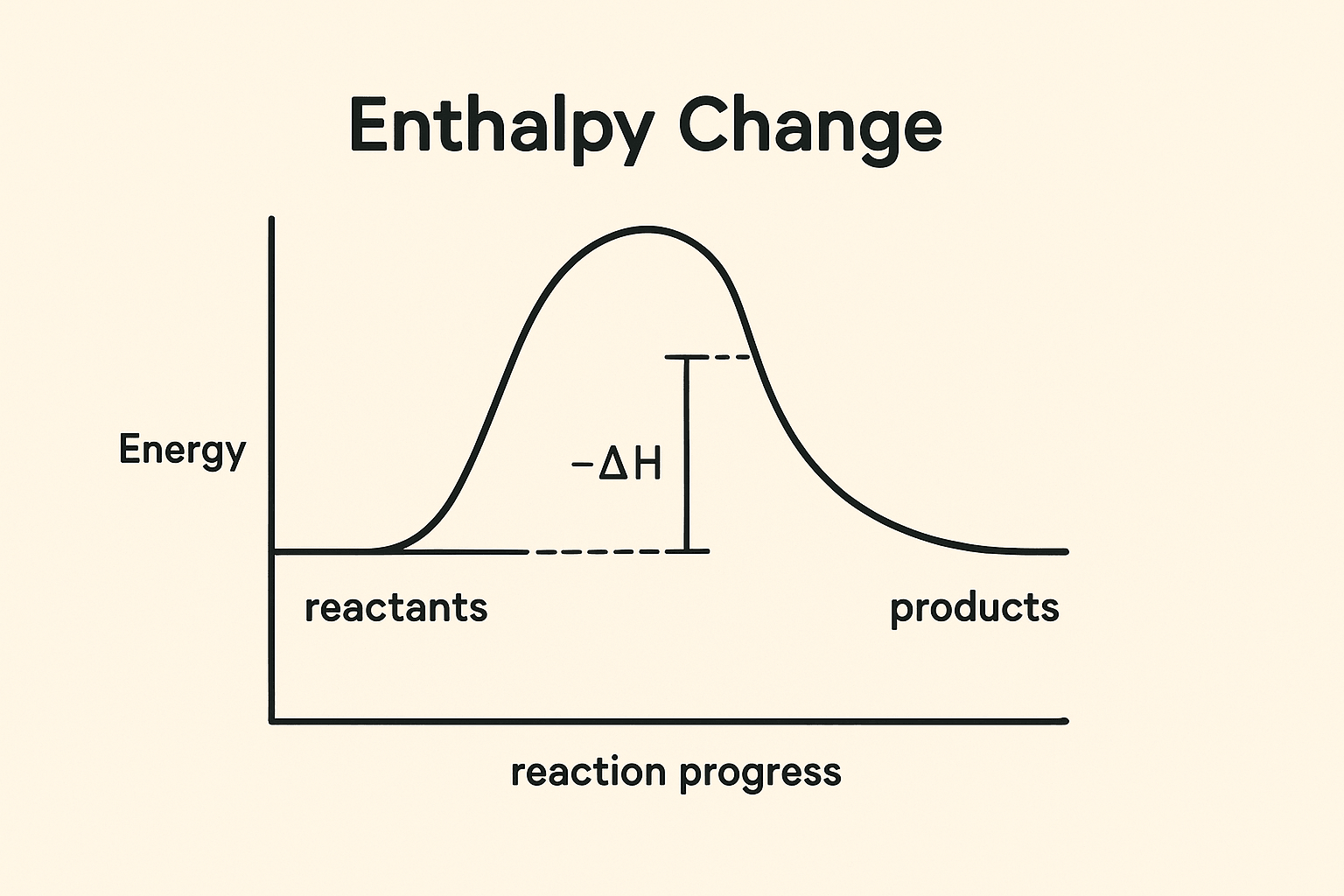
Enthalpy is a thermodynamic quantity that measures the total heat content of a system at constant pressure. The change in enthalpy (\( \Delta H \)) tells you how much heat a chemical reaction releases or absorbs. Exothermic reactions have \( \Delta H < 0 \) (release heat to the surroundings). Endothermic reactions have \( \Delta H > 0 \) (absorb heat). Combustion, neutralization, condensation are exothermic; melting, vaporization, photosynthesis are endothermic. Enthalpy is the central thermodynamic property tracked by almost every chemistry textbook because reactions at constant atmospheric pressure (which is most lab and industrial chemistry) make \( \Delta H \) directly equal to heat flow.
Enthalpy change equals heat transfer at constant pressure when the relevant work and process conditions make that relationship applicable. It is not a universal heat-content measure.
Definition
Enthalpy \( H \) is defined as:
$$ H = U + PV $$
where \( U \) is internal energy, \( P \) is pressure, and \( V \) is volume. The product \( PV \) is the ‘work’ contribution from the system pushing against its surroundings at constant pressure.
For a process at constant pressure, the change in enthalpy equals the heat exchanged:
$$ \Delta H = q_p $$
This is why enthalpy is so practical, laboratory and industrial chemistry mostly happens at constant atmospheric pressure, so measuring heat flow directly tells you \( \Delta H \).
Sign Convention
- \( \Delta H < 0 \): exothermic. Energy flows OUT of the system as heat. Products have lower energy than reactants. Examples: combustion, neutralization, freezing, condensation.
- \( \Delta H > 0 \): endothermic. Energy flows INTO the system as heat. Products have higher energy than reactants. Examples: melting, boiling, photosynthesis, dissolving ammonium nitrate in water.
Hess’s Law
Hess’s law: the total enthalpy change for a reaction is independent of the pathway taken. If a reaction can be broken into intermediate steps, \( \Delta H \) for the overall reaction equals the sum of \( \Delta H \) for each step. This is a direct consequence of enthalpy being a state function (it depends only on the initial and final states, not on the path).
Example. To find \( \Delta H \) for \( \text{C}(s) + \tfrac{1}{2}\text{O}_2 \to \text{CO}(g) \) (hard to measure directly), use known data for \( \text{C}(s) + \text{O}_2 \to \text{CO}_2 \) (\( \Delta H = -393.5 \) kJ) and \( \text{CO}(g) + \tfrac{1}{2}\text{O}_2 \to \text{CO}_2 \) (\( \Delta H = -283.0 \) kJ). The target reaction’s \( \Delta H = -393.5 – (-283.0) = -110.5 \) kJ. Hess’s law lets you compute enthalpies of reactions that can’t be measured directly.
Standard Enthalpies of Formation
The standard enthalpy of formation \( \Delta H_f^\circ \) is the enthalpy change when 1 mole of a compound forms from its constituent elements in their standard states (1 atm, 298 K). By convention, \( \Delta H_f^\circ \) of an element in its standard state is zero.
Tabulated values let you compute \( \Delta H \) for any reaction:
$$ \Delta H_{rxn} = \sum n_p \Delta H_f^\circ(\text{products}) – \sum n_r \Delta H_f^\circ(\text{reactants}) $$
where \( n_p \) and \( n_r \) are the stoichiometric coefficients. A table of \( \Delta H_f^\circ \) values is the chemistry student’s most useful single resource for enthalpy calculations.
Bond Enthalpies
Each chemical bond has a characteristic enthalpy required to break it (in the gas phase). Average bond enthalpies:
| Bond | Average enthalpy (kJ/mol) | Bond | Average enthalpy (kJ/mol) |
|---|---|---|---|
| H-H | 436 | C-C | 346 |
| O=O | 498 | C=C | 614 |
| N≡N | 945 | C-O | 358 |
| O-H | 463 | C-H | 414 |
Reaction enthalpy can be estimated as: \( \Delta H \approx \sum(\text{bonds broken}) – \sum(\text{bonds formed}) \). Bonds broken require energy input (positive contribution); bonds formed release energy (negative contribution). Less precise than tabulated formation enthalpies but useful for rough estimates and intuition.
Why Exothermic Doesn’t Mean Spontaneous
A common student misconception: that exothermic (\( \\Delta H < 0 \)) reactions are always spontaneous. They aren’t. Spontaneity depends on the Gibbs free energy change \( \\Delta G = \\Delta H – T\\Delta S \), which combines enthalpy and entropy. Even an endothermic reaction can be spontaneous if it produces enough entropy increase (e.g., dissolving ammonium nitrate cools the solution because \( \\Delta H > 0 \) but the entropy gain makes \( \\Delta G < 0 \)).
This is why you need both enthalpy and entropy to predict reaction direction. Enthalpy alone is incomplete.
Related study notes: Laws of Thermodynamics, Chemical Equilibrium, Le Chatelier’s Principle, Stoichiometry.
The OpenStax chemistry textbooks provide further explanations of the chemical principles used in this note.
A Reaction-Amount Calculation
A reaction has molar enthalpy change -50 kJ per mole of the reaction as written. If the reaction advances by 0.20 mol under the specified conditions, its enthalpy change is -10 kJ. The sign indicates energy release from the reacting system in the corresponding constant-pressure heat interpretation.
Reversing the reaction changes the sign; doubling every coefficient doubles the enthalpy change assigned to that written equation. Physical states also matter. A formation or combustion calculation should use thermochemical data for the same states and reference conditions.
The points to check in this example are:
- Enthalpy is H = U + PV.
- A negative reaction enthalpy is exothermic under the corresponding heat-transfer conditions.
- Hess’s law follows from enthalpy being a state function.
Check Your Understanding
Try the questions before reading the answers.
Question 1. What is the enthalpy change for the reverse written reaction?
Answer. +50 kJ per mole of reaction.
Question 2. Does a negative enthalpy change alone prove spontaneity?
Answer. No. Entropy and temperature also matter.
Practice Questions
Work each question before reading its solution. The set runs from direct recall and substitution to the applied questions that exams actually use to separate grades. The downloadable PDF includes these questions and their solutions.
Question 1. Define \(\Delta H\) and state what its sign tells you about a reaction.
Solution. \(\Delta H\) is the heat absorbed or released by a reaction at constant pressure. Negative \(\Delta H\): exothermic, heat flows out, products sit lower in energy than reactants. Positive \(\Delta H\): endothermic, heat flows in. The sign is defined from the system’s point of view, not yours.
Question 2. How much heat is needed to warm 200 g of water from 25°C to 75°C? (\(c = 4.18\) J/g°C)
Solution. \(q = mc\Delta T = 200 \times 4.18 \times 50 = 41{,}800\) J \(= 41.8\) kJ. Mass in grams, specific heat in J/g°C, temperature change in °C: the units cancel to joules.
Question 3. Given C + O\(_2\) \(\rightarrow\) CO\(_2\), \(\Delta H = -393.5\) kJ/mol, and CO + \(\frac{1}{2}\)O\(_2\) \(\rightarrow\) CO\(_2\), \(\Delta H = -283.0\) kJ/mol, find \(\Delta H\) for C + \(\frac{1}{2}\)O\(_2\) \(\rightarrow\) CO.
Solution. Subtract the second equation from the first: the CO\(_2\) cancels and CO flips to the product side. \(\Delta H = -393.5 – (-283.0) = -110.5\) kJ/mol. Hess’s law: enthalpy changes add like the equations themselves, because enthalpy is a state function.
Question 4. Using formation enthalpies (CH\(_4\): \(-74.8\), CO\(_2\): \(-393.5\), H\(_2\)O(l): \(-285.8\), all kJ/mol), find \(\Delta H\) for CH\(_4\) + 2O\(_2\) \(\rightarrow\) CO\(_2\) + 2H\(_2\)O(l).
Solution. \(\Delta H = \sum \Delta H_f(\text{products}) – \sum \Delta H_f(\text{reactants}) = [-393.5 + 2(-285.8)] – [-74.8 + 0] = -965.1 + 74.8 = -890.3\) kJ/mol. Elements in their standard states, like O\(_2\), contribute zero by definition.
Question 5. Estimate \(\Delta H\) for H\(_2\) + Cl\(_2\) \(\rightarrow\) 2HCl using bond enthalpies: H-H 436, Cl-Cl 242, H-Cl 431 kJ/mol.
Solution. Bonds broken: \(436 + 242 = 678\) kJ in. Bonds formed: \(2 \times 431 = 862\) kJ out. \(\Delta H \approx 678 – 862 = -184\) kJ/mol, exothermic. Break minus form: energy in to break, energy out on forming.
Question 6. Why is the enthalpy of vaporization of water (40.7 kJ/mol) so much larger than its enthalpy of fusion (6.0 kJ/mol)?
Solution. Melting only loosens the hydrogen-bond network enough for molecules to slide; most attractions survive into the liquid. Vaporization must separate every molecule from all its neighbors completely, breaking essentially the full set of intermolecular attractions. Nearly 7 times the energy for the full separation is the price.
Question 7. Burning 0.5 mol of a fuel releases 445 kJ. Find its molar enthalpy of combustion.
Solution. \(\Delta H = -445/0.5 = -890\) kJ/mol, negative because combustion releases heat. Scaling to 1 mole is the whole calculation; forgetting the sign is the common slip.
Question 8. Sketch in words the energy profile of an endothermic reaction, distinguishing \(\Delta H\) from activation energy.
Solution. The curve starts at the reactant level, climbs over a hump, and ends higher than it started. The height from reactants to products is \(\Delta H > 0\). The height from reactants to the top of the hump is the activation energy, which exists for exothermic reactions too. \(\Delta H\) says where you end; activation energy says what the journey costs.
Question 9. Why does \(\Delta H\) for a reaction change when H\(_2\)O is produced as gas instead of liquid?
Solution. Standard enthalpies are tied to specific physical states. Producing H\(_2\)O(g) instead of H\(_2\)O(l) leaves the vaporization energy, 44 kJ/mol, unreleased, so the reaction gives off 44 kJ less per mole of water. This is exactly why methane’s combustion enthalpy is quoted as \(-890\) (liquid water) or \(-802\) kJ/mol (steam).
Question 10. A coffee-cup calorimeter measurement of a reaction’s heat usually underestimates the true magnitude. Why?
Solution. Some heat leaks to the surroundings: the cup, the thermometer, the air. The water temperature rise then reports less heat than the reaction actually produced. Better insulation and a calibrated calorimeter constant shrink the gap; ignoring it biases every result low.
Frequently Asked Questions
What is enthalpy in simple terms?
Enthalpy (H) is a thermodynamic quantity that measures the total heat content of a system at constant pressure. The change in enthalpy (ΔH) tells you how much heat a chemical reaction releases or absorbs. ΔH 0 means endothermic (absorbs heat).
What’s the difference between enthalpy and energy?
Internal energy U is the total energy stored in a system. Enthalpy H = U + PV adds in the pressure-volume work term. At constant volume (sealed container), heat flow equals ΔU. At constant pressure (open container, atmospheric pressure), heat flow equals ΔH. Since most chemistry happens at constant atmospheric pressure, ΔH is the more directly measurable quantity.
How does Hess’s law work?
Hess’s law says the total enthalpy change for a reaction is independent of the path taken. If a reaction can be split into intermediate steps, the total ΔH equals the sum of ΔH for each step. This is a consequence of enthalpy being a state function. Hess’s law lets you calculate ΔH for reactions that are hard to measure directly by combining ΔH values from related reactions.
What is the standard enthalpy of formation?
ΔH_f° is the enthalpy change when 1 mole of a compound forms from its constituent elements in their standard states (1 atm, 298 K). By convention, ΔH_f° of any element in its standard state is zero. Tabulated values let you compute ΔH for any reaction using: ΔH_rxn = Σ ΔH_f(products) – Σ ΔH_f(reactants).
Why isn’t every exothermic reaction spontaneous?
Because spontaneity is determined by Gibbs free energy ΔG = ΔH – TΔS, which combines enthalpy and entropy. Even an endothermic reaction (ΔH > 0) can be spontaneous if it produces enough entropy increase. Ammonium nitrate dissolving in water absorbs heat (cools the solution) but is spontaneous because the entropy gain dominates. Enthalpy alone doesn’t predict direction.
What are bond enthalpies used for?
Bond enthalpies estimate reaction enthalpies as: ΔH ≈ Σ(bonds broken) – Σ(bonds formed). Bond breaking is endothermic (positive); bond formation is exothermic (negative). The method is less precise than tabulated formation enthalpies (because bond enthalpies are averages over many molecules) but useful for quick estimates and for building chemical intuition about which reactions release the most energy.
Browse more in Chemistry.