
Laws of Thermodynamics
The laws of thermodynamics govern energy, temperature, and entropy across every physical and chemical process in the universe. Four short laws encode some of the deepest constraints in physics: energy is conserved, disorder tends to increase, and you cannot reach absolute zero. They underpin every engine, refrigerator, battery, biological process, and stellar reaction in existence.
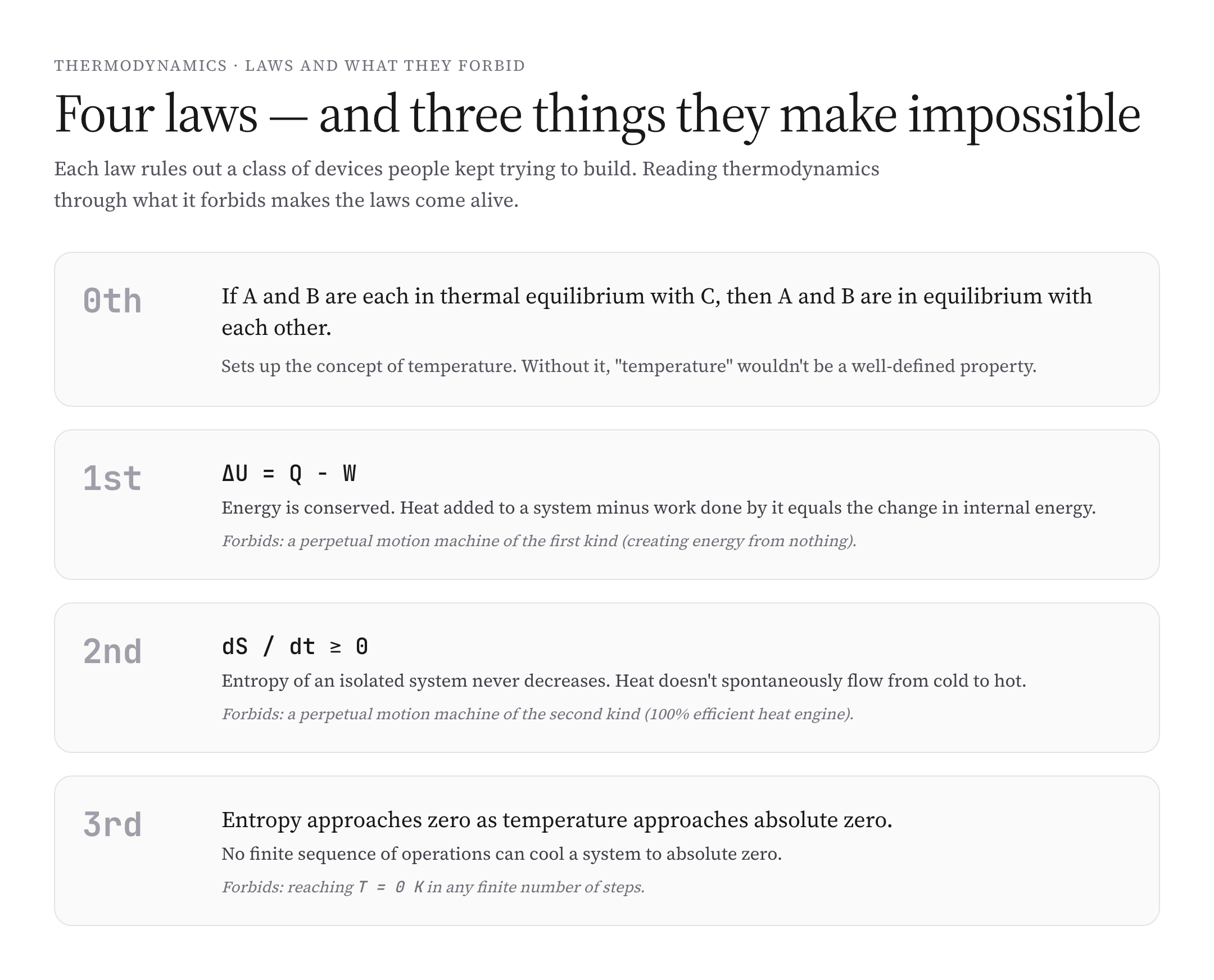
Each law forbids a specific class of devices that engineers and inventors kept trying to build. The first law rules out perpetual motion machines that create energy from nothing. The second law rules out 100% efficient heat engines and engines that move heat from cold to hot without work. The third law rules out reaching absolute zero in any finite process. Read through what each law forbids and the laws come alive.
This study note covers each of the four laws, key concepts (heat, work, entropy, internal energy), worked examples, the Carnot cycle, applications across science and engineering, common pitfalls, and the historical context that made thermodynamics one of the most successful frameworks in physics.
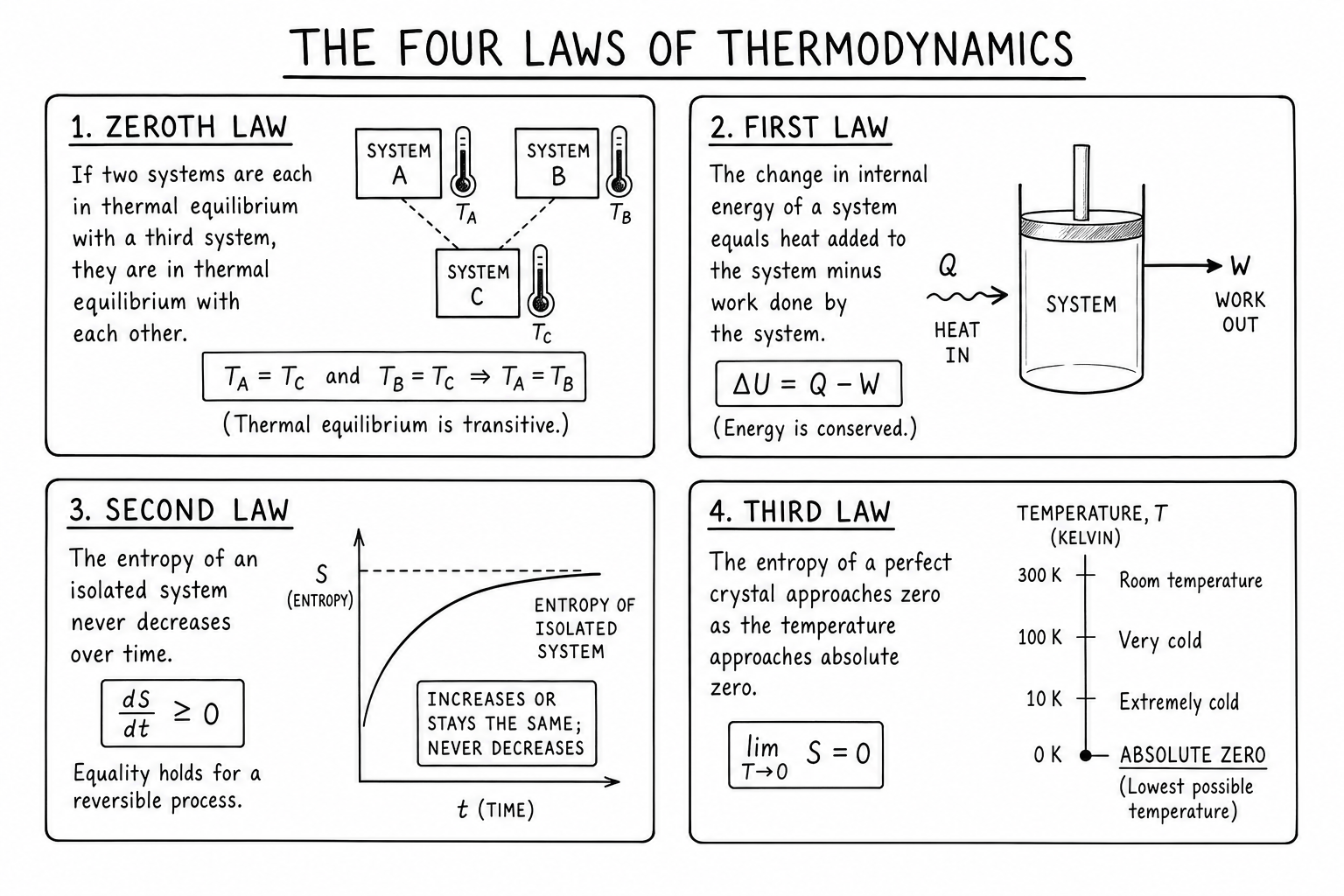
The Zeroth Law: Thermal Equilibrium
If two systems are each in thermal equilibrium with a third system, they are in thermal equilibrium with each other.
The zeroth law sounds trivial but is foundational. It establishes that “temperature” is a well-defined property — an equivalence class on the set of all systems, with thermometers as the reference systems that let us assign temperature values consistently.
Without the zeroth law, comparing temperatures between two systems by means of a thermometer wouldn’t be valid. The law was named “zeroth” because its importance was recognized after the first, second, and third laws were already numbered, and renumbering was unwieldy.
The First Law: Energy Conservation
The change in internal energy of a closed system equals heat added minus work done by the system:
$$\Delta U = Q – W$$This is the conservation of energy applied to thermodynamic systems. Heat \(Q\) and work \(W\) are different ways of transferring energy across the system boundary; internal energy \(U\) is the total energy stored within the system (kinetic + potential at the molecular level).
The first law forbids perpetual motion machines of the first kind — devices that produce energy from nothing. Every claimed perpetual motion machine has some hidden energy source (a battery, gravity, ambient heat) or simply doesn’t work. Patent offices in many countries automatically reject perpetual motion patent applications without further review because they all violate the first law.
The Second Law: Entropy Never Decreases
The total entropy of an isolated system never decreases over time:
$$\Delta S \geq 0$$Entropy is a measure of the disorder or microstate count of a system. Hot coffee in a cold room cools down, mixing at uniform temperature; the reverse — cold coffee spontaneously heating up while the room cools — never happens, even though it would conserve energy.
The second law has many equivalent statements: heat doesn’t spontaneously flow from cold to hot (Clausius); no heat engine can convert all heat into work (Kelvin-Planck); entropy of an isolated system tends to a maximum. All capture the same arrow-of-time asymmetry that distinguishes “before” from “after” in thermodynamic processes.
The Third Law: Absolute Zero Is Unreachable
The entropy of a perfect crystal at absolute zero is exactly zero:
$$\lim_{T \to 0} S = 0$$An equivalent statement: it is impossible to reduce the temperature of any system to absolute zero in a finite number of operations. You can get arbitrarily close — modern laboratories routinely reach picokelvin temperatures with laser cooling — but never exactly zero.
The third law also has consequences for specific heats. As \(T \to 0\), all specific heats must approach zero, otherwise the entropy integral would diverge. This was a puzzle in classical thermodynamics that quantum mechanics resolved — at low temperatures, quantum effects freeze out degrees of freedom and reduce specific heats.
Heat, Work, and Internal Energy
Three central quantities in thermodynamics:
- Heat (\(Q\)): energy transferred due to temperature difference. Heat flows from hot to cold spontaneously. Measured in joules (or older units like calories).
- Work (\(W\)): energy transferred via mechanical, electrical, or other macroscopic means. Pushing a piston, running a motor, doing electrical work — all are work, not heat.
- Internal energy (\(U\)): total energy stored in the random motion and configuration of the system’s constituent particles. Function of state — depends only on the current state, not the path that got there.
The first law is fundamentally an accounting statement: energy entering the system as heat or leaving as work changes the internal energy by exactly the right amount to balance the books. There’s no creating or destroying energy, only converting between forms or transferring across boundaries.
Worked Example: An Ideal Gas Compression
Compress 1 mole of ideal gas isothermally from volume \(V_1\) to \(V_2 < V_1\) at temperature \(T\). For an isothermal process on an ideal gas, internal energy doesn't change (\(\Delta U = 0\)), so by the first law: \(Q = W\).
The work done by the gas is:
$$W = \int_{V_1}^{V_2} P\, dV = nRT \int_{V_1}^{V_2} \frac{dV}{V} = nRT \ln(V_2 / V_1)$$For \(V_2 < V_1\), this is negative — the gas does negative work, meaning work is done on the gas. By the first law, \(Q\) is also negative — heat must be removed from the gas to keep its temperature constant. This is exactly what a refrigerator does in its compression stage.
The Carnot Cycle and Heat Engines
A heat engine takes heat from a hot reservoir, does work, and dumps remaining heat to a cold reservoir. The Carnot cycle is the most efficient possible heat engine — a theoretical upper bound that no real engine can exceed:
$$\eta_{\text{Carnot}} = 1 – \frac{T_C}{T_H}$$where \(T_H\) is the hot reservoir temperature and \(T_C\) the cold reservoir temperature, both in Kelvin. For \(T_H = 500\) K and \(T_C = 300\) K: maximum efficiency is 40%. Real engines achieve significantly less because they have friction, finite-rate heat transfer, and other irreversibilities.
This is the second law in action. It rules out 100% efficient engines: even ideal engines must dump some heat to a cold reservoir. It also explains why power plants can’t simply convert all the heat from burning fuel into electricity — a fundamental thermodynamic limit, not a temporary engineering challenge.
Entropy in Statistical Mechanics
The microscopic interpretation of entropy comes from statistical mechanics:
$$S = k_B \ln \Omega$$where \(\Omega\) is the number of microstates compatible with the macroscopic state, and \(k_B = 1.381 \times 10^{-23}\) J/K is the Boltzmann constant. This is Boltzmann’s famous formula, engraved on his tombstone in Vienna.
Entropy is essentially “log of the number of arrangements that look the same macroscopically.” A deck of cards in order has entropy near zero; a shuffled deck has high entropy. The arrow of time emerges from systems evolving toward macroscopically high-entropy states because there are vastly more ways to be disorganized than organized.
This statistical-mechanical view connects thermodynamics to information theory: Shannon entropy uses the same mathematical structure. Read more in the related notes on normal distribution and expected value.
Free Energy and Chemical Reactions
For systems at constant temperature and pressure (most chemistry), the relevant thermodynamic potential is the Gibbs free energy: \(G = U + PV – TS\). Reactions proceed spontaneously when \(\Delta G < 0\). For constant temperature and volume, use Helmholtz free energy: \(F = U - TS\).
This is how chemistry uses thermodynamics. Whether a reaction will spontaneously occur, what equilibrium concentrations to expect, how much work can be extracted from a reaction — all follow from free energy calculations. Biochemistry runs on the same principles applied to enormous, complex molecular systems.
Applications Across Science and Engineering
- Power generation: coal, gas, nuclear, geothermal, and even solar thermal plants are heat engines limited by Carnot efficiency.
- Refrigeration and air conditioning: heat pumps move heat from cold to hot using work, with COP (coefficient of performance) bounded by \(T_C/(T_H – T_C)\).
- Internal combustion engines: automotive engines, jet engines, and rockets are heat engines whose efficiency is bounded by thermodynamic limits.
- Chemistry: reaction spontaneity, equilibrium constants, and reaction rates all depend on thermodynamic quantities.
- Biology: ATP hydrolysis, metabolic pathways, protein folding, and ecosystem energy flows all obey thermodynamics.
- Cosmology: the heat death of the universe is a long-term consequence of the second law applied to the entire cosmos.
- Materials science: phase transitions, melting, evaporation, and alloy properties depend on free energy minimization.
Common Mistakes With Thermodynamics
- Confusing heat and temperature. Temperature is intensive (doesn’t depend on amount); heat is energy in transit. A small amount of high-temperature steam carries far less heat than a bathtub of warm water.
- Ignoring the second law. Many “free energy” claims violate the second law by implicitly drawing on hidden energy sources or environmental gradients.
- Mistreating the system boundary. Thermodynamics is bookkeeping across a boundary. Define the system clearly: a closed system exchanges no matter; an isolated system exchanges no matter or energy.
- Confusing entropy with disorder colloquially. Entropy has a precise statistical-mechanical definition; “disorder” is a useful intuition but can mislead in specific contexts.
- Applying ideal gas equations to non-ideal cases. The ideal gas law works for dilute, non-interacting gases. Real gases at high pressure or near phase transitions need real-gas equations of state.
A Brief History
Thermodynamics emerged in the 19th century from the practical problem of improving steam engine efficiency. Sadi Carnot (1824) introduced reversible cycles and the maximum-efficiency limit. Rudolf Clausius (1850) formulated the first and second laws and coined “entropy.” William Thomson (Lord Kelvin) introduced the absolute temperature scale.
Ludwig Boltzmann (1870s) connected macroscopic thermodynamics with microscopic statistical mechanics. Walther Nernst (1906) formulated the third law. By 1900, classical thermodynamics was largely complete. Quantum statistical mechanics extended it to atomic scales in the early 20th century.
Today thermodynamics underlies energy policy, climate modeling, biotechnology, materials engineering, and cosmology. Despite being one of the oldest physical theories, it remains active research — non-equilibrium thermodynamics, fluctuation theorems, and information-theoretic perspectives continue to extend the field.
The Arrow of Time
Most fundamental physical laws are time-symmetric — they look the same whether time runs forward or backward. The second law of thermodynamics is the major exception. Entropy increases over time, distinguishing past from future at the macroscopic level.
This thermodynamic arrow of time is one of the deepest puzzles in physics. The microscopic laws are time-symmetric, yet the macroscopic behavior is not. The standard explanation invokes the low-entropy initial conditions of the early universe — entropy has been increasing ever since because there’s so much room to grow. Whether this is the complete answer remains an active question in foundations of physics and cosmology.
Maxwell’s Demon and Information Thermodynamics
James Clerk Maxwell proposed a thought experiment in 1867: a tiny “demon” sorts molecules in a gas by speed, sending fast ones one way and slow ones the other. This appears to violate the second law by creating a temperature difference without doing work.
The resolution came in the 20th century. Charles Bennett (1982) showed that the demon must store information about each molecule’s speed; Landauer’s principle says erasing one bit of information dissipates at least \(k_B T \ln 2\) of heat. The demon’s information processing pays the entropy cost. This connects thermodynamics to information theory and underpins the modern field of thermodynamics of computation.
Modern realizations of “Maxwell demons” have been built — not as cheating devices, but as proofs that information and entropy are deeply connected. The cost of computation is fundamentally bounded by Landauer’s limit, which sets a thermodynamic floor on energy-efficient computing.
Negative Temperature Systems
Some quantum systems can have negative absolute temperatures, which sounds impossible but follows directly from the statistical-mechanical definition of temperature. A two-level system (like nuclear spins) has a population inversion at high enough energy — more spins in the upper state than the lower. By the Boltzmann distribution, this corresponds to a negative temperature.
Negative temperatures are paradoxically hotter than any positive temperature: heat flows spontaneously from negative T systems to positive T systems. Lasers exploit population inversion in their gain medium — they’re effectively negative-temperature devices in the relevant degree of freedom. The third law (entropy → 0 as T → 0) doesn’t apply to systems that can reach negative T because they pass through infinity, not zero.
Heat Death of the Universe
The second law applied at cosmic scale predicts the eventual heat death of the universe. As stars burn out, black holes evaporate, and matter spreads thinner and thinner, the universe approaches a state of maximum entropy — a uniform, near-zero-temperature soup with no usable energy gradients. No work can be extracted; no further evolution is possible.
This is the ultimate consequence of the second law: time runs forward, entropy grows, and the universe slowly winds down toward thermodynamic equilibrium. The timescale is staggering — roughly \(10^{100}\) years for proton decay (if it happens) and Hawking-radiation evaporation of supermassive black holes — but the eventual fate is fixed by thermodynamics. The arrow of time has a destination, even if it’s almost incomprehensibly far in the future.
Worked Example: Carnot Engine Efficiency
A Carnot engine operates between hot reservoir T_H = 600 K and cold reservoir T_C = 300 K. Maximum efficiency:
$$\eta = 1 – T_C/T_H = 1 – 300/600 = 0.5 = 50\%$$If the engine takes in 1000 J of heat at T_H per cycle, it produces at most 500 J of work and dumps at least 500 J to the cold reservoir. Real engines achieve significantly less than the Carnot limit due to friction, finite-rate heat transfer, and other irreversibilities.
The Carnot efficiency is the upper bound — no engine, no matter how cleverly designed, can exceed it without violating the second law. Modern combined-cycle gas turbines reach about 60% efficiency by operating at very high T_H (around 1500 K) where the Carnot limit is much higher. The fundamental thermodynamic constraint sets the ceiling for all heat-engine technology.
FAQs
What are the four laws of thermodynamics?
Zeroth: thermal equilibrium is transitive (defines temperature). First: energy is conserved (ΔU = Q − W). Second: entropy of an isolated system never decreases. Third: entropy approaches zero as temperature approaches absolute zero (and absolute zero is unreachable in finite steps).
What is entropy?
A measure of disorder or the number of microstates compatible with a macroscopic state. Boltzmann’s formula S = k_B ln Ω relates entropy to microstate count. The second law says entropy of an isolated system tends to maximum, giving the arrow of time and the asymmetry between past and future.
Why can’t I build a perpetual motion machine?
First-kind perpetual motion (creating energy from nothing) violates the first law. Second-kind perpetual motion (100% efficient heat engine, or moving heat from cold to hot without work) violates the second law. No claimed perpetual motion machine has ever worked; patent offices automatically reject perpetual motion applications.
What is the Carnot efficiency?
η = 1 − T_C/T_H, where T_H and T_C are hot and cold reservoir temperatures in Kelvin. It’s the maximum possible efficiency for any heat engine operating between two reservoirs. Real engines achieve less due to friction, finite-rate heat transfer, and other irreversibilities. The bound itself is a direct consequence of the second law.
What does the third law really say?
Two equivalent statements: the entropy of a perfect crystal at absolute zero is exactly zero; and you cannot reach absolute zero through any finite sequence of operations. You can get arbitrarily close — picokelvin temperatures are routine in cold-atom labs — but never exactly zero.
How is entropy connected to information?
Through the same mathematical formula. Boltzmann’s S = k_B ln Ω matches Shannon’s information entropy H = −Σ p log p (with appropriate constants). Both measure ‘amount of uncertainty’ or ‘number of equally probable outcomes.’ This connection underlies modern thermodynamics of computation, Maxwell’s demon resolutions, and Landauer’s principle of erasure cost.
Why is heat different from work?
Heat is energy transferred due to temperature difference; work is energy transferred via macroscopic forces. Both change the internal energy of a system. The distinction matters because the second law treats them asymmetrically — converting work to heat is easy and unconstrained; converting heat to work is bounded by Carnot efficiency.
What is the difference between intensive and extensive properties?
Intensive properties (temperature, pressure, density) don’t depend on the amount of substance. Extensive properties (mass, volume, internal energy, entropy) scale with the amount. Splitting a system in half doesn’t change intensive properties but halves extensive ones. The distinction matters for thermodynamic calculations and dimensional analysis.
How does the second law apply to living organisms?
Living organisms are not isolated systems — they exchange energy and matter with their environment. They maintain low internal entropy by exporting more entropy than they import (e.g., absorbing organized chemical energy and exporting heat and waste). The total entropy of organism + environment increases, satisfying the second law globally even though local entropy decreases.
What is Gibbs free energy?
G = U + PV − TS, the relevant thermodynamic potential at constant temperature and pressure. Reactions proceed spontaneously when ΔG < 0. Equilibrium occurs at minimum G. Most of chemistry uses Gibbs free energy because chemists typically work at constant T and P (atmospheric conditions in a flask).
What’s the connection between thermodynamics and statistical mechanics?
Statistical mechanics provides the microscopic foundation for macroscopic thermodynamics. Macroscopic quantities (temperature, pressure, entropy) emerge from averages over enormous numbers of microscopic particles. Boltzmann derived classical thermodynamics from statistical mechanics in the 1870s; quantum statistical mechanics extends it to atomic scales.
Why is the arrow of time tied to the second law?
Microscopic physical laws are time-symmetric, but the second law is not — entropy increases. This asymmetry distinguishes past from future at the macroscopic level. The ultimate explanation is believed to involve the very low-entropy initial conditions of the early universe; entropy has been increasing ever since because there’s so much room to grow.
What is Landauer’s principle?
Erasing one bit of classical information dissipates at least k_B T ln 2 of heat to the environment, where T is the temperature in Kelvin. This connects information theory to thermodynamics and sets a fundamental thermodynamic limit on the energy efficiency of computation. Resolves Maxwell’s demon paradox by accounting for the demon’s information storage.