by
by
Kinetic energy is the energy an object has because it is moving. The formula \( KE = \frac{1}{2} m v^2 \) is one of the first equations students learn in physics, and it captures a deceptively important result: kinetic energy scales linearly with mass but with the SQUARE of velocity. Double the mass, double the kinetic energy. Double the speed, quadruple the kinetic energy. This single quadratic relationship explains why car accidents at 60 mph are far worse than at 30 mph, why air resistance becomes brutal at highway speeds, and why kinetic-energy weapons in physics are so disproportionately powerful.
The kinetic-energy formula needs a reference frame. Doubling speed changes the classical kinetic energy by a factor of 4.
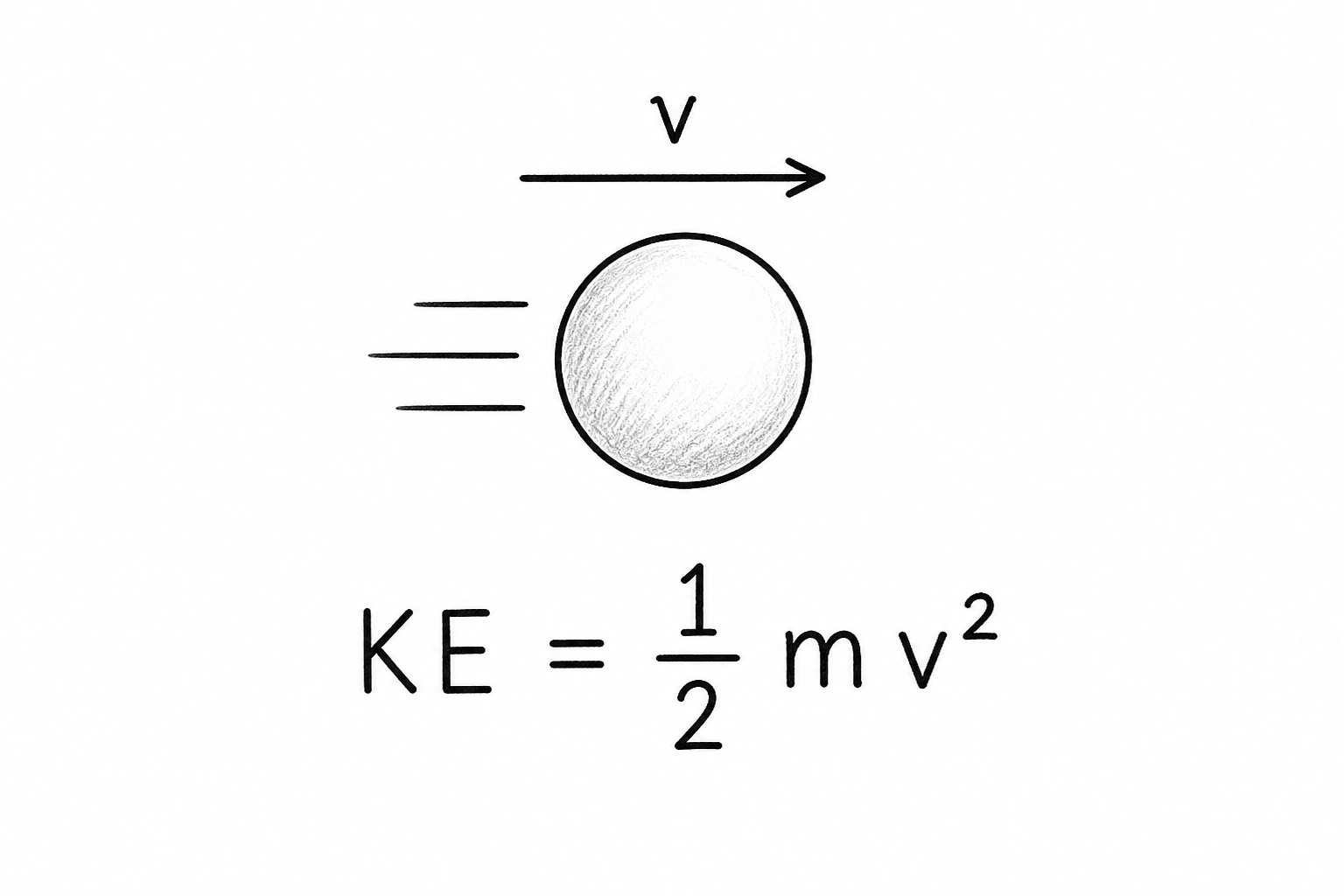
The Equation
The kinetic energy of an object moving in translation is:
$$ KE = \frac{1}{2} m v^2 $$
Where:
- \( KE \) = kinetic energy, in joules (J)
- \( m \) = mass of the object, in kilograms (kg)
- \( v \) = speed of the object, in meters per second (m/s)
One joule is a small amount of energy on a human scale, roughly the energy of dropping a small apple about 10 cm. A 70 kg person running at 5 m/s has kinetic energy \( \\tfrac{1}{2} \\times 70 \\times 25 = 875 \) J. A 1,500 kg car at 30 m/s (about 108 km/h) has \( \\tfrac{1}{2} \\times 1500 \\times 900 = 675{,}000 \) J, nearly a thousand times more.
Why the Velocity-Squared Term Matters
The quadratic in velocity is the single most consequential feature of the kinetic energy equation. It means doubling the speed quadruples the energy. Tripling the speed multiplies energy by nine.
Practical consequences:
- Car safety. A 60 mph collision delivers 4× the energy of a 30 mph collision into the same car body. Braking distance scales with the square of speed, going twice as fast needs four times the stopping distance.
- Bullets. A heavy slow bullet and a light fast bullet can have similar momentum but very different kinetic energies. Wounding power tracks kinetic energy more closely than momentum.
- Energy storage. Flywheels store kinetic energy in proportion to the square of angular velocity. Doubling the rpm quadruples the stored energy.
- Wind power. A wind turbine’s power output scales with v³ (because energy scales with v² and the air-mass-per-second through the blades also scales with v). 20% more wind speed = 73% more power.
Deriving the Equation from First Principles
The kinetic energy formula falls out of the work-energy theorem. Work done by a constant force \( F \) over a distance \( d \) is \( W = Fd \). For an object accelerating from rest under that force, Newton’s second law gives \( F = ma \), and the kinematic equation \( v^2 = 2ad \) (starting from \( v_0 = 0 \)) gives \( d = v^2/(2a) \).
Substituting:
$$ W = Fd = (ma) \cdot \frac{v^2}{2a} = \frac{1}{2} m v^2 $$
The work done equals the kinetic energy gained. So \( KE = \\tfrac{1}{2} m v^2 \) is just a definition that makes the work-energy theorem clean.
Kinetic Energy Is Frame-Dependent
Unlike mass, kinetic energy depends on the frame of reference of the observer. A passenger sitting still in a moving train has zero kinetic energy in the train’s reference frame but a substantial amount in the ground’s reference frame. There is no ‘true’ kinetic energy of an object in absolute terms, it depends on who’s watching and from where.
This is why kinetic-energy calculations always specify the reference frame implicitly (usually the ground frame for everyday problems). When two objects collide, you can analyze the collision in any inertial frame, the math is easiest in the center-of-mass frame, where total momentum is zero.
Rotational Kinetic Energy
Spinning objects also have kinetic energy, distinct from translational motion. For a rigid body rotating about a fixed axis:
$$ KE_{rot} = \frac{1}{2} I \omega^2 $$
Where \( I \) is the moment of inertia (the rotational analog of mass) and \( \\omega \) is the angular velocity in radians per second. Notice the same quadratic structure as translational KE. A rolling ball has both, translational KE for its center-of-mass motion and rotational KE for its spin.
Conservation of Kinetic Energy
Kinetic energy is conserved only in elastic collisions, collisions where no energy is converted to heat, deformation, or sound. Perfect elastic collisions are rare in macroscopic physics (close approximations: two hard steel balls, billiard ball-on-ball at low speed).
Most real collisions are inelastic, kinetic energy decreases as some converts to other forms. A perfectly inelastic collision (objects stick together) loses the maximum possible kinetic energy consistent with conservation of momentum.
Example. A 2 kg ball at 10 m/s hits a stationary 3 kg ball and they stick together. Momentum is conserved: \( 2 \\times 10 + 3 \\times 0 = 5 v_f \), so \( v_f = 4 \) m/s. Initial KE: \( \\tfrac{1}{2} \\times 2 \\times 100 = 100 \) J. Final KE: \( \\tfrac{1}{2} \\times 5 \\times 16 = 40 \) J. The 60 J difference became heat and deformation.
Relativistic Kinetic Energy
At speeds approaching the speed of light, the simple \( \\tfrac{1}{2} m v^2 \) formula breaks down. Einstein’s special relativity gives:
$$ KE = (\gamma – 1) m c^2 \quad \text{where} \quad \gamma = \frac{1}{\sqrt{1 – v^2/c^2}} $$
For \( v \\ll c \), this reduces back to the classical \( \\tfrac{1}{2} m v^2 \) (verify by Taylor-expanding \( \\gamma \)). For \( v \\to c \), \( \\gamma \\to \\infty \), meaning infinite kinetic energy is required to reach the speed of light. This is the relativistic reason no massive object can ever reach \( c \).
Related study notes: Newton’s Laws of Motion, Special Relativity, Simple Harmonic Motion, Laws of Thermodynamics.
The OpenStax physics textbooks develop the corresponding physical models with further worked problems.
Work and Speed
A 2 kg object speeds up from 3 m/s to 5 m/s. Its classical kinetic energy changes from 9 J to 25 J, so the net work is 16 J. The change uses the difference of squared speeds, not the square of their difference.
If a constant opposing force stops the object, the stopping distance equals its initial kinetic energy divided by that force magnitude in this simple model. With the same mass and opposing force, doubling initial speed multiplies stopping distance by 4. Real braking can involve speed-dependent forces and reaction distance, which need separate treatment.
The points to check in this example are:
- Kinetic energy depends on speed, not the sign of a velocity component.
- The work-energy theorem relates net work to kinetic-energy change.
- The classical expression is appropriate when relativistic corrections are negligible.
Check Your Understanding
Try the questions before reading the answers.
Question 1. What is the kinetic energy of 4 kg at 2 m/s?
Answer. 8 J.
Question 2. Can 2 observers in different inertial frames assign different kinetic energies?
Answer. Yes, because they can measure different speeds.
Practice Questions
Work each question before reading its solution. The set runs from direct recall and substitution to the applied questions that exams actually use to separate grades. The downloadable PDF includes these questions and their solutions.
Question 1. Compute the kinetic energy of a 1,200 kg car at 20 m/s (72 km/h).
Solution. \(KE = \frac{1}{2}mv^2 = 0.5 \times 1200 \times 400 = 240{,}000\) J \(= 240\) kJ. About the energy in a 57-calorie snack, delivered in one instant if the car hits a wall.
Question 2. The same car doubles its speed to 40 m/s. What happens to its kinetic energy, and why does this matter on the road?
Solution. Energy quadruples to 960 kJ, because \(v\) enters squared. Braking distance scales with energy, so doubling speed roughly quadruples the distance needed to stop. The square is the physics behind speed limits.
Question 3. A 0.145 kg baseball at 40 m/s and a 7,000 kg truck at 1 m/s: which carries more kinetic energy?
Solution. Ball: \(0.5 \times 0.145 \times 1600 = 116\) J. Truck: \(0.5 \times 7000 \times 1 = 3500\) J. The crawling truck wins by 30 times, but note the ball beats it per kilogram a thousandfold: mass enters linearly, speed squared.
Question 4. State the work-energy theorem and use it: a net 500 N force pushes a 50 kg crate from rest through 8 m. Find its final speed.
Solution. Net work equals the change in kinetic energy: \(W = \Delta KE\). Work \(= 500 \times 8 = 4000\) J \(= \frac{1}{2}(50)v^2\), so \(v^2 = 160\) and \(v \approx 12.6\) m/s. No kinematics equations needed; energy bookkeeping replaces them.
Question 5. From what height must you drop a car to match its kinetic energy at 100 km/h (27.8 m/s)?
Solution. Set \(mgh = \frac{1}{2}mv^2\): \(h = \frac{v^2}{2g} = \frac{772}{19.6} \approx 39\) m, a 13-story building. Mass cancels; the answer is the same for any object. Highway speed is a 13-floor fall in disguise.
Question 6. A 9 g bullet leaves a rifle at 800 m/s. Compute its kinetic energy and compare it with the 240 kJ car of Question 1.
Solution. \(KE = 0.5 \times 0.009 \times 640{,}000 = 2880\) J. The car carries 80 times more energy, yet the bullet is deadlier: it delivers its 2.9 kJ into square millimeters, while the car spreads 240 kJ over crumple zones. Energy density, not just energy, decides damage.
Question 7. Kinetic energy can never be negative, but a change in kinetic energy can. Explain both statements.
Solution. \(KE = \frac{1}{2}mv^2\) squares the speed, so it is zero or positive regardless of direction; energy has no direction to be negative in. But \(\Delta KE\) is negative whenever something slows, meaning the net work on it was negative: friction and brakes do negative work, draining speed into heat.
Question 8. Two identical cars collide head-on at 50 km/h each. Is the crash energy the same as hitting a rigid wall at 100 km/h?
Solution. No. Each car carries the KE of 50 km/h, so the pair dissipates \(2 \times KE_{50}\). The 100 km/h wall crash dissipates \(KE_{100} = 4 \times KE_{50}\) in 1 car: twice the total, all in your crumple zone. By symmetry, the head-on equals hitting a wall at 50, not 100. The squared law breaks the intuition.
Question 9. A pendulum swings from a 30 cm height. Ignoring friction, how fast is the bob at the lowest point?
Solution. All potential energy converts: \(v = \sqrt{2gh} = \sqrt{2 \times 9.8 \times 0.3} = \sqrt{5.88} \approx 2.4\) m/s. Conversion between \(mgh\) and \(\frac{1}{2}mv^2\), in both directions, is the workhorse of mechanics problems.
Question 10. At what speed does a 70 kg sprinter match the kinetic energy of a 70 g arrow flying at 60 m/s?
Solution. Arrow: \(0.5 \times 0.07 \times 3600 = 126\) J. Sprinter: \(0.5 \times 70 \times v^2 = 126\) gives \(v^2 = 3.6\), \(v = 1.9\) m/s, a jog. A thousand times the mass needs only \(\sqrt{1000} \approx 32\) times less speed for equal energy: the square root soft-pedals mass differences.
Frequently Asked Questions
What is kinetic energy?
Kinetic energy is the energy an object has because it is moving. It is calculated as KE = 1/2 × mass × velocity². A heavier object at the same speed has more kinetic energy; a faster object has dramatically more (because of the velocity-squared term). Kinetic energy is measured in joules (J).
Why does kinetic energy scale with v² and not v?
Because the work needed to accelerate an object from rest scales with distance, and the stopping distance for a moving object scales with v². Specifically, deriving from F = ma and v² = 2ad gives KE = (1/2) m v² directly. The quadratic is a fundamental property of work done against acceleration, not an arbitrary choice.
How much more dangerous is a 60 mph crash than a 30 mph crash?
Four times more dangerous in terms of kinetic energy. Doubling speed quadruples KE. The collision delivers four times the energy into deforming the car body, breaking glass, and injuring occupants. Braking distance also scales with v², so going 60 mph needs four times the stopping distance of 30 mph.
Is kinetic energy a vector or a scalar?
Scalar. Kinetic energy has magnitude only, no direction. This is one of its useful properties, energy from multiple sources adds up arithmetically without worrying about vector components. Momentum, by contrast, is a vector, so adding momenta requires vector addition.
Is kinetic energy conserved in collisions?
Only in elastic collisions (perfectly bouncy). Most real collisions are inelastic, some kinetic energy converts to heat, deformation, or sound. A perfectly inelastic collision (objects stick together) loses the maximum possible KE. Momentum, however, IS conserved in all collisions (in the absence of external forces).
How does kinetic energy change at relativistic speeds?
At speeds close to the speed of light, the simple 1/2 m v² formula breaks down. The correct relativistic formula is KE = (γ – 1) m c², where γ = 1/√(1 – v²/c²). As v approaches c, γ goes to infinity, meaning infinite KE is needed to reach light speed. This is the relativistic reason why massive objects can never reach c.
Browse more in Physics.