
Simple Harmonic Motion
Simple harmonic motion (SHM) is the back-and-forth oscillation produced when a restoring force is directly proportional to the displacement from equilibrium. A mass on a spring, a pendulum swinging at small angles, an atom vibrating in a crystal lattice, the alternating current in an AC circuit, the displacement of air molecules in a sound wave — all are simple harmonic. The motion produces a clean sinusoidal position-vs-time curve, and the same set of equations describes every physical system that obeys SHM. Master this one model and the math transfers across hundreds of physics, engineering, and biological contexts.
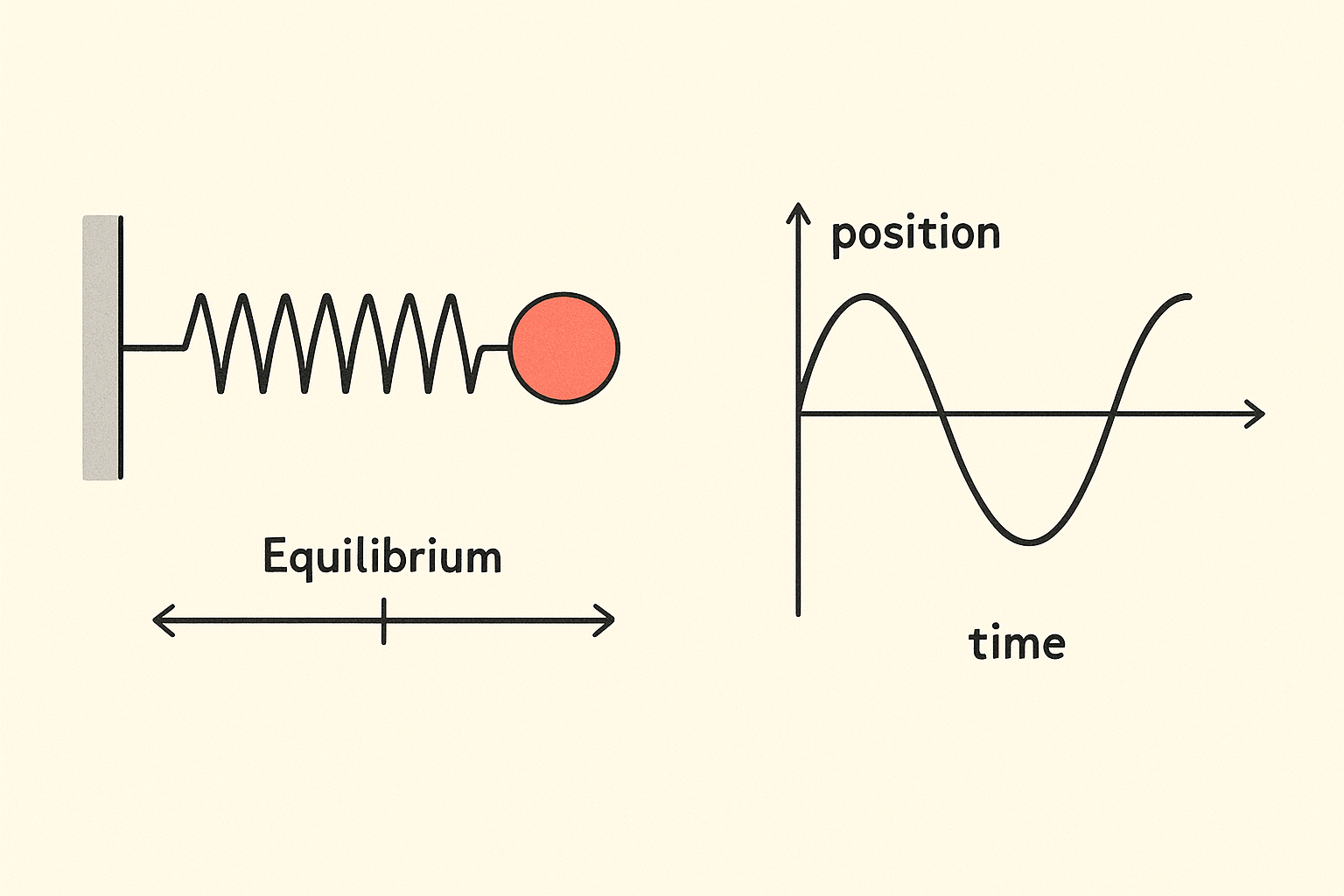
The Defining Equation
Simple harmonic motion occurs whenever the restoring force on an object is proportional to its displacement from equilibrium, and points back toward equilibrium. For a mass on a spring, Hooke’s law gives:
$$ F = -kx $$
Where \( F \) is the force, \( x \) is displacement from equilibrium, and \( k \) is the spring constant. The negative sign is critical — it means the force always points opposite to the displacement (back toward equilibrium).
Applying Newton’s second law \( F = ma = m\ddot{x} \) gives the SHM differential equation:
$$ m\ddot{x} = -kx \quad \Longrightarrow \quad \ddot{x} = -\dfrac{k}{m} x = -\omega^2 x $$
Where \( \omega = \sqrt{k/m} \) is called the angular frequency. The solution to this differential equation is a sinusoid.
The Sinusoidal Solution
The general solution to the SHM equation is:
$$ x(t) = A \cos(\omega t + \varphi) $$
Where each symbol has a clean physical meaning:
- \( A \) = amplitude — the maximum displacement from equilibrium
- \( \omega \) = angular frequency — how fast the oscillation occurs, in radians per second
- \( \varphi \) = phase constant — sets the starting position at \( t = 0 \)
- \( t \) = time
The period \( T \) (time for one complete oscillation) and frequency \( f \) (oscillations per second) relate to angular frequency as:
$$ T = \dfrac{2\pi}{\omega} \qquad f = \dfrac{1}{T} = \dfrac{\omega}{2\pi} $$
For the spring-mass system specifically:
$$ T = 2\pi \sqrt{\dfrac{m}{k}} \qquad f = \dfrac{1}{2\pi} \sqrt{\dfrac{k}{m}} $$
Note what these formulas DON’T contain: the amplitude \( A \). The period of SHM is independent of how far you pull the mass before releasing it. A large swing and a tiny swing take exactly the same time. This is a defining feature of SHM and one of its most useful properties (the basis of pendulum clocks).
Velocity and Acceleration
Differentiating the position once gives velocity; differentiating again gives acceleration:
$$ x(t) = A \cos(\omega t + \varphi) $$
$$ v(t) = \dot{x}(t) = -A\omega \sin(\omega t + \varphi) $$
$$ a(t) = \ddot{x}(t) = -A\omega^2 \cos(\omega t + \varphi) = -\omega^2 x(t) $$
Maximum velocity \( v_{max} = A\omega \) occurs at equilibrium position (when displacement is zero). Maximum acceleration \( a_{max} = A\omega^2 \) occurs at the extreme positions (when displacement equals \( \pm A \), and the restoring force is largest). Position, velocity, and acceleration are all sinusoidal with the same frequency but offset by 90° in phase.
Energy in SHM
Total mechanical energy in SHM is the sum of kinetic and potential energies:
$$ E_{total} = \dfrac{1}{2} m v^2 + \dfrac{1}{2} k x^2 $$
Substituting the sinusoidal solutions and simplifying:
$$ E_{total} = \dfrac{1}{2} k A^2 = \dfrac{1}{2} m \omega^2 A^2 $$
The total energy is constant (conservation of energy) and proportional to the square of the amplitude. Energy continuously transfers between kinetic and potential forms — fully kinetic at equilibrium (where displacement is zero), fully potential at the extremes (where velocity is zero), and mixed everywhere in between. Doubling the amplitude quadruples the energy.
Other Examples of SHM
Pendulum (small angles)
A simple pendulum of length \( L \) under gravity \( g \) has approximate SHM for small angular displacements:
$$ T = 2\pi \sqrt{\dfrac{L}{g}} $$
The independence from amplitude (for small swings) was famously discovered by Galileo in the late 1500s. He used it to develop the first reliable pendulum clock. The approximation breaks down at large angles where sine x is no longer approximately x.
LC Circuit
A capacitor and inductor in a closed circuit (with no resistance) oscillate electrically with angular frequency:
$$ \omega = \dfrac{1}{\sqrt{LC}} $$
This is the basis of radio-tuning circuits — you adjust C to tune to a specific frequency.
Molecular Vibrations
Bonds between atoms behave like tiny springs at low energies. The H-H bond in molecular hydrogen vibrates at about 130 trillion Hz. Each chemical bond has a characteristic vibration frequency that infrared spectroscopy uses to identify molecules.
Damped and Driven SHM
Real systems have friction (damping) that gradually reduces the amplitude. A driven system has an external periodic force adding energy. When the driving frequency matches the system’s natural frequency \( \omega_0 \), resonance occurs — the amplitude can grow dramatically. The 1940 Tacoma Narrows Bridge collapse, the swing pumping at the right frequency, and microwave ovens (driving water molecules at their resonant frequency) are all resonance phenomena. Resonance is one of the most consequential applications of SHM theory in real-world engineering.
Related study notes: Sine Cosine Tangent, Newton’s Laws of Motion, Exponential Function, Derivatives in Calculus.
Frequently Asked Questions
What is simple harmonic motion?
Simple harmonic motion (SHM) is the back-and-forth oscillation that occurs whenever a restoring force is directly proportional to the displacement from equilibrium. The motion produces a sinusoidal (sine or cosine) position-vs-time curve. Examples include a mass on a spring (Hooke’s law), small-angle pendulums, atomic vibrations in solids, and the alternating current in LC circuits.
What is the equation for simple harmonic motion?
The defining equation is F = -kx, where F is the restoring force and x is the displacement from equilibrium. This leads to the differential equation d²x/dt² = -ω²x, whose solution is x(t) = A cos(ωt + φ) — a sinusoidal function of time with amplitude A, angular frequency ω = √(k/m), and phase φ.
What is the period of a mass on a spring?
T = 2π√(m/k), where m is the mass and k is the spring constant. The period depends on the mass and spring stiffness but is independent of the amplitude. A large oscillation and a tiny oscillation take exactly the same time, which is what makes SHM so useful in clocks.
Why is the period independent of amplitude?
Because the restoring force scales linearly with displacement. If you double the amplitude, the maximum restoring force doubles, the maximum acceleration doubles, the maximum velocity doubles, but the distance traveled also doubles. All the factors cancel out exactly, leaving the period unchanged. This is unique to SHM; non-linear restoring forces give amplitude-dependent periods.
What is angular frequency?
Angular frequency ω is the rate of oscillation expressed in radians per second. It is related to ordinary frequency f (in Hz) by ω = 2πf. The factor 2π appears because one full oscillation cycle corresponds to 2π radians on the unit circle. For a mass on a spring, ω = √(k/m). For a pendulum, ω = √(g/L).
What is resonance in SHM?
Resonance occurs when a driven oscillator is forced at a frequency matching its natural frequency. At resonance, energy is added to the system most efficiently, and the amplitude can grow dramatically (limited only by damping). The Tacoma Narrows Bridge collapse, pumping a swing to greater heights, microwave ovens heating water, and tuning a radio are all resonance phenomena.