by
by
Planck’s constant \(h \approx 6.626 \times 10^{-34}\) J·s is the fundamental constant that sets the scale of quantum effects. Where Newton’s gravitational constant \(G\) sets the scale of gravity and the speed of light \(c\) sets the relativistic limit, Planck’s constant sets the boundary between classical and quantum physics. Anywhere energy, momentum, or action becomes comparable to \(h\), classical descriptions break down and quantum mechanics takes over.
Max Planck introduced the constant in 1900 to fix a glaring failure of classical physics in explaining blackbody radiation. He treated it as a mathematical trick at first, but Einstein’s 1905 photoelectric effect paper turned it into a physical fact: light energy comes in discrete packets of size \(hf\). The quantum revolution had begun. By the 1920s, Planck’s constant appeared everywhere in atomic physics, wavelengths, energy levels, uncertainty relations, angular momentum quantization.
This study note covers the discovery, the Planck-Einstein relation, the photoelectric effect, the relationship to angular momentum and the reduced constant ℏ, modern applications, the role in defining SI units, common pitfalls, and the historical context that makes \(h\) one of the most consequential numbers in physics.
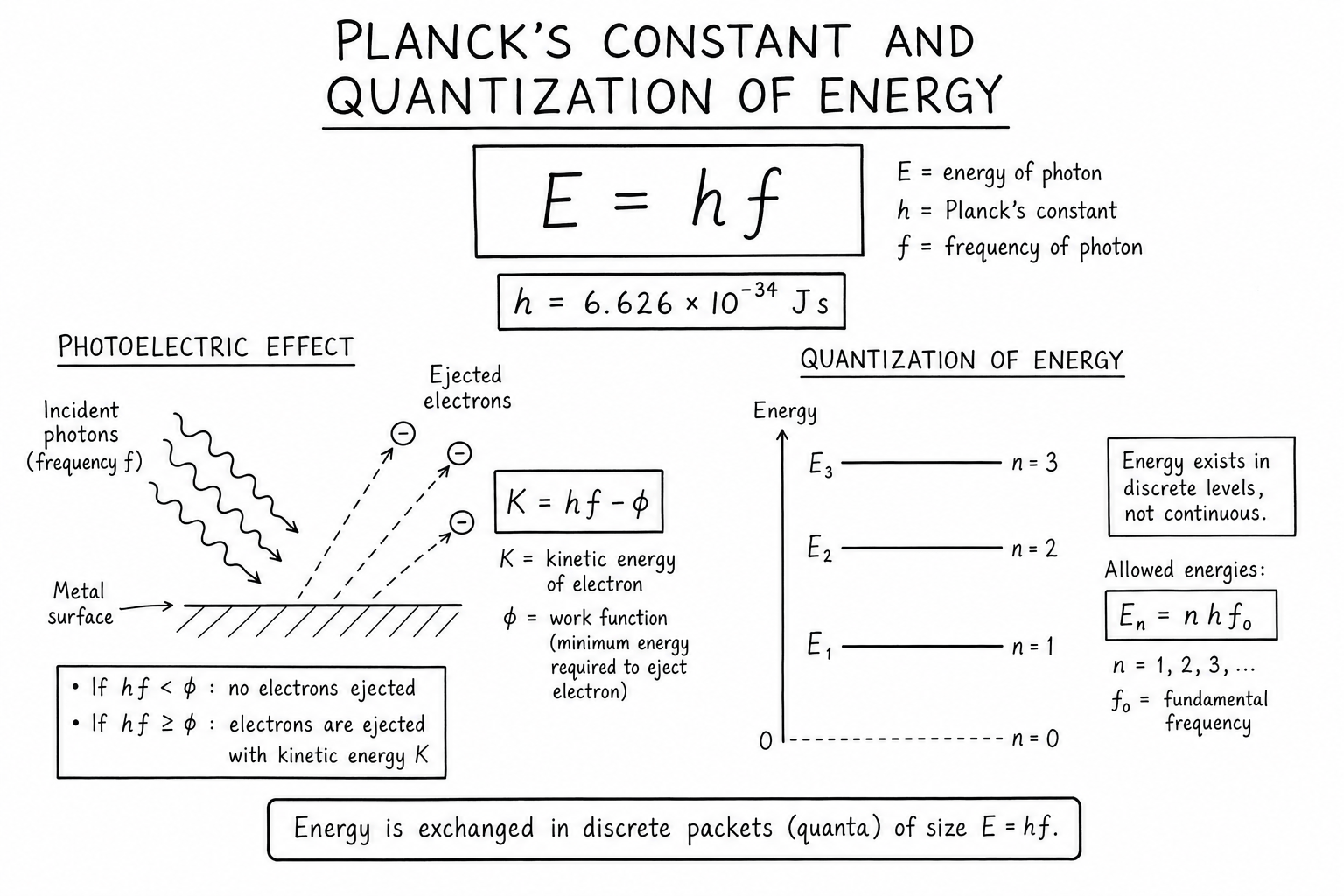
Planck’s constant relates photon energy to frequency and sets the unit of action. The reduced constant differs by a factor of 2π.
Definition and Value
Planck’s constant relates the energy of a photon to its frequency:
$$E = h f$$The 2019 SI redefinition fixed the value of \(h\) exactly:
$$h = 6.62607015 \times 10^{-34} \text{ J} \cdot \text{s}$$The reduced Planck constant \(\hbar = h/(2\pi) \approx 1.0545718 \times 10^{-34}\) J·s appears in the Schrödinger equation, angular momentum quantization, and many other quantum formulas. Both \(h\) and \(\hbar\) appear constantly; which one shows up depends on whether the formula uses frequency \(f\) or angular frequency \(\omega = 2\pi f\).
The Discovery: Blackbody Radiation
Classical physics in the late 1800s couldn’t explain the spectrum of light emitted by a hot object (a “blackbody”). The Rayleigh-Jeans law, derived from classical electromagnetism and statistical mechanics, predicted that intensity should grow without bound at high frequencies, the “ultraviolet catastrophe.” Experiment showed the opposite: intensity peaks and falls off at high frequencies.
Max Planck (1900) found the correct formula by assuming that a blackbody emits energy only in discrete quanta of size \(hf\), not continuously. The constant \(h\) was a fitting parameter chosen to match experiment. Planck himself viewed this as a mathematical trick rather than a physical fact and spent years trying to derive the correct formula classically. He never succeeded, the quantization is real.
Planck’s law for the spectral energy density:
$$u(f, T) = \frac{8\pi h f^3}{c^3} \cdot \frac{1}{e^{hf/k_B T} – 1}$$matches experiment exactly across all frequencies. The blackbody spectrum was the first measured manifestation of quantum mechanics.
The Photoelectric Effect
Light shining on certain metals ejects electrons. Classical physics predicted that brighter light (more intense) should eject electrons with more energy; in fact, increasing intensity only increased the number of electrons ejected, not their kinetic energy. Higher-frequency light, however, gave higher-energy electrons, with a sharp threshold frequency below which no electrons came out at all.
Einstein (1905) explained this by treating light as a stream of particles (photons), each carrying energy \(hf\). One photon ejects one electron, and the electron’s maximum kinetic energy is:
$$K_{\text{max}} = h f – \phi$$where \(\phi\) is the work function (binding energy) of the metal. Below the threshold frequency \(f_0 = \phi/h\), photons don’t have enough energy to free electrons. This was the first direct experimental confirmation that Planck’s constant has physical reality, not just mathematical convenience. Einstein won the 1921 Nobel Prize specifically for this work.
The Planck-Einstein Relation Generalized
The relation \(E = hf\) extends across many quantum phenomena:
- Photons: energy of an electromagnetic photon is \(hf\); momentum is \(p = h/\lambda\).
- De Broglie waves: matter has wavelength \(\lambda = h/p\), where \(p\) is momentum. Electrons, atoms, and even molecules show wave-like behavior at this scale.
- Atomic spectra: photons emitted by atoms have specific frequencies given by \(E_{\text{photon}} = hf = E_i – E_f\), where \(E_i\) and \(E_f\) are initial and final atomic energy levels.
- Vibrational quanta: molecular vibrations are quantized in units of \(hf\); same for crystal phonons.
Anywhere “discrete quanta” appear, Planck’s constant sets the size. It’s the universal conversion between frequency-like quantities and energy-like quantities at the quantum scale.
Worked Example: Photon Energies
What’s the energy of a visible-light photon at 500 nm wavelength?
Frequency: \(f = c/\lambda = (3 \times 10^8 \text{ m/s}) / (500 \times 10^{-9} \text{ m}) = 6 \times 10^{14}\) Hz.
Energy: \(E = hf = (6.626 \times 10^{-34}) \times (6 \times 10^{14}) \approx 3.97 \times 10^{-19}\) J ≈ 2.48 eV.
For comparison: an X-ray photon at 0.1 nm has energy ~12,400 eV (12.4 keV), about 5,000 times more energetic than a visible photon. A microwave photon at 12 GHz has energy ~50 µeV, about 50,000 times less energetic. The same simple relation \(E = hf\) covers the entire electromagnetic spectrum.
Photoelectric Effect: Quantitative Analysis
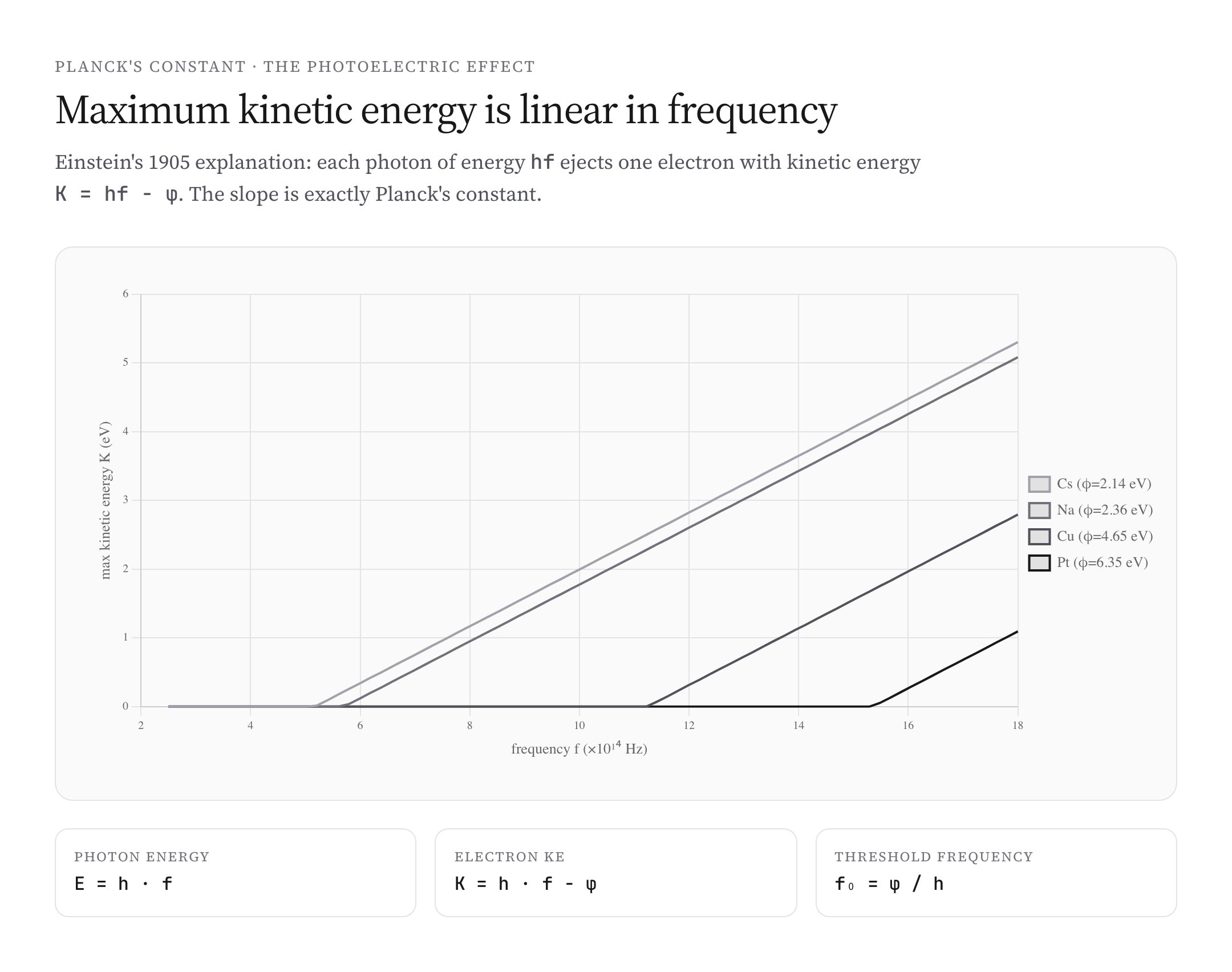
Plotting maximum kinetic energy of ejected electrons against photon frequency gives a straight line. The slope is exactly Planck’s constant \(h\). The x-intercept is the threshold frequency \(f_0 = \phi/h\). The y-intercept (extrapolated) is \(-\phi\), the negative of the work function.
This plot is one of the cleanest experimental measurements of \(h\) in physics. Different metals give different work functions but the same slope, confirming that \(h\) is a universal constant of nature, not metal-specific.
Robert Millikan performed the definitive measurement in the 1910s, expecting to disprove Einstein’s theory. The data instead confirmed it precisely. Millikan won the 1923 Nobel Prize for this work, even though he had set out to prove Einstein wrong.
Planck’s Constant and Angular Momentum
Quantum angular momentum is quantized in units of \(\hbar\):
$$L_z = m_\ell \hbar, \quad m_\ell = -\ell, -\ell+1, \ldots, \ell$$The total angular momentum is \(L = \sqrt{\ell(\ell+1)} \hbar\). Spin angular momentum (intrinsic, not orbital) is also quantized in units of \(\hbar/2\) for fermions like electrons.
This quantization is why atoms have discrete energy levels and why the periodic table has the structure it does. The Bohr model of hydrogen (1913) was the first to use angular momentum quantization, predicting the Rydberg formula for hydrogen spectral lines that had previously been purely empirical.
The Heisenberg Uncertainty Principle
Heisenberg’s uncertainty principle ties Planck’s constant directly to the limits of measurement:
$$\Delta x \cdot \Delta p \geq \hbar / 2$$The product of the uncertainties in position and momentum is bounded below by \(\hbar/2\). For everyday objects, \(\hbar/2\) is so small that the uncertainty is unmeasurable. For atoms and subatomic particles, the uncertainty is fundamental and shapes their behavior. Read more in the related Heisenberg uncertainty principle note.
Modern Applications
- LEDs and lasers: color of emitted light is set by \(E = hf\) for the energy gap of the active material. Engineers tune semiconductor compositions to achieve specific colors.
- Solar cells: photovoltaic conversion of light into electrons relies on photons with energy above the semiconductor band gap.
- X-ray imaging: high-frequency photons penetrate tissue; energy and frequency are related by \(E = hf\).
- Atomic clocks: energy differences between atomic states correspond to specific microwave frequencies; the SI second is defined as 9,192,631,770 cycles of cesium-133’s hyperfine transition.
- Quantum computing: energy levels of qubits, gate operations, and decoherence times all involve \(\hbar\) and \(h\).
- SI unit definitions: the kilogram is now defined via Planck’s constant (since 2019), through the Kibble balance, replacing the old physical platinum-iridium prototype.
Reduced Planck Constant ℏ vs H
Two related constants appear in physics:
- \(h \approx 6.626 \times 10^{-34}\) J·s, appears in formulas using ordinary frequency \(f\) (Hz).
- \(\hbar = h/(2\pi) \approx 1.055 \times 10^{-34}\) J·s, appears in formulas using angular frequency \(\omega = 2\pi f\) (rad/s).
Both have units of action (energy × time). Many quantum formulas use \(\hbar\) for compactness because angular frequency is more natural in wave equations. The Schrödinger equation, angular momentum quantization, and the uncertainty principle all use \(\hbar\). Planck’s original blackbody formula and Einstein’s photoelectric formula use \(h\) because they’re stated in terms of frequency.
Common Mistakes with Planck’s Constant
- Confusing \(h\) with \(\hbar\). Off by a factor of \(2\pi\), easy to forget which one applies in a given formula. Check whether you’re using ordinary or angular frequency.
- Treating photons as having a “size” or “shape.” Photons are quanta of electromagnetic field; they have energy, momentum, and polarization but no spatial extent in the classical sense.
- Forgetting unit conversions. Energy in joules vs eV (1 eV = \(1.602 \times 10^{-19}\) J). Wavelength in meters vs nanometers. Sanity-check magnitudes after every calculation.
- Misinterpreting the photoelectric formula. \(K_{\text{max}} = hf – \phi\) gives maximum kinetic energy. Most ejected electrons have less due to scattering inside the metal before they emerge.
- Assuming Planck’s constant is large. It’s tiny, \(10^{-34}\) J·s. Quantum effects are negligible for everyday-sized objects because their action is enormous compared to \(\hbar\). The classical limit is \(\hbar \to 0\).
A Brief History
Max Planck spent six years (1894-1900) trying to derive the correct blackbody spectrum from classical physics. He failed. In late 1900 he introduced the energy-quantization hypothesis as a “desperate” mathematical trick to fit the data. The constant \(h\) was a free parameter, fit to experiment.
Einstein’s 1905 photoelectric paper turned the trick into physics. By the late 1910s, Niels Bohr had used \(\hbar\) for atomic angular momentum, and atomic spectra were being explained in detail. Heisenberg, Schrödinger, and Dirac developed full quantum mechanics in the late 1920s, with \(h\) and \(\hbar\) at its core.
The 2019 SI redefinition fixed Planck’s constant exactly, redefining the kilogram in terms of \(h\) instead of a physical artifact. This change tied the kilogram to a fundamental constant of nature, the same way the meter and second had already been tied to the speed of light and atomic transitions. Planck’s constant is now one of the seven defining constants of the modern SI system, the others are \(c\), \(\Delta\nu_{\text{Cs}}\), \(e\), \(k_B\), \(N_A\), and \(K_{\text{cd}}\).
Why Planck’s Constant Matters
Planck’s constant is the dividing line between classical and quantum physics. Anywhere quantities of action (energy times time) are comparable to \(h\), quantum effects matter. Anywhere they’re enormous compared to \(h\), classical physics suffices.
For a bowling ball rolling down an alley, action is \(\sim 1\) J·s, which is \(10^{34}\) times \(\hbar\). Quantum effects are utterly negligible. For an electron in a hydrogen atom, action is comparable to \(\hbar\), and quantum effects dominate. This is why everyday physics looks classical despite the world being fundamentally quantum at the smallest scales, the quantum and classical limits are smoothly connected through scale, with \(\hbar\) marking the transition.
The 2019 SI Redefinition
Until 2019, the kilogram was defined by a physical platinum-iridium artifact kept in a vault outside Paris. Drift in the artifact’s mass over decades was a known problem, the international prototype had gained or lost mass relative to copies made at the same time.
The 2019 SI redefinition fixed Planck’s constant exactly at \(h = 6.62607015 \times 10^{-34}\) J·s and uses the Kibble balance to realize the kilogram. The Kibble balance equates electrical and mechanical force; at fixed h, the mass of a test object can be computed in terms of measured electrical quantities. This ties the kilogram to a fundamental constant of nature and eliminates the artifact drift problem entirely.
The same redefinition fixed values for the elementary charge \(e\), Boltzmann constant \(k_B\), Avogadro number \(N_A\), and luminous efficacy \(K_{cd}\). Combined with previously fixed values for \(c\) and the cesium hyperfine frequency, the entire SI system is now built on seven defining constants of nature. No physical artifacts; no drift.
Wave-Particle Duality
Light shows particle behavior in the photoelectric effect (one photon ejects one electron) and wave behavior in interference experiments (double-slit, diffraction). The same is true of matter: electrons show particle behavior when detected, wave behavior when passing through a double slit. Planck’s constant is the bridge, \(E = hf\) connects particle energy to wave frequency, and \(p = h/\lambda\) connects particle momentum to wave wavelength.
This duality isn’t a contradiction; it’s a recognition that quantum objects don’t fit neatly into classical “particle” or “wave” categories. They’re quantum entities with both wave-like and particle-like properties. Modern quantum mechanics formalizes this through wavefunctions that propagate like waves but produce particle-like detection events.
Planck’s Constant in Modern Technology
Every LED, laser, solar panel, atomic clock, and MRI scanner exploits Planck’s constant directly. LEDs and lasers emit photons whose energy E = hf is set by the band gap of the semiconductor or active medium. Solar cells absorb photons with energy above the band gap and convert them to electrons. Atomic clocks count cycles of microwave photons emitted by atomic transitions. MRI uses radio-frequency photons to probe nuclear spin states.
Quantum computing relies on h and ℏ at every level, qubit energies, gate operation times, and decoherence rates all involve Planck’s constant. The next decade of quantum technology, quantum networks, quantum sensors, error-corrected quantum processors, will continue to be built on Planck’s foundational discovery from 1900.
The OpenStax physics textbooks develop the corresponding physical models with further worked problems.
A Photon-Energy Calculation
A photon of frequency \(5.0\times10^{14}\) Hz has energy \(hf\), about \(3.31\times10^{-19}\) J or 2.07 eV. With vacuum wavelength 600 nm, \(hc/\lambda\) gives the same result.
In a photoelectric model, the maximum electron kinetic energy is hf minus the work function when the photon energy exceeds the threshold. Increasing intensity can supply more photons, but does not raise the energy of each photon if the frequency remains fixed. The distinction between total beam energy and single-photon energy matters.
The points to check in this example are:
- The exact SI value of h is 6.62607015 × 10⁻³⁴ J·s.
- The reduced constant is h divided by 2π.
- Frequency is measured in cycles per second; angular frequency uses radians per second.
Check Your Understanding
Try the questions before reading the answers.
Question 1. What happens to photon energy if frequency doubles?
Answer. It doubles.
Question 2. What happens if wavelength doubles in vacuum?
Answer. The photon energy is halved.
FAQs
What is Planck’s constant?
h ≈ 6.626 × 10⁻³⁴ J·s. It’s the fundamental constant relating photon energy to frequency: E = hf. Planck’s constant sets the scale of quantum effects, anywhere action becomes comparable to h, classical physics breaks down and quantum mechanics takes over. The reduced version ℏ = h/(2π) appears constantly in quantum formulas.
Who discovered Planck’s constant?
Max Planck introduced it in 1900 to explain blackbody radiation. He treated it as a mathematical trick. Einstein’s 1905 photoelectric effect paper revealed its physical meaning, light comes in discrete energy quanta. Both received Nobel Prizes (Planck in 1918, Einstein in 1921 for the photoelectric work).
What’s the difference between h and ℏ?
ℏ = h/(2π) is the reduced Planck constant. h appears in formulas using ordinary frequency f (Hz); ℏ appears in formulas using angular frequency ω = 2πf (rad/s). Both have units of action (energy × time). Most quantum mechanics formulas (Schrödinger equation, uncertainty principle, angular momentum) use ℏ for compactness.
What is the photoelectric effect?
Light shining on certain metals ejects electrons. The maximum kinetic energy of the ejected electrons depends only on photon frequency, not intensity, with K_max = hf − φ where φ is the metal’s work function. Einstein explained this using photons with energy E = hf, which was the first direct evidence that Planck’s constant has physical reality.
Why does Planck’s constant set the scale of quantum effects?
Because action (energy × time, momentum × position) becomes comparable to h at quantum scales. For everyday objects, action is many orders of magnitude larger than h, so quantum effects are negligible. For atoms and smaller, action is comparable to ℏ and quantum effects dominate. h marks the dividing line.
What’s the value of Planck’s constant?
h = 6.62607015 × 10⁻³⁴ J·s exactly, fixed by the 2019 SI redefinition. The reduced version ℏ = h/(2π) ≈ 1.0545718 × 10⁻³⁴ J·s. These tiny values are why quantum effects are imperceptible at human scales, every macroscopic object has action vastly larger than ℏ.
How is Planck’s constant used in modern physics?
Everywhere in quantum mechanics: photon energies (E = hf), de Broglie wavelengths (λ = h/p), the Schrödinger equation (involves ℏ), Heisenberg uncertainty (Δx·Δp ≥ ℏ/2), angular momentum quantization, atomic spectra, blackbody radiation, and the photoelectric effect. Quantum computing, lasers, LEDs, atomic clocks, and solar cells all rely on it.
What is the Planck-Einstein relation?
E = hf, the equation that gives photon energy in terms of frequency. Generalized to all quantum phenomena: discrete energy levels, vibrational quanta, atomic spectra, etc. The momentum version p = h/λ relates wavelength to momentum. These relations connect wave properties (frequency, wavelength) to particle properties (energy, momentum).
How was Planck’s constant discovered?
Max Planck (1900) introduced it to fit the experimental blackbody spectrum after classical physics failed (the ultraviolet catastrophe). He assumed energy could only be emitted in discrete quanta of size hf, with h chosen to match data. He viewed it as a mathematical trick; Einstein’s 1905 photoelectric paper revealed it as a fundamental physical constant.
Why is the SI kilogram defined using Planck’s constant?
Since the 2019 SI redefinition, the kilogram is defined by fixing the value of h exactly and using a Kibble balance (which relates electrical and mechanical force) to realize the unit. This replaced the old physical platinum-iridium prototype kept in Paris, tying the kilogram to a fundamental constant of nature instead of an artifact that could drift over time.
Can I see quantum effects in everyday life?
Most quantum effects are imperceptible at macroscopic scales, but several technologies make them visible: LED lights and lasers (photons at specific frequencies), atomic clocks (microsecond accuracy from atomic energy transitions), MRI machines (nuclear spin states), solar cells (photoelectric effect), semiconductor electronics (band-gap physics). Without quantum mechanics and Planck’s constant, none of these would exist.
What is action in physics?
Action has units of energy × time (J·s), the same as Planck’s constant. Classical mechanics is built on the principle of stationary action: physical systems follow paths that minimize (or extremize) the action integral. Quantum mechanics extends this with the path integral formulation, where ℏ sets the scale of quantum interference between alternative paths.
Why was the kilogram redefined in terms of Planck’s constant?
The old definition used a physical platinum-iridium artifact kept in Paris, which slowly drifted in mass relative to its copies. The 2019 SI redefinition fixed h exactly and uses the Kibble balance to realize the kilogram in terms of electrical quantities. This ties the unit to a fundamental constant of nature instead of a drifting artifact.
Browse more in Physics.