by
by
Activation energy is the minimum amount of energy that reactant molecules must have to undergo a chemical reaction. It’s the height of the energy hill that reactants must climb before they can roll down to become products. The concept, formalized by Svante Arrhenius in 1889, explains why most reactions need heating to start, why catalysts speed reactions up, and why reaction rates depend exponentially on temperature.
Activation energy concerns a reaction barrier, while reaction enthalpy compares reactant and product states. A favorable energy change does not establish a fast reaction.
The Energy Barrier
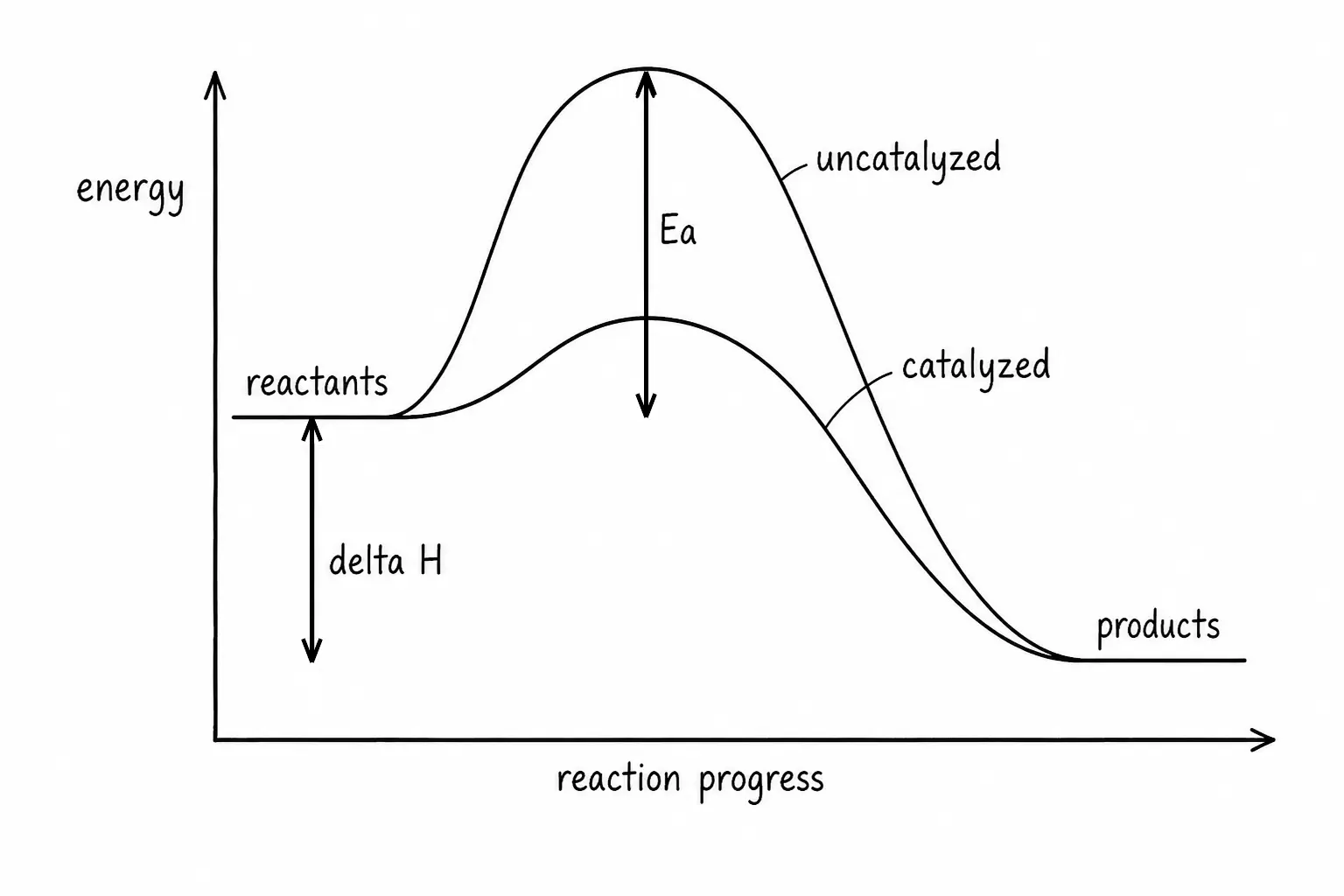
In an energy diagram (energy vs reaction coordinate), reactants sit at one energy and products at another. Between them is a peak, the transition state, corresponding to the moment when old bonds are partially broken and new bonds are partially formed. The energy difference between reactants and this peak is the activation energy \( E_a \).
For an exothermic reaction, the products are lower than the reactants, but molecules still must climb \( E_a \) first. Once over the barrier, energy is released as heat. For an endothermic reaction, products are higher than reactants, and \( E_a \) is even larger.
The Arrhenius Equation
The temperature dependence of a reaction rate constant \( k \) is:
$$ k = A \cdot e^{-E_a / (RT)} $$
where:
- \( A \) is the pre-exponential factor (frequency of collisions with correct orientation).
- \( E_a \) is the activation energy in joules per mole.
- \( R = 8.314 \) J/(mol·K) is the gas constant.
- \( T \) is absolute temperature in kelvins.
The exponential \( e^{-E_a/(RT)} \) is the fraction of molecules with enough energy to react. At low temperature, very few molecules clear the barrier; at high temperature, many more do. A 10°C rise often doubles or triples a reaction rate, exactly because that exponential is so sensitive to \( T \).
Catalysts: Lowering the Barrier
A catalyst speeds a reaction by providing an alternative pathway with a lower activation energy. The reactants and products are unchanged; the catalyst itself emerges unaltered at the end of each cycle. The lower \( E_a \) means a much larger fraction of molecules can react at any given temperature.
Example: hydrogen peroxide decomposes very slowly on its own (\( E_a \approx 76 \) kJ/mol), but with catalase enzyme present, \( E_a \) drops to ~8 kJ/mol. The rate at body temperature rises by roughly \( e^{(76-8) \cdot 10^3 / (8.314 \cdot 310)} \approx 10^{11} \), eleven orders of magnitude faster.
Worked Example: Rate Doubling with Temperature
A reaction has \( E_a = 50 \) kJ/mol. By how much does the rate change going from 25°C (298 K) to 35°C (308 K)?
Using \( \ln(k_2/k_1) = -E_a/R \cdot (1/T_2 – 1/T_1) \):
$$ \ln(k_2/k_1) = -\frac{50000}{8.314} \left(\frac{1}{308} – \frac{1}{298}\right) = -6015 \cdot (-1.089 \times 10^{-4}) = 0.655 $$
So \( k_2/k_1 = e^{0.655} \approx 1.93 \). A 10°C rise nearly doubles the rate, the classic ‘rule of thumb’ that holds when \( E_a \) is in the 50 kJ/mol range.
Why Activation Energy Exists
For a chemical reaction to occur, reactant molecules must collide with enough kinetic energy to break or distort existing bonds, and they must collide in an orientation that allows new bonds to form. Most molecular collisions in everyday conditions fail one or both tests. The activation energy is the energetic price of getting past the unstable transition-state geometry.
Some reactions have negligible \( E_a \), for example, radical recombination in a flame or acid-base proton transfers in solution. These proceed at the collision rate. Most reactions have \( E_a \) values between 40 and 200 kJ/mol, which is why heating is often required.
Applications
- Reaction rate prediction. Measuring rate at two or more temperatures and plotting \( \ln k \) versus \( 1/T \) gives a straight line whose slope is \( -E_a/R \), the standard way activation energies are determined experimentally.
- Industrial catalysis. Nearly every large-scale chemical (ammonia, sulfuric acid, ethylene, gasoline, polyethylene) is made using catalysts that drop \( E_a \) and let reactions run at practical temperatures.
- Enzymes. Living cells use thousands of protein enzymes, each tailored to lower the \( E_a \) of a specific reaction. Without enzymes, life’s chemistry would be too slow to support metabolism.
- Food preservation. Refrigeration slows spoilage reactions exponentially through the Arrhenius equation; a 10°C drop typically cuts microbial growth rate by 2-3×.
- Combustion ignition. Petrol needs a spark and diesel needs compression heating to clear the activation energy barrier; once over it, combustion releases enough energy to keep the reaction going.
Related study notes: Catalysis, Enthalpy, Redox Reactions, Chemical Kinetics.
The OpenStax chemistry textbooks provide further explanations of the chemical principles used in this note.
Temperature and a Barrier
The Arrhenius expression \(k=Ae^{-E_a/(RT)}\) predicts a larger rate constant at a higher temperature when the parameters are held fixed. Taking the ratio between 2 temperatures gives \(\ln(k_2/k_1)=-(E_a/R)(1/T_2-1/T_1)\).
A catalyst supplies an alternative pathway with a lower relevant barrier. It can speed both directions toward equilibrium without changing the equilibrium free-energy difference at the same temperature. In an energy sketch, the catalytic and uncatalyzed paths should share the same reactant and product levels for the same net reaction.
The points to check in this example are:
- Kelvin temperature belongs in the Arrhenius expression.
- Activation energy and reaction enthalpy measure different differences.
- A reaction mechanism can change with conditions, limiting a single-parameter extrapolation.
Check Your Understanding
Try the questions before reading the answers.
Question 1. Does an exothermic reaction have to be fast?
Answer. No. It can have a substantial barrier.
Question 2. Does a catalyst change the net reaction enthalpy?
Answer. No, for the same initial and final states.
Practice Questions
Work each question before reading its solution. The set runs from direct recall and substitution to the applied questions that exams actually use to separate grades. The downloadable PDF includes these questions and their solutions.
Question 1. Define activation energy, and explain why thermodynamically favorable reactions can still be slow.
Solution. \(E_a\) is the minimum energy colliding molecules need to reach the transition state and react. Favorability (\(\Delta G < 0\)) says where equilibrium lies, not how fast it arrives: gasoline plus oxygen is enormously favorable yet sits inert until a spark supplies the barrier energy. Rate and destination are separate questions.
Question 2. Sketch in words the energy profile of an exothermic reaction, marking \(E_a\) and \(\Delta H\).
Solution. The curve starts at the reactant level, climbs to the transition-state peak, and descends to a products level below the start. \(E_a\) is the climb from reactants to the peak; \(\Delta H\) is the net drop from reactants to products. The two are independent: a very exothermic reaction can still carry a huge barrier.
Question 3. What does a catalyst change on the energy profile, and what does it leave untouched?
Solution. It provides an alternative pathway with a lower peak, cutting \(E_a\); enzymes and industrial catalysts both work this way. It does not change reactant or product energies, so \(\Delta H\) and the equilibrium constant stay exactly as they were, and the catalyst emerges unconsumed. Catalysts change the speed of arriving at equilibrium, never its position.
Question 4. Why does a 10°C temperature rise roughly double many reaction rates, when the average molecular energy rises only about 3%?
Solution. Reacting molecules come from the high-energy tail of the Boltzmann distribution, the fraction \(e^{-E_a/RT}\). A small shift of the whole distribution swells that exponential tail disproportionately: for \(E_a \approx 50\) kJ/mol near room temperature, the tail roughly doubles per 10°C. The average barely moves; the eligible minority explodes.
Question 5. State the Arrhenius equation and identify each factor.
Solution. \(k = Ae^{-E_a/RT}\). The exponential is the fraction of collisions energetic enough to clear the barrier; \(A\), the pre-exponential factor, counts collision frequency and how often geometry is right; \(R\) is the gas constant and \(T\) absolute temperature. Taking logarithms gives \(\ln k = \ln A – E_a/RT\), a straight line in \(1/T\) whose slope measures \(E_a\).
Question 6. A reaction’s rate constant doubles between 300 K and 310 K. Estimate \(E_a\).
Solution. \(\ln 2 = \dfrac{E_a}{R}\left(\dfrac{1}{300} – \dfrac{1}{310}\right)\). The bracket is \(\frac{10}{93{,}000} = 1.075 \times 10^{-4}\), so \(E_a = \dfrac{0.693 \times 8.314}{1.075 \times 10^{-4}} \approx 53{,}600\) J/mol \(\approx 54\) kJ/mol. The rule-of-thumb doubling corresponds to a barrier near 50 kJ/mol, exactly why the rule is only a rule of thumb.
Question 7. Why does a refrigerator slow food spoilage, in activation-energy terms?
Solution. Spoilage is chemistry: microbial enzyme reactions and oxidation, all with barriers. Cooling from 25°C to 4°C shrinks the \(e^{-E_a/RT}\) fraction severalfold for typical barriers, so the same reactions run several times slower. The food is not sterilized, merely decelerated, which is why refrigeration buys days, not months.
Question 8. Enzymes accelerate reactions by up to \(10^{17}\). Translate a rate gain of \(10^6\) into an effective \(E_a\) reduction at 310 K.
Solution. Rate ratio \(= e^{\Delta E_a/RT}\), so \(\Delta E_a = RT\ln 10^6 = 8.314 \times 310 \times 13.8 \approx 35{,}600\) J \(\approx 36\) kJ/mol. A modest-sounding barrier cut of 36 kJ/mol delivers a millionfold speedup: the exponential converts small energy engineering into enormous rate leverage.
Question 9. A match ignites paper, yet the fire continues without more matches. Explain the energetics.
Solution. The match supplies the initial \(E_a\) for combustion. Once burning starts, the exothermic reaction releases far more energy than the barrier requires, and that heat activates neighboring molecules in a chain: the reaction pays its own activation bill thereafter. Self-sustaining combustion is a reaction financing its \(E_a\) from its \(\Delta H\).
Question 10. Two reactions have identical \(\Delta H = -100\) kJ/mol, but reaction 1 has \(E_a = 40\) and reaction 2 has \(E_a = 120\) kJ/mol. Compare their behavior at room temperature and their responses to heating.
Solution. Reaction 1 proceeds readily; reaction 2 is effectively frozen, its rate smaller by a factor \(e^{80{,}000/RT} \approx 10^{14}\). Heating helps reaction 2 proportionally more, since the rate’s temperature sensitivity grows with \(E_a\): high-barrier reactions are the ones that “switch on” dramatically when heated. Same destination, wildly different journeys.
Frequently Asked Questions
What is activation energy?
The minimum energy that reactant molecules must possess to undergo a chemical reaction. In an energy diagram, it’s the height of the hill between reactants and products. Reactants must climb this hill (via molecular collisions with enough kinetic energy) before they can become products.
What is the Arrhenius equation?
k = A × e^(-Ea/RT), where k is the rate constant, A is the pre-exponential factor, Ea is activation energy, R is the gas constant, and T is absolute temperature. The exponential factor gives the fraction of molecules with enough energy to react. Plotting ln(k) versus 1/T gives a straight line with slope -Ea/R, the standard way Ea is measured experimentally.
How do catalysts lower activation energy?
A catalyst provides an alternative reaction pathway, one with a lower energy transition state. The reactants and final products are the same, but instead of climbing the original tall hill, the reactants take a shorter route via a different intermediate. Lower Ea means a much larger fraction of molecules have enough energy to react at any given temperature, so the reaction speeds up dramatically.
Why does temperature affect reaction rate so strongly?
Because the rate depends exponentially on -Ea/(RT). Small changes in T cause large changes in e^(-Ea/RT). For activation energies around 50 kJ/mol, a 10°C rise roughly doubles the rate. For Ea around 100 kJ/mol, the same 10°C rise can triple or quadruple it. That’s why refrigerators slow spoilage so effectively.
What is a transition state?
The unstable, high-energy configuration of atoms at the top of the activation energy barrier. Old bonds are partially broken, new bonds are partially formed, and the species has no stable existence, it lasts only a femtosecond or so. Quantum chemistry can model transition states, which is how researchers design new catalysts and pharmaceuticals.
Can activation energy be zero?
Effectively yes for some reactions. Radical-radical combinations and many ion-ion reactions in solution have negligible activation energy and proceed at every collision. But most reactions, especially those involving covalent bond-breaking, have Ea in the 40-200 kJ/mol range, which is why heating, light, or catalysts are usually needed.
Browse more in Chemistry.