by
by
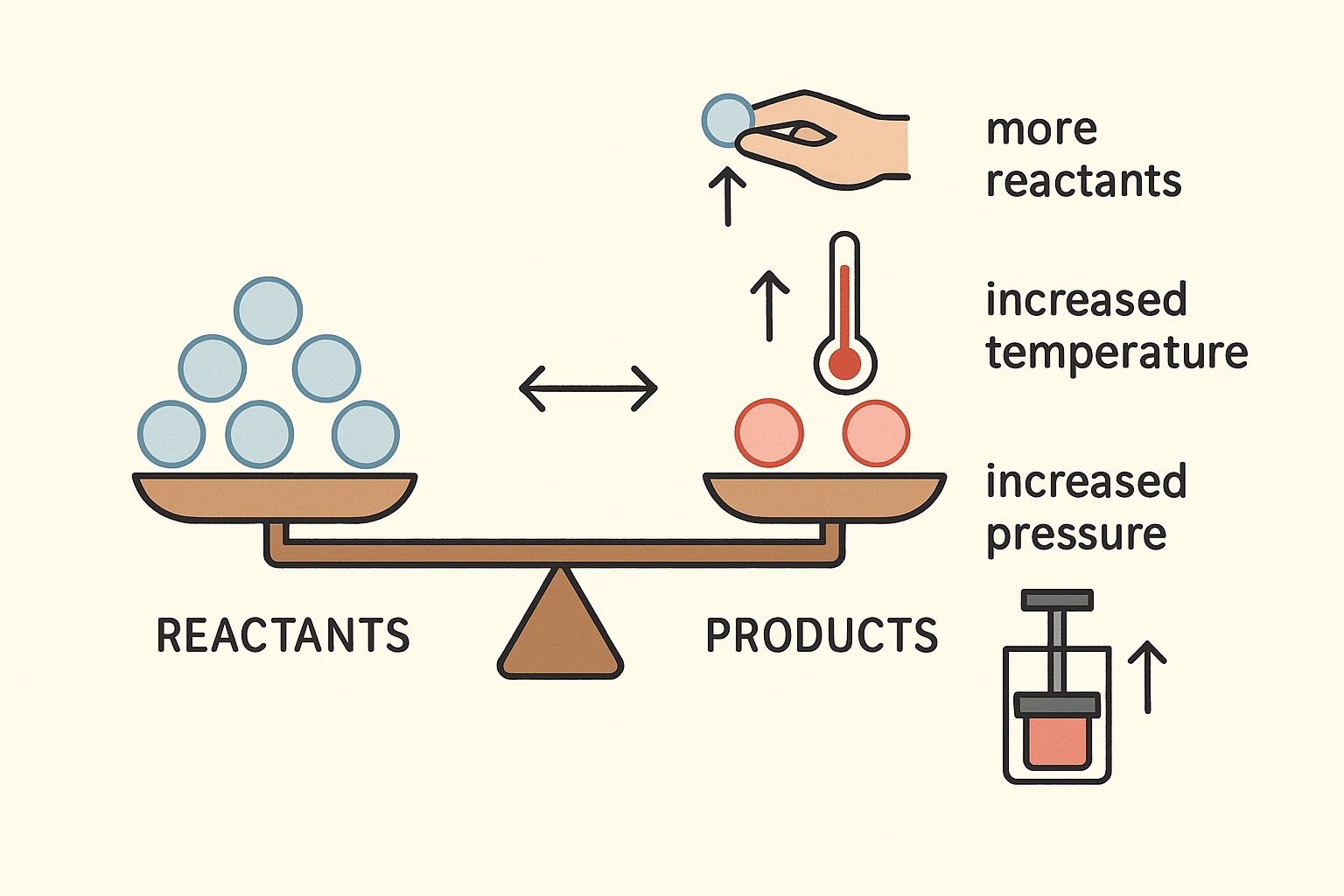
Le Chatelier’s principle is the central rule for predicting how a chemical equilibrium responds to external disturbances. The principle states: when a system at equilibrium is disturbed, the equilibrium shifts in whatever direction counteracts the disturbance and re-establishes equilibrium. Henri-Louis Le Chatelier formulated it in 1884, and it has been the standard mental model for predicting equilibrium behavior ever since. Master Le Chatelier and you can predict the direction of shift for any equilibrium under any of the three standard disturbances, concentration changes, temperature changes, and pressure changes.
An equilibrium disturbance should be analyzed through the reaction quotient and the equilibrium condition. The kind of pressure or concentration change matters.
The Principle
In its simplest form, Le Chatelier’s principle says: if a chemical equilibrium is disturbed, the system shifts to partially counteract the disturbance and re-establish a new equilibrium.
For a generic equilibrium:
$$ aA + bB \rightleftharpoons cC + dD $$
The equilibrium constant \( K_{eq} \) at a given temperature is fixed by thermodynamics. When you disturb the system, the reaction temporarily falls out of equilibrium. It then shifts in whichever direction restores the ratio of products to reactants demanded by \( K_{eq} \). The shift opposes the change you made.
Three Types of Disturbances
1. Concentration Change
Adding more reactants pushes the equilibrium to the right (more product forms). Adding more product pushes it to the left (more reactant forms). Removing reactants pushes left; removing products pushes right. The system always shifts to counteract whatever you added or removed.
Example. For \( N_2 + 3H_2 \rightleftharpoons 2NH_3 \) at equilibrium, adding more N₂ shifts the equilibrium right, producing more NH₃. This is exploited in the Haber-Bosch process for industrial ammonia production, continuously adding feed gases while removing ammonia product keeps the reaction running far to the right.
2. Temperature Change
This is the only type of disturbance that actually changes the value of K_eq. For an exothermic reaction (releases heat), raising the temperature is like adding a product (heat), the equilibrium shifts left, reducing the amount of product. Cooling shifts it right.
For an endothermic reaction (absorbs heat), the reverse: raising temperature shifts right (more product); cooling shifts left.
Example. The Haber process \( N_2 + 3H_2 \rightleftharpoons 2NH_3 + \text{heat} \) is exothermic. Lower temperature would shift right and give higher yield. But lower temperature also makes the reaction painfully slow. Industrial ammonia is produced at a compromise temperature around 400-500°C, with iron catalysts to speed up the kinetics.
3. Pressure Change (for gas-phase reactions)
Increasing pressure on a gas equilibrium shifts the system toward the side with FEWER moles of gas (it occupies less volume, partially relieving the pressure increase). Decreasing pressure shifts toward MORE moles of gas.
Example. \( N_2 + 3H_2 \rightleftharpoons 2NH_3 \) has 4 moles of gas on the left and 2 moles on the right. Increasing pressure shifts the equilibrium right (toward fewer moles), favoring ammonia production. This is why industrial ammonia is produced at extreme pressures, typically 200-300 atmospheres.
Reactions with the same number of moles on each side (like \(H_2 + I_2 \rightleftharpoons 2 HI\)) are not affected by pressure changes, there is no ‘fewer moles’ direction to shift toward.
What a Catalyst Does NOT Do
Catalysts speed up the rates of both forward and reverse reactions equally. They lower the activation energy for both directions by the same amount. The result: the system reaches equilibrium faster, but the equilibrium position itself is unchanged. The K_eq value is unaffected. Catalysts do not shift equilibria, only their approach speed.
This is a common test-question gotcha. If you see ‘a catalyst is added’ in a Le Chatelier problem, the answer is ‘no shift’, the system just gets to its existing equilibrium faster.
The Haber-Bosch Process, A Classic Le Chatelier Application
\( N_2(g) + 3H_2(g) \rightleftharpoons 2NH_3(g) \), exothermic, 4 moles gas → 2 moles gas. Le Chatelier predicts the conditions that maximize ammonia yield:
- Low temperature: favors the exothermic forward reaction.
- High pressure: favors the side with fewer moles of gas (the products).
- High concentrations of N₂ and H₂: push the equilibrium toward products.
- Continuous removal of NH₃: keeps the system out of equilibrium in the forward direction.
In practice, low temperature would make the kinetics intolerably slow. Industry settles on a compromise: temperature ~400-500°C, pressure ~200-300 atm, iron catalyst to speed the reaction. The Haber-Bosch process has been running since 1913 and is responsible for the synthetic nitrogen fertilizers that feed roughly half the world’s population. It is also one of the most energy-intensive industrial processes, consuming about 1-2% of global energy production.
Quantitative Approach, the Reaction Quotient Q
Le Chatelier’s principle is qualitative. For quantitative predictions, compare the reaction quotient \( Q \) to the equilibrium constant \( K_{eq} \).
$$ Q = \dfrac{[C]^c [D]^d}{[A]^a [B]^b} $$
\( Q \) has the same form as \( K_{eq} \) but uses CURRENT concentrations, not equilibrium concentrations. Then:
- If \( Q < K_{eq} \), the reaction shifts RIGHT (toward products) to reach equilibrium.
- If \( Q > K_{eq} \), the reaction shifts LEFT (toward reactants).
- If \( Q = K_{eq} \), the system is at equilibrium and no net shift occurs.
This is the rigorous version of Le Chatelier. The principle gives the direction; \( Q \) vs \( K_{eq} \) gives the precise mathematical reason.
Related study notes: Chemical Equilibrium, Ideal Gas Law, Stoichiometry, Electronegativity.
The OpenStax chemistry textbooks provide further explanations of the chemical principles used in this note.
Pressure and an Inert Gas
For N2 + 3H2 ⇌ 2NH3 in an ideal-gas mixture, compression at constant temperature raises the partial pressures and favors the side with fewer gas molecules. The product side has 2 coefficient units compared with 4 on the reactant side.
Adding an inert gas at constant volume does not change the reactants’ partial pressures in the ideal-gas model, so it does not cause the same shift as compression. Adding it at constant total pressure expands the mixture and can produce a different response. "Increasing pressure" should therefore describe an actual operation.
The points to check in this example are:
- Temperature can change K, while many composition disturbances initially change Q.
- A catalyst does not shift the equilibrium position at fixed temperature.
- Equal gas-coefficient totals remove the simple compression preference in the ideal model.
Check Your Understanding
Try the questions before reading the answers.
Question 1. What side does compression favor in the ammonia example?
Answer. The ammonia side.
Question 2. Does inert-gas addition at constant volume necessarily shift it?
Answer. No, under the ideal-gas assumptions.
Frequently Asked Questions
What is Le Chatelier’s principle in simple terms?
When a chemical equilibrium is disturbed, the system shifts in the direction that opposes the disturbance and re-establishes equilibrium. If you add more reactant, the reaction makes more product. If you raise temperature on an exothermic reaction, the reaction shifts to absorb the heat. The system always pushes back against whatever you change.
What are the three types of disturbances?
(1) Concentration changes, adding or removing reactants or products. (2) Temperature changes, heating or cooling. (3) Pressure changes, for gas-phase reactions only. Each disturbance type causes the equilibrium to shift in a predictable direction based on Le Chatelier’s principle.
Does a catalyst shift the equilibrium?
No. Catalysts speed up both the forward and reverse reactions equally, so the system reaches equilibrium faster but the equilibrium position itself is unchanged. K_eq is independent of the catalyst. This is a common test gotcha, when a catalyst is added, the answer is always ‘no shift’.
How does temperature affect chemical equilibrium?
For exothermic reactions (release heat), raising temperature shifts equilibrium LEFT, toward reactants. Cooling shifts right. For endothermic reactions (absorb heat), raising temperature shifts RIGHT, toward products. Cooling shifts left. Temperature is the only type of disturbance that actually changes the value of K_eq.
Why does increasing pressure favor products in the Haber process?
The Haber process N₂ + 3H₂ → 2NH₃ has 4 moles of gas on the reactant side and only 2 moles on the product side. Le Chatelier’s principle says that increasing pressure favors the side with FEWER moles of gas, because compressing into fewer gas molecules partially relieves the pressure increase. So high pressure (~200-300 atm in industrial practice) shifts the equilibrium toward ammonia.
What is the difference between Q and K_eq?
K_eq (equilibrium constant) is the ratio of product to reactant concentrations AT equilibrium. Q (reaction quotient) has the same mathematical form but uses CURRENT (non-equilibrium) concentrations. Comparing Q to K_eq tells you which way the reaction will shift: if Q K_eq, it shifts left.
Browse more in Chemistry.