
 by
byStoichiometry is the quantitative arithmetic of chemical reactions. It tells you how much product forms from given amounts of reactants, which reactant runs out first, what the percent yield is, and how to scale a reaction up or down. Every working chemist uses stoichiometry constantly, in the lab, in industrial chemistry, in pharmaceutical manufacturing, and in any quantitative reaction analysis.
The whole framework rests on conservation of mass (atoms aren’t created or destroyed) and the mole concept (counting via Avogadro’s number). The five-step recipe, balance the equation, convert mass to moles, apply mole ratio, convert moles back to mass, check limiting reagent, handles essentially every textbook stoichiometry problem.
This study note covers balanced equations, mole ratios, the conversion recipe, limiting reagents and percent yield, solutions and gas stoichiometry, worked examples, common pitfalls, and the practical applications across industries.
Balanced Chemical Equations
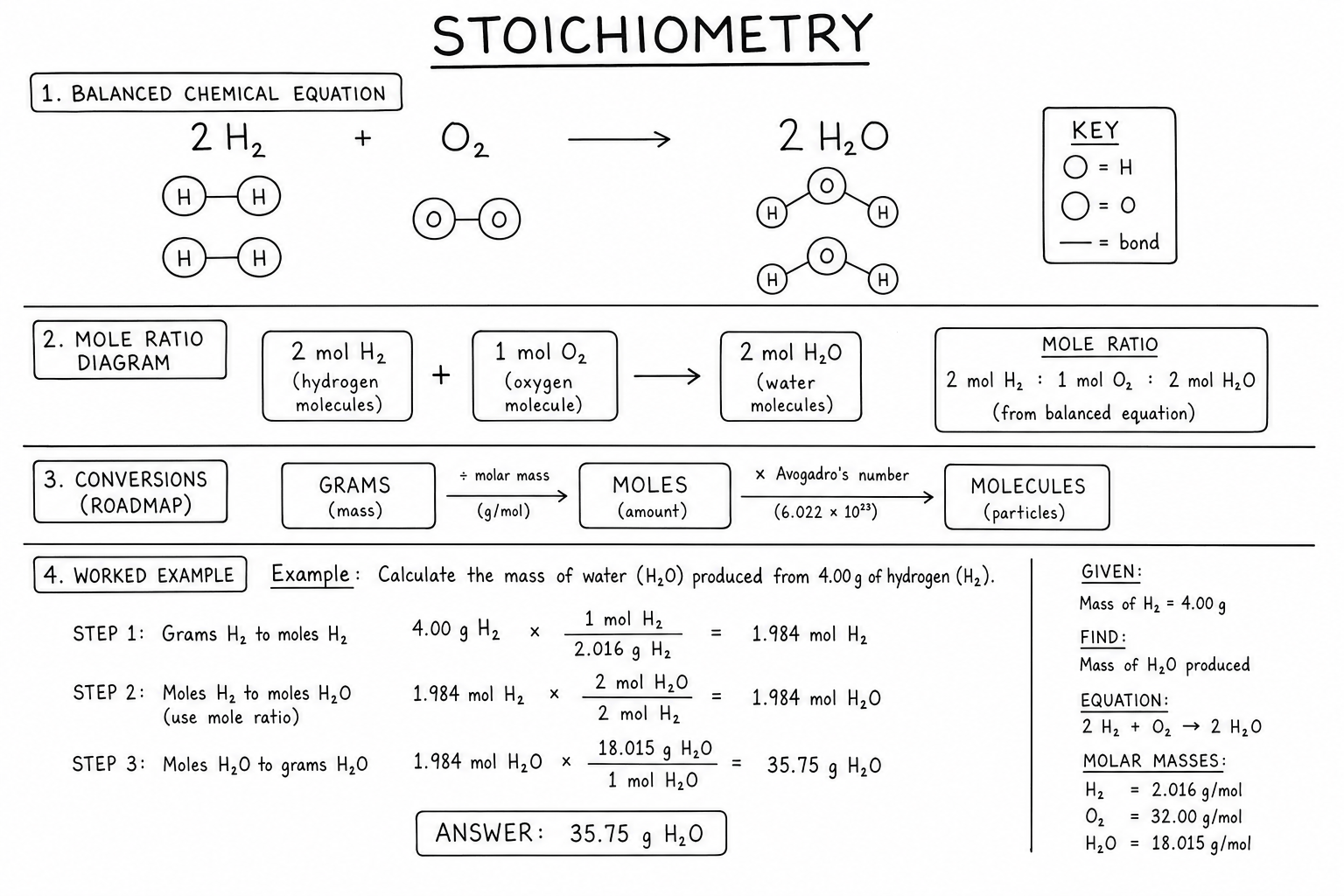
A chemical equation describes a reaction by listing reactants on the left and products on the right, with an arrow between them. Balancing requires equal numbers of each atom on both sides, reflecting conservation of mass (Lavoisier, 1774).
Example: hydrogen reacting with oxygen to form water. The skeleton equation H₂ + O₂ → H₂O isn’t balanced (2 H and 2 O on left vs 2 H and 1 O on right). Balance by adjusting coefficients (never subscripts): 2H₂ + O₂ → 2H₂O. Now: 4 H and 2 O on each side. Done.
Balancing harder equations uses systematic methods: balance the most complex molecule first, save H and O for last, use fractional coefficients then multiply through. For redox reactions, balance using half-reactions tracking electron transfer separately.
Mole Ratios from the Equation
Coefficients in a balanced equation give mole ratios, not mass ratios. The equation \(2H_2 + O_2 \to 2H_2O\) means: 2 moles of hydrogen plus 1 mole of oxygen produce 2 moles of water. The mass ratios are different (4 g H₂ + 32 g O₂ → 36 g H₂O, same total mass, but very different per-substance proportions).
Mole ratios are the bridge between reactants and products in any stoichiometry calculation. To find moles of any species in the reaction, multiply moles of any other species by the appropriate ratio from the balanced equation.
This is the chemistry-specific step in every stoichiometry problem. Everything else is unit conversion. Reading mole ratios off a balanced equation is a foundational skill.
Mole Ratio Examples
- 2H₂ + O₂ → 2H₂O: H₂:O₂:H₂O = 2:1:2. So 4 mol H₂ requires 2 mol O₂ and produces 4 mol H₂O.
- N₂ + 3H₂ → 2NH₃: N₂:H₂:NH₃ = 1:3:2. So 5 mol N₂ requires 15 mol H₂ and produces 10 mol NH₃.
- C₃H₈ + 5O₂ → 3CO₂ + 4H₂O: C₃H₈:O₂:CO₂:H₂O = 1:5:3:4. So 2 mol propane requires 10 mol O₂ and produces 6 mol CO₂ and 8 mol H₂O.
Once you can extract these ratios on sight, stoichiometry becomes routine arithmetic.
The Five-Step Recipe
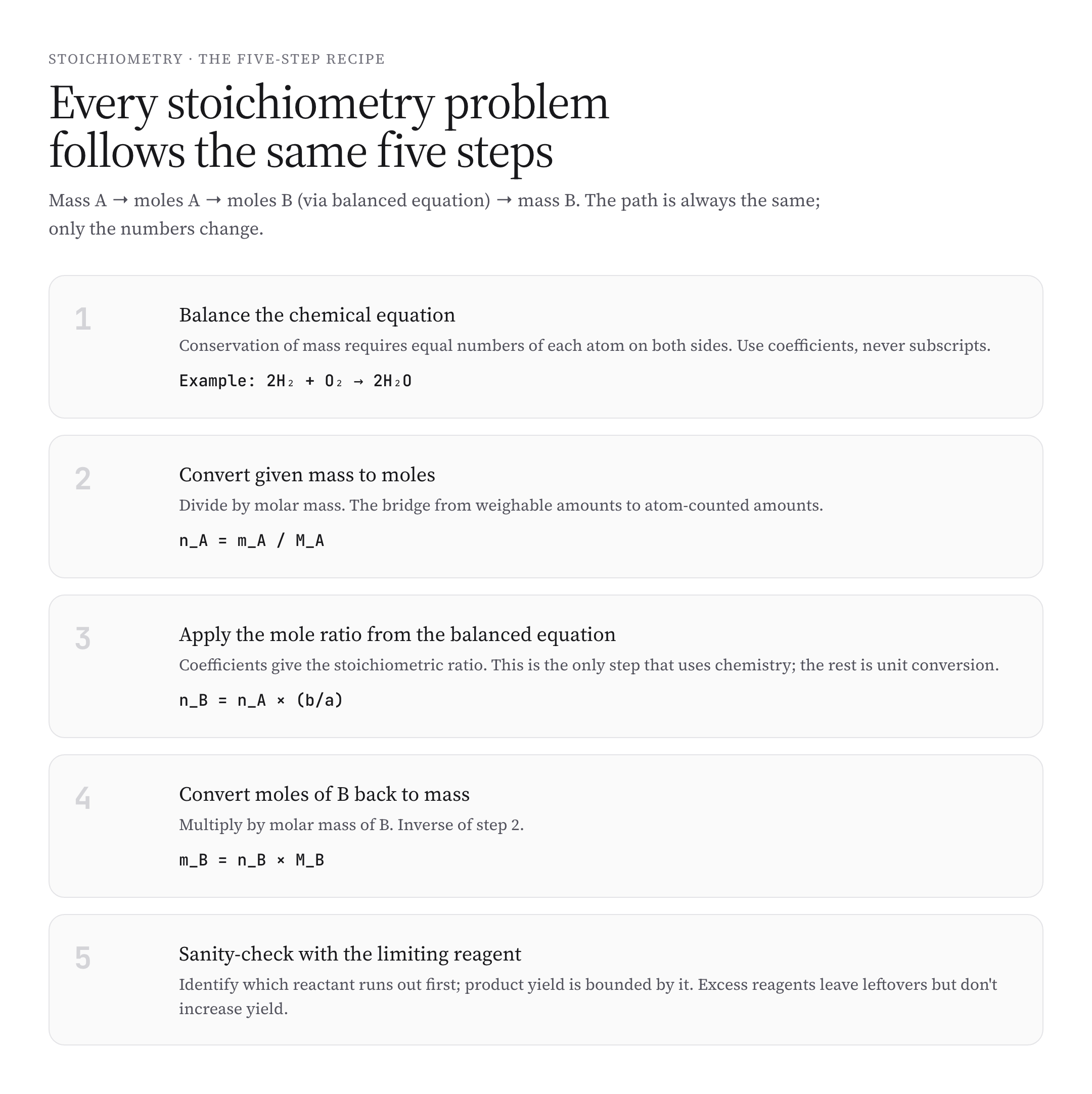
Every standard stoichiometry problem follows the same five steps:
- Balance the chemical equation. Without a balanced equation, the mole ratio is wrong.
- Convert given mass (or volume, or particles) of starting substance to moles.
- Apply the mole ratio from the balanced equation to get moles of the target substance.
- Convert moles of target back to mass (or volume, or particles).
- Check for limiting reagent if more than one reactant is given. The limiting reagent determines how much product can form; excess reactants leave leftovers.
This recipe scales from simple homework problems to industrial reactor design. The arithmetic gets longer for complex reactions, but the structure is always the same.
Limiting Reagent
When you mix specified amounts of two or more reactants, one of them runs out before the others. That’s the limiting reagent, it determines how much product can form. Excess reagents are whatever’s left over.
To find the limiting reagent: convert each reactant to moles, divide by its coefficient, and the smallest result identifies the limiting reagent. The amount of product calculated using the limiting reagent’s moles is the maximum theoretical yield.
Example: 4 mol H₂ + 1 mol O₂ in the reaction 2H₂ + O₂ → 2H₂O. H₂: 4/2 = 2. O₂: 1/1 = 1. O₂ is limiting (smaller value). Theoretical yield: 1 mol O₂ × (2 mol H₂O / 1 mol O₂) = 2 mol H₂O. Excess H₂: 4 mol provided − (2 × 1 mol used) = 2 mol H₂ left over.
Theoretical and Percent Yield
The theoretical yield is the maximum amount of product that could form, based on stoichiometry from the limiting reagent. The actual yield is what you obtain experimentally, almost always less, due to incomplete reaction, side reactions, losses during purification.
Percent yield = (actual yield / theoretical yield) × 100%. Industrial reactions typically aim for 80-95% yield. Pharmaceutical syntheses sometimes accept much lower per-step yields when the products are valuable enough.
If percent yield exceeds 100%, your product is impure (contaminated with solvent or unreacted starting material). 100% yields are rare and slightly suspicious. Most synthetic chemists treat anything above 95% with skepticism unless they can verify purity.
Worked Example: Limiting Reagent
How much water forms when 6.0 g H₂ reacts with 32 g O₂? (2H₂ + O₂ → 2H₂O)
Convert to moles. H₂: 6.0 / 2.016 = 2.98 mol. O₂: 32 / 32.0 = 1.0 mol.
Find limiting reagent. H₂: 2.98 / 2 = 1.49. O₂: 1.0 / 1 = 1.0. O₂ is limiting.
Use limiting reagent to find moles of product. Mol H₂O = 1.0 × (2/1) = 2.0 mol.
Convert moles to mass. Mass H₂O = 2.0 × 18.02 = 36 g.
So 36 g of water form. Excess H₂: 2.98 mol provided − (2 × 1.0 mol used) = 0.98 mol H₂ = 1.97 g unreacted.
Solution Stoichiometry
For solutions, use molarity to convert between volume and moles. \(n = M \times V\) (moles = molarity × volume in liters). The rest of the recipe is the same.
Example: how much 0.5 M NaOH solution neutralizes 25 mL of 1.0 M HCl? Reaction: HCl + NaOH → NaCl + H₂O (1:1 mole ratio).
Moles HCl = 0.025 L × 1.0 M = 0.025 mol. Moles NaOH needed = 0.025 mol (1:1 ratio). Volume NaOH = 0.025 / 0.5 = 0.050 L = 50 mL.
Titration calculations follow this same pattern. Acid-base neutralizations, redox titrations, and complexation titrations all reduce to solution stoichiometry.
Gas Stoichiometry
For gases at STP, use 22.4 L/mol to convert between volume and moles. For other conditions, use the ideal gas law \(PV = nRT\). The rest of the recipe is unchanged.
Example: how many liters of CO₂ form at STP when 100 g of propane (C₃H₈, molar mass 44.1 g/mol) burns completely? Reaction: C₃H₈ + 5O₂ → 3CO₂ + 4H₂O.
Mol C₃H₈ = 100 / 44.1 = 2.27 mol. Mol CO₂ = 2.27 × 3 = 6.80 mol. Volume = 6.80 × 22.4 = 152 L.
Combustion calculations like this are central to chemical engineering, environmental analysis (CO₂ emissions), and energy calculations.
Empirical and Molecular Formulas Revisited
Stoichiometry also goes the other direction, given combustion analysis or elemental composition, work out the formula. Burn a sample, measure CO₂ and H₂O produced, and back-calculate moles of each element.
Example: 0.30 g of an unknown compound burns to produce 0.44 g CO₂ and 0.18 g H₂O. Mol C = 0.44 / 44 = 0.010 (one C per CO₂). Mol H = 2 × (0.18 / 18) = 0.020 (two H per H₂O). Mass of C = 0.010 × 12 = 0.12 g. Mass of H = 0.020 × 1 = 0.020 g. Total = 0.14 g, so the rest (0.30 − 0.14 = 0.16 g) is some other element, often O. Mol O = 0.16 / 16 = 0.010.
Mole ratio C : H : O = 0.010 : 0.020 : 0.010 = 1 : 2 : 1. Empirical formula: CH₂O. Combined with the molar mass (from a separate measurement), the molecular formula follows.
Excess Reagent Tracking
Stoichiometry isn’t just about the limiting reagent. You often need to know how much excess remains, since excess reagents have to be removed, recycled, or disposed of.
Industrial reactions often run with one cheap reagent in excess to ensure complete conversion of the expensive one. Example: the Haber process for ammonia uses excess hydrogen to push N₂ + 3H₂ → 2NH₃ toward completion (N₂ is the more expensive feedstock to manufacture pure).
Tracking excess matters for purification too. The unreacted excess reagent has to be separated from the product, which adds cost and complexity. Choosing the right reagent ratios is part of every reaction design.
Atom Economy and Green Chemistry
Atom economy is the fraction of reactant atoms that end up in the desired product. \(\text{Atom economy} = (\text{molar mass of product}) / (\text{sum of molar masses of all reactants}) \times 100\%\).
High atom economy means little waste. Low atom economy means lots of byproducts to dispose of. Green chemistry favors high-atom-economy reactions because they generate less waste, use less raw material, and produce cleaner products.
Example: an addition reaction (A + B → AB) has 100% atom economy, every atom of A and B ends up in the product. A substitution reaction (A-X + Y → A-Y + X) has lower atom economy because X is lost as waste. Modern industrial chemistry is increasingly evaluated on atom economy alongside yield.
Common Mistakes With Stoichiometry
- Forgetting to balance the equation. Unbalanced equations give wrong mole ratios. Always balance first; never skip this step.
- Using mass ratios instead of mole ratios. Coefficients are mole ratios, not mass ratios. You can’t reason with grams directly; convert to moles first.
- Skipping the limiting reagent check. When two or more reactants are given, identify the limiting reagent before computing yields. Otherwise you may overestimate.
- Confusing molar mass and atomic mass. Molar mass is g/mol; atomic mass is amu. Numerically equal but different units in different contexts.
- Misapplying the ideal gas law. The 22.4 L/mol value is only at STP. For non-STP conditions, use the full PV = nRT.
- Not tracking units. Stoichiometry has many unit conversions. Track units explicitly through every step; they catch most calculation errors.
Industrial and Lab Stoichiometry
- Industrial chemistry: reactor sizing, raw material orders, byproduct disposal, all stoichiometry-driven.
- Pharmaceuticals: drug synthesis routes optimized for atom economy, yield, and minimal protecting-group steps. Multi-step syntheses compound stoichiometric losses; high per-step yields matter enormously.
- Combustion analysis: determines C, H, O composition of organic compounds via CO₂ and H₂O production.
- Titration: determines unknown concentration by stoichiometric reaction with known concentration. Universal in analytical chemistry.
- Environmental monitoring: emission inventories, fertilizer runoff calculations, ozone-depletion potential, all stoichiometry.
- Food chemistry: nutritional labeling, fermentation calculations, baking soda vs baking powder ratios, stoichiometric balancing in everyday cooking.
Worked Example: Combustion Analysis
A 1.00 g sample of an organic compound containing only C, H, and O burns completely to produce 2.40 g CO₂ and 0.984 g H₂O. Find the empirical formula.
Mol C = 2.40 / 44.0 = 0.0545 mol. Mass C = 0.0545 × 12.01 = 0.655 g. Mol H = 2 × 0.984 / 18.02 = 0.109 mol. Mass H = 0.109 × 1.008 = 0.110 g. Mass O = 1.00 − 0.655 − 0.110 = 0.235 g. Mol O = 0.235 / 16.00 = 0.0147 mol.
Mole ratio C : H : O = 0.0545 : 0.109 : 0.0147. Divide by smallest (0.0147): 3.71 : 7.41 : 1. Multiply by 4: 14.8 : 29.6 : 4 ≈ C₁₅H₃₀O₄ (rough). Actually with cleaner experimental numbers, you’d typically land on a clean integer ratio like C₃H₆O, a propanol or related compound.
Combustion analysis was the standard method for organic compound formulas before mass spectrometry. It still gives elemental composition reliably.
Industrial Stoichiometry
Industrial chemistry runs on stoichiometric calculations at scale. The Haber process produces ammonia (N₂ + 3H₂ → 2NH₃) at roughly 200 million tons per year worldwide. Stoichiometric calculations determine: how much N₂ and H₂ to feed the reactor, how much NH₃ comes out, how much energy is released, what reactor volume is needed for given throughput, and what byproducts (if any) form.
Other major industrial stoichiometric processes: contact process (sulfuric acid, 250M tons/year), Solvay process (sodium carbonate), Ostwald process (nitric acid), and steel production. Each uses stoichiometry-based design at every step. Engineers regularly compute byproduct flows, recycle streams, and conversion efficiencies, all stoichiometry applied at industrial scale.
Worked Example: Solution Stoichiometry
How many mL of 0.50 M H₂SO₄ are needed to neutralize 25.0 mL of 0.40 M NaOH?
Reaction: H₂SO₄ + 2NaOH → Na₂SO₄ + 2H₂O. Mole ratio H₂SO₄:NaOH = 1:2.
Mol NaOH = 0.0250 × 0.40 = 0.0100 mol. Mol H₂SO₄ needed = 0.0100 × (1/2) = 0.00500 mol. Volume H₂SO₄ = 0.00500 / 0.50 = 0.0100 L = 10.0 mL.
About 10 mL of sulfuric acid neutralize 25 mL of sodium hydroxide solution at the given concentrations. Titration calculations like this run constantly in analytical chemistry labs to determine unknown concentrations or to prepare specific solutions.
FAQs
What is stoichiometry?
The quantitative arithmetic of chemical reactions, calculating amounts of reactants needed, products formed, limiting reagents, and percent yields from balanced chemical equations. Every quantitative chemistry problem involving reactions uses stoichiometry.
How do I balance a chemical equation?
Adjust coefficients (never subscripts) so each element has equal counts on both sides. Strategy: balance most complex molecule first, save H and O for last, use fractional coefficients then multiply through. For redox reactions, balance using half-reactions tracking electron transfer.
What is a mole ratio?
The ratio of coefficients in a balanced equation, giving how many moles of one substance correspond to each mole of another. The equation 2H₂ + O₂ → 2H₂O has H₂:O₂:H₂O = 2:1:2. Mole ratios are the chemistry-specific bridge between reactants and products in stoichiometric calculations.
What is a limiting reagent?
The reactant that runs out first in a reaction with two or more reactants, determining the maximum amount of product. To find it: convert each reactant to moles, divide by its coefficient, and the smallest result identifies the limiting reagent. Excess reagents leave leftovers.
What is theoretical yield?
The maximum amount of product that could form, calculated from the limiting reagent’s moles using stoichiometry. Actual yield is what you obtain experimentally; percent yield = actual / theoretical × 100%. Most reactions yield less than theoretical due to incomplete reaction, side reactions, or losses during purification.
How do I calculate percent yield?
Percent yield = (actual yield / theoretical yield) × 100%. The theoretical yield comes from stoichiometric calculation using the limiting reagent. Percent yields above 100% indicate impure product (contaminated with solvent or starting material).
What’s the five-step stoichiometry recipe?
(1) Balance the equation. (2) Convert given mass to moles via molar mass. (3) Apply the mole ratio from the balanced equation. (4) Convert moles back to mass. (5) Check for limiting reagent if multiple reactants given. Every standard stoichiometry problem follows this pattern.
How do I do gas stoichiometry?
At STP (0°C, 1 atm), one mole of any ideal gas occupies 22.4 L. So convert between gas volume and moles using V = n × 22.4 L. For non-STP conditions, use the ideal gas law PV = nRT. The rest of the stoichiometry recipe is unchanged.
How do I do solution stoichiometry?
Use molarity to convert between volume and moles: n = M × V (volume in liters). Otherwise the recipe is the same. Titration calculations are the most common example: find unknown concentration by stoichiometric reaction with known concentration.
What is atom economy?
The fraction of reactant atoms that end up in the desired product. Higher atom economy means less waste. Calculated as (molar mass of product) / (sum of molar masses of all reactants) × 100%. Green chemistry favors high-atom-economy reactions.
Why is balancing the equation so important?
Because the mole ratio comes from the coefficients, and unbalanced equations give wrong ratios. Without correct stoichiometric coefficients, every subsequent calculation is wrong. Balance first, always; never skip the step even when the answer ‘looks obvious.’
Can I do stoichiometry in mass units instead of moles?
Only by converting through moles. The mole is the universal counting unit; mass ratios depend on molar masses and don’t follow the equation coefficients directly. Trying to skip the mole step is the most common source of stoichiometric errors.
How does stoichiometry apply to industrial chemistry?
It drives reactor sizing, raw material procurement, byproduct disposal, energy calculations, and economic analysis. Industrial chemists optimize stoichiometric ratios to maximize yield, minimize waste, and reduce cost. The Haber process for ammonia and the contact process for sulfuric acid are textbook examples of stoichiometric optimization.
What’s the difference between empirical and molecular formula calculation?
Both use stoichiometry but in opposite directions. Empirical formula: from elemental composition (mass percentages), find the simplest integer ratio of atoms. Molecular formula: combine empirical formula with molar mass to get the actual atom count, which is an integer multiple of empirical.
How is stoichiometry used in industrial chemistry?
To determine reactor sizes, raw material orders, energy requirements, byproduct flows, and economic viability of chemical processes. The Haber process for ammonia, contact process for sulfuric acid, and Solvay process for sodium carbonate all rely on detailed stoichiometric analysis at industrial scale to optimize yield and cost.
Browse more in Chemistry.