by
by
Molarity is the most common way to express the concentration of a solution in chemistry. It is defined as moles of solute per liter of solution, with units of mol/L (often abbreviated M). A 1 M solution contains 1 mole of solute dissolved in enough solvent to make exactly 1 liter of solution. Molarity is the workhorse unit for stoichiometry, titration calculations, and most quantitative chemistry. Master molarity and you can convert between mass, moles, and volume in any solution problem.
Molarity uses the final solution volume. The solvent volume poured initially is not automatically the same quantity.
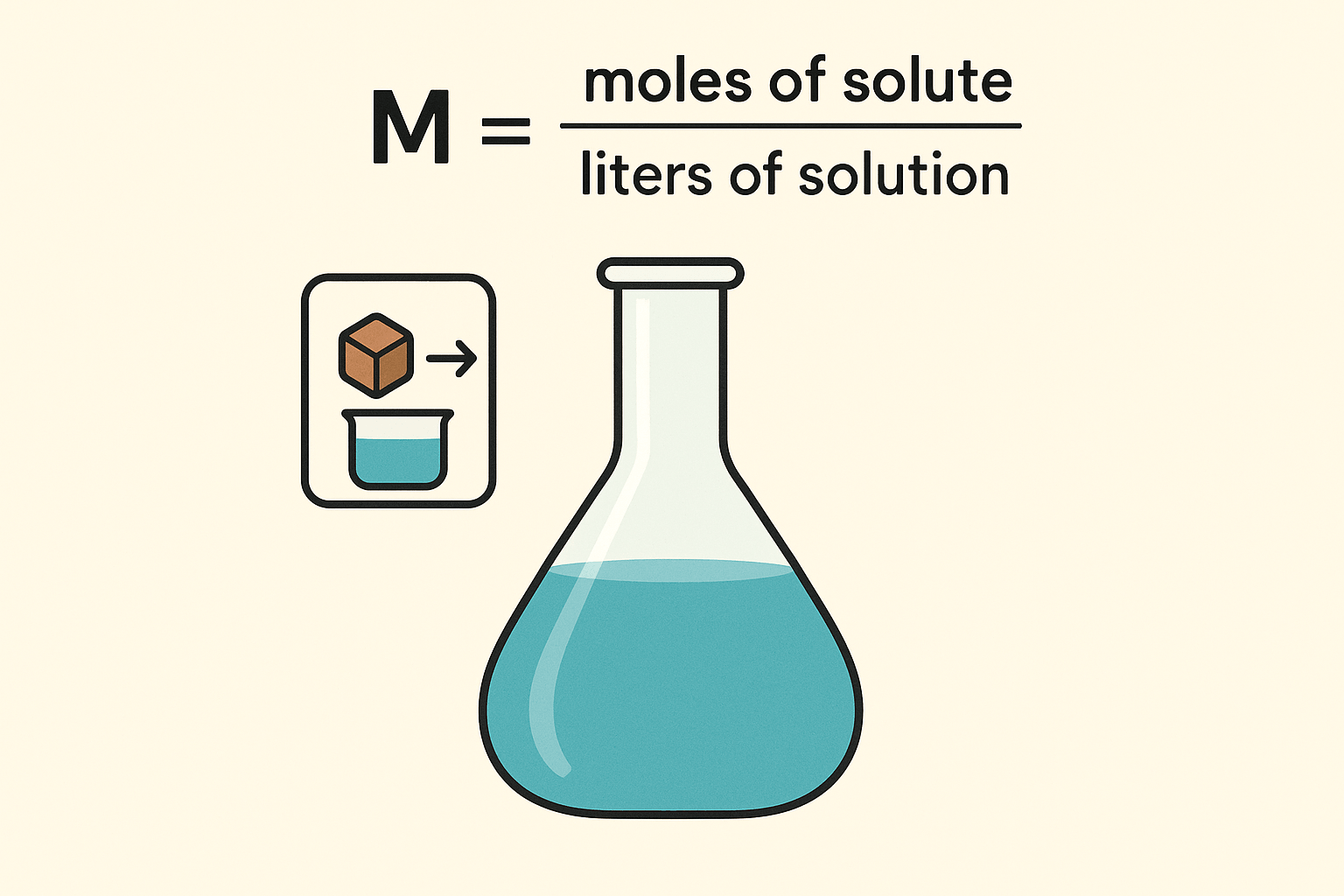
The Formula
$$ \text{Molarity} = \frac{\text{moles of solute}}{\text{liters of solution}} $$
$$ M = \frac{n}{V} $$
Notice the denominator is the volume of the FINAL solution, not the volume of solvent added. This distinction matters, adding 100 g of NaCl to 1 L of water yields more than 1 L of solution because the dissolved ions take up space. To prepare a 1 M solution precisely, you dissolve the solute in some water, then dilute up to the 1 L mark in a volumetric flask.
Worked Examples
Example 1. Calculate the molarity of a solution made by dissolving 58.5 g of NaCl in enough water to make 0.500 L of solution.
NaCl molar mass = 58.5 g/mol, so 58.5 g = 1.00 mol. Molarity = 1.00 mol / 0.500 L = 2.00 M.
Example 2. How much solute is needed to make 250 mL of 0.10 M glucose solution? Glucose molar mass = 180.16 g/mol.
Moles needed = 0.10 mol/L × 0.250 L = 0.025 mol. Mass = 0.025 mol × 180.16 g/mol = 4.50 g.
Example 3. What volume of 6.0 M HCl gives 0.30 mol of HCl?
Volume = moles / molarity = 0.30 mol / 6.0 mol/L = 0.050 L = 50 mL.
Dilution
When a stock solution is diluted with more solvent, the number of moles of solute stays constant while the volume increases. The dilution equation:
$$ M_1 V_1 = M_2 V_2 $$
where subscripts 1 and 2 refer to before and after dilution. To prepare a less concentrated solution from a stock, measure out the volume \( V_1 \) of stock needed and dilute up to the desired final volume \( V_2 \).
Example. To make 500 mL of 0.20 M NaOH from 2.0 M stock: \( V_1 = (0.20)(500)/2.0 = 50 \) mL. Measure 50 mL of stock solution, then dilute up to 500 mL total.
Molarity vs Other Concentration Units
| Unit | Definition | When used |
|---|---|---|
| Molarity (M) | moles solute / liters solution | Default for most chemistry; varies with temperature (volume changes) |
| Molality (m) | moles solute / kg solvent | Used when temperature changes are important (mass is temperature-invariant) |
| Mass % | (mass solute / mass solution) × 100 | Industrial and food applications |
| Mole fraction | moles solute / total moles | Vapor-pressure calculations, gas mixtures |
| Parts per million (ppm) | (mass solute / mass solution) × 10⁶ | Very dilute solutions, environmental chemistry |
| Normality (N) | equivalents solute / liters solution | Acid-base and redox titrations; now mostly replaced by molarity |
Using Molarity in Stoichiometry
Molarity is the link between volume and moles in solution stoichiometry. For a reaction in solution:
- Convert solution volume × molarity → moles of solute.
- Use the balanced equation’s mole ratio → moles of other species.
- Convert moles → mass, or → volume of another solution (if also given a molarity).
Example. What volume of 0.150 M AgNO₃ is needed to precipitate all the chloride from 25.0 mL of 0.100 M NaCl? Reaction: \( \text{AgNO}_3 + \text{NaCl} \to \text{AgCl} + \text{NaNO}_3 \) (1:1 mole ratio). Moles NaCl = 0.0250 × 0.100 = 0.00250 mol. Moles AgNO₃ needed = 0.00250 mol (1:1). Volume = 0.00250 / 0.150 = 0.0167 L = 16.7 mL.
Related study notes: Mole Concept, Avogadro’s Number, Stoichiometry, Titration.
The OpenStax chemistry textbooks provide further explanations of the chemical principles used in this note.
Preparation and Dilution
A solution containing 0.0500 mol of solute in a final volume of 250.0 mL has concentration 0.200 mol/L. The calculation uses 0.2500 L of solution, including the solute contribution to the final volume.
To dilute 25.0 mL of that solution to 100.0 mL without reaction or loss of solute, the final molarity is 0.0500 M. The solute amount remains 0.00500 mol. The relation M1V1 = M2V2 expresses that conserved amount; it does not cover a situation where the solute reacts or precipitates.
The points to check in this example are:
- Use liters when concentration is expressed in mol/L.
- Final solution volume belongs in the denominator.
- Temperature can change volume and therefore molarity.
Check Your Understanding
Try the questions before reading the answers.
Question 1. How many moles are in 100 mL of a 0.10 M solution?
Answer. 0.010 mol.
Question 2. Does dilution change the amount of solute if nothing is lost or reacted?
Answer. No.
Frequently Asked Questions
What is molarity?
Molarity is the concentration of a solution expressed as moles of solute per liter of solution. Units are mol/L or M. A 1 M solution contains 1 mole of solute dissolved in enough solvent to bring the total volume to exactly 1 liter. Molarity is the default concentration unit for most chemistry calculations.
How do you calculate molarity?
Molarity = moles of solute ÷ liters of solution. To find moles from mass: moles = mass ÷ molar mass. So molarity = (mass ÷ molar mass) ÷ volume in liters. Example: 58.5 g of NaCl (molar mass 58.5 g/mol) in 0.5 L of solution gives molarity = 1.00 mol / 0.5 L = 2.00 M.
What’s the difference between molarity and molality?
Molarity (M) uses liters of solution (the final volume after dissolving). Molality (m) uses kilograms of solvent (just the mass of solvent before adding solute). Molarity changes with temperature because volume depends on temperature; molality does not. For most lab work, molarity is used. For freezing-point and boiling-point calculations, molality is preferred because temperature changes are involved.
What is the dilution formula?
M1 × V1 = M2 × V2. The moles of solute stay constant during dilution (you’re just adding solvent), so the product of molarity and volume is conserved. To prepare a less concentrated solution, measure the volume V1 of stock solution and dilute up to the final volume V2 with solvent.
Why is volume measured AFTER dissolving the solute?
Because dissolved solute takes up some volume. Adding 100 g of NaCl to exactly 1 L of water gives MORE than 1 L of solution. To prepare exactly 1 L of 1 M NaCl, dissolve 1 mole of NaCl in some water, then add water up to the 1 L mark in a volumetric flask. This way the final volume is precisely 1 L, regardless of how much volume the dissolved ions added.
How do you use molarity in stoichiometry?
Convert volume × molarity → moles of solute, then use the balanced equation’s mole ratios to find moles of other species, then convert back to mass or volume as needed. Molarity is the bridge between volume and moles. Example: to find how much AgNO3 reacts with 25 mL of 0.1 M NaCl, calculate moles of NaCl (0.025 × 0.1 = 0.0025 mol), find moles of AgNO3 needed (1:1 ratio), then convert moles to volume of AgNO3 solution.
Browse more in Chemistry.