
 by
byThe mole concept is the bridge that makes chemistry quantitative. Atoms and molecules are too small to count one by one, but they react in fixed ratios. The mole packages a huge but precisely-defined number of particles, Avogadro’s number, \(6.022 \times 10^{23}\), into a unit you can weigh on a balance. Chemistry stops being about atoms and starts being about grams once you have moles.
Every quantitative calculation in chemistry uses moles. Stoichiometry, solution chemistry, gas laws, thermodynamics, kinetics, all rely on the mole as the central counting unit. The reason: balanced chemical equations specify mole ratios, not mass ratios. To convert measurable quantities (mass, volume) into reaction-relevant quantities, you go through moles.
This study note covers Avogadro’s number, the definition of the mole, molar mass, the conversion triangle (mass ↔ moles ↔ particles), gas volume relationships at STP, worked examples, applications across chemistry, common pitfalls, and the historical context that explains why this seemingly arbitrary number is so foundational.
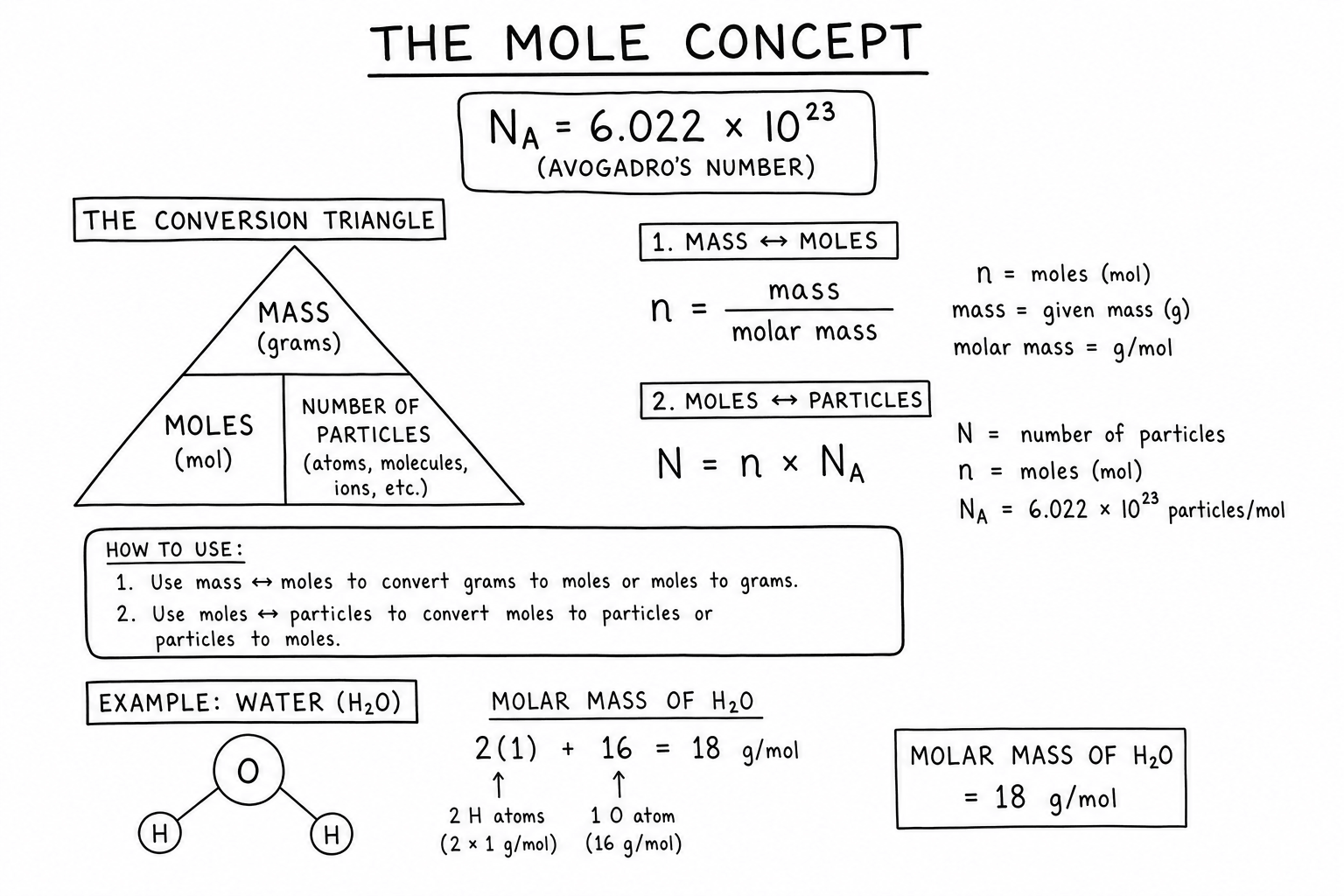
Avogadro’s Number and the Definition
One mole equals exactly \(6.02214076 \times 10^{23}\) particles, Avogadro’s number, denoted \(N_A\). The 2019 SI redefinition fixed this value exactly, making the mole an exact unit (no more empirical determination required).
What kind of particles? Anything you specify: atoms, molecules, ions, electrons, photons. A mole of carbon contains \(6.022 \times 10^{23}\) carbon atoms. A mole of water contains \(6.022 \times 10^{23}\) water molecules. A mole of electrons contains \(6.022 \times 10^{23}\) electrons. The unit is universal; the particle type depends on context.
Why This Number?
Avogadro’s number is chosen so that one mole of an element with atomic mass \(M\) (in atomic mass units) weighs exactly \(M\) grams. Carbon-12 has atomic mass 12 amu by definition; one mole of carbon-12 weighs exactly 12 grams.
This isn’t a coincidence, \(N_A\) was historically defined to make this relationship work. The atomic mass unit and the gram are linked through Avogadro’s number: \(1 \text{ amu} = 1/N_A \text{ g}\). The mole is the bridge that lets the microscopic atomic mass scale (in amu) match up with the macroscopic gram scale.
This is why molar mass is numerically equal to atomic mass for elements and to formula mass for compounds. Look up an element’s atomic mass in the periodic table, and that’s its molar mass in g/mol. No conversion needed.
Molar Mass
Molar mass is the mass of one mole of a substance, in grams per mole (g/mol). For elements, molar mass equals the atomic mass on the periodic table:
- Hydrogen: 1.008 g/mol
- Carbon: 12.011 g/mol
- Oxygen: 16.00 g/mol
- Iron: 55.85 g/mol
For compounds, molar mass equals the sum of the atomic masses of all atoms in the formula:
- H₂O: 2(1.008) + 16.00 = 18.02 g/mol
- CO₂: 12.011 + 2(16.00) = 44.01 g/mol
- NaCl: 22.99 + 35.45 = 58.44 g/mol
- C₆H₁₂O₆ (glucose): 6(12.011) + 12(1.008) + 6(16.00) = 180.16 g/mol
Molar mass is the conversion factor between grams (which you can weigh) and moles (which match reaction equations).
The Conversion Triangle
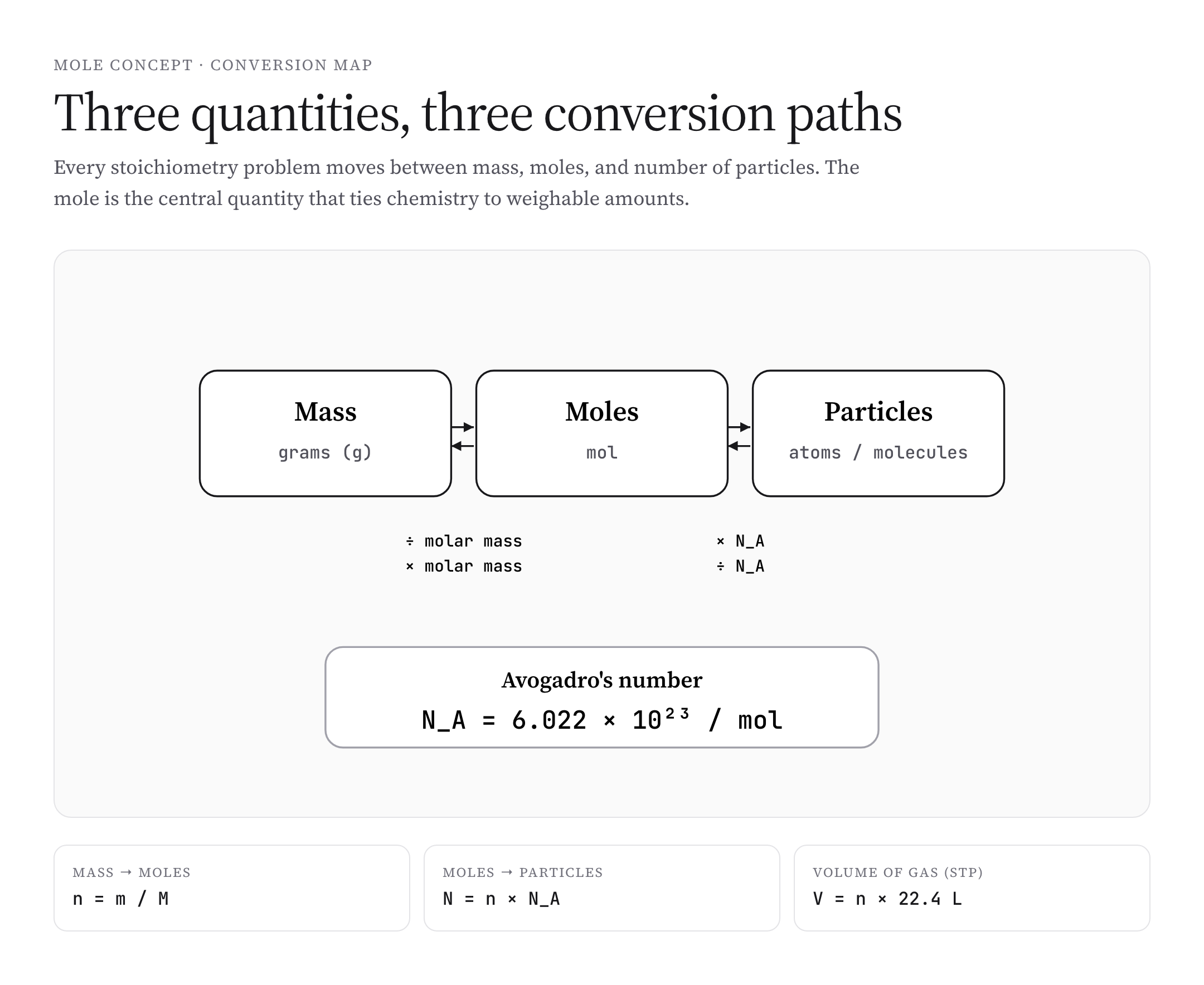
Every mole calculation moves between three quantities: mass, moles, and number of particles. The conversion factors:
- Mass to moles: \(n = m / M\), divide grams by molar mass.
- Moles to mass: \(m = n \times M\), multiply moles by molar mass.
- Moles to particles: \(N = n \times N_A\), multiply moles by Avogadro’s number.
- Particles to moles: \(n = N / N_A\), divide particles by Avogadro’s number.
Memorize this triangle and most chemistry quantitative work becomes routine arithmetic. Even multi-step problems, mass A to moles A to moles B to mass B (stoichiometry), are sequences of these basic conversions.
Gas Volume at STP
One mole of any ideal gas occupies 22.4 L at standard temperature and pressure (STP, defined as 0°C and 1 atm). This is a consequence of the ideal gas law \(PV = nRT\): at fixed T and P, volume is proportional to moles, regardless of what gas you have.
So a fourth conversion factor:
- Moles of gas to volume at STP: \(V = n \times 22.4 \text{ L}\).
- Volume of gas at STP to moles: \(n = V / 22.4 \text{ L}\).
For non-STP conditions, use the full ideal gas law: \(n = PV/RT\). The 22.4 L value only applies at STP. Modern STP is sometimes redefined as 1 bar instead of 1 atm, giving 22.7 L/mol, always check the convention.
Worked Example: Mass to Moles
How many moles are in 50.0 g of glucose (C₆H₁₂O₆, molar mass 180.16 g/mol)?
$$n = m / M = 50.0 / 180.16 \approx 0.277 \text{ mol}$$About 0.28 moles of glucose. To find the number of glucose molecules:
$$N = n \times N_A = 0.277 \times 6.022 \times 10^{23} \approx 1.67 \times 10^{23} \text{ molecules}$$Both calculations use the conversion triangle directly. The mass-moles step uses molar mass; the moles-particles step uses Avogadro’s number.
Worked Example: Stoichiometry
How many grams of water form when 8.0 g of hydrogen react completely with oxygen?
Balanced equation: \(2 H_2 + O_2 \to 2 H_2O\). Mole ratio H₂:H₂O = 2:2 = 1:1.
Step 1: convert mass H₂ to moles. Molar mass H₂ = 2.016 g/mol. \(n_{H_2} = 8.0 / 2.016 \approx 3.97\) mol.
Step 2: apply mole ratio. \(n_{H_2O} = 3.97 \times (2/2) = 3.97\) mol.
Step 3: convert moles H₂O to grams. Molar mass H₂O = 18.02 g/mol. \(m_{H_2O} = 3.97 \times 18.02 \approx 71.5\) g.
About 71.5 grams of water. The five-step stoichiometry recipe (mass → moles → ratio → moles → mass) handles every reaction problem the same way.
Why the Mole Matters
Without the mole, you can’t write a chemical equation that means anything quantitatively. The equation \(2 H_2 + O_2 \to 2 H_2O\) says “2 moles of hydrogen plus 1 mole of oxygen produce 2 moles of water.” It does NOT say “2 grams of hydrogen plus 1 gram of oxygen produce 2 grams of water”, the mass ratios are completely different.
Mass conservation requires \(m_{\text{reactants}} = m_{\text{products}}\), but the mass ratio of individual species depends on the molar masses, not the coefficients. The coefficients give mole ratios, and you have to convert through molar mass to get mass ratios.
This is why every chemistry problem that involves weighing substances goes through moles. Mass tells you how much you have to weigh; moles tells you what reaction equations actually predict.
Solutions and Molarity
For solutions, the most common concentration unit is molarity (M): moles of solute per liter of solution. \(M = n/V\). A 1 M NaCl solution has 1 mole of NaCl per liter; a 0.1 M HCl solution has 0.1 mole of HCl per liter.
Preparing a solution: weigh out \(n \times M\) grams of solute, dissolve in less than the target volume, then dilute to the final volume. Molarity is convenient for stoichiometric calculations involving solutions because it directly gives moles per volume.
Other concentration units (molality, normality, mole fraction, mass percent) exist for specific applications, but molarity dominates everyday lab work.
Empirical and Molecular Formulas
The mole concept underlies determining chemical formulas from elemental analysis. Given the mass percent of each element in a compound, divide by molar mass to get moles, then divide by the smallest mole value to find the integer ratio.
Example: a compound is 40.0% C, 6.7% H, 53.3% O by mass. In 100 g: 40 g C / 12 = 3.33 mol; 6.7 g H / 1 = 6.7 mol; 53.3 g O / 16 = 3.33 mol. Divide by smallest (3.33): C : H : O = 1 : 2 : 1. Empirical formula: CH₂O.
The molecular formula could be CH₂O (formaldehyde, M = 30), C₂H₄O₂ (acetic acid, M = 60), C₆H₁₂O₆ (glucose, M = 180), or any other multiple. Knowing the actual molar mass distinguishes between them.
History and the SI Redefinition
Amedeo Avogadro proposed in 1811 that equal volumes of gases at the same temperature and pressure contain the same number of molecules. The hypothesis was controversial for decades but turned out to be true. The number of molecules in a specified volume eventually became known as Avogadro’s number, even though Avogadro himself never measured it.
The first experimental determinations came in the early 20th century, Perrin’s Brownian motion experiments (1908), X-ray crystallography of crystals, oil-drop measurements. By the 1970s, the value was known to ~6 significant figures.
The 2019 SI redefinition fixed Avogadro’s number at exactly \(6.02214076 \times 10^{23}\), making the mole an exact unit defined in terms of this number rather than tied to the kilogram of carbon-12. The new definition removes the dependency on a physical artifact and makes \(N_A\) part of the seven defining constants of nature in modern SI.
Common Mistakes With the Mole Concept
- Forgetting which species the mole refers to. One mole of CO₂ is one mole of CO₂ molecules but contains one mole of C atoms and two moles of O atoms.
- Confusing molar mass with molecular weight. Numerically equal but with different units. Molar mass is g/mol; molecular weight (or relative molecular mass) is dimensionless.
- Using the wrong gas law formula. 22.4 L/mol applies only at STP. For other conditions, use \(PV = nRT\) with R = 0.0821 L·atm/(mol·K).
- Mixing up empirical and molecular formulas. Empirical = simplest integer ratio; molecular = actual atom count. Molecular formula is always an integer multiple of empirical.
- Forgetting to balance the equation first. Stoichiometry requires balanced equations. Unbalanced equations give wrong mole ratios.
Where the Mole Concept Lives in Practice
- Industrial chemistry: reactors are sized by moles of reactant per hour, not by mass. Mole-based scaling is universal in chemical engineering.
- Pharmaceuticals: drug dosing is often per mole (or millimole) for precision. Small molecule drugs are typically dosed in milligrams, but the chemistry is mole-based.
- Analytical chemistry: titration calculations move between volume, molarity, and moles to determine unknown concentrations.
- Biochemistry: enzyme kinetics, equilibrium constants, and reaction rates all use moles or millimoles.
- Materials science: alloy compositions, crystal stoichiometry, and doping concentrations are mole-based.
- Environmental chemistry: pollutant concentrations, atmospheric chemistry models, and water chemistry all use molar quantities.
Mole Day
October 23 is celebrated as Mole Day in chemistry classrooms worldwide, 6:02 AM to 6:02 PM on 10/23, a nod to \(6.02 \times 10^{23}\). Chemistry teachers use it to make moles approachable and memorable. The traditions vary: mole-themed snacks, costumes, and puns proliferate. Behind the silliness is genuine conceptual respect for one of chemistry’s most useful inventions.
If you ever forget Avogadro’s number, you can sometimes recall it from the date: 6.02 × 10²³ → October 23, 6:02. The mnemonic is widely taught precisely because the number is so foundational.
How Big Is a Mole?
A mole is an extraordinarily large number, almost incomprehensible at human scales. Some illustrations:
- One mole of pennies covering Earth’s surface would form a layer about 250 miles deep.
- One mole of grains of sand would fill several oceans.
- If you counted at one number per second from the Big Bang to today, you’d be far short of one mole.
- One mole of marbles would fill a volume larger than the entire Earth.
The mole is huge because atoms are tiny. Even 18 grams of water, three tablespoons, contains \(6.022 \times 10^{23}\) molecules. Scaling between human-sized quantities (grams, tablespoons) and atomic-sized quantities (molecules, atoms) requires a number this large.
Worked Example: Limiting Reagent via Moles
Mix 5.0 g of nitrogen and 5.0 g of hydrogen for the Haber process: N₂ + 3H₂ → 2NH₃. Which is limiting?
Mol N₂ = 5.0 / 28.0 = 0.179 mol. Mol H₂ = 5.0 / 2.016 = 2.48 mol.
Required ratio: 1 mol N₂ : 3 mol H₂. From 0.179 mol N₂, we need 0.179 × 3 = 0.536 mol H₂, and we have 2.48 mol H₂, far more than needed.
So N₂ is limiting. Theoretical yield: 0.179 × (2/1) = 0.358 mol NH₃ = 6.10 g NH₃. Excess H₂: 2.48 − 0.536 = 1.94 mol = 3.91 g unreacted. The mole concept makes the limiting-reagent analysis straightforward.
Solution Stoichiometry Quick Reference
For solutions, molarity converts between volume and moles: \(n = M \times V\) (V in liters). The standard recipe for solution stoichiometry: convert each known to moles via molarity (or molar mass for solid solutes), apply the mole ratio from the balanced equation, convert the answer back to whatever units are needed.
Common conversions: a 1 M solution has 1 mole per liter (or 1 mmol per mL). Diluting reduces molarity proportionally: \(M_1 V_1 = M_2 V_2\). For mixing solutions of different molarities, total moles before mixing equals total moles after; molarity of mixture is total moles divided by total volume. These three rules cover essentially every solution chemistry calculation in introductory courses.
Mole Concept and the SI Definition
Before 2019, the mole was defined as the number of atoms in exactly 12 grams of carbon-12. After the 2019 SI redefinition, the mole is defined directly: exactly 6.02214076 × 10²³ entities. The numerical value didn’t change appreciably (it was already known very precisely), but the definition no longer depends on the kilogram or any physical artifact.
The change put Avogadro’s number among the seven defining constants of nature in modern SI, alongside the speed of light, Planck’s constant, the elementary charge, the Boltzmann constant, and others. Physical units now derive from natural constants instead of artifacts, which is a deeper philosophical shift than it might seem at first.
FAQs
What is a mole in chemistry?
A unit equal to exactly 6.02214076 × 10²³ particles (atoms, molecules, ions, or any specified entity). The mole is chemistry’s counting unit, it lets you convert between weighable masses (grams) and reaction-relevant numbers of particles. Avogadro’s number is the conversion factor.
What is Avogadro’s number?
6.02214076 × 10²³, the number of particles in one mole. Fixed exactly in the 2019 SI redefinition. Originally chosen so that one mole of an element with atomic mass M weighs exactly M grams, making the mole bridge between atomic-mass-unit and gram scales.
What is molar mass?
The mass of one mole of a substance, in grams per mole. For elements, molar mass equals atomic mass on the periodic table. For compounds, it’s the sum of atomic masses of all atoms in the formula. Used to convert between mass and moles.
How do I convert grams to moles?
Divide by molar mass: n = m / M. For 18 grams of water (molar mass 18 g/mol): n = 1 mole. For 50 grams of glucose (molar mass 180 g/mol): n ≈ 0.28 mole. The conversion is one-line arithmetic once you know the molar mass.
How do I convert moles to number of particles?
Multiply by Avogadro’s number: N = n × N_A. One mole = 6.022 × 10²³ particles. Two moles = 1.204 × 10²⁴ particles. The exponent base 10²³ is the universal conversion between moles and particle count.
Why does one mole of any ideal gas occupy 22.4 L at STP?
Because of the ideal gas law PV = nRT: at fixed temperature and pressure, volume is proportional to moles, regardless of which gas. At standard temperature (0°C = 273.15 K) and pressure (1 atm), the proportionality constant works out to 22.4 L per mole. Modern definitions sometimes use 1 bar instead, giving 22.7 L/mol.
How do I find the molar mass of a compound?
Add the atomic masses of every atom in the chemical formula. For H₂O: 2(1.008) + 16.00 = 18.02 g/mol. For glucose C₆H₁₂O₆: 6(12.011) + 12(1.008) + 6(16.00) = 180.16 g/mol. Atomic masses come from the periodic table.
What is molarity and how does it relate to moles?
Molarity (M) is moles of solute per liter of solution. A 1 M solution has 1 mole of solute per liter; a 0.1 M solution has 0.1 mole per liter. To prepare: weigh out n × M grams of solute, dissolve, dilute to final volume. Molarity is the standard concentration unit in solution chemistry.
What’s the difference between empirical and molecular formula?
Empirical formula gives the simplest integer ratio of atoms (CH₂O for formaldehyde). Molecular formula gives the actual atom count, which is an integer multiple of the empirical (CH₂O for formaldehyde, C₆H₁₂O₆ for glucose, both with the same empirical CH₂O). You need molar mass to distinguish between possible molecular formulas.
Who discovered Avogadro’s number?
Amedeo Avogadro proposed the underlying hypothesis in 1811 that equal gas volumes contain equal numbers of molecules. He never measured the number that bears his name. First experimental determinations came in the early 20th century from Jean Perrin, X-ray crystallography, and other techniques. The 2019 SI redefinition fixed the value exactly.
How do I do stoichiometry calculations?
Five steps: (1) balance the equation; (2) convert mass of given substance to moles via molar mass; (3) apply mole ratio from balanced equation to find moles of target substance; (4) convert moles back to mass via molar mass; (5) check for limiting reagent if more than one reactant. The mole concept makes the whole sequence routine arithmetic.
Why is the mole so big?
Because atoms are so small. To weigh out a measurable amount of any substance, you need an enormous number of atoms or molecules, typically 10²² to 10²⁴. Avogadro’s number is sized to make a ‘mole’ equal to ‘gram-quantity’ for typical small molecules. Smaller numbers wouldn’t bridge the atomic and macroscopic scales usefully.
Why is October 23 celebrated as Mole Day?
It’s a play on Avogadro’s number 6.02 × 10²³ → 10/23 (October 23), 6:02 AM to 6:02 PM. Chemistry teachers worldwide celebrate with mole-themed activities, snacks, and puns. The unofficial holiday helps make the mole concept memorable and approachable for students.
Did the 2019 SI redefinition change the mole?
Yes. Before 2019, the mole was defined as the number of atoms in 12 grams of carbon-12. After 2019, the mole is defined directly as exactly 6.02214076 × 10²³ particles. The numerical value didn’t change appreciably, but the definition no longer depends on the kilogram or any physical artifact, it’s a pure number.
Browse more in Chemistry.