by
by
Chromatography is a family of laboratory techniques used to separate the components of a mixture by exploiting the different ways those components interact with two phases: a stationary phase that stays put and a mobile phase that moves through it. Components that bind tightly to the stationary phase move slowly; components that prefer the mobile phase move quickly. The result is a spatial separation that lets chemists identify, quantify, or purify each component.
A chromatographic separation depends on relative interactions with the stationary and mobile phases. A spot’s position should be measured from the same origin as the solvent front.
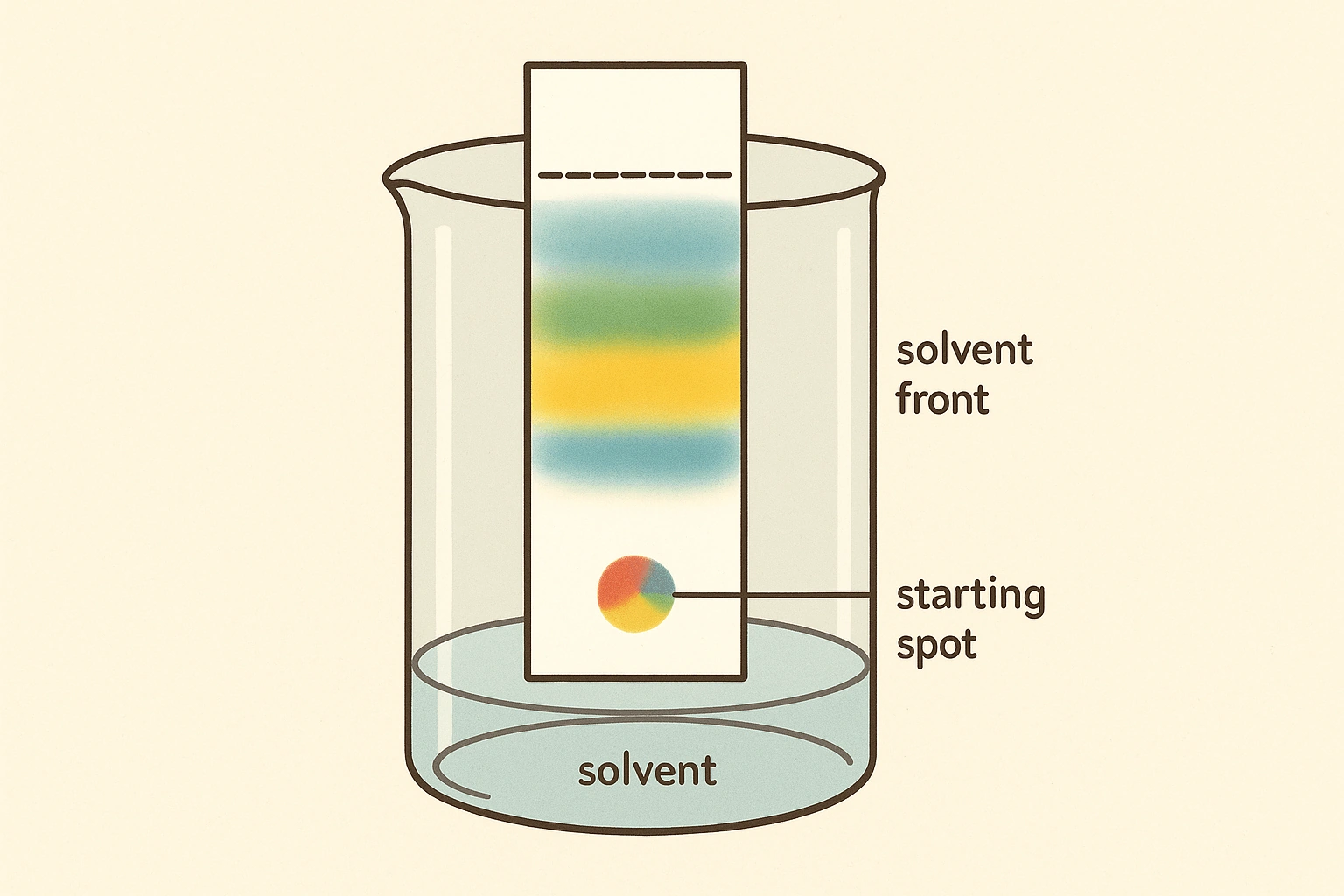
How Chromatography Works
Every chromatographic technique has two phases:
- Stationary phase. A solid or a liquid coated onto a solid support that does not move, paper, silica gel, a packed column, a thin layer.
- Mobile phase. A liquid or gas that carries the sample through the stationary phase.
As the mobile phase flows past the stationary phase, each component of the sample partitions between the two phases according to its chemical affinity. Components that interact strongly with the stationary phase are held back; components that prefer the mobile phase travel faster. Given enough distance, the original mixture spreads out into distinct bands or peaks.
Major Types
| Technique | Stationary phase | Mobile phase | Used for |
|---|---|---|---|
| Paper chromatography | Cellulose (filter paper) | Solvent (water, ethanol) | Pigments, dyes, simple mixtures |
| Thin-layer chromatography (TLC) | Silica or alumina on glass/plastic | Organic solvent | Quick reaction monitoring, ID |
| Column chromatography | Silica gel in a vertical tube | Solvent driven by gravity | Purification of organic compounds |
| Gas chromatography (GC) | Liquid coating in capillary column | Inert gas (helium, nitrogen) | Volatile compounds, forensics |
| HPLC | Microparticles in pressurized column | Liquid solvent at high pressure | Pharmaceuticals, biomolecules |
| Ion-exchange chromatography | Charged resin beads | Aqueous buffer | Proteins, amino acids, ions |
The Retention Factor
For TLC and paper chromatography, each component is characterized by its retention factor (Rf):
$$ R_f = \frac{\text{distance traveled by component}}{\text{distance traveled by solvent front}} $$
\( R_f \) is always between 0 and 1. It depends on the compound, the stationary phase, and the mobile phase, so under standardized conditions \( R_f \) acts like a fingerprint for identification.
Worked Example: Separating Ink
Place a small dot of black water-soluble ink near the bottom of a filter paper strip. Dip the bottom edge in water (not submerging the ink). As the water travels up the paper by capillary action, it carries the ink components along. Within minutes you see distinct bands, typically yellow, magenta, cyan, and sometimes black, revealing that the ‘black’ ink is actually a mixture of dyes. Measuring each band’s distance gives the \( R_f \) for each dye.
Applications
- Pharmaceutical analysis. HPLC verifies drug purity and quantifies active ingredients in tablets.
- Forensic chemistry. GC-MS identifies trace drugs, explosives, accelerants in fire debris, and ink composition in document analysis.
- Food and beverage. Detecting pesticide residues, verifying flavor compounds, checking for adulteration.
- Environmental monitoring. Identifying pollutants in water and air samples at parts-per-billion levels.
- Biochemistry. Purifying proteins, separating amino acids, sequencing DNA fragments by electrophoretic chromatography.
- Doping control. Olympic and professional sports use GC-MS and LC-MS to detect banned substances.
Related study notes: Titration, Distillation, Solubility, Molarity.
The OpenStax chemistry textbooks provide further explanations of the chemical principles used in this note.
Calculating an Rf Value
On a paper chromatogram, a component travels 3.0 cm from the origin and the solvent front travels 6.0 cm. Its Rf is 0.50. A second component at 4.5 cm has Rf 0.75 under the same run conditions.
The solvent front should be marked when the run ends, because it may become invisible as the solvent evaporates. Matching an Rf under stated conditions can support identification but is not conclusive proof of a unique compound. Different substances can share similar migration and a mixture can remain unresolved.
The points to check in this example are:
- The origin is the reference for both distances.
- Rf depends on the material and the separation conditions.
- Keeping the starting spot above the solvent reservoir helps avoid washing the sample straight into the reservoir.
Check Your Understanding
Try the questions before reading the answers.
Question 1. What is Rf for a 2 cm spot and a 5 cm solvent front?
Answer. 0.40.
Question 2. Does a single visible spot prove purity?
Answer. No. Components can overlap or remain undetected by the method.
Practice Questions
Work each question before reading its solution. The set runs from direct recall and substitution to the applied questions that exams actually use to separate grades. The downloadable PDF includes these questions and their solutions.
Question 1. What physical principle lets chromatography separate a mixture into its components?
Solution. Components partition differently between a stationary phase and a mobile phase: a molecule that clings to the stationary phase lags behind, one that prefers the mobile phase races ahead. Different affinities mean different travel speeds, and speed differences become spatial separation.
Question 2. In paper chromatography, a dye travels 6.4 cm while the solvent front travels 8.0 cm. Compute the Rf value.
Solution. \(R_f = \dfrac{\text{distance moved by substance}}{\text{distance moved by solvent}} = \dfrac{6.4}{8.0} = 0.80\). Rf always sits between 0 (never left the origin) and 1 (moved with the solvent), a fingerprint for identifying a substance under fixed conditions.
Question 3. Two dyes have Rf 0.3 and 0.75 on the same paper. Which is more soluble in the mobile solvent, and which is more strongly adsorbed to the paper?
Solution. The Rf 0.75 dye travels closer to the solvent front: more soluble in the mobile phase, weaker attraction to the stationary paper. The Rf 0.3 dye clings to the paper and lags. Rf ranks affinity directly: higher means mobile-phase-loving.
Question 4. Why must the solvent level in TLC or paper chromatography start below the sample spot?
Solution. If the spot sits underwater, the sample dissolves straight into the bulk solvent instead of migrating by capillary action through the stationary phase, and the whole separation is ruined. The rule “spot above the solvent line” protects the entire experiment.
Question 5. Distinguish adsorption chromatography from partition chromatography, with 1 stationary/mobile phase pair for each.
Solution. Adsorption: separation by surface binding strength to a solid stationary phase, as in silica-gel TLC with an organic solvent. Partition: separation by differential solubility between 2 liquid phases, as in paper chromatography, where the stationary phase is water held in the paper’s cellulose fibers and the mobile phase is the running solvent.
Question 6. In gas chromatography, why does a compound with a lower boiling point generally elute first?
Solution. Lower-boiling compounds are more volatile: they spend more time as vapor in the mobile carrier gas and less time condensed in the stationary liquid film, so they move through the column faster. Elution order in GC largely tracks the volatility ladder, modified by how strongly each compound interacts chemically with the stationary phase.
Question 7. HPLC forces solvent through a column under high pressure instead of relying on gravity or capillary action. What does this buy?
Solution. A tightly packed column with far smaller particles resolves closely related compounds that gravity-fed methods blur together, and the process finishes in minutes instead of hours. The tradeoff is more expensive instrumentation. HPLC is the workhorse of pharmaceutical purity testing for exactly this resolving power.
Question 8. A crime lab needs to prove an ink sample matches a suspect pen. How does chromatography build that evidence?
Solution. Run the questioned ink and a known reference from the pen side by side on the same TLC plate under identical conditions. Matching Rf values and matching color-band patterns support a common origin; any mismatched spot rules it out. The method is comparative, not absolute: it excludes non-matches with confidence and supports (never proves outright) a match.
Question 9. Column chromatography can purify a natural pigment like chlorophyll. What does the column separate it from, and how is progress tracked visually?
Solution. It separates chlorophyll a, chlorophyll b, and the carotenoid pigments (carotenes, xanthophylls) that coexist in plant extract, each traveling at its own rate due to differing polarity. As solvent flows through, distinctly colored bands, green, yellow-green, orange, become visible and are collected separately as they exit: chromatography’s original 1900s demonstration, which is also where the technique’s name (color-writing) comes from.
Question 10. Why does changing the mobile-phase solvent change every Rf value in the experiment, and what must you record alongside a reported Rf?
Solution. Rf reflects a specific balance of solubility in that particular solvent versus adsorption to that particular stationary phase; a different solvent shifts every compound’s balance, often unevenly. A useful Rf report always specifies the solvent system and stationary phase used, since the number alone is meaningless without them.
Frequently Asked Questions
What is chromatography?
Chromatography is a laboratory technique used to separate the components of a mixture. A sample is dissolved in a mobile phase (liquid or gas) that moves through a stationary phase (solid or liquid coating). Components separate according to how strongly each one interacts with the two phases, strong binders travel slowly, weak binders travel fast.
How does paper chromatography work?
A drop of sample is placed near the bottom of a strip of filter paper, which is dipped into a solvent. The solvent climbs the paper by capillary action and carries the sample components with it. Each component travels a distance proportional to its affinity for the moving solvent versus the paper. The end result is visible bands at different heights.
What is the Rf value?
The retention factor (Rf) is the distance traveled by a sample component divided by the distance traveled by the solvent front. It’s a number between 0 and 1 that characterizes a compound under specific conditions (stationary phase, solvent, temperature). Identical Rf values under matched conditions suggest the same compound.
What’s the difference between TLC and HPLC?
TLC (thin-layer chromatography) uses a thin layer of silica on a plate with solvent rising by capillary action, fast, cheap, qualitative, used for monitoring reactions. HPLC (high-performance liquid chromatography) forces liquid through a tightly packed column under high pressure, giving sharp peaks and excellent quantitative precision. HPLC is the workhorse of pharmaceutical analysis.
What is the difference between gas and liquid chromatography?
Gas chromatography uses an inert gas (typically helium) as the mobile phase and works on volatile, thermally stable compounds. Liquid chromatography uses a solvent as the mobile phase and works on non-volatile or thermally fragile compounds, proteins, polymers, most pharmaceuticals. The choice depends on what you’re analyzing.
Why is chromatography used in drug testing?
Because it can separate trace amounts of one compound from a complex biological sample (blood, urine) and detect them at extremely low concentrations. Gas or liquid chromatography coupled with mass spectrometry (GC-MS, LC-MS) can identify and quantify specific banned substances even at parts-per-billion levels, sensitive enough to catch micro-doses.
Browse more in Chemistry.