by
by
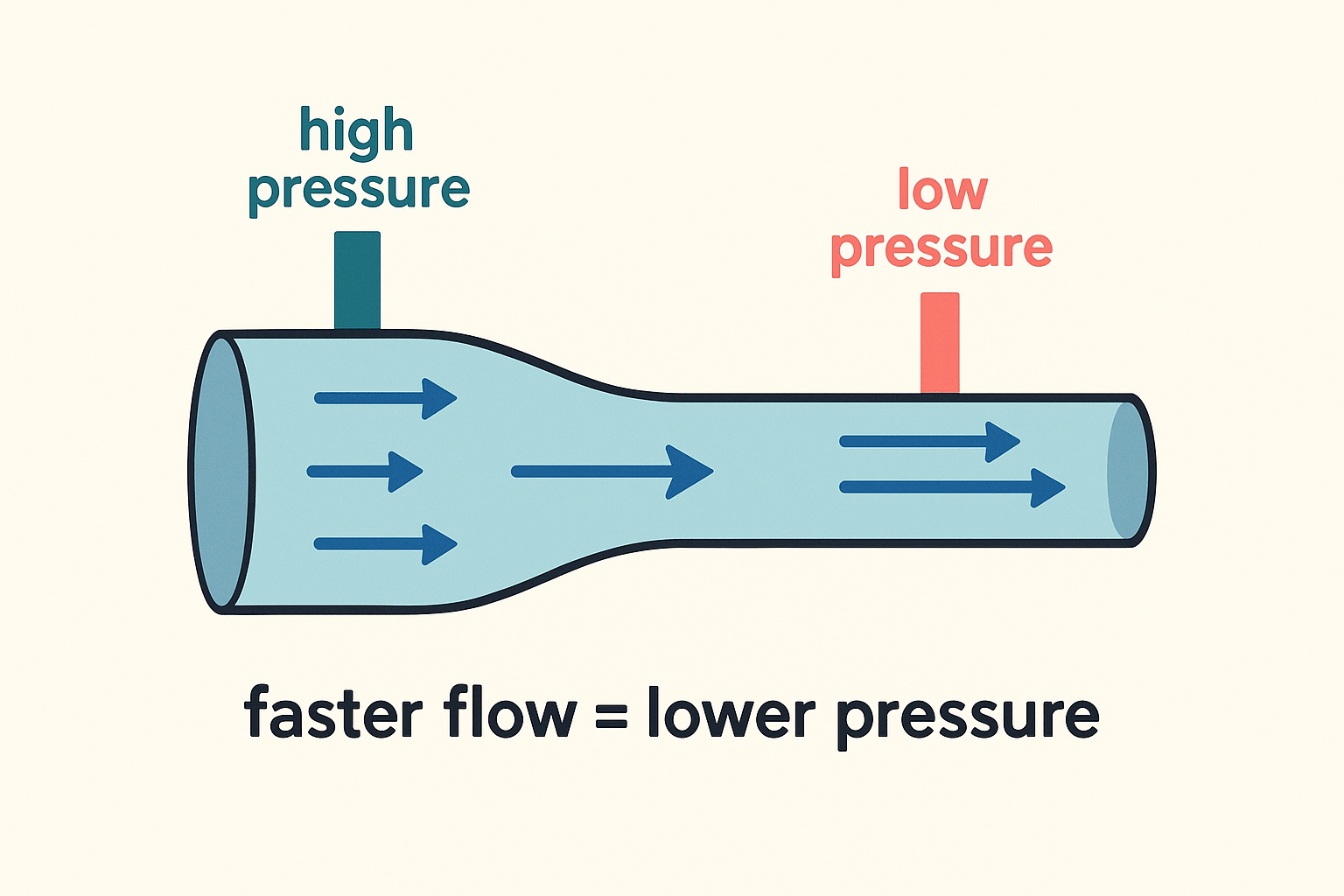
Bernoulli’s principle says that in a flowing fluid, faster flow means lower pressure. The fluid’s total energy, kinetic plus potential plus pressure, stays constant along a streamline. Where the fluid speeds up (through a constricted pipe, over an airfoil, around a curveball), pressure drops. Where it slows down, pressure rises. Daniel Bernoulli published the principle in 1738 in his book Hydrodynamica, and it remains the central equation in fluid dynamics. The principle explains why airplanes fly, why curveballs curve, why hurricane winds tear off roofs, and why a shower curtain billows inward when you turn on the water.
Bernoulli’s equation applies along a streamline under its stated ideal-flow assumptions. Speed and pressure cannot be compared across arbitrary flows without those conditions.
The Equation
For an ideal (incompressible, non-viscous) fluid flowing steadily along a streamline, Bernoulli’s equation is:
$$ P + \frac{1}{2} \rho v^2 + \rho g h = \text{constant} $$
Each term is an energy density (energy per unit volume):
- \( P \): static pressure of the fluid
- \( \\frac{1}{2} \\rho v^2 \): kinetic energy per unit volume (dynamic pressure). \( \\rho \) is fluid density, \( v \) is flow speed.
- \( \\rho g h \): gravitational potential energy per unit volume. \( g \) is gravity, \( h \) is height above some reference level.
The sum is conserved along a streamline. So if speed goes up at constant height, pressure must drop to compensate. If height changes at constant speed, pressure adjusts. The total energy in the fluid stays put.
The Intuition Behind the Equation
Where does the kinetic-energy term come from? Apply the work-energy theorem to a fluid parcel. The net work done by pressure forces on each side of the parcel must equal its change in kinetic energy. Working out the algebra for a steady flow through a pipe of varying cross-section gives exactly Bernoulli’s equation.
Conservation of mass (the continuity equation) says the volumetric flow rate must be constant along a streamline: A₁v₁ = A₂v₂, where A is cross-sectional area and v is flow speed. So if the pipe narrows, the speed must increase. Bernoulli’s principle then says the pressure must decrease, because the kinetic energy increase had to come from somewhere, and the only energy source available is the pressure energy.
Worked Examples
Venturi tube
A pipe with a constricted section. Water enters the wide part at speed \( v_1 \) and pressure \( P_1 \). At the narrow part, conservation of mass forces speed to increase to \( v_2 \). Bernoulli’s principle gives the pressure drop:
$$ P_1 – P_2 = \frac{1}{2} \rho (v_2^2 – v_1^2) $$
This is exploited in carburetors, atomizers, and Venturi flow meters.
Airplane wing (simplified)
The classical (simplified) explanation: an airfoil is shaped so air flows faster over the top than the bottom. Bernoulli’s principle says faster flow = lower pressure, so the pressure on top is lower than on the bottom. The pressure difference times the wing area is the lift force.
This is a partial truth. Real aircraft lift involves the Coanda effect, downwash, and Newton’s third law (the wing pushes air down, and air pushes the wing up) just as much as Bernoulli. But the Bernoulli component is real and contributes substantially.
Tornado roof damage
In a hurricane or tornado, wind speeds outside a building can exceed 100 mph. The fast-moving air outside has much lower pressure than the (relatively still) air inside. The pressure difference pushes the roof upward and outward. This is one reason building codes in tornado country require strong roof-to-wall connections.
When Bernoulli’s Equation Doesn’t Apply
The standard Bernoulli equation makes four assumptions, all of which fail under some conditions:
- Incompressible flow. Valid for water and slow-moving air. For air at speeds above about 100 m/s (Mach 0.3+), compressibility matters and you need the compressible Bernoulli equation.
- Non-viscous flow. No friction. Real fluids have viscosity that dissipates energy. For slow flow through long thin pipes, viscous losses dominate and Poiseuille’s law applies instead.
- Steady flow. Flow patterns don’t change with time. Turbulent or unsteady flow needs more sophisticated treatment.
- Along a streamline. The conservation applies to fluid parcels following the same streamline. Comparing pressures between different streamlines requires additional conditions (irrotational flow).
For most introductory physics problems, the assumptions hold well enough. For rigorous engineering analysis, the Navier-Stokes equations (the full equations of fluid motion) take over.
Counterintuitive Demonstrations
Classic Bernoulli demonstrations that make great physics-class demos:
- The blown ping-pong ball. A ping-pong ball levitates in a stream of air from a hair dryer. The fast air around the ball has lower pressure than the still surrounding air, which pushes the ball back into the stream from all sides.
- The two-paper trick. Hold two pieces of paper hanging vertically about an inch apart. Blow between them. They move TOGETHER, not apart, because the fast moving air between them has lower pressure than the still air on the outside.
- The shower curtain effect. When you turn on a shower, the curtain billows INWARD toward you. The fast-moving (and slightly warmer) air inside the shower has lower pressure than the still bathroom air.
- The funnel and ping-pong ball. Place a ping-pong ball in a funnel and blow downward through the funnel. The ball stays put, even when you turn the funnel sideways or upside down, because air rushing around the ball creates lower pressure that holds it in place.
Related study notes: Ideal Gas Law, Kinetic Energy, Newton’s Laws of Motion, Laws of Thermodynamics.
The OpenStax physics textbooks develop the corresponding physical models with further worked problems.
A Horizontal Pipe
Water flows steadily through a horizontal pipe whose cross-sectional area halves. For incompressible flow, continuity makes the speed double. If the initial speed is 2 m/s, the narrower section has speed 4 m/s.
With density 1,000 kg/m³ and negligible dissipative loss, Bernoulli’s equation gives a pressure reduction of ½ρ(4² – 2²) = 6,000 Pa. The sections have equal elevation. A height change would add a gravitational term; viscosity, pumps and turbines can require an extended energy balance.
The points to check in this example are:
- Continuity supplies the relationship between area and speed.
- Equal elevation is an assumption in this simplified pressure comparison.
- Faster flow does not imply lower pressure in every unrelated situation.
Check Your Understanding
Try the questions before reading the answers.
Question 1. What is the volume-flow rate if the first area is 0.01 m²?
Answer. 0.02 m³/s.
Question 2. Does Bernoulli alone calculate real pipe-friction loss?
Answer. No. A loss model or measurement is needed.
Practice Questions
Work each question before reading its solution. The set runs from direct recall and substitution to the applied questions that exams actually use to separate grades. The downloadable PDF includes these questions and their solutions.
Question 1. State Bernoulli’s equation for steady, incompressible, frictionless flow, naming each term.
Solution. $$P + \frac{1}{2}\rho v^2 + \rho g h = \text{constant along a streamline}$$ Static pressure, dynamic pressure (kinetic energy per volume), and gravitational head. It is energy conservation for flowing fluid: what one term gains, the others surrender.
Question 2. Water flows through a pipe that narrows from area 8 cm² to 2 cm². If the wide-section speed is 1 m/s, find the narrow-section speed.
Solution. Continuity: \(A_1 v_1 = A_2 v_2\) for incompressible flow, so \(v_2 = 1 \times 8/2 = 4\) m/s. The same volume per second must squeeze through a quarter of the area at 4 times the speed. Continuity, not Bernoulli, sets the speed; Bernoulli then prices it in pressure.
Question 3. For that same pipe (horizontal, water), find the pressure drop between wide and narrow sections.
Solution. \(\Delta P = \frac{1}{2}\rho(v_2^2 – v_1^2) = 500(16 – 1) = 7500\) Pa. The narrow, fast section sits 7.5 kPa LOWER in pressure. Counterintuitive but mandatory: accelerating fluid from 1 to 4 m/s requires a net forward force, which only a higher pressure behind can supply.
Question 4. Why must the pressure be lower where the flow is faster? Give the force argument, not just the formula.
Solution. A fluid parcel entering a constriction speeds up, so it accelerates, and acceleration needs a net force pointing downstream. That force can only come from higher pressure upstream than downstream. Low pressure at high speed is not a mystery; it is Newton’s second law applied to the parcel.
Question 5. A shower curtain billows inward when the water runs. Explain.
Solution. The falling spray drags air downward inside the curtain, setting it moving; moving air carries lower static pressure than the still air outside. The pressure difference, a few pascals over the curtain’s square meters, pushes it inward. Small \(\Delta P\), large area, visible force.
Question 6. Blowing across the top of a strip of paper lifts it. Why does blowing UNDER a drooping strip not push it down?
Solution. Air blown across the top is fast, so its pressure falls below atmospheric, and the still air below lifts the strip into the deficit. Blown underneath, the fast stream’s low pressure pulls the strip DOWN toward it: the strip flutters into the jet rather than rising away. Both observations are the same rule; the naive push-picture predicts the wrong direction.
Question 7. An airplane wing generates lift. What does Bernoulli correctly explain, and what popular version of the story is wrong?
Solution. Air over the curved top does travel faster, and its pressure is genuinely lower: the pressure difference integrates to most of the lift. The false part is the “equal transit time” story, that top and bottom parcels must reunite; measurements show the top air arrives far earlier. The full account couples Bernoulli with the wing deflecting air downward, Newton’s third law in the vertical.
Question 8. A Venturi meter reads a pressure drop of 2,000 Pa between a 10 cm² throat and a 30 cm² pipe carrying water. Find the throat speed.
Solution. With \(v_{pipe} = v_t/3\): \(\Delta P = \frac{1}{2}\rho v_t^2(1 – \frac{1}{9}) = \frac{4}{9}\rho v_t^2\)… compute: \(2000 = \frac{1}{2} \times 1000 \times v_t^2 \times \frac{8}{9}\), so \(v_t^2 = 4.5\) and \(v_t \approx 2.1\) m/s. Venturi meters, carburetors, and airspeed pitot tubes all convert a pressure reading into a speed this way.
Question 9. Why does a curveball curve? Connect spin to Bernoulli-type pressure asymmetry.
Solution. The spinning ball drags a boundary layer of air around itself. On the side where spin motion adds to the airstream the flow is faster, pressure lower; on the opposing side slower, pressure higher. The net sideways force, the Magnus effect, bends the trajectory. Free kicks in football and tennis topspin dips are the same physics.
Question 10. List the assumptions behind Bernoulli’s equation, and give a flow where applying it fails badly.
Solution. Steady flow, incompressible fluid, negligible viscosity, and comparison along a streamline. It fails in strongly viscous flow (honey in a tube: pressure drop with NO speed change, all friction), across turbulent mixing, in compressible high-speed gas near the sound barrier, and between points on different streamlines. The equation is an idealization with a well-marked fence.
Frequently Asked Questions
What is Bernoulli’s principle in simple terms?
Bernoulli’s principle says that in a flowing fluid, faster flow means lower pressure, and slower flow means higher pressure. The fluid’s total mechanical energy (pressure energy + kinetic energy + gravitational potential energy) stays constant along a streamline. So when one component changes, another must compensate.
What is Bernoulli’s equation?
P + (1/2)ρv² + ρgh = constant along a streamline, for an ideal incompressible non-viscous fluid in steady flow. P is static pressure, ρ is fluid density, v is flow speed, g is gravity, h is height. Each term has units of energy per unit volume.
Does Bernoulli’s principle explain why airplanes fly?
Partially. The traditional simplified explanation is: airfoil shape forces air over the top to flow faster, which by Bernoulli’s principle means lower pressure on top, producing lift. This is real but incomplete. Real aircraft lift also involves the wing pushing air downward (Newton’s third law), the Coanda effect, and downwash. The Bernoulli contribution is one of several mechanisms working together.
Why does a shower curtain billow inward?
Because the water spray creates a fast-moving column of air inside the shower. The faster air has lower pressure than the still bathroom air outside the curtain. The pressure difference pushes the curtain inward. The effect is enhanced by slight warming of the shower air (which rises and creates a vacuum at the bottom that the bathroom air rushes to fill). Both are consistent with Bernoulli’s principle.
When does Bernoulli’s equation NOT apply?
When the fluid is compressible (high-speed air above Mach 0.3, where density changes), when viscosity matters (slow flow through narrow tubes, where friction dissipates energy), when the flow is unsteady (turbulent or pulsating), or when comparing streamlines that don’t share the same total energy. For rigorous engineering, the Navier-Stokes equations take over.
How is Bernoulli’s principle related to conservation of energy?
It IS conservation of energy, applied to a flowing fluid along a streamline. The three terms in Bernoulli’s equation (pressure, kinetic, gravitational) are three forms of energy per unit volume that can interconvert as fluid moves. The total stays constant because no energy is lost in an ideal fluid. Bernoulli’s principle is the work-energy theorem written in fluid-dynamics language.
Browse more in Physics.