
 by
byElectrolysis uses electrical energy to drive a chemical reaction that would not happen on its own. An external power source pushes electrons through a liquid electrolyte, causing reduction at the cathode and oxidation at the anode. It’s the reverse of what happens in a battery: instead of a spontaneous reaction producing electricity, electricity forces a non-spontaneous reaction to occur. Industrial electrolysis is how aluminium is smelted, how chlorine and sodium hydroxide are made, and how metal objects are electroplated.
Free download: Electrolysis Study Notes (PDF)
The full note as a print-ready PDF: every section and worked example, the 10-question practice set with solutions, an answer key, and a 1-page revision sheet for last-minute revision.
The Electrolytic Cell
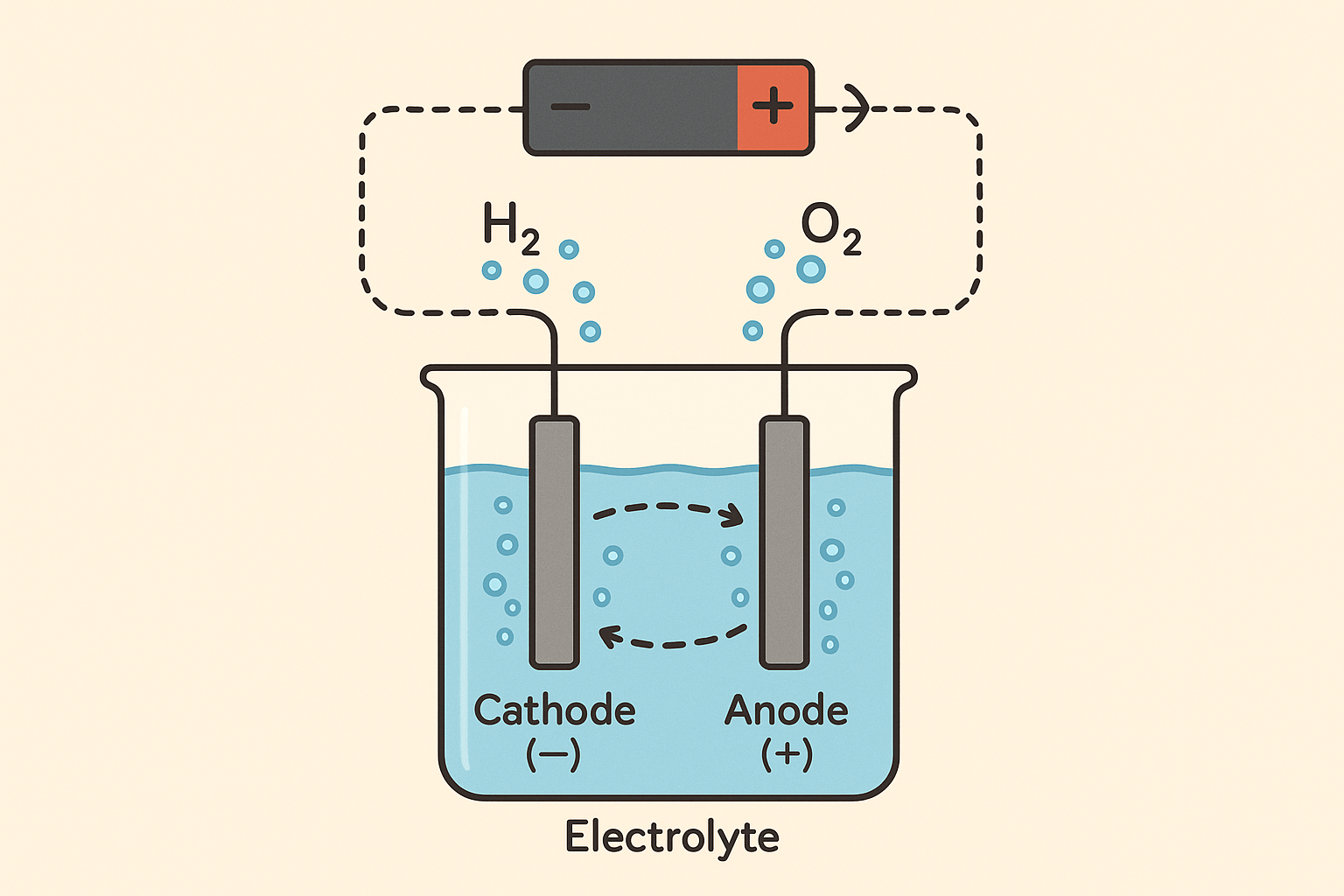
An electrolytic cell has three essential parts:
- Electrolyte. A liquid (molten salt or aqueous solution) containing mobile ions.
- Cathode. The electrode connected to the negative terminal of the power supply. Cations migrate here and are reduced.
- Anode. The electrode connected to the positive terminal. Anions migrate here and are oxidized.
Note the sign convention is opposite to a galvanic cell: in electrolysis the cathode is negative and the anode is positive, because the power supply pushes electrons into the cathode and out of the anode.
Electrolysis of Water
With a small amount of acid or base added to make it conductive, water splits into hydrogen and oxygen:
Cathode (reduction): \( 2\text{H}_2\text{O} + 2e^- \rightarrow \text{H}_2 + 2\text{OH}^- \)
Anode (oxidation): \( 2\text{H}_2\text{O} \rightarrow \text{O}_2 + 4\text{H}^+ + 4e^- \)
Overall: \( 2\text{H}_2\text{O} \rightarrow 2\text{H}_2 + \text{O}_2 \)
You get twice as many moles of hydrogen as oxygen, visible as the relative volumes collected over the two electrodes. The minimum theoretical voltage is 1.23 V, though in practice 1.7-2.0 V is needed because of overpotential.
Electrolysis of Brine
Electrolysing concentrated aqueous sodium chloride (brine) is the basis of the chlor-alkali industry, among the largest industrial chemical processes in the world:
Cathode: \( 2\text{H}_2\text{O} + 2e^- \rightarrow \text{H}_2 + 2\text{OH}^- \)
Anode: \( 2\text{Cl}^- \rightarrow \text{Cl}_2 + 2e^- \)
Three products are produced simultaneously: hydrogen gas, chlorine gas, and sodium hydroxide solution. All three are essential industrial chemicals used in plastics (PVC), water treatment, paper bleaching, soap manufacture, and chemical synthesis.
Faraday’s Laws of Electrolysis
Michael Faraday’s 1834 quantitative laws relate the amount of substance deposited to the charge passed:
- First law. The mass of substance deposited at an electrode is proportional to the total electric charge passed through the cell.
- Second law. For the same quantity of charge, the masses of different substances deposited are proportional to their equivalent weights (molar mass divided by the number of electrons transferred).
Combined, this gives \( m = \frac{QM}{nF} \), where \( m \) is mass deposited, \( Q \) is charge (in coulombs), \( M \) is molar mass, \( n \) is the number of electrons in the half-reaction, and \( F \) is Faraday’s constant (96,485 C/mol).
Industrial Applications
- Aluminium extraction. The Hall-Héroult process electrolyses molten Al₂O₃ dissolved in cryolite. Aluminium is too reactive to extract by traditional reduction; electrolysis is the only economic route. Globally consumes roughly 3% of all electricity.
- Chlor-alkali industry. Brine electrolysis produces chlorine, sodium hydroxide, and hydrogen at enormous scale.
- Electroplating. A thin layer of metal (gold, silver, chromium, nickel) is deposited on an object by making it the cathode in a solution of the plating metal’s salt.
- Copper refining. Impure copper is the anode, pure copper plates out at the cathode, and the impurities settle as anode mud, often containing recoverable silver, gold, and platinum.
- Hydrogen production. Electrolysis of water using renewable electricity (‘green hydrogen’) is a leading candidate for decarbonising steel, ammonia, and long-haul transport.
Related study notes: Redox Reactions, Electronegativity, Ionic vs Covalent Bonds, Molarity.
Practice Questions
Work each question before reading its solution. The set runs from direct recall and substitution to the applied questions that exams actually use to separate grades. All 10 also appear in the downloadable PDF with a separate answer key.
Question 1. Define electrolysis and explain how it differs from what happens in a battery (galvanic cell).
Solution. Electrolysis uses an external electrical supply to force a non-spontaneous chemical reaction to occur. A galvanic cell runs the opposite direction: a spontaneous reaction generates electrical current. Electrolysis spends electricity to make chemistry happen; galvanic cells spend chemistry to make electricity happen.
Question 2. In electrolysis, which electrode is the anode and which is the cathode, and what happens at each?
Solution. The anode connects to the power source’s positive terminal, and OXIDATION occurs there (electrons leave the solution). The cathode connects to the negative terminal, and REDUCTION occurs there (electrons arrive and are gained). The mnemonic “AnOx RedCat” pins both electrode names to their reaction in 1 phrase.
Question 3. Write the half-reactions for the electrolysis of molten NaCl, and the overall products.
Solution. Cathode (reduction): \(Na^+ + e^- \rightarrow Na\). Anode (oxidation): \(2Cl^- \rightarrow Cl_2 + 2e^-\). Molten NaCl electrolysis produces liquid sodium metal and chlorine gas, the industrial route (the Downs process) that supplies most of the world’s metallic sodium.
Question 4. Why does electrolyzing aqueous NaCl (brine) give different products than molten NaCl?
Solution. In water, H\(_2\)O molecules compete with Na\(^+\) at the cathode and are easier to reduce, so H\(_2\) gas forms instead of sodium metal, leaving NaOH in solution; Cl\(_2\) still forms at the anode. This chlor-alkali process is how industry manufactures chlorine gas, hydrogen gas, and sodium hydroxide simultaneously from ordinary salt water.
Question 5. State Faraday’s first law of electrolysis and its formula.
Solution. The mass of substance deposited or liberated is proportional to the total electric charge passed: \(m = \dfrac{Q \times M}{n \times F}\), where \(Q = It\), \(M\) is molar mass, \(n\) is electrons transferred per ion, and \(F = 96{,}485\) C/mol is the Faraday constant. More charge, proportionally more product: the law that turns electrolysis into precision manufacturing.
Question 6. A current of 2 A flows for 1 hour through molten CuCl\(_2\). Find the mass of copper deposited (Cu²⁺ + 2e⁻ → Cu, M = 63.5 g/mol).
Solution. \(Q = It = 2 \times 3600 = 7200\) C. \(m = \dfrac{7200 \times 63.5}{2 \times 96{,}485} = \dfrac{457{,}200}{192{,}970} \approx 2.37\) g. Every electroplating shop runs this exact calculation to time a plating bath for a target coating thickness.
Question 7. How many coulombs are needed to deposit 1 mole of aluminum from Al³⁺, and why does aluminum refining consume so much electricity industrially?
Solution. Al³⁺ needs 3 electrons per ion: \(Q = 3F = 3 \times 96{,}485 \approx 289{,}500\) C per mole (27 g). Because \(n=3\) instead of 1, aluminum costs 3 times the charge per mole compared to a singly-charged ion like Ag\(^+\), which is exactly why aluminum smelting (the Hall-Heroult process) is one of the most electricity-hungry industrial processes on Earth, and why recycling aluminum saves about 95% of that energy.
Question 8. What is electroplating, and which electrode does the object being plated connect to?
Solution. Depositing a thin metal layer onto an object using electrolysis for protection or decoration (chrome-plated fixtures, silver-plated cutlery). The object being plated is the CATHODE, since metal ions must be REDUCED (gain electrons) to deposit as solid metal onto its surface; the anode is typically a bar of the plating metal itself, dissolving to replenish the solution.
Question 9. Explain electrolytic refining of copper: why does impure copper go at the anode and pure copper collect at the cathode?
Solution. The anode (impure copper) dissolves via oxidation, releasing Cu²⁺ into solution along with impurities; more reactive impurities stay dissolved while less reactive ones (gold, silver) fall as valuable “anode mud.” At the cathode, only Cu²⁺ is selectively reduced back to solid metal, since the deposition potential is controlled. The impurities never get to travel: dissolve at one electrode, redeposit purely at the other, a purification method that yields over 99.99% pure copper.
Question 10. Electrolysis of water splits it into hydrogen and oxygen. Write both half-reactions and explain why the gas VOLUME ratio is 2:1 (H\(_2\):O\(_2\)), tying it back to Faraday’s law.
Solution. Cathode: \(4H^+ + 4e^- \rightarrow 2H_2\). Anode: \(2H_2O \rightarrow O_2 + 4H^+ + 4e^-\). The same 4 electrons that reduce to make 2 moles of H\(_2\) are the same 4 electrons released oxidizing to make just 1 mole of O\(_2\): equal charge, but H\(_2\) needs only 2 electrons per molecule while O\(_2\) needs 4, so twice as many H\(_2\) molecules form per unit charge. Faraday’s law, applied separately to each half-reaction’s electron count, predicts the 2:1 ratio exactly, which is why this reaction is proposed as a hydrogen-fuel production route.
Frequently Asked Questions
What is electrolysis?
Electrolysis is the use of electrical energy to drive a non-spontaneous chemical reaction. An external power supply pushes electrons through a liquid electrolyte, causing reduction at the cathode and oxidation at the anode. It’s the reverse of a battery, instead of a chemical reaction producing electricity, electricity forces a chemical reaction to occur.
What are the products of electrolysis of water?
Hydrogen gas at the cathode and oxygen gas at the anode, in a 2:1 volume ratio. The overall reaction is 2H₂O → 2H₂ + O₂. The minimum theoretical voltage is 1.23 V, but real cells need around 1.7-2 V because of overpotential.
What is the difference between an electrolytic cell and a galvanic cell?
A galvanic (voltaic) cell uses a spontaneous redox reaction to produce electricity, that’s a battery. An electrolytic cell uses an external electricity supply to force a non-spontaneous reaction. The sign convention of the electrodes is opposite: in a galvanic cell the cathode is positive; in an electrolytic cell the cathode is negative.
What is Faraday’s law of electrolysis?
Faraday’s two laws say: (1) the mass deposited is proportional to the total charge passed, and (2) for the same charge, masses of different elements are proportional to their equivalent weights (molar mass / electrons transferred). Combined: m = QM/(nF), where F is Faraday’s constant (96,485 C/mol).
Why is aluminium made by electrolysis?
Because aluminium is too reactive to extract by reducing its oxide with carbon (the way iron is made). The Hall-Héroult process dissolves Al₂O₃ in molten cryolite and electrolyses the mixture, depositing pure aluminium at the cathode. This is the only economic route, and it consumes about 3% of global electricity.
What is electroplating?
Electroplating uses electrolysis to deposit a thin layer of metal onto an object. The object becomes the cathode in a solution of the plating metal’s salt; the anode is typically pure plating metal. Common examples: chromium plating on car parts, silver plating on cutlery, gold plating on electrical contacts, zinc plating (galvanising) on steel for rust protection.
Browse more in Chemistry.