by
by
Ionic and covalent bonds are the two main ways atoms join to form compounds. The mechanism is very different. In ionic bonding, one atom donates one or more electrons to another, and the resulting cation and anion attract electrostatically. In covalent bonding, two atoms share electrons in a pair (or two pairs, or three pairs) that orbit both nuclei simultaneously. The choice between the two depends on the electronegativity difference between the atoms. Master this distinction and you can predict the bond type of any binary compound just from its periodic-table positions.
Electron transfer is a useful way to construct ions, while an ionic bond is the attraction between charged species. Covalent bonding shares electron density between atoms.
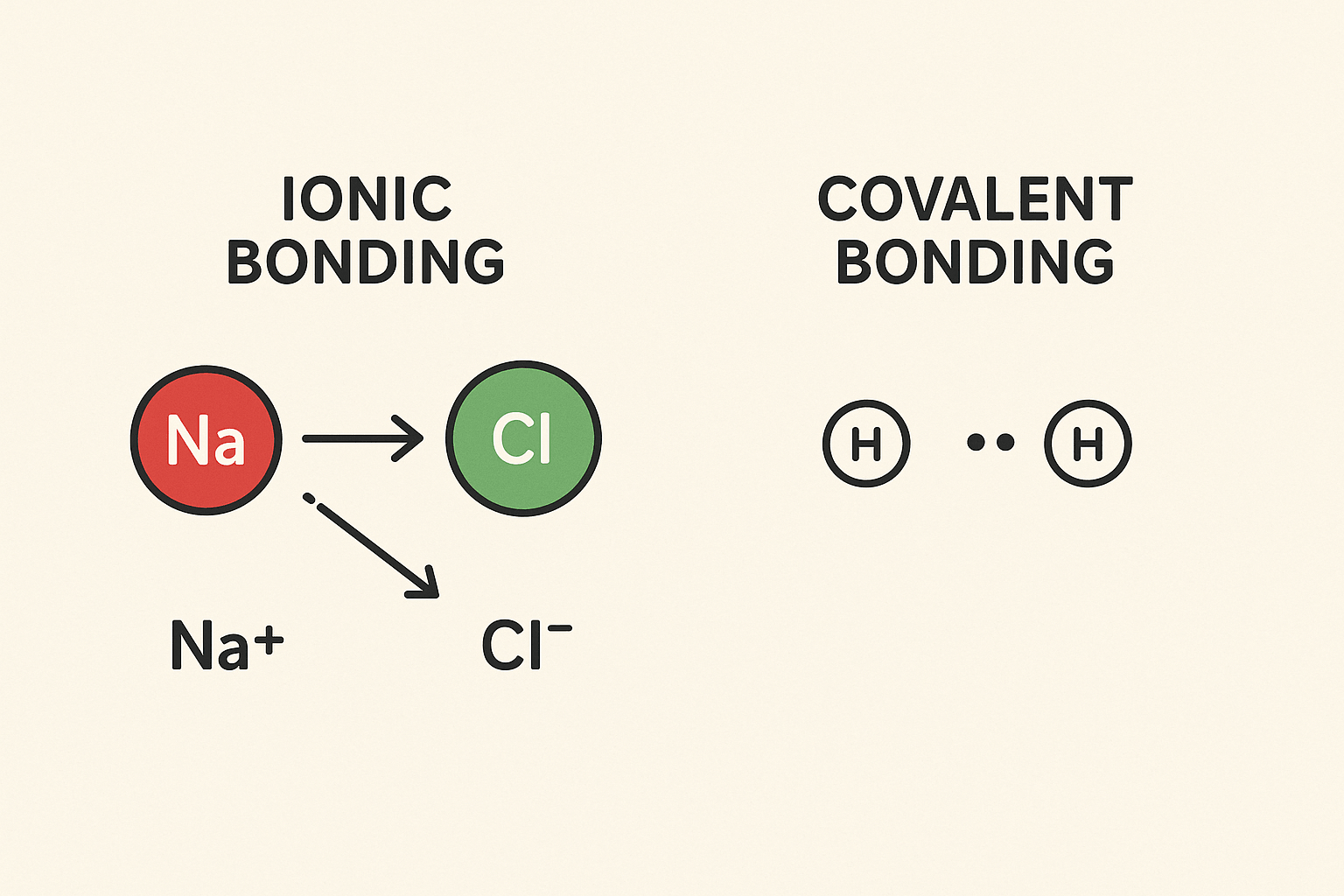
Ionic Bonding
Ionic bonding involves the COMPLETE TRANSFER of one or more electrons from one atom (typically a metal) to another (typically a nonmetal). The result is a positive cation and a negative anion held together by electrostatic attraction.
Example. Sodium chloride (NaCl): sodium loses its lone valence electron to become Na⁺ (neon configuration); chlorine gains that electron to become Cl⁻ (argon configuration). The electrostatic attraction between the two ions is the ionic bond.
Properties of ionic compounds:
- Form crystalline solids (lattices of alternating cations and anions) at room temperature.
- High melting points and boiling points (NaCl melts at 801 °C) because of strong electrostatic attractions.
- Conduct electricity when dissolved in water or molten (the ions become mobile), but not as solids.
- Generally water-soluble (water’s polarity stabilizes the separated ions).
- Hard and brittle (shifting a row of ions causes like charges to align and the lattice fractures).
Covalent Bonding
Covalent bonding involves the SHARING of electrons between two atoms. Each atom contributes one (or more) electrons to a shared pair that orbits both nuclei. Covalent bonding is typical between two nonmetals with similar electronegativities.
Variants:
- Single bond: one pair of shared electrons (H-H, C-H, O-H).
- Double bond: two pairs of shared electrons (C=C, C=O, O=O).
- Triple bond: three pairs of shared electrons (N≡N, C≡N, C≡C).
- Polar covalent: unequal sharing because of electronegativity difference (O-H, where O pulls harder). Creates a partial charge on each atom.
- Nonpolar covalent: equal sharing between atoms of similar or identical electronegativity (H-H, C-C, F-F).
Properties of covalent compounds:
- Often gases, liquids, or low-melting solids at room temperature (low intermolecular forces between molecules).
- Don’t conduct electricity (no mobile ions or electrons).
- Solubility varies, nonpolar covalent compounds dissolve in nonpolar solvents (like dissolves like); polar covalent in polar solvents.
- Tend to be softer than ionic crystals; soft solids and liquids can flex without lattice fracture.
Predicting Bond Type from Electronegativity
The electronegativity difference (Δχ) between two bonded atoms predicts whether the bond is ionic or covalent.
| Δχ | Bond character | Example |
|---|---|---|
| 0 to 0.4 | Nonpolar covalent | C-H (Δχ ≈ 0.35), Cl-Cl (Δχ = 0) |
| 0.5 to 1.7 | Polar covalent | O-H (Δχ ≈ 1.24), N-H (Δχ ≈ 0.84) |
| 1.8 and above | Ionic | Na-Cl (Δχ ≈ 2.23), K-F (Δχ ≈ 3.16) |
The 1.7 threshold is a convention, not a hard line. Real bond character lies on a continuum. Many bonds (like HF, Δχ ≈ 1.78) sit at the boundary and have intermediate character.
Metallic Bonding, the Third Type
A third bond type, distinct from both ionic and covalent, is metallic bonding. In metals, valence electrons are delocalized, they don’t stay near any specific atom but form an ‘electron sea’ that flows around fixed positive metal ion cores. This explains metals’ characteristic properties:
- Electrical conductivity: mobile electrons can carry current.
- Thermal conductivity: same mobile electrons carry thermal energy.
- Malleability and ductility: the lattice can shift without losing the electron-sea bonding.
- Lustrous appearance: the electron sea reflects light at all visible wavelengths.
Comparison Summary
| Property | Ionic | Covalent (polar) | Covalent (nonpolar) | Metallic |
|---|---|---|---|---|
| Electron behavior | Transferred | Shared unequally | Shared equally | Delocalized |
| Typical atoms | Metal + nonmetal | Two nonmetals (different) | Two nonmetals (same/similar) | Metal + metal |
| Melting point | High | Moderate | Low | Variable (often high) |
| Conductivity (solid) | No | No | No | Yes |
| Conductivity (molten) | Yes | No | No | Yes |
| State at room temp | Solid (crystal) | Often liquid/gas | Often gas | Solid |
| Example | NaCl, MgO | H₂O, HCl | CH₄, O₂ | Cu, Fe |
Related study notes: Chemical Bonding, Electronegativity, Valence Electrons, Lewis Structure.
The OpenStax chemistry textbooks provide further explanations of the chemical principles used in this note.
Comparing NaCl and HCl
The main-group picture forms Na⁺ and Cl⁻ by transferring an electron from sodium to chlorine. In solid NaCl, each ion interacts with a surrounding lattice of oppositely charged ions, rather than belonging to a single isolated pair.
HCl is a polar covalent molecule in the gas phase. When dissolved in water, it reacts to form hydronium and chloride ions. Conductivity in an aqueous sample therefore does not by itself prove that the original gas-phase molecule was an ionic compound. The physical state and chemistry of the sample both matter.
The points to check in this example are:
- A bond’s character should be distinguished from the species produced in a solvent.
- An ionic formula often gives a simplest ratio in a lattice.
- A polar covalent bond has unequal sharing without requiring complete electron transfer.
Check Your Understanding
Try the questions before reading the answers.
Question 1. What is the ion ratio in NaCl?
Answer. 1 sodium ion to 1 chloride ion.
Question 2. Can a polar covalent molecule form ions in water?
Answer. Yes; HCl provides an example.
Frequently Asked Questions
What’s the difference between ionic and covalent bonds?
In ionic bonds, one atom completely transfers electrons to another, creating a cation and an anion that attract electrostatically (e.g., NaCl). In covalent bonds, two atoms share electrons in a pair (or two or three pairs) that orbit both nuclei (e.g., H-H or O=O). Ionic typically forms between metals and nonmetals; covalent typically forms between two nonmetals.
How do you predict bond type from the periodic table?
Find the electronegativity difference (Δχ) between the two atoms. Δχ < 0.4: nonpolar covalent. Δχ 0.5 to 1.7: polar covalent. Δχ ≥ 1.8: ionic. The 1.7 threshold is a convention, bond character is really a continuum from pure covalent to pure ionic.
Why are ionic compounds usually solids while covalent compounds are often gases?
Because ionic compounds have strong electrostatic attractions between many ions in a 3D lattice, requiring lots of energy to disrupt. Covalent compounds have strong bonds WITHIN molecules but only weak intermolecular forces between molecules. So small covalent molecules like CO₂ and CH₄ are gases, while ionic NaCl is a solid up to 801 °C.
What is a polar covalent bond?
A polar covalent bond is a covalent bond where the electrons are shared UNEQUALLY because one atom is more electronegative than the other. The more electronegative atom gets a slight negative charge (δ-); the less electronegative atom gets a slight positive charge (δ+). H-O bonds in water are polar covalent; H-H bonds are not.
Why do ionic compounds conduct electricity in solution but not as solids?
In a solid ionic crystal, the ions are locked in fixed positions and can’t move, no electrical conduction. When dissolved in water or melted, the ions become mobile and can carry charge through the solution or melt. This is why aqueous NaCl conducts but solid NaCl does not.
What is metallic bonding?
Metallic bonding is a distinct third bond type found in metals. Instead of transfer (ionic) or sharing (covalent), valence electrons are delocalized, they form a mobile ‘electron sea’ that flows around the fixed positive metal ion cores. This explains why metals conduct electricity and heat, are malleable, and have a lustrous appearance.
Browse more in Chemistry.