by
by
Coulomb’s law gives the electrostatic force between two stationary point charges. The force grows with the product of the charges and falls with the square of their separation. Like charges repel, while opposite charges attract.
Coulomb’s law gives a force magnitude for point charges, while attraction or repulsion determines its direction. Signed components should be assigned after the geometry is established.
The magnitude formula is simple, but sign and direction cause most errors. I recommend calculating a positive magnitude first, drawing the force direction from the charge signs, and then resolving components using your chosen coordinate axes.
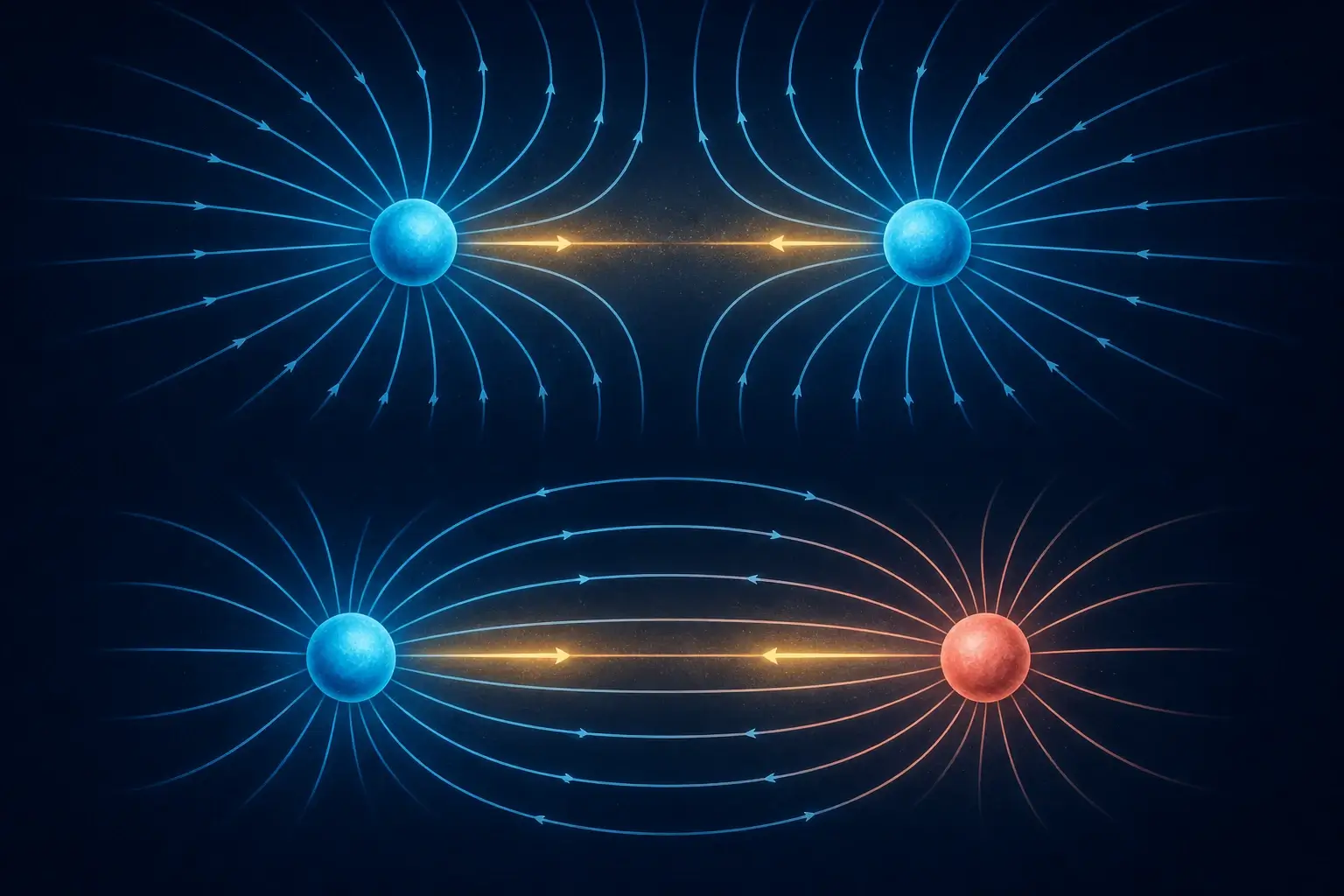
What Is Coulomb’s Law?
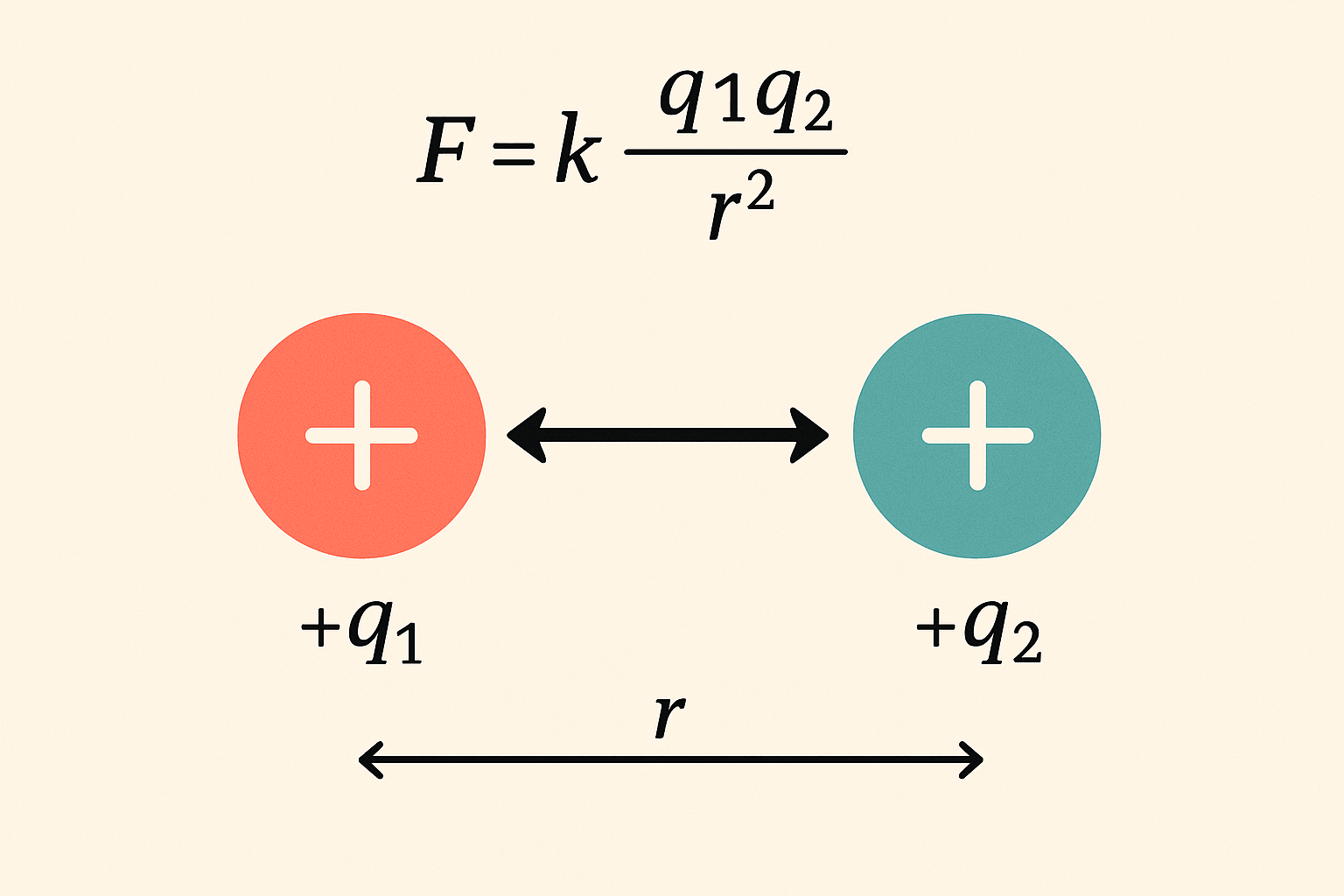
For two point charges in vacuum separated by distance \(r\), the force magnitude is
$$F=k_{\mathrm e}\frac{|q_1q_2|}{r^2}$$
Coulomb’s law itself has no single SI unit. In \(F=k_{\mathrm e}|q_1q_2|/r^2\), force \(F\) is measured in newtons (N), charge in coulombs (C), distance in metres (m), and Coulomb’s constant \(k_{\mathrm e}\) in \(\text{N m}^2\text{C}^{-2}\). A question asking for the SI unit of Coulomb’s law usually means the unit of Coulomb’s constant.
where \(k_{\mathrm e}=1/(4\pi\varepsilon_0)\approx8.9875517923\times10^9\,\text{N m}^2\text{C}^{-2}\). The force acts along the line joining the charges.
| Symbol | Meaning | SI unit |
|---|---|---|
| \(F\) | Force magnitude | newton (N) |
| \(q_1,q_2\) | Electric charges | coulomb (C) |
| \(r\) | Distance between charge positions | metre (m) |
| \(\varepsilon_0\) | Vacuum permittivity | farad per metre (F/m) |
| \(k_{\mathrm e}\) | Coulomb constant | \(\text{N m}^2\text{C}^{-2}\) |
The OpenStax University Physics treatment of Coulomb’s law gives the same inverse-square relation and develops superposition with vectors.
Direction and the Vector Form
The force on charge 2 due to charge 1 points along the unit vector from charge 1 to charge 2. A compact vector form is
$$\mathbf F_{2\leftarrow1}=\frac{1}{4\pi\varepsilon_0}\frac{q_1q_2}{|\mathbf r_2-\mathbf r_1|^3}(\mathbf r_2-\mathbf r_1)$$
The product \(q_1q_2\) carries the attraction or repulsion sign. If it is positive, the force on charge 2 points away from charge 1. If it is negative, the force points toward charge 1. Newton’s third law gives \(\mathbf F_{1\leftarrow2}=-\mathbf F_{2\leftarrow1}\).
- Positive-positive: each force points away from the other charge.
- Negative-negative: the charges also repel.
- Positive-negative: each force points toward the other charge.
- Zero charge: the electrostatic force from this pair is zero.
Worked Example: Two Point Charges
Place \(q_1=+2.0\,\mu\text C\) and \(q_2=-3.0\,\mu\text C\) at a separation of \(0.50\,\text m\). The force magnitude is
$$F=(8.99\times10^9)\frac{(2.0\times10^{-6})(3.0\times10^{-6})}{(0.50)^2}\approx0.216\,\text N$$
The force is attractive because the charges have opposite signs. The force on \(q_1\) points toward \(q_2\), and the equal-magnitude force on \(q_2\) points toward \(q_1\).
The Inverse-Square Dependence
Doubling the separation makes the force one quarter as large. Tripling it makes the force one ninth as large. This geometric dilution is the same distance dependence that appears in the field of a point source and in Newton’s ideal point-mass gravity.
| New separation | Force compared with original |
|---|---|
| \(r/2\) | \(4F\) |
| \(2r\) | \(F/4\) |
| \(3r\) | \(F/9\) |
| \(10r\) | \(F/100\) |
Do not confuse an inverse-square law with exponential decay. The force never reaches exactly zero at a finite distance in the ideal vacuum model, although it can become negligible compared with other effects.
Superposition for More Than Two Charges
Coulomb’s law applies to each pair, and the total force is the vector sum. Other charges do not switch off a pair interaction. They add more force vectors.
$$\mathbf F_{\text{net on }i}=\sum_{j\ne i}\frac{1}{4\pi\varepsilon_0}\frac{q_iq_j}{|\mathbf r_i-\mathbf r_j|^3}(\mathbf r_i-\mathbf r_j)$$
- Draw the position of every charge and define axes.
- Choose the charge whose net force you need.
- Calculate the force from each other charge separately.
- Resolve every force into x and y components.
- Add components, then find the resultant magnitude and angle.
Three-Charge Symmetry Check
If two equal positive charges sit the same distance to the left and right of a third positive charge, their forces on the middle charge cancel. Each pair force is nonzero; the vector sum is zero. This is equilibrium by symmetry, not absence of electric interaction.
Electric Field and Coulomb’s Law
The electric field is force per unit positive test charge. For a point source charge \(Q\)
$$\mathbf E=\frac{\mathbf F}{q_0}=\frac{1}{4\pi\varepsilon_0}\frac{Q}{r^2}\hat{\mathbf r}$$
Once the field is known, any charge \(q\) placed there feels \(\mathbf F=q\mathbf E\). A negative test charge feels force opposite the field direction. The field belongs to the source distribution; the force also depends on the test charge.
For highly symmetric continuous charge distributions, Gauss’s law is often faster than adding contributions directly.
Coulomb’s Law in Matter
In a uniform linear dielectric, the ideal macroscopic formula becomes
$$F=\frac{1}{4\pi\varepsilon}\frac{|q_1q_2|}{r^2},\qquad \varepsilon=\varepsilon_r\varepsilon_0$$
Polarization usually reduces the field produced by free charges compared with vacuum. But writing \(F_{\text{vacuum}}/\varepsilon_r\) is only safe for a homogeneous, isotropic, linear medium in the relevant regime. Interfaces, nonlinear materials, and microscopic separations require more careful field and material models.
From Point Charges to Continuous Charge
For an extended object, divide the charge into elements \(dq\), write the vector field contribution, and integrate over the distribution.
$$d\mathbf E=\frac{1}{4\pi\varepsilon_0}\frac{dq}{R^2}\hat{\mathbf R},\qquad \mathbf E=\int d\mathbf E$$
The point-charge formula is also an excellent approximation outside a spherically symmetric charge distribution, or whenever the object’s size is much smaller than the observation distance. It is not accurate near an irregularly shaped extended charge.
Common Mistakes
- Using microcoulombs as coulombs: \(1\,\mu\text C=10^{-6}\,\text C\).
- Using diameter instead of center-to-center separation: \(r\) is the distance between charge positions.
- Keeping the algebraic sign inside the magnitude formula: use absolute values for magnitude and determine direction separately.
- Adding magnitudes instead of vectors: forces in different directions require components.
- Using Coulomb’s law for moving charges without qualification: magnetic fields and retardation can matter.
- Applying a single dielectric constant across interfaces: material boundaries change the field pattern.
Related Physics Guides
Use these next if you want to connect this result with the surrounding physics:
Key Takeaways
- Coulomb’s law has magnitude \(F=k_{\mathrm e}|q_1q_2|/r^2\).
- Like charges repel and opposite charges attract.
- The force is a vector directed along the line joining the charges.
- For many charges, add the pairwise forces by superposition.
- In matter, permittivity and material geometry affect the field.
Force and Separation
Charges +2 μC and -3 μC are separated by 0.50 m in vacuum. Using k ≈ 8.99 × 10⁹ N·m²/C² gives force magnitude about 0.216 N. The charges attract, so each force points toward the other charge.
Doubling their separation to 1.00 m reduces the magnitude to about 0.0539 N, a quarter of the original. With several charges, you should add vector forces rather than their magnitudes. A negative charge product can indicate attraction, but it is not a substitute for defining a coordinate direction.
The points to check in this example are:
- Convert microcoulombs to coulombs before substitution.
- The point-charge model needs an appropriate distance scale.
- Superposition adds individual electric-force vectors.
Check Your Understanding
Try the questions before reading the answers.
Question 1. What happens if 1 charge doubles while the separation stays fixed?
Answer. The force magnitude doubles.
Question 2. Are the forces on the 2 charges equal in magnitude?
Answer. Yes, and opposite in direction.
Practice Questions
Work each question before reading its solution. The set runs from direct recall and substitution to the applied questions that exams actually use to separate grades. The downloadable PDF includes these questions and their solutions.
Question 1. Two charges of 1 \(\mu\)C each sit 10 cm apart. Find the force between them.
Solution. \(F = k\dfrac{q_1 q_2}{r^2} = \dfrac{9 \times 10^9 \times (10^{-6})^2}{(0.1)^2} = \dfrac{9 \times 10^{-3}}{0.01} = 0.9\) N. Nearly a full newton from 2 microscopic charge amounts at hand-width distance: the electric force is enormous.
Question 2. The distance between 2 charges doubles. What happens to the force?
Solution. The inverse-square law divides it by \(2^2\): the force drops to a quarter. Halving the distance would quadruple it. Distance enters squared, so it dominates every estimate.
Question 3. How does the force differ between like and unlike charges?
Solution. The magnitude is identical for the same \(|q_1 q_2|\) and \(r\); only the direction changes. Like charges repel along the line joining them; unlike charges attract along the same line. Both charges feel equal and opposite forces, Newton’s third law included.
Question 4. Compute the electric force between the proton and electron in hydrogen (\(r = 5.3 \times 10^{-11}\) m).
Solution. \(F = \dfrac{9 \times 10^9 \times (1.6 \times 10^{-19})^2}{(5.3 \times 10^{-11})^2} = \dfrac{2.3 \times 10^{-28}}{2.8 \times 10^{-21}} \approx 8.2 \times 10^{-8}\) N. Tiny in absolute terms, but acting on an electron of mass \(9.1 \times 10^{-31}\) kg it produces an acceleration of about \(10^{22}\) m/s\(^2\).
Question 5. For the same hydrogen atom, compare the electric force with the gravitational attraction between the 2 particles.
Solution. \(F_g = G\dfrac{m_e m_p}{r^2} = \dfrac{6.67 \times 10^{-11} \times 9.1 \times 10^{-31} \times 1.67 \times 10^{-27}}{2.8 \times 10^{-21}} \approx 3.6 \times 10^{-47}\) N. The ratio is about \(2 \times 10^{39}\): electricity beats gravity by 39 orders of magnitude. Gravity rules planets only because bulk matter is almost perfectly charge-neutral.
Question 6. Charges \(+q\) sit at \(x = 0\) and \(x = 1\) m. Where does a test charge feel zero net force?
Solution. At the midpoint, \(x = 0.5\) m. Both repulsions have equal magnitude there and point in opposite directions, canceling exactly. Symmetry answers before algebra does; for unequal charges the balance point shifts toward the weaker one.
Question 7. Charges \(+2\,\mu\)C, \(-1\,\mu\)C, and \(+2\,\mu\)C sit at \(x = 0\), \(0.5\), and 1 m. Find the net force on the middle charge.
Solution. The left \(+2\,\mu\)C attracts the middle charge leftward with \(F = \dfrac{9 \times 10^9 \times 2 \times 10^{-12}}{0.25} = 0.072\) N. The right \(+2\,\mu\)C attracts it rightward with the same 0.072 N by symmetry. The pulls cancel: net force zero. Superposition means summing forces as vectors, and here the vectors kill each other.
Question 8. Find the electric field 0.3 m from a \(5\,\mu\)C point charge.
Solution. \(E = k\dfrac{q}{r^2} = \dfrac{9 \times 10^9 \times 5 \times 10^{-6}}{0.09} = 5 \times 10^5\) N/C, pointing radially away. The field is force per unit charge: any charge \(q\) placed there feels \(F = qE\).
Question 9. How are \(k\) and \(\varepsilon_0\) related?
Solution. \(k = \dfrac{1}{4\pi\varepsilon_0} \approx 9 \times 10^9\) N·m\(^2\)/C\(^2\), with \(\varepsilon_0 = 8.85 \times 10^{-12}\) in SI units. The \(4\pi\) version makes later formulas cleaner: Gauss’s law, capacitance, and field equations all prefer \(\varepsilon_0\).
Question 10. Why an inverse-square law? Give the geometric picture.
Solution. Picture the influence of a point charge spreading uniformly through space. At radius \(r\) it crosses a sphere of area \(4\pi r^2\), so the same total influence spreads over an area growing as \(r^2\), diluting the intensity as \(1/r^2\). Gravity and light obey the same geometry, which is why all 3 share the same law shape.
Frequently Asked Questions
What is Coulomb’s law?
Coulomb’s law states that the electrostatic force between stationary point charges is proportional to the product of their charges and inversely proportional to the square of their separation.
What is the formula for Coulomb’s law?
In vacuum, the magnitude is F = ke|q1q2|/r², where ke = 1/(4πε0). The force acts along the line joining the two charges.
Why does Coulomb’s law use distance squared?
A point source’s field spreads over spherical surfaces whose area grows as 4πr². The same flux distributed over a larger sphere gives the inverse-square dependence.
Can Coulomb’s law give a negative force?
The scalar magnitude is nonnegative. Charge signs determine whether the vector force points toward the other charge, attraction, or away from it, repulsion.
Does Coulomb’s law work inside materials?
A permittivity-modified form works for homogeneous, linear dielectrics. Interfaces, anisotropic materials, microscopic distances, and nonlinear response require a fuller electromagnetic treatment.
How is Coulomb’s law related to Gauss’s law?
Coulomb’s inverse-square field satisfies Gauss’s law. Conversely, Gauss’s law plus spherical symmetry gives the point-charge field efficiently.
Calculate magnitude, draw direction, and add vectors. That three-step habit prevents nearly every beginner error.
Browse more in Physics.